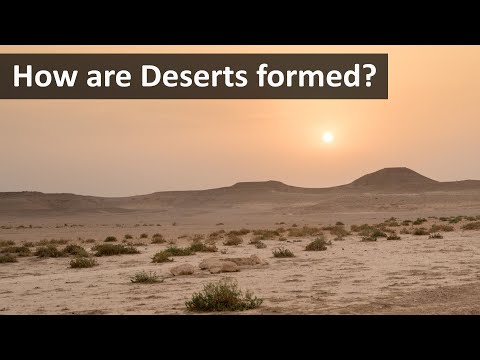
Deserts form primarily due to a lack of precipitation, which can be caused by high-pressure zones, rain shadow effects from mountain ranges, distance from water bodies, and cold ocean currents that reduce moisture in the air.
Contents
- MCQs
- 1. What is one of the main reasons deserts form?
- 2. Which climate condition contributes to the formation of deserts?
- 3. What role do high-pressure systems play in desert formation?
- 4. How does the rain shadow effect contribute to desert formation?
- 5. What is not a natural process that leads to desert formation?
MCQs
1. What is one of the main reasons deserts form?
A) Too much rainfall
B) Frequent tornadoes
C) Lack of sufficient rainfall
D) Overpopulation
Answer: C) Lack of sufficient rainfall
Explanation: Deserts primarily form because they receive very little rainfall each year, typically less than 250 millimeters or 10 inches, which is not enough to support most forms of vegetation.
2. Which climate condition contributes to the formation of deserts?
A) High humidity
B) Low humidity
C) Heavy snowfall
D) Frequent hurricanes
Answer: B) Low humidity
Explanation: Low humidity means there is little moisture in the air, which contributes to the dry conditions characteristic of deserts.
3. What role do high-pressure systems play in desert formation?
A) They bring heavy rains.
B) They prevent rain clouds from forming.
C) They lower the temperature.
D) They increase vegetation growth.
Answer: B) They prevent rain clouds from forming.
Explanation: High-pressure systems stabilize the air, preventing the upward movement that helps form rain clouds, thus reducing the likelihood of rain and contributing to desert conditions.
4. How does the rain shadow effect contribute to desert formation?
A) By increasing rainfall on mountain slopes
B) By causing floods in valleys
C) By creating dry areas on the leeward side of mountains
D) By cooling the temperature
Answer: C) By creating dry areas on the leeward side of mountains
Explanation: The rain shadow effect occurs when mountains block the passage of rain-producing weather systems, casting a “shadow” of dryness behind them, which can lead to desert conditions.
5. What is not a natural process that leads to desert formation?
A) Deforestation
B) Ocean currents
C) Wind erosion
D) Rain shadow effect
Answer: A) Deforestation
Explanation: While deforestation can lead to soil degradation and desertification, it is primarily a human-induced process, unlike the natural processes of ocean currents, wind erosion, and the rain shadow effect that naturally contribute to desert formation.
Read More