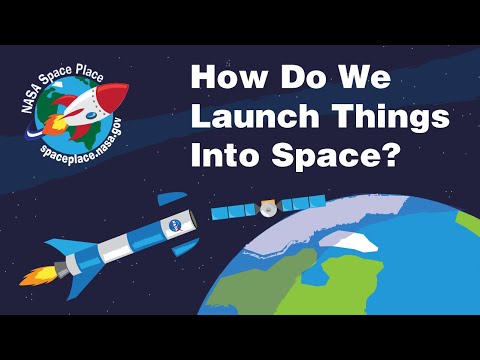
Rockets launch into space by igniting their engines to produce thrust, which propels the rocket upwards against Earth’s gravity. As the engines burn fuel, the rocket accelerates and climbs into the atmosphere. Once in space, engines can be reignited for course adjustments or to enter orbit.
Contents
MCQs
1. What force do rockets need to overcome to launch into space?
A) Gravity
B) Friction
C) Magnetism
D) Air resistance
Answer: A) Gravity
Explanation: Rockets need to overcome Earth’s gravity to launch into space. Gravity is the force that pulls objects towards the Earth.
2. What part of the rocket contains the fuel?
A) The capsule
B) The engine
C) The booster
D) The tank
Answer: D) The tank
Explanation: The tank of the rocket holds the fuel. This fuel is used by the engine to produce thrust, which propels the rocket upwards.
3. What is the name of the effect that propels rockets forward?
A) Newton’s First Law
B) Newton’s Second Law
C) Newton’s Third Law
D) Einstein’s Theory of Relativity
Answer: C) Newton’s Third Law
Explanation: Newton’s Third Law states that for every action, there is an equal and opposite reaction. Rockets move forward by expelling gas out of the back at high speed, which pushes them in the opposite direction.
4. Which of these is not a stage of a rocket launch?
A) Ignition
B) Orbit
C) Separation
D) Landing
Answer: D) Landing
Explanation: Landing is not a stage of a rocket launch but rather the final phase of a space mission when the spacecraft returns to Earth. The launch stages typically include ignition, liftoff, and separation.
5. Why do rockets have stages?
A) To carry more astronauts
B) To increase speed gradually
C) To drop weight as they go higher
D) To look more impressive
Answer: C) To drop weight as they go higher
Explanation: Rockets have stages to drop parts of themselves (like empty fuel tanks) that are no longer needed. This reduces the weight of the rocket, making it easier to accelerate as it climbs.
For More