
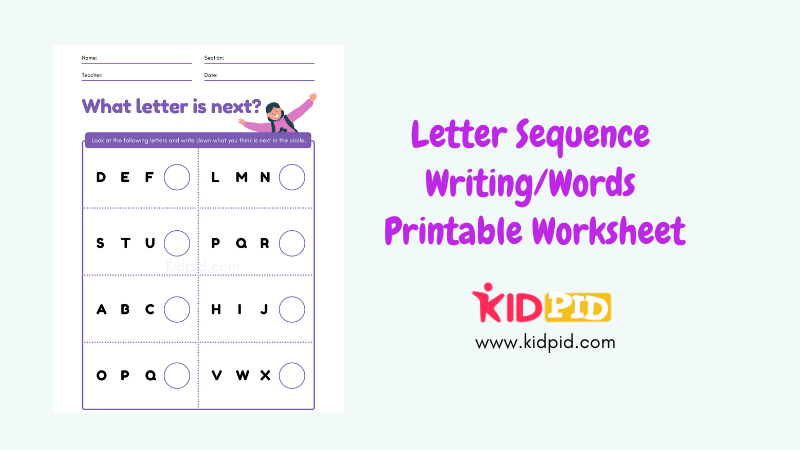
Free Letter Sequence Writing Printable Worksheet to identify and pronounce letters for kids. It is perfect for preschoolers and kindergarteners.
[Scroll Down for Download Link]
Contents
- What letter is next?
- Key Facts About the Letter Sequence Writing Worksheet
- Parts, Types, and Examples of Letter Sequencing
- How Does the Letter Sequence Writing Worksheet Work?
- Benefits of Learning About Letter Sequences
- Learning Objectives
- Worksheet Instructions
- Interesting Facts About Letter Sequences and Typography
- Vocabulary Words
- Real-Life Applications
- FAQs
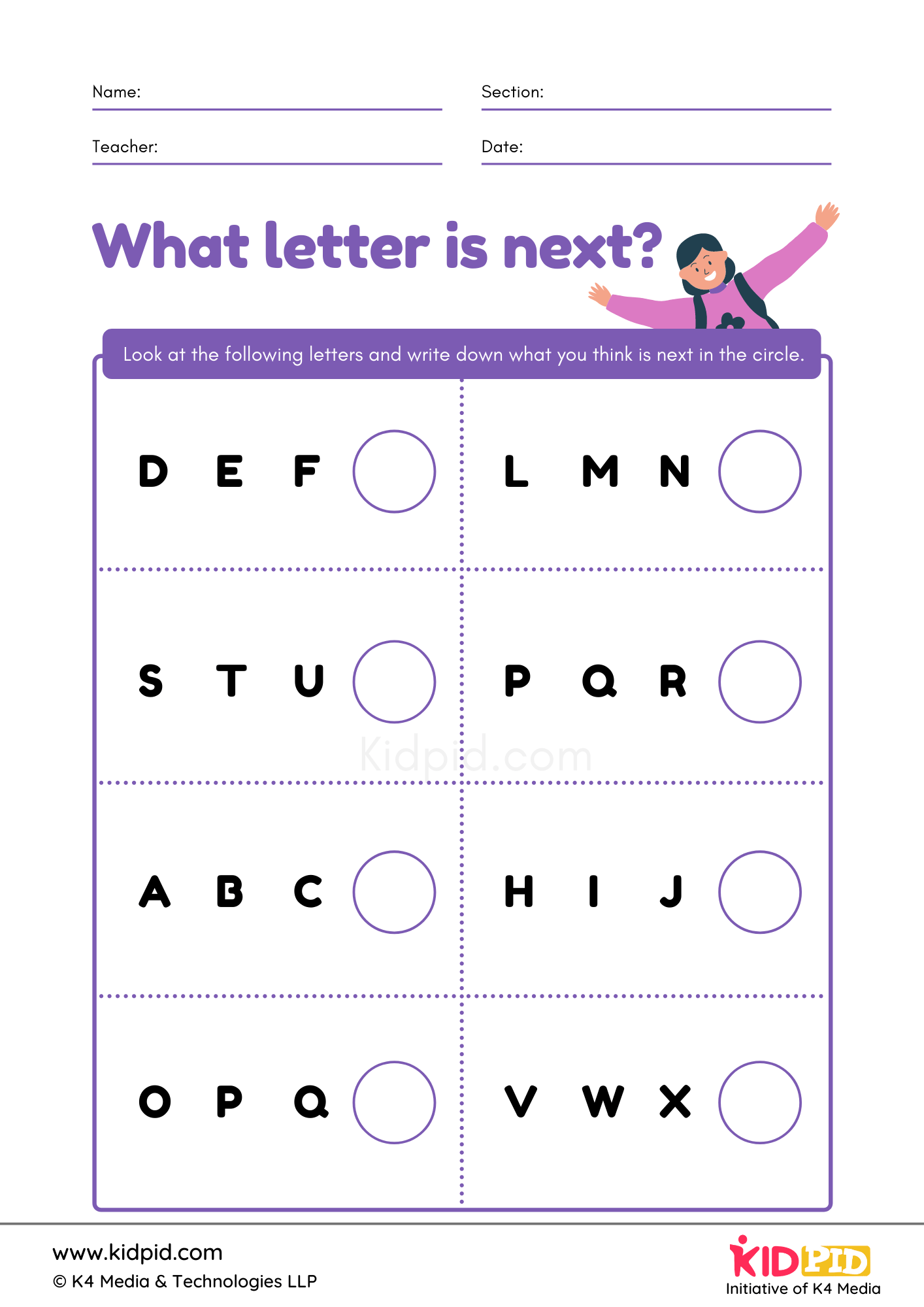
What letter is next?
Look at the following letters and write down what you think is next in the circle.
Click here for more printable worksheets.
Skills
Learning letters, learning the alphabet.
Click here for more printable worksheets.
Answer
- Bottle
- Hat
- Apple
- Shoe
- Ball
Simple Addition Printable Worksheet
Key Facts About the Letter Sequence Writing Worksheet
Developing early literacy requires more than just memorizing the alphabet song; it requires sequential mastery. This foundational printable is structured to test and solidify a child’s understanding of alphabetical order and orthographic processing (the ability to recognize and visualize letter patterns).
- Target Audience: Ideal for preschoolers, kindergarteners, and early Grade 1 students (ages 4 to 6).
- Core Focus: Sequential letter recognition, fine motor writing practice, and basic phonics building blocks.
- Format: A clean, minimal-distraction layout designed specifically to prevent cognitive overload in young learners.
- Curriculum Alignment: Supports early childhood literacy standards focused on print concepts and alphabetic principles.
Parts, Types, and Examples of Letter Sequencing
Letter sequencing exercises generally come in three distinct structural variations, each targeting a different stage of a child’s cognitive development:
- Forward Tracking (The Linear Chain): The worksheet presents a standard, consecutive progression (e.g.,
A→B→C→[ ? ]). The child determines thatDis the missing link. - Interval Skipping (The Pattern Chain): Advanced variations skip letters to focus on phonetic intervals or vowel/consonant alternating patterns.
- Word-Association Blocks: Incorporating simple, high-frequency sight words or object names (like Ball, Hat, or Apple) alongside the letters to help children bridge the gap between abstract sequences and concrete vocabulary.
How Does the Letter Sequence Writing Worksheet Work?
At its core, this worksheet acts as a cognitive puzzle for early learners. Instead of passively reading the alphabet, children must actively retrieve structural information from their long-term memory.
When a child looks at a sequence like H, I, J, K, Their brain performs an active memory scan. Once they identify the pattern, they must translate that mental realization into physical movement by utilizing fine motor skills to physically write the correct letter (in this case L) inside the designated shape. This dual-action process of cognitive retrieval and physical writing dramatically improves long-term retention.
Benefits of Learning About Letter Sequences
Mastering alphabetical sequences is a critical stepping stone toward fluid reading and writing. Key benefits include:
- Prevents Letter Reversals: Regular practice helps children understand structural left-to-right progression, lowering the instances of common mix-ups (like confusing
bandd). - Boosts Reading Fluency: Children who rapidly identify letter sequences can decode words much faster than those who struggle to remember what letter comes next.
- Encourages Dictionary and Index Skills: Long-term, understanding sequencing allows kids to easily navigate alphabetized data, library shelves, and indices later in life.
Learning Objectives
By completing this foundational activity, students will achieve the following developmental milestones:
- Cognitive: Demonstrate the ability to accurately recall and predict the letter that immediately follows any given alphabetical anchor point.
- Motor Skills: Improve pencil grip, spatial awareness, and proper stroke mechanics by writing letters within constrained boundary lines.
- Phonological: Connect visual letter sequences to their corresponding acoustic sounds and pronunciations.
Worksheet Instructions
To get the most out of this printable, teachers and parents should guide children using these clear, step-by-step instructions:
- Point and Read: Have the child point to each letter in the row from left to right, pronouncing the names or sounds of the letters aloud.
- Identify the Gap: Point to the empty circle at the end of the row and ask: “What letter comes right after the last one we said?”
- Trace or Write: Instruct the child to carefully write the missing letter inside the circle using a pencil. Encourage them to stay within the lines to practice fine motor control.
- Celebrate and Verify: Review the completed line together by reading the entire sequence from start to finish to confirm it sounds correct.
Interesting Facts About Letter Sequences and Typography
- The “ETAOIN SHRDLU” Mystery: Letters don’t appear in English words at random. In terms of frequency, the sequence of the most commonly used letters in the English language is E-T-A-O-I-N, followed closely by S-H-R-D-L-U!
- The Brain is an Auto-Completer: Human brains are wired to look for patterns. When an established sequence is interrupted or left incomplete, our minds experience a brief moment of tension until we solve it.
- The Evolution of Order: The alphabetical order we use today has remained largely unchanged for thousands of years, tracing its structural ancestry all the way back to ancient Phoenician scripts.
Vocabulary Words
Introducing these simple vocabulary words alongside the worksheet helps contextualize the abstract concepts for young learners:
- Sequence: An ordered list of things where the position of each item matters.
- Alphabet: A standardized set of letters or symbols used to write a language.
- Foundational: The base or groundwork that supports everything built on top of it.
- Predict: To guess or figure out what is going to happen next based on clues.
Real-Life Applications
Letter sequencing is not a skill confined to a school desk; it is an everyday utility used throughout adulthood:
- Filing and Organization: From medical records to digital databases, almost all physical and digital archives rely heavily on alphabetical sorting.
- Searching the Web: Search engine algorithms use character string sequences to instantly predict what you are typing in the search bar.
- Using a Glossary: Looking up a word in a book index, a physical dictionary, or an encyclopedia requires rapid mental tracking of alphabetical sequences.
FAQs
Q1: At what age should a child start practicing letter sequencing?
Answer: Most children are ready to begin basic, guided sequencing activities around ages 4 to 5, usually after they can reliably identify individual letters out of order.
Q2: My child keeps writing the correct letters but backwards. Is this normal?
Answer: Yes, letter reversal is entirely normal and highly common up until the age of 7. Printables like these are explicitly designed to help correct that spatial confusion through consistent, repetitive exposure.
Q3: How can I make this worksheet more interactive for an active child?
Answer: Try pairing the printable with physical alphabet blocks. Have your child physically place a plastic or wooden block onto the empty circle on the paper before they write the answer down.
These Letter Sequence Writing worksheets help children recognize letter order, strengthen alphabet knowledge, and improve handwriting skills. Regular practice builds confidence, enhances early literacy, and creates a strong foundation for reading, spelling, and writing success. Explore our collection of worksheets, essays, paragraphs, flashcards, quizzes, and interactive resources. Stay updated on YouTube & Facebook.
The Content Team developed this worksheet to advance learning improvement.
Reviewed By Chaitrali Shelar
More Printable



It’s not downloading
Please check again.