

Tracing letters helps kids learn the alphabet and build penmanship skills. We provide a tracing worksheet for all 26 uppercase letters.
[Scroll Down for Download Link]
Contents
- Finding Letters Printable Worksheet
- Key Facts About Finding Letters Printable Worksheets
- Parts, Types, and Examples of Alphabet Tracking Sheets
- How Does a Finding Letters Printable Worksheet Work?
- Benefits of Learning About and Using Letter Identification Activities
- Learning Objectives
- Worksheet Instructions
- Interesting Facts About Letter Recognition in Early Childhood
- Vocabulary Words
- Real-Life Applications
- FAQs
Finding Letters Printable Worksheet
Look at the letter on the left and circle the same letter in the row.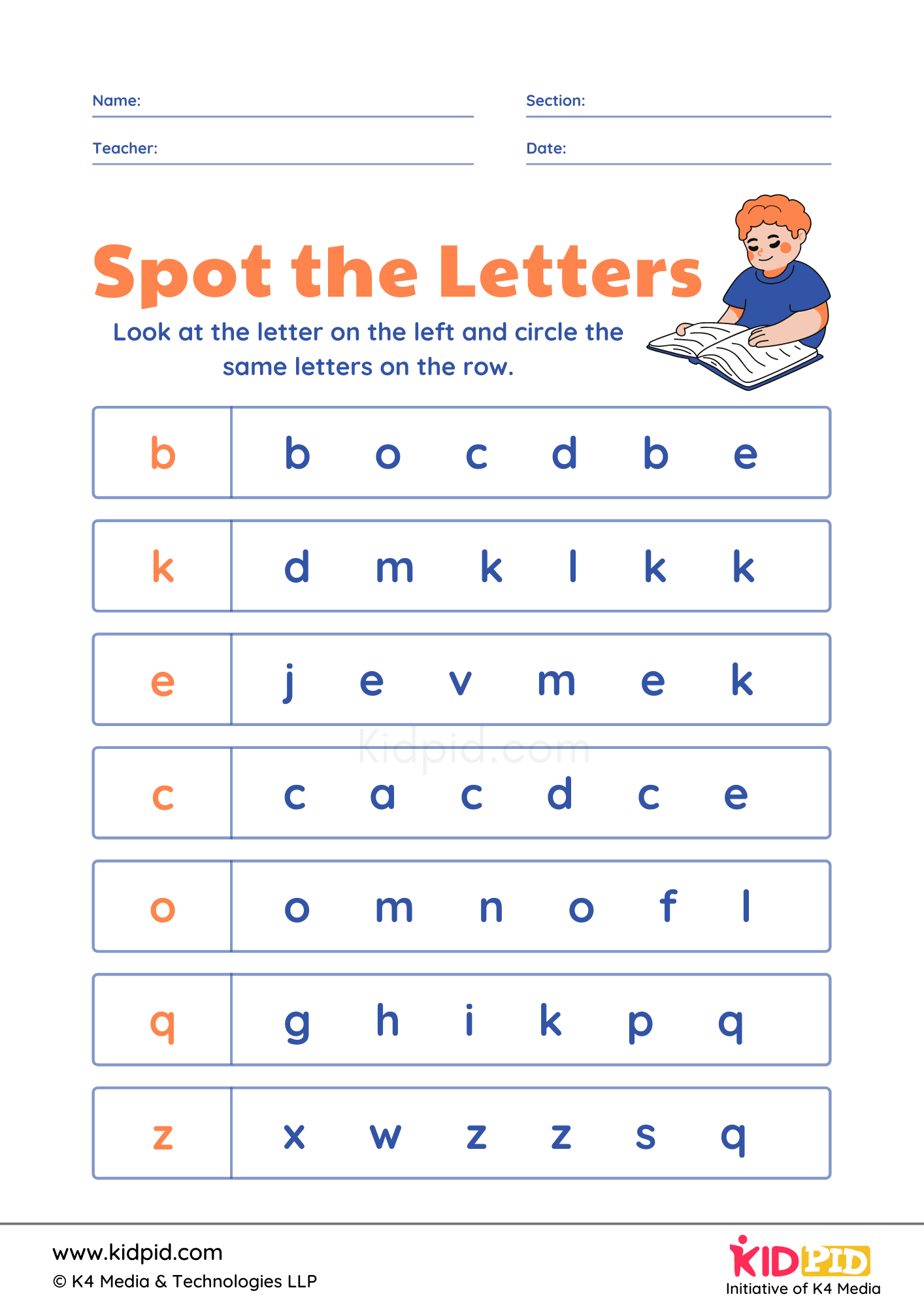
Click here for more printable worksheets.
Simple Addition Printable Worksheet
Early childhood literacy relies heavily on environmental print and interactive recognition. These curated printable activities bridge the gap between abstract sounds and physical letters.
Letter recognition isn’t a one-size-fits-all milestone. To support differentiated learning, early childhood educators classify these worksheets into distinct types based on the child’s developmental stage:
At a glance, these exercises look like simple games, but they stimulate intense neurological activity. When a preschooler engages with the page, their brain follows a structured sequence:
Regularly practicing with structured scanning materials sets the foundation for lifelong reading habits. The core benefits include:
By completing these guided activity sheets, young learners will achieve the following developmental benchmarks:
To ensure a frustration-free and successful learning session, present the sheets using this clear, conversational sequence:
Help your child build their vocabulary by introducing these terms naturally during your practice sessions:
Letter matching shouldn’t end when you put the pencil down. Bring these printables to life out in the real world:
Answer: Most kids enjoy these activities between 3 and 5 years old. If your child can recognize basic shapes (like circles and squares) and can hold a crayon comfortably, they are ready for these sheets.
Answer: Both are helpful, but teaching them together yields the best results. When pointing to a letter on the page, say its name and its sound at the same time: “This is the letter B, and it says /b/ like ball.”
Answer: This is highly common as tracking muscles develop. Take a dark piece of construction paper or a ruler and slide it down the page, covering everything below the row your child is actively working on. This removes the visual noise and keeps them focused on a single line.
Answer: A gentle pacing of 1 to 2 letters per week works beautifully for most preschoolers. Focus on depth of recognition, tracing, and sound pairing rather than rushing through the entire alphabet.
Key Facts About Finding Letters Printable Worksheets
Parts, Types, and Examples of Alphabet Tracking Sheets
How Does a Finding Letters Printable Worksheet Work?
Benefits of Learning About and Using Letter Identification Activities
Learning Objectives
Worksheet Instructions
Point directly to the bold letter on the far left of the row. Say its name and sound out loud (e.g., “This is the letter M, it makes the /m/ sound”). Have the child repeat it.
Slide your finger along the row from left to right. Stop at a matching letter and say, “Look, this matches our target letter!” Circle it together using a bright marker or crayon.
Let the child scan the remaining rows on their own. Remind them to move carefully across each line without jumping around the page.
Count the circled letters together. To reinforce vocabulary, ask the child to name an object that starts with that letter’s sound.Interesting Facts About Letter Recognition in Early Childhood
Vocabulary Words
Real-Life Applications
FAQs
Q1. What is the ideal age to start using letter-finding worksheets?
Q2. Should I teach letter names or letter sounds first?
Q3. My child keeps skipping lines on the worksheet. How can I help them track?
Q4. How many letters should a preschooler learn per week?
Boost alphabet recognition with these Finding Letters printable worksheets for preschoolers. Children search for and identify letters while improving observation, concentration, and visual discrimination skills. These engaging activities strengthen early literacy and prepare young learners for confident reading and writing. Learning uppercase letters becomes easy as children practice using them at the start of sentences and for proper nouns. They will also improve their letter recognition and alphabet skills. Explore fun worksheets, essays, paragraphs, flashcards, quizzes, and interactive resources. Follow us on YouTube & Facebook.
Hope you liked these finding letters printables. At Kidpid, you can find free printable colouring pages, sheets, colouring books, illustrations, printable pictures, clipart, black and white pictures, line art, and drawings for kids. You can find here hard and detailed patterns, advanced animal drawings, simple colorings, or easy outlines.
The worksheet is prepared by the Content Team to foster student growth.
Reviewed By Gargy
More Printables



Nice work all good