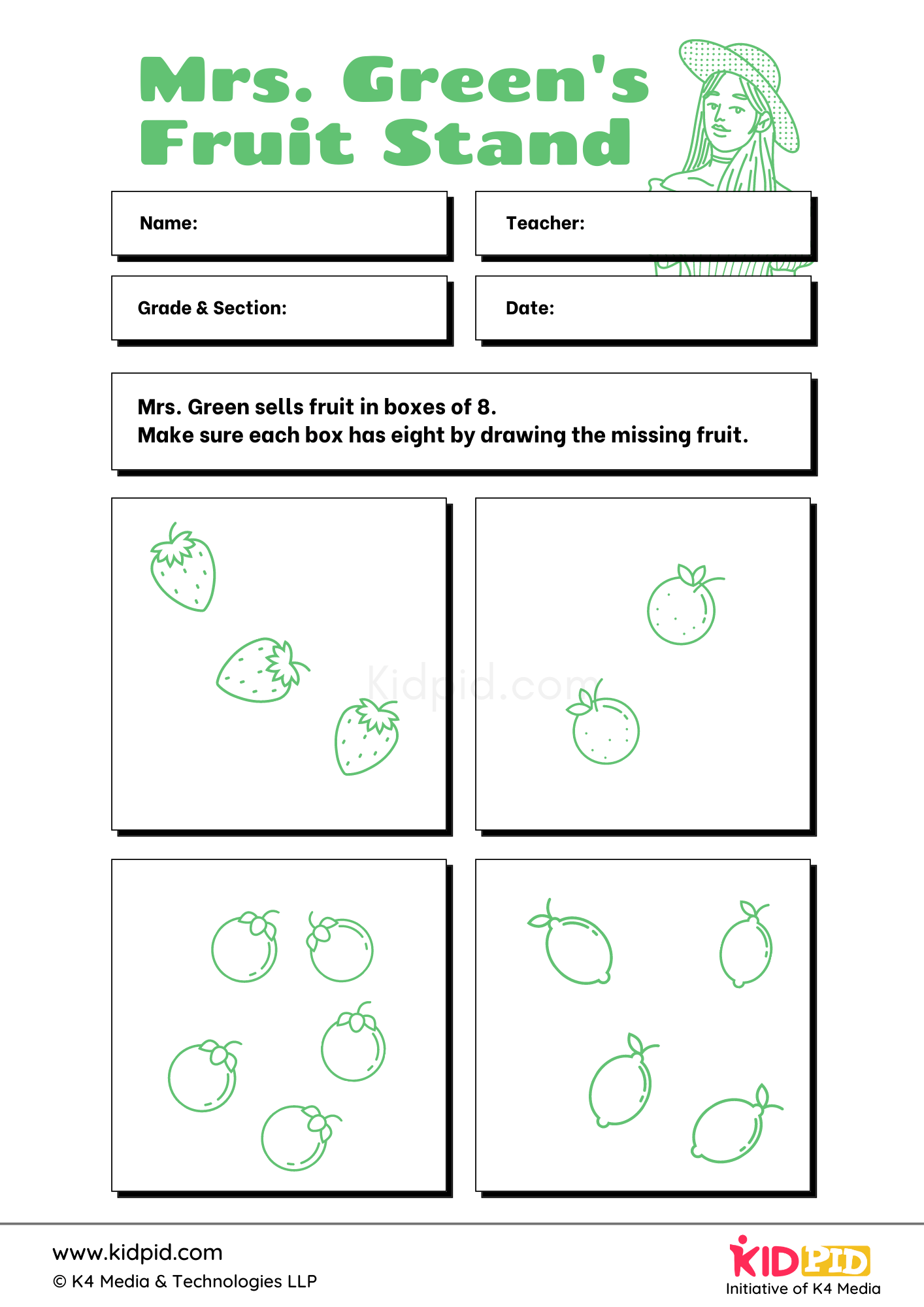
Free printable worksheets for kids to learn addition with drawings. It is suitable for preschool and kindergarten. This worksheet will help your kids to learn addition and improve drawing skills.
Simple Addition Printable Worksheet

Click here for more printable worksheets.
Skills
Key Facts About Simple Addition Printable Worksheet
- Target Audience: Perfect for preschoolers, kindergarteners, and early Grade 1 students (typically ages 4 to 6).
- Core Concepts: Combines basic single-digit addition with visual object counting.
- Dual-Skill Development: Designed to boost both foundational math skills and fine-motor drawing/coloring skills simultaneously.
- Format: Free, downloadable, high-quality printable PDF that is printer-friendly for classroom or home use.
- Curriculum Alignment: Aligned with early childhood math frameworks focusing on counting and cardinality, and operations in algebraic thinking.
Parts, Types, and Examples of Simple Addition Worksheets
To build robust math skills, early learners need to interact with different styles of addition. This specific worksheet blends several approaches:
- Visual/Pictorial Addition: Problems that use images (like fruits or shapes) instead of just numbers. Example: 3 apples + 2 apples = 5 apples.
- Concrete-to-Abstract Bridge: Worksheets that place numbers directly below pictures, helping children connect a physical count to an abstract digit.
- Horizontal vs. Vertical Formats: Early addition is typically presented horizontally (2 + 3 = 5) to read like a sentence, transitioning later to vertical stacks.
How Does the Simple Addition Printable Worksheet Work?
This worksheet acts as a scaffold (a temporary learning support) for young minds. Instead of forcing a child to memorize that 4 + 2 = 6, it leverages their natural ability to count.
- Identification: The child looks at the first group of objects and counts them.
- Tracking the Operator: They recognize the plus sign (+), which signals that they need to put groups together.
- Totaling (Sum): They count all the objects across both groups combined to find the total.
- Kinesthetic Reinforcement: By drawing or coloring the items, the child slows down, reinforcing the mathematical concept through physical touch and visual tracking.
Benefits of Learning About Simple Addition
Mastering single-digit addition early provides critical cognitive advantages:
- Develops Number Sense: Children begin to understand that numbers represent real, physical quantities, not just symbols on a page.
- Prevents “Math Anxiety”: Using bright, engaging drawings makes early math feel like a game, building confidence before equations become more abstract.
- Enhances Cognitive Load Management: When a child learns to add small numbers fluently, it frees up brainpower for more complex problem-solving later on, like double-digit addition or subtraction.
- Fine Motor Coordination: Holding crayons or pencils to trace and draw shapes on the worksheet strengthens the small hand muscles needed for writing.
Learning Objectives
By completing this printable activity, students will achieve the following milestones:
- Objective 1: Accurately count groups of physical objects up to 10.
- Objective 2: Understand the meaning of the plus sign (+) as “putting together” and the equal sign (=) as “the same as.”
- Objective 3: Represent an addition equation using drawings, objects, or numbers.
- Objective 4: Solve single-digit addition problems with a sum of 10 or less.
Worksheet Instructions
Parents and teachers, read these steps aloud to your little learners:
- Count the First Group: Point your finger at the pictures in the first box. Count them out loud (“1, 2, 3…”) and write that number underneath.
- Count the Second Group: Look past the plus sign (+). Count the pictures in the second box and write that number down too.
- Count Them All Together: Go back to the very beginning. Count all the pictures from both boxes without stopping.
- Write Your Answer: Write the final total number right after the equal sign (=).
- Get Creative: Use your favorite crayons to color in the drawings or draw your own matching shapes in the answer space!
Interesting Facts About Simple Addition
- The Ancient Plus Sign: The plus sign (+) we use today is a shorthand version of the Latin word “et”, which means “and.”
- Subitizing Power: Human brains can naturally “see” a small group of objects (up to 4) and know how many there are without actually counting them one by one. This skill is called subitizing, and addition worksheets help train it!
- The Commutative Property: It doesn’t matter what order you add numbers in; the answer stays the same. 2 + 3 is always equal to 3 + 2. Young kids love discovering this “math magic trick”!
Vocabulary Words
- Add: To put two or more numbers or groups together to make a larger total.
- Plus Sign (+): The mathematical symbol that tells you to add numbers together.
- Sum: The total amount you get when you add two or more numbers together.
- Equal Sign (=): The symbol that shows the amounts on both sides are the same value.
- Equation: A mathematical statement showing that two expressions are equal (e.g., 4 + 1 = 5).
Real-Life Applications
Addition isn’t just for a school desk; children use it constantly in their daily routines:
- Snack Time Fractions: “You have 3 crackers, and I give you 2 more. How many do you have now?”
- Toy Cleanup: Counting and combining blocks, toy cars, or dolls to ensure nothing is left under the bed.
- Nature Walks: Collecting 4 pinecones, finding 3 more leaves, and figuring out the size of the entire nature treasure collection.
FAQs
Q1. At what age is best for this simple addition worksheet?
Answer: This worksheet is ideal for children aged 4 to 6 who are in preschool, kindergarten, or the beginning of first grade.
Q2. My child can count but struggles with writing the numbers. How can I help?
Answer: Focus on the math verbally first! Let your child count the pictures and say the answer out loud. You can write the numbers for them, or use dot-to-dot tracing so they can practice their writing grip without getting frustrated by the math.
Q3. Why use picture worksheets instead of just flashcards with numbers?
Answer: Young children are concrete thinkers. Flashcards (3 + 2) are entirely abstract and require memorization. Picture worksheets allow children to physically see and verify why the answer is what it is, which builds deep mathematical understanding rather than temporary rote memory.
Q4. Can I use this worksheet for a classroom setting?
Answer: Absolutely! Kidpid worksheets are designed to be freely downloaded and printed for home use, daycare centers, preschools, or primary classrooms.
Build early math confidence with these Simple Addition printable worksheets. Children practice basic addition skills, improve number recognition, and develop problem-solving abilities through engaging activities. Regular practice strengthens calculation skills and creates a solid foundation for future mathematics learning. Hope you liked these additional printables. Visit our website to explore a wide collection of free worksheets, essays, paragraphs, flashcards, quizzes, and interactive resources. Designed to make learning fun for kids. Stay updated on YouTube & Facebook.
The Content Team develops the worksheet to promote scholastic growth.
Reviewed By Sushmita
More Printables