

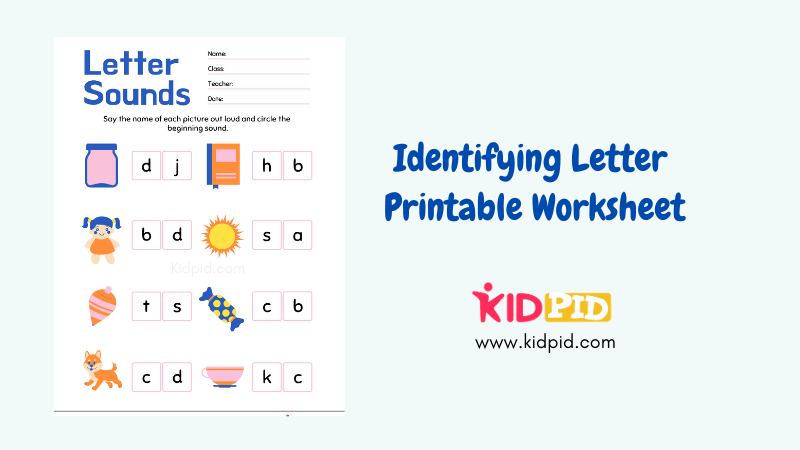
Free Phonics Printable to identify and pronounce letters for kids. It is perfect for preschoolers and kindergarteners.
Contents
- Identifying Letter Foundational Worksheet
- Key Facts About the Identifying Letter Foundational Printable Worksheet
- Parts, Types, and Examples of Letter Identification Worksheets
- How Does an Identifying Letter Printable Worksheet Work?
- Benefits of Learning About Letter Identification
- Learning Objectives and Worksheet Instructions
- Interesting Facts About Letter Recognition and Vocabulary Words
- Real-Life Applications
- FAQs
Identifying Letter Foundational Worksheet
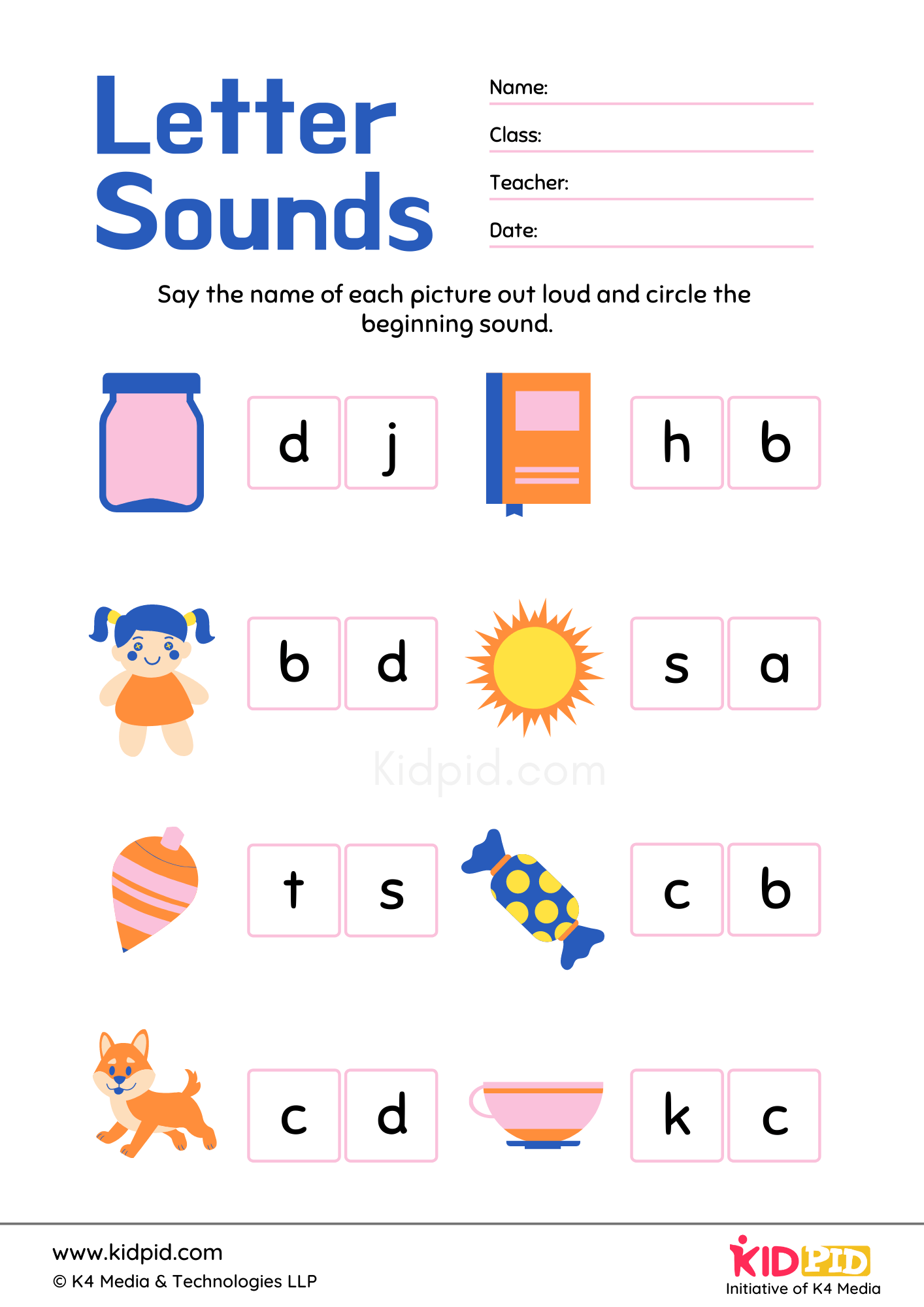
Say the name of each picture out loud and circle the beginning sound.

Click here for more printable worksheets.
Simple Addition Printable Worksheet
Key Facts About the Identifying Letter Foundational Printable Worksheet
- Target Demographics: Primarily engineered for preschoolers, kindergarteners, and early Grade 1 students (typically ages 3 to 6).
- Core Focus Areas: Combining visual letter recognition with initial phonemes—the specific individual sounds that make up spoken words.
- Format Structure: A distraction-free, high-contrast layout that prevents cognitive overload in young learners who are still developing visual tracking skills.
- Curriculum Alignment: Aligns with standard early-year literacy benchmarks, specifically targeting the mastery of beginning sounds.
Parts, Types, and Examples of Letter Identification Worksheets
Letter recognition resources vary based on the specific mechanical skill being reinforced. Early childhood educators categorize these activities into several distinct frameworks:
1. Initial Sound Identification (Phonics Focus)
Students look at an image (e.g., an apple) and isolate the first sound they hear, pairing it with the correct symbol (A). This matches the setup of Kidpid’s foundational printable worksheet.
2. Case Discrimination (Grapheme Focus)
Exercises that require children to differentiate between the uppercase (majuscule) and the lowercase (minuscule) versions of the same letter.
3. Visual Tracking and Sorting Mazes
A grid format where a child must trace a path of a single repeating letter (e.g., following only the letter B through a sea of Ps and Ds) to build visual discrimination.
How Does an Identifying Letter Printable Worksheet Work?
The cognitive process behind a letter identification worksheet relies on a multi-sensory educational sequence known as the See-Say-Do method.
- The Visual Cue (See): The child identifies a familiar, concrete object illustrated on the page. This anchors the abstract letter to a real-world concept.
- Phonemic Retrieval (Say): The child says the name of the object out loud. By voicing the word, their brain isolates the leading vocal onset (the starting sound).
- Graphemic Selection (Do): The child scans the provided choices and matches that spoken sound to its visual text representation, physically circling or marking the target letter to finalize the cognitive connection.
Benefits of Learning About Letter Identification
Mastering letter identification early prevents learning gaps as text complexity increases. Key pedagogical benefits include:
- Stronger Orthographic Mapping: This is the mental process readers use to permanently store words for immediate, effortless retrieval. It starts by securely locking in individual letter-sound pairs.
- Fine Motor Control: The physical acts of tracking with a finger, holding a crayon, and neatly circling a specific target shape build intrinsic hand strength and pencil grip.
- Decoder Confidence: Children who instantly recognize letters do not waste mental energy trying to decipher shapes; instead, they can focus entirely on blending sounds to read full words.
Learning Objectives and Worksheet Instructions
By completing this foundational literacy activity, the student will:
- Isolate and pronounce the initial phoneme (beginning sound) of common everyday objects.
- Demonstrate consistent visual discrimination by selecting the correct letter from a small group of distractor letters.
- Execute basic fine motor tasks by cleanly marking or circling their chosen answers.
Step-by-Step Instructions
- Look and Label: Point directly to the first picture on the worksheet. Ask your child to name the object clearly out loud.
- Isolate the First Sound: Ask the child to repeat the word, but stretch out or emphasize the very first sound they make (e.g., “b-b-banana”).
- Scan and Identify: Have the child look at the row of letters right next to that image. Guide their finger across each choice from left to right.
- Mark the Answer: Encourage the child to circle, color, or place a stamp over the exact letter that makes that opening sound. Repeat the sequence for the remaining rows.
Interesting Facts About Letter Recognition and Vocabulary Words
Fascinating Literacy Insights
- The “Mirroring” Stage: It is entirely normal for young brains to write or read letters completely backward (like b and d, or p and q) until around age 7. The brain’s visual system naturally treats flipped shapes as the same object until it learns that orientation matters in human language.
- Frequency Dynamics: The letter E is the most common letter in the English language, while Z is used the least. Teaching highly frequent letters first helps children start decoding simple words much faster.
Key Vocabulary Words to Teach Your Child
- Letter: A written symbol that represents a sound in spoken language.
- Sound (Phoneme): The smallest unit of sound that we make with our mouths when we talk.
- Beginning Sound: The very first sound you hear when you start saying a word.
Real-Life Applications
Letter identification shouldn’t stop when the paper is turned over. You can easily extend this learning style into normal routines:
- Grocery Store Scavenger Hunts: While walking down the aisles, point to large signs and ask your child to find items that start with a specific sound, like searching for apples or bananas based on their letters.
- Environmental Print Walks: Look at street signs, stop signs, and building logos while outside. These clean, bold fonts are perfect for children practicing visual tracking in real time.
- Interactive Story Time: During your evening reading session, pick one specific letter before opening the book. Ask your child to point it out whenever it shows up in a main page headline.
FAQs
Q1. At what age should a child start using letter identification worksheets?
Answer: Most children are ready for structured visual identification worksheets between the ages of 3 and 5. If your child is still struggling to hold a crayon, you can modify the activity by having them point to the letter or cover it with a small toy block rather than writing.
Q2. My child keeps confusing ‘b’ and ‘d ‘. Is this a problem?
Answer: No, letter reversal is a completely normal developmental milestone in early childhood education. At this stage, their brains are still learning that directionality alters meaning. Consistent, gentle exposure through phonics worksheets will resolve this naturally over time.
Q3. Should I teach letter names or letter sounds first?
Answer: Research suggests teaching letter sounds (phonics) alongside letter shapes offers the fastest path to reading fluency. Knowing that the letter B says “/b/” is instantly useful for reading the word “cat,” whereas just knowing the name “Bee” can sometimes confuse early blending practices.
These Identifying Letter Foundational printable worksheets help children recognize uppercase and lowercase letters, strengthen alphabet knowledge, and improve early reading skills. Regular practice builds confidence, enhances letter recognition, and prepares young learners for successful reading and writing. Browse our website for worksheets, essays, paragraphs, flashcards, quizzes, and interactive resources. Follow us on YouTube & Facebook.
This worksheet is designed by the Content Team to enhance academic development.
Reviewed By Drashti
More Printables


useful for my sibling!