
Learning about plural words helps you understand how to talk about more than one thing. This worksheet will guide you in tracing, writing, and spelling plural words, like “cats” and “dogs.” By practicing these words, you’ll learn how to correctly add “s” or “es” to make words plural. Mastering plural words is important for improving your reading and writing skills and making your sentences clearer and more accurate.
[Scroll Down for Download Link]
Contents
- Trace, Write, and Spell Plural Words Worksheet For Grade 1
- Key Facts About Plural Words Practice Worksheet for Grade 1
- Parts/Types/Examples of Plural Words Practice Worksheet for Grade 1
- How Does the Plural Words Practice Worksheet for Grade 1 Work?
- Benefits of Learning About Plural Words: Practice Worksheet for Grade 1
- Learning Objectives
- Worksheet Instructions
- Interesting Facts About Plural Words Vocabulary Words
- Real-Life Applications
- FAQs
- Q1. What are plural words?
- Q2. Why should Grade 1 students learn plural nouns?
- Q3. What is the most common way to form plurals?
- Q4. When do we add -es instead of -s?
- Q5. How do worksheets help children learn plural words?
- Q6. Can plural word practice improve writing skills?
- Q7. Are plural words important in daily life?
- Read More:
Trace, Write, and Spell Plural Words Worksheet For Grade 1
Read More: Singular and Plural Nouns Flashcards
Plural Words Ending With ‘s.’

Plural Words Ending With ‘s.’
Key Facts About Plural Words Practice Worksheet for Grade 1
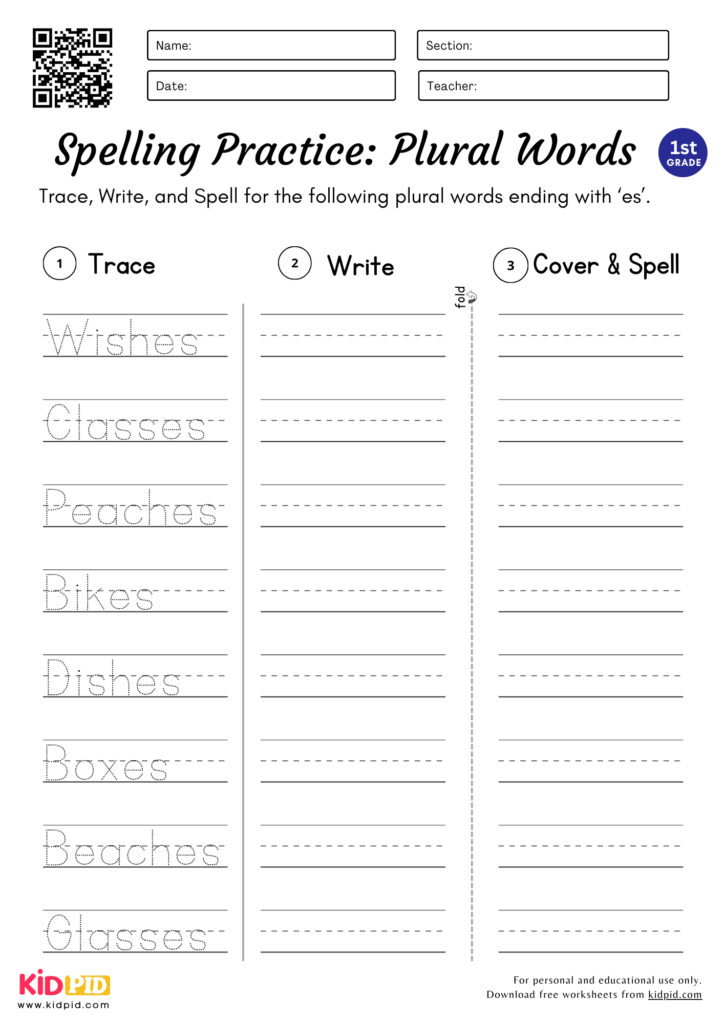
Plural words are used to show that there is more than one person, place, animal, or thing. The Plural Words Practice Worksheet for Grade 1 helps children understand the basic rules of forming plural nouns through engaging exercises and examples. This worksheet introduces young learners to common plural endings such as -s and -es, helping them build essential grammar and vocabulary skills. Designed for first-grade students, the activities support reading, writing, spelling, and language development while making grammar learning enjoyable and interactive.
Parts/Types/Examples of Plural Words Practice Worksheet for Grade 1
The worksheet may include several sections that help children recognize and practice plural nouns:
- Adding -s: cat → cats, book → books
- Adding -es: box → boxes, bus → buses
- Picture Identification: Match images with the correct plural words.
- Fill in the Blanks: Complete sentences using plural nouns.
- Word Matching Activities: Connect singular words to their plural forms.
- Writing Practice: Rewrite singular nouns as plurals.
Examples:
- Dog → Dogs
- Apple → Apples
- Fox → Foxes
- Class → Classes
How Does the Plural Words Practice Worksheet for Grade 1 Work?
The worksheet guides students through step-by-step activities that teach plural noun formation. Children begin by identifying singular nouns and then learn how to change them into plural forms. Through matching exercises, sentence completion tasks, picture-based activities, and writing practice, learners strengthen their understanding of grammar rules. Repetition and hands-on activities help improve retention and boost confidence in using plural words correctly in everyday communication.
Benefits of Learning About Plural Words: Practice Worksheet for Grade 1
- Improves grammar and sentence structure skills.
- Expands vocabulary knowledge.
- Enhances reading comprehension.
- Develops writing accuracy and confidence.
- Strengthens spelling abilities.
- Encourages language development through practical exercises.
- Supports classroom learning and independent practice.
- Builds a strong foundation for future grammar concepts.
Learning Objectives
By completing this worksheet, students will:
- Understand the concept of singular and plural nouns.
- Learn common pluralization rules.
- Identify plural words in sentences.
- Convert singular nouns into plural forms correctly.
- Improve spelling and vocabulary skills.
- Use plural nouns confidently in speaking and writing.
- Develop stronger reading and comprehension abilities.
Worksheet Instructions
- Read each word carefully.
- Identify whether the noun is singular or plural.
- Add the correct ending (-s or -es) when required.
- Complete matching and fill-in-the-blank activities.
- Check your answers for correct spelling.
- Read sentences aloud to practice pronunciation.
- Review mistakes and correct them for better understanding.
Interesting Facts About Plural Words Vocabulary Words
- Most English nouns become plural by adding -s.
- Some words require -es because of their ending sounds.
- Certain nouns have irregular plural forms, such as child → children and mouse → mice.
- Plural nouns help make communication clearer and more accurate.
- Learning plural words improves both speaking and writing skills.
- Plural forms are commonly used in books, conversations, and classroom activities.
Real-Life Applications
Plural words are used every day in communication. Children use them when talking about multiple objects, people, animals, or places. Examples include:
- Describing classroom supplies: pencils, books, crayons.
- Talking about family members and friends.
- Writing stories and journal entries.
- Reading books and understanding sentence meanings.
- Participating in conversations and classroom discussions.
Mastering plural nouns helps students communicate more clearly and confidently in both academic and real-world situations.
FAQs
Q1. What are plural words?
Answer: Plural words are nouns that indicate more than one person, place, animal, or thing.
Q2. Why should Grade 1 students learn plural nouns?
Answer: Learning plural nouns helps children develop grammar, vocabulary, reading, and writing skills.
Q3. What is the most common way to form plurals?
Answer: Most nouns become plural by adding -s at the end of the word.
Q4. When do we add -es instead of -s?
Answer: Words ending in s, x, z, ch, or sh usually take -es to form their plural.
Q5. How do worksheets help children learn plural words?
Answer: Worksheets provide structured practice, repetition, and engaging activities that reinforce grammar concepts.
Q6. Can plural word practice improve writing skills?
Answer: Yes. Understanding plural nouns helps students write grammatically correct sentences and communicate ideas more effectively.
Q7. Are plural words important in daily life?
Answer: Absolutely. Plural nouns are used in conversations, reading, writing, and classroom activities every day.
 Practicing plural words helps Grade 1 students understand singular and plural noun forms with ease. These engaging worksheets strengthen grammar, spelling, vocabulary, sentence-building skills, and confidence in everyday communication. Discover engaging worksheets, essays, paragraphs, flashcards, quizzes, and interactive resources on our website. Stay connected on YouTube & Facebook.
This worksheet was developed by the Content Team to promote quality education.
Reviewed By Sheereen
Read More: