


Nouns can exist in singular or plural forms, depending on whether they refer to one or multiple items. This worksheet will guide you through distinguishing between singular and plural nouns, helping you strengthen your understanding of this fundamental grammatical concept.
[Scroll Down for Download Link]
Contents
- Choose and Circle Singular or Plural Nouns Worksheet
- Key Facts About Singular & Plural Nouns Worksheets
- Parts, Types & Examples of Nouns in the Worksheets
- How Does a Singular or Plural Nouns Worksheet Work?
- Benefits of Learning About Singular and Plural Nouns
- Learning Objectives
- Worksheet Instructions
- Interesting Facts About Nouns & Vocabulary Words
- Real-Life Applications
- FAQs
- Read More
Choose and Circle Singular or Plural Nouns Worksheet
Read More: Singular & Plural Flashcards for Kids


Key Facts About Singular & Plural Nouns Worksheets
- Target Age & Grade: Primarily designed for early childhood and primary education, focusing heavily on Kindergarten, Grade 1, and Grade 2.
- Core Focus: Training children to recognize the visual and auditory difference between a single entity (one) and multiple entities (more than one).
- Format: Engaging, printable PDF pages that combine text with visual cues (like matching pictures to words) to keep young minds focused.
- Skill Progression: These worksheets typically start with simple regular plurals (adding -s) before moving on to more complex grammar rules.
Parts, Types & Examples of Nouns in the Worksheets
To provide a comprehensive learning experience, these printables break down the vast world of nouns into digestible categories. Students will interact with several types of singular and plural formations:
- Regular Nouns (The “+s” or “+es” Rule): The easiest starting point for early readers.
- Examples: Cat → Cats; Book → Books; Box → Boxes.
- Nouns Ending in “-y” (The Change to “-ies” Rule): Introducing basic spelling modifications.
- Examples: Baby → Babies; Puppy → Puppies.
- Irregular Plural Nouns: Words that completely change their form or remain the same, which often require memorization.
- Examples: Child → Children; Tooth → Teeth; Sheep → Sheep.
How Does a Singular or Plural Nouns Worksheet Work?
- Visual Stimulus: The worksheet displays an image (e.g., a picture of one apple vs. a basket of apples).
- Identification & Isolation: The student reads the accompanying words or looks at a prompt to determine the quantity.
- Active Kinesthetic Response: Children complete a physical action—such as circling the correct word, matching a line from the singular to the plural form, or filling in a missing suffix. This physical interaction reinforces muscle memory and cognitive retention.
Benefits of Learning About Singular and Plural Nouns
- Prevents Subject-Verb Disagreement: Children learn early that “The dogs barks” sounds incorrect, paving the way for flawless sentence structure.
- Boosts Reading Comprehension: Recognizing plural endings allows kids to accurately visualize the context of a story without pausing to guess quantities.
- Expands Vocabulary Capacity: It shifts a child’s mindset from learning individual words to understanding word systems and rules.
Learning Objectives
By completing these grammar worksheets, young learners are expected to achieve the following academic milestones:
- Identify the difference between a singular noun and a plural noun within written sentences.
- Apply basic spelling rules (adding -s or -es) to convert single objects into multiples.
- Distinguish between regular patterns and irregular exceptions through contextual practice.
- Demonstrate confidence in early reading fluency and handwriting via interactive fill-in-the-blank prompts.
Worksheet Instructions
Parents and educators can read these clear, kid-friendly instructions aloud to guide children through the activities:
- Step 1: Look closely at the picture provided on the left side of the page. Count how many items you see.
- Step 2: If there is only one item, you are looking at a singular noun. If there are two or more, you are looking at a plural noun.
- Step 3: Read the word choices carefully. Use your pencil to circle the correct word or write down the missing plural ending in the blank space.
- Step 4: Double-check your work! Read the final word out loud to ensure it matches the picture.
Interesting Facts About Nouns & Vocabulary Words
Grammar doesn’t have to be dry! Share these fun linguistic facts with your students to spark curiosity:
- The “No-Change” Club: Some animals refuse to change their names when they hang out in groups. One deer or ten deer—the word stays the same!
- A Goose vs. A Moose: English can be beautifully strange. The plural of goose is geese, but the plural of moose is absolutely not meese (it’s just moose).
- The Suffix Story: The letters -s and -es are called suffixes. They act like little math signs in reading, adding “plus more” to the end of a base word.
Real-Life Applications
Grammar isn’t just an exercise for the classroom; it governs how children interact with the real world every single day:
- Following Directions: “Please grab the marker” requires a completely different action than “Please grab the markers.”
- Storytelling & Expressing Needs: Accurately telling a parent, “Two dogs chased me!” instead of “Two dogs chased me,” ensures a child is fully understood and safe.
- Early Math Integration: Counting objects in math class inherently relies on switching labels from singular units to plural totals.
FAQs
Q1: At what age should kids start learning about singular and plural nouns?
Answer: Children typically start recognizing the difference in speech around ages 2 to 3. However, formal written worksheets are most effective between ages 5 and 8 (Kindergarten through Grade 2), once they have a grasp of basic phonics.
Q2: Why do children struggle with irregular plural nouns?
Answer: Young brains look for logical patterns. Once they learn the “+s” rule, they try to apply it to everything (e.g., “foots” instead of “feet”). This is a completely natural stage of language development called overgeneralization. Practice worksheets help them identify and memorize the exceptions.
Q3: How can I make noun worksheets more interactive at home?
Answer: Pair the printable sheet with physical objects! If the worksheet shows “three blocks,” place three physical toy blocks on the table in front of your child so they can touch, count, and connect the tangible object to the written word.

The Singular or Plural Nouns Worksheet helps children identify and use singular and plural nouns correctly. Fun grammar activities strengthen vocabulary, reading, writing, and language skills while building confidence through engaging daily practice. Make every learning moment enjoyable with our free worksheets, essays, paragraphs, flashcards, quizzes, and interactive resources. Visit our website and follow YouTube & Facebook for daily updates.
The Content Team designed this worksheet to strengthen learning quality.
Reviewed By Palak
Read More
Find Plural Nouns: Fun Worksheets for Grade 1
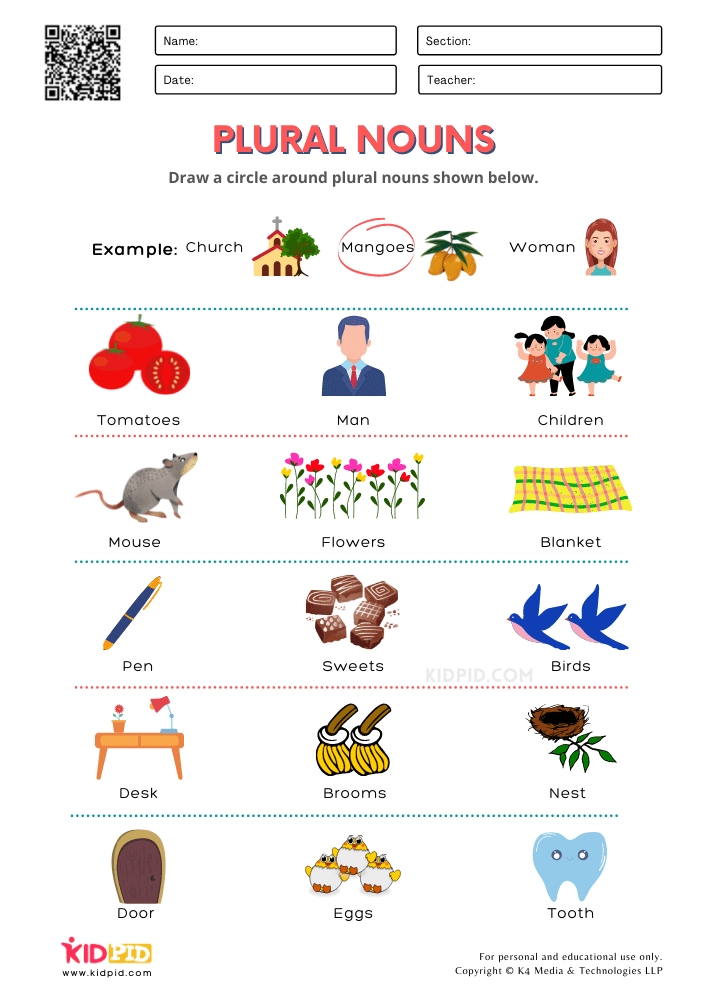
Help Grade 1 kids learn plural nouns with these fun worksheets! They’ll practice finding and writing words that mean more than one. A simple, engaging way to build grammar skills and boost confidence!
Spot Singular and Plural Nouns: Worksheets for Grade 1
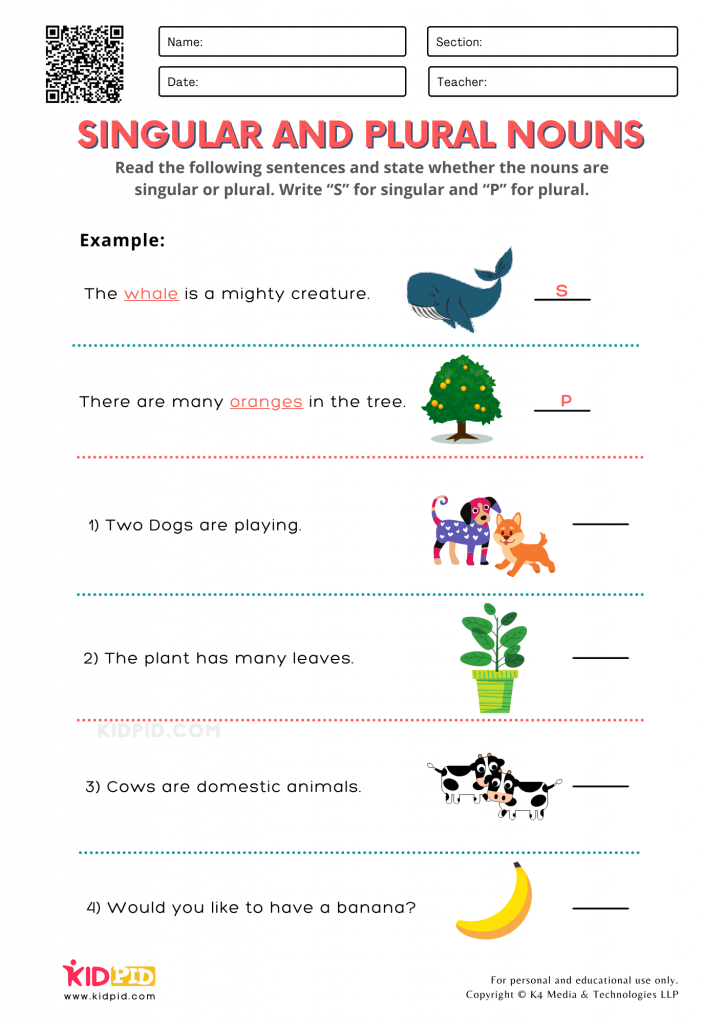
Help Grade 1 kids learn singular and plural nouns with fun worksheets! They’ll spot and identify nouns for one thing or many things. A simple and engaging way to build grammar skills! Perfect for young learners!
Learn Irregular Plural Nouns: Worksheets for Grade 2
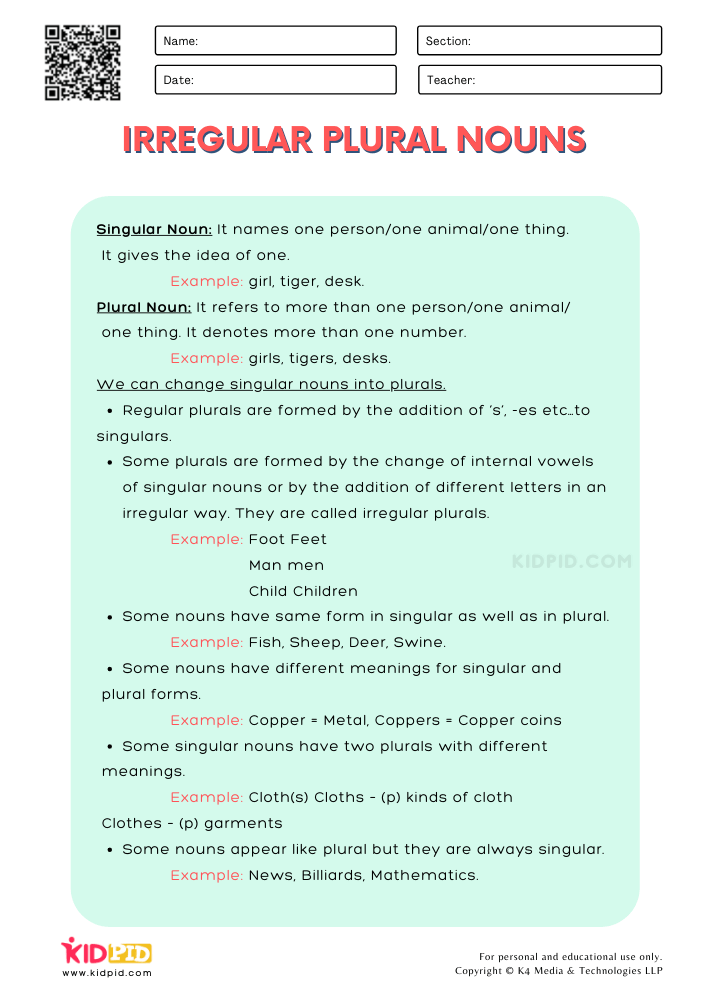
Help Grade 2 kids master tricky plural nouns with these fun worksheets! They’ll learn how some nouns change in special ways (like “child” to “children”) while practicing and building strong grammar skills. Perfect for young learners!
Singular and Plural Nouns Practice for Grade 2
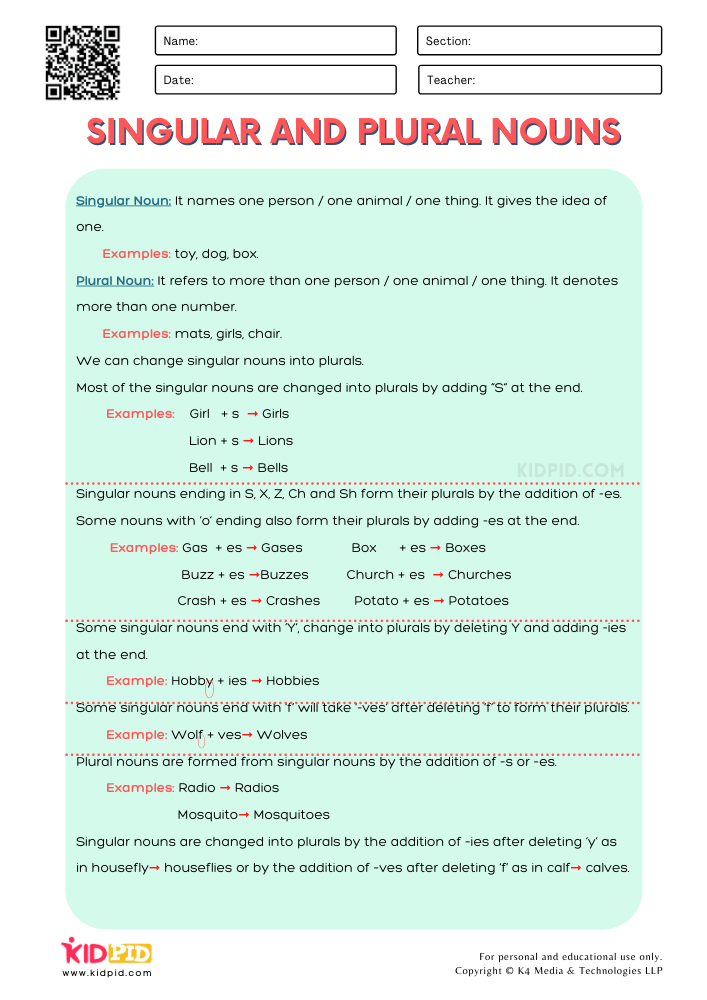
Help Grade 2 kids master singular and plural nouns with fun practice worksheets! They’ll learn to change one thing into many and spot tricky plural forms. A great way to build grammar skills easily!
Match Singular and Plural Nouns: Worksheets for Grade 1
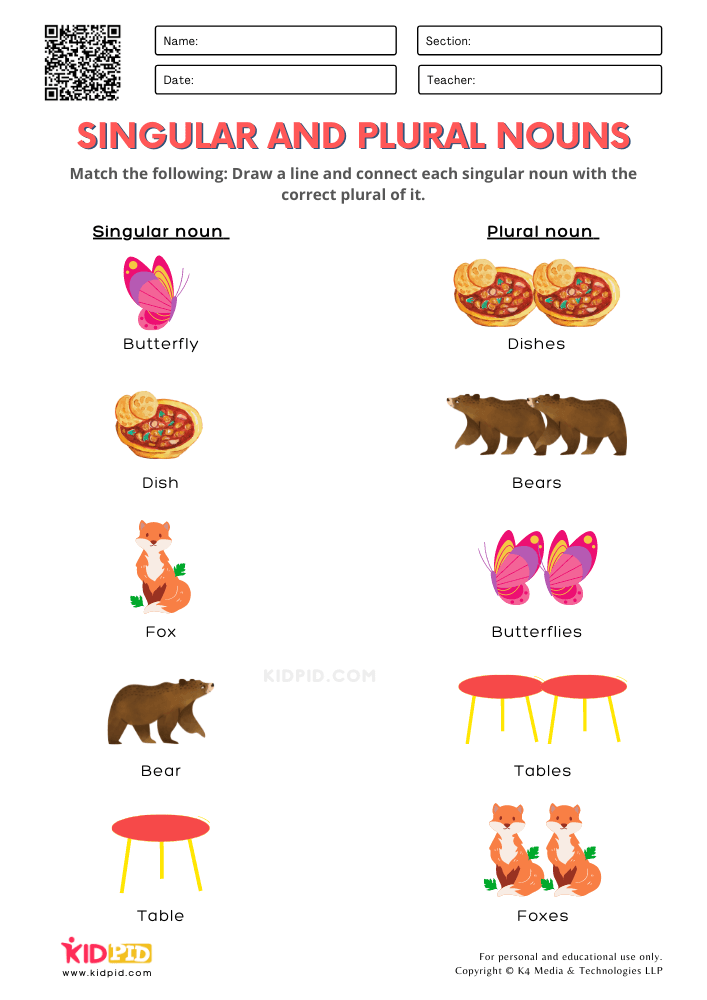
Help Grade 1 kids learn singular and plural nouns with fun matching worksheets! They’ll connect one thing to many things, like “cat” to “cats.” A simple, engaging way to build early grammar skills!



