
This hands-on activity allows you to physically manipulate noun cards, sorting them into singular and plural categories. By cutting out the noun words and organizing them, you’ll engage kinesthetically with distinguishing between nouns that represent one item versus multiple items.
[Scroll Down for Download Link]
Contents
- Singular Plural Nouns Cut-Out Card Activity For Kids
- Key Facts About the Singular Plural Nouns Cut-Out Card Activity Worksheet
- Parts/Types/Examples Featured in the Activity
- How Does the Singular Plural Nouns Cut-Out Card Activity Work?
- Benefits of Learning About Singular and Plural Nouns
- Learning Objectives
- Worksheet Instructions
- Interesting Facts About Nouns & Vocabulary Words
- Real-Life Applications
- FAQs
- Q1. What grade level is best suited for this singular and plural nouns activity?
- Q2. Why does this activity use a “cut-out” card design instead of simple writing lines?
- Q3. How do I explain “irregular plurals” to a child who keeps adding “-s” to everything?
- Q4. Can I reuse these cut-out flashcards for future classroom lessons?
Singular Plural Nouns Cut-Out Card Activity For Kids
Read More: Bunny Crafts for Kids to Make at Home
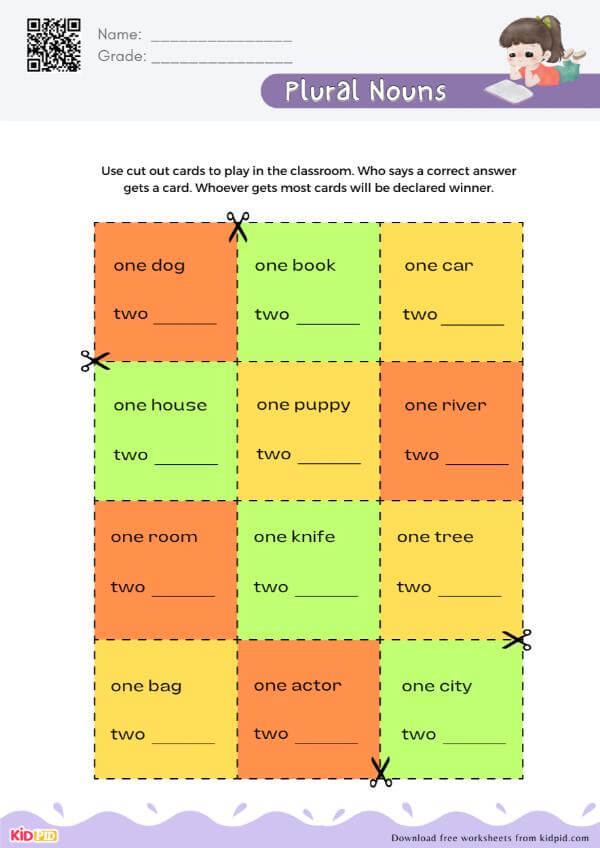
- one dog two dogs
- one book two books
- one car two cars
- one house two houses
- one puppy two puppies
- one river two rivers
- one room two rooms
- one knife two knives
- one tree two trees
- one bag two bags
- one actor two actors
- One City Two Cities
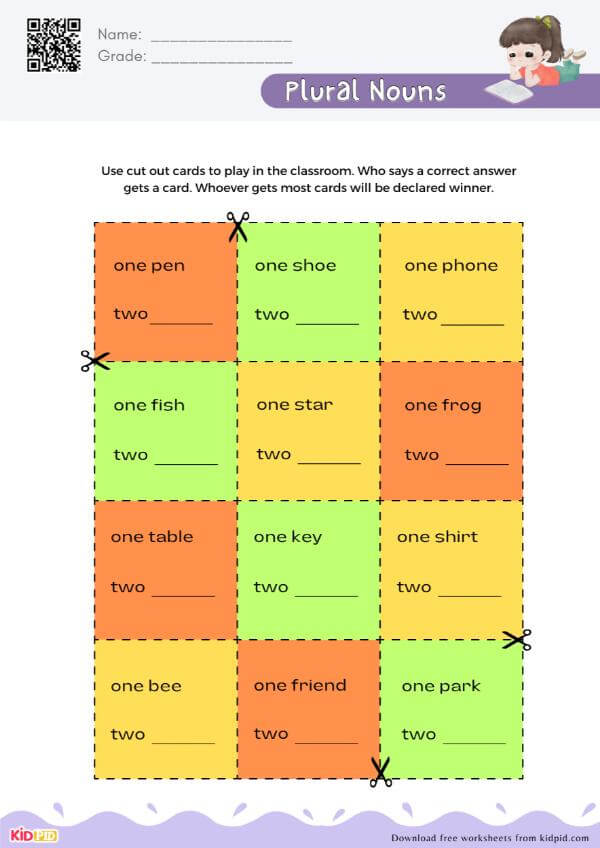
- one pen two pens
- one shoe two shoes
- one phone two phones
- one fish two fishes
- one star two stars
- one frog two frogs
- one table two tables
- one key two keys
- one shirt two shirts
- one bee two bees
- one friend two friends
- one park two parks
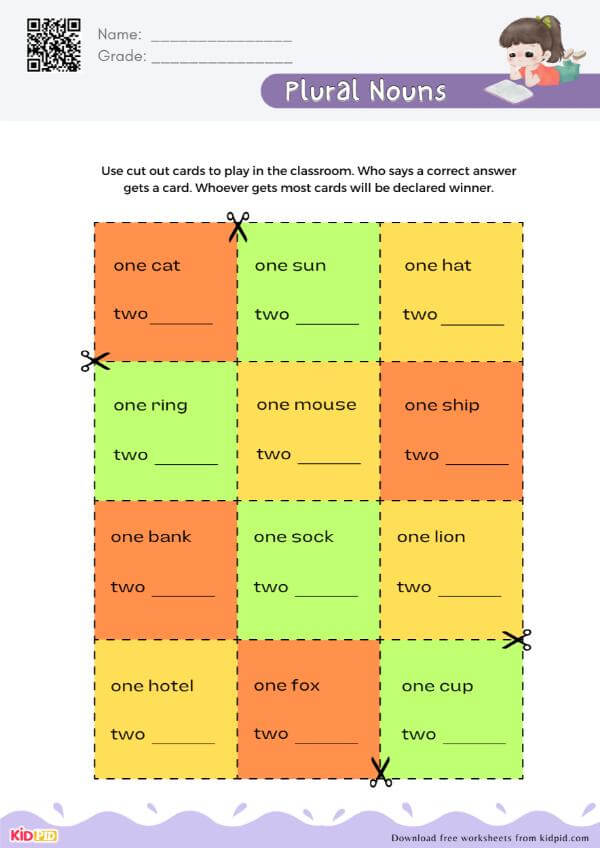
- one cat two cats
- one sun two suns
- One hat, two hats
- one ring two rings
- One mouse, two mice
- one ship two ships
- one bank two banks
- one sock two socks
- One Lion, Two Lions
- one hotel two hotels
- one fox two foxes
- one cup two cups
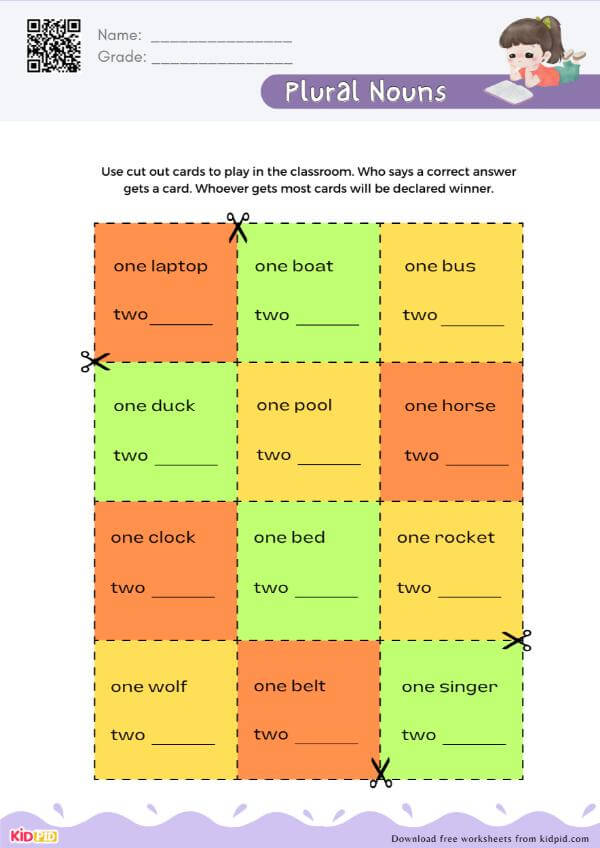
- one laptop two laptops
- one boat two boats
- one bus two buses
- One duck, two ducks
- one pool two pools
- one horse two horses
- one clock two clocks
- one bed two beds
- one rocket two rockets
- one wolf two wolves
- one belt two belts
- one singer two singers
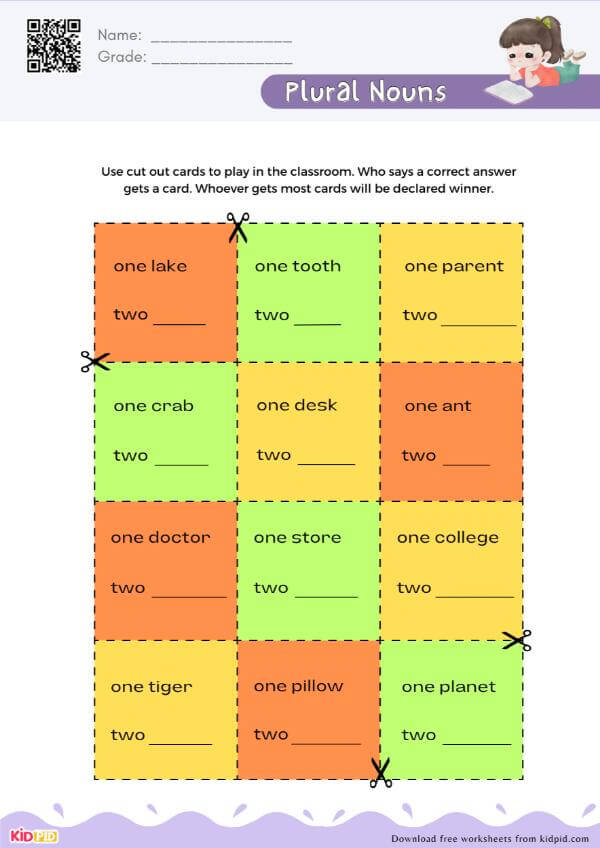
- one lake two lakes
- one tooth two teeth
- one parent two parents
- one crab two crabs
- one desk two desks
- One ant, two ants
- One doctor, two doctors
- one store two stores
- one college two colleges
- one tiger two tigers
- one pillow two pillows
- one planet two planets
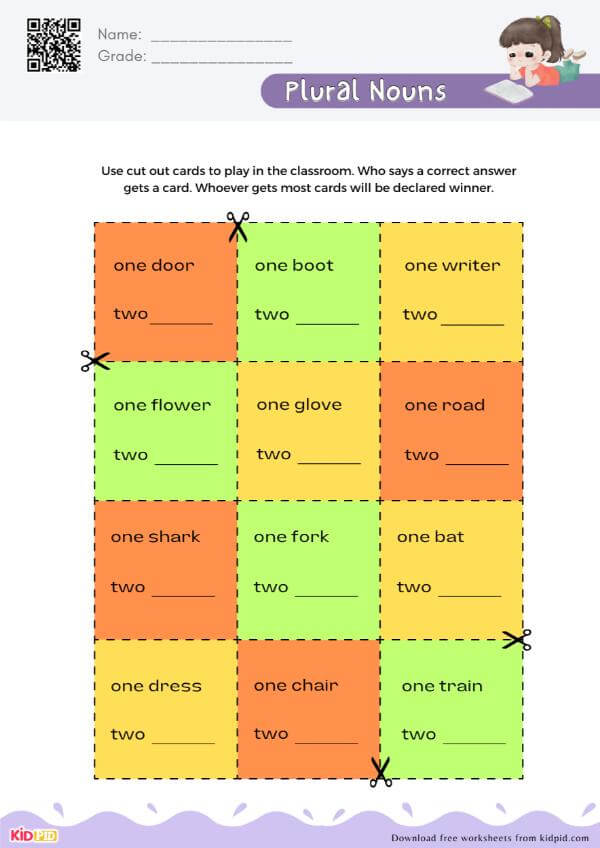
- one door two doors
- one boot two boots
- One writer, two writers
- one flower two flowers
- one glove two gloves
- One road, two roads
- One shark, two sharks
- one fork two forks
- One bat, two bats
- one dress two dresses
- one chair two chairs
- one train two trains
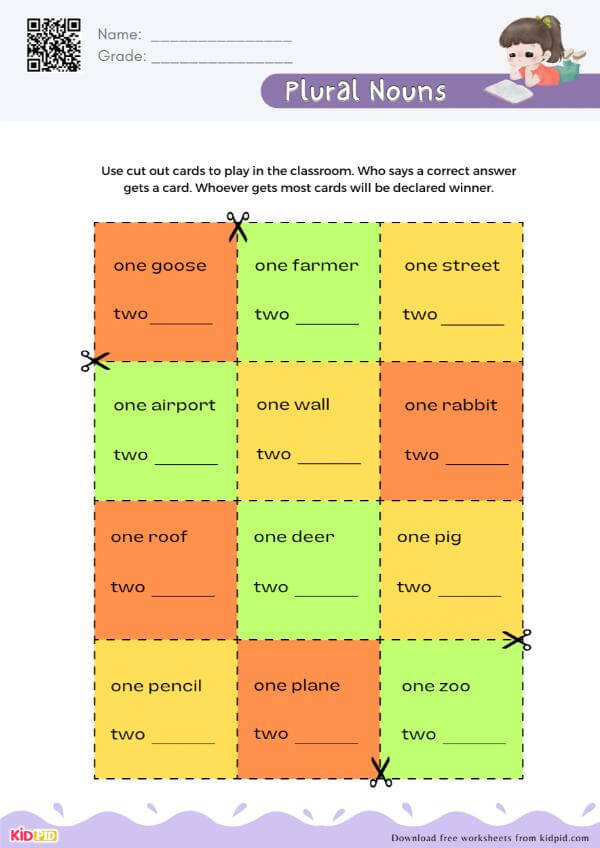
- one goose two geese
- one farmer two farmers
- one street two streets
- one airport two airports
- one wall two walls
- one rabbit two rabbits
- one roof two roofs
- one deer two deers
- one pig two pigs
- one pencil two pencils
- one plane two planes
- one zoo two zoos
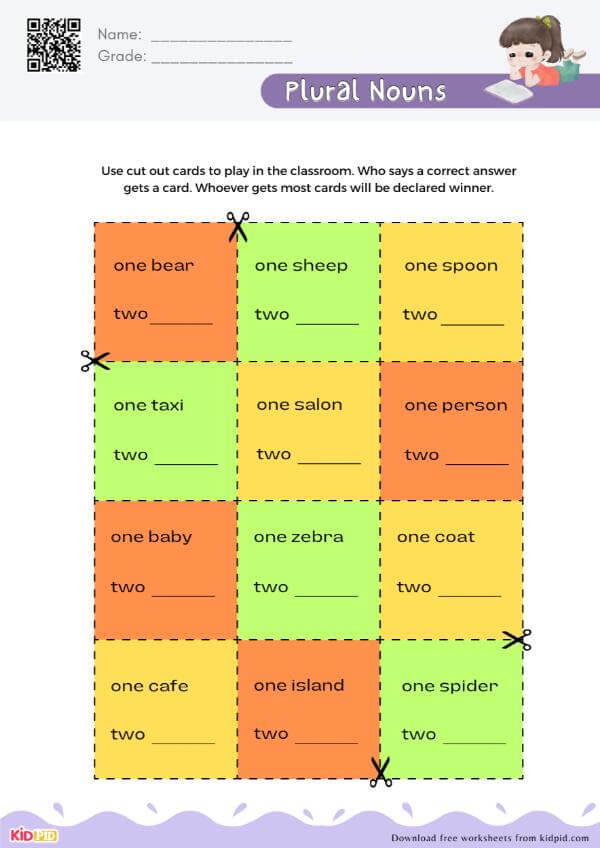
- one bear two bears
- one sheep two sheep
- one spoon two spoons
- one taxi two taxis
- one salon two salons
- one person two people
- one baby two babies
- one zebra two zebras
- one coat, two coats
- one cafe two cafes
- one island two islands
- one spider two spiders
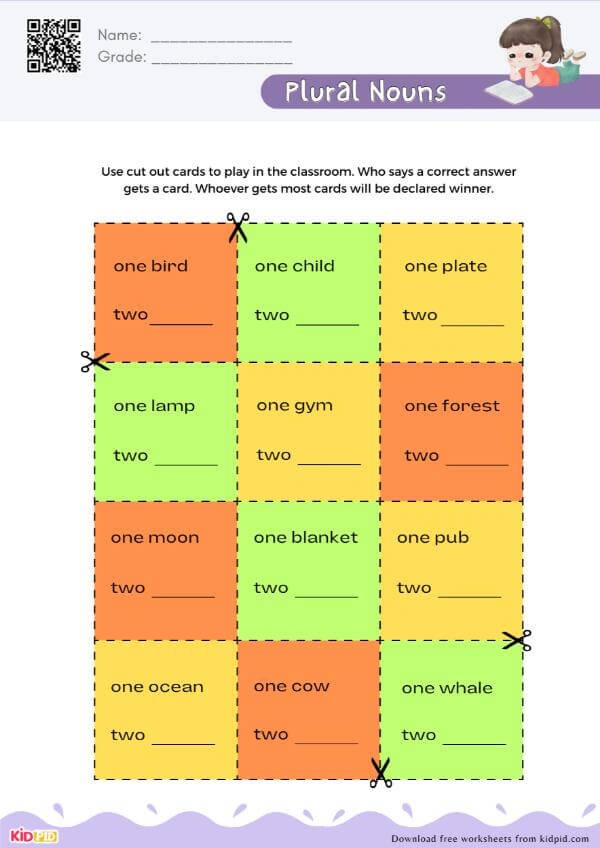
- one bird two birds
- one child two children
- one plate two plates
- one lamp two lamps
- One gym, two gyms
- one forest two forests
- One Moon Two Moons
- one blanket two blankets
- one pub two pubs
- one ocean two oceans
- one cow two cows
- one whale two whales
Key Facts About the Singular Plural Nouns Cut-Out Card Activity Worksheet
- Target Grade Levels: Ideal for early elementary students, specifically Kindergarten, Grade 1, and Grade 2.
- Activity Type: Hands-on, tactile sorting game using printable flashcards and cut-out words.
- Core Subject: English Language Arts (ELA) – Grammar and Morphology (word patterns).
- Skills Developed: Fine motor skills (cutting and pasting), visual word recognition, and categorization.
- Format: Free downloadable, print-ready PDF containing side-by-side comparative noun lists.
Parts/Types/Examples Featured in the Activity
This printable resource is meticulously structured to introduce young learners to multiple distinct categories of pluralization in the English language. Rather than just overwhelming kids with abstract rules, the worksheet uses clear, visual pairs to demonstrate how words transform.
The worksheet includes three foundational types of nouns:
- Regular Plurals (Adding “-s”): The most common pattern is where a standard singular word needs only an “s” at the end.
- Examples: one dog → two dogs; one book → two books; one car → two cars; one pen → two pens.
- Regular Plurals ending in “-es” or “-ies”: Tricker regular endings that require spelling adjustments based on the final letter of the singular noun.
- Examples: one bus → two buses; one fox → two foxes; one puppy → two puppies; one baby → two babies.
- Irregular Plurals (Word Mutations & Mutations): Nouns that completely change their internal spelling or structural form when pluralized, completely breaking the standard rules.
- Examples: one mouse → two mice; one child → two children; one person → two people; one tooth → two teeth; one goose → two geese.
How Does the Singular Plural Nouns Cut-Out Card Activity Work?
This educational activity works by bridging the gap between abstract grammar rules and physical, concrete objects. It is rooted in the Multisensory Structured Language (MSL) approach, which asserts that children retain language rules much better when they can see, hear, and physically manipulate the words simultaneously.
- Step 1: Visual Reading: The child reads the singular noun alongside its quantitative paired phrase (e.g., “one cat” next to “two cats”).
- Step 2: Physical Dissection: Using child-safe scissors, the student cuts along the dotted borders to separate the individual flashcards.
- Step 3: Cognitive Sorting: The child shuffles the cards and physically groups them into two master piles or boxes labeled “Singular” (representing exactly one person, place, or thing) and “Plural” (representing more than one).
- Step 4: Pattern Recognition: By laying the cards side-by-side, the brain naturally recognizes patterns, such as noticing how a regular “-s” looks compared to a dramatic irregular change like “wolf” turning into “wolves.”
Benefits of Learning About Singular and Plural Nouns
Mastering the distinction between singular and plural forms early in a child’s educational journey forms the literal building blocks for advanced communication.
- Prevents Subject-Verb Disagreement: If a child does not truly understand whether a noun represents one item or multiple items, they will struggle with subject-verb agreement in writing later on (e.g., writing confusing sentences like “The dogs run” instead of “The dogs run”).
- Accelerates Reading Fluency: Instantly identifying plural suffixes (like “-s” and “-es”) allows young readers to decode blocks of text faster without stumbling over word endings.
- Expands Expressive Vocabulary: Learning irregular mutations (like deer staying deer, or foot becoming feet) prevents common speech errors and builds confidence when speaking in front of peers.
Learning Objectives
By completing this interactive cut-out card activity, young learners will achieve the following academic benchmarks aligned with primary ELA core standards:
- Identify: Correctly distinguish whether a spoken or written noun represents a single entity or multiple entities.
- Classify: Accurately sort a mixed deck of regular and irregular nouns into their correct linguistic categories with at least 80% accuracy.
- Apply: Demonstrate the ability to form regular plurals by adding correct suffixes and recognize common irregular plural nouns.
- Execute: Refine bilateral coordination and fine motor control through precision cutting and clean pasting tasks.
Worksheet Instructions
Parents and teachers can follow these simple, step-by-step instructions to guide their students through this classroom resource successfully:
- Print the Pages: Download and print the complete Kidpid noun worksheet packets on standard paper (or heavy cardstock for long-term flashcard durability).
- Review Together: Before reaching for the scissors, read through the singular and plural noun lists aloud with your student to ensure correct pronunciation.
- Cut the Cards: Guide the child to carefully cut along the dotted layout lines to create a pile of individual word cards.
- Prepare the Sorting Mat: On a large table or piece of paper, draw two columns: one titled “Singular (Only 1)” and the other titled “Plural (2 or More)”.
- Sort and Mix: Mix up the cut-out flashcards. Instruct the student to pick up one card at a time, read it aloud, and place it under the correct column on the sorting mat.
- Glue to Secure (Optional): Once you have checked and verified their work, the child can glue the cards down to turn the activity into a permanent study guide.
Interesting Facts About Nouns & Vocabulary Words
Grammar doesn’t have to be boring! Share these fascinating facts with your young learners to spark their curiosity about how the English language evolved:
The “Zero Plural” Mystery: Did you know that some words don’t change at all when they become plural? The worksheet features words like sheep and deer. One deer is just a “deer,” but a whole group of them is still called “deer”! This happens because these old words tracking back to ancient hunting terms naturally resisted changes over hundreds of years.
Key Vocabulary Words to Review:
- Noun: A vocabulary term that names a person, a place, a thing, or an abstract idea.
- Singular: A word form indicating that there is exactly one of something.
- Plural: A word form indicating that there are two or more (multiple) of something.
- Suffix: A tiny group of letters attached strictly to the end of a base word to change its core meaning (like adding “-es” to bus).
- Irregular Noun: A rule-breaking noun that completely transforms its spelling structure to become plural instead of taking the easy “-s” ending.
Real-Life Applications
Grammar rules aren’t just confined to a school desk—we use singular and plural distinctions every single hour of our daily lives!
- Grocery Shopping and Cooking: Knowing the difference between asking for “one apple” versus “five apples,” or using “one knife” versus a set of “knives” to prep dinner safely.
- Following Assembly Instructions: Building toys, Legos, or furniture requires tracking quantities precisely (e.g., matching “one wheel” to a specific axle versus organizing “four wheels”).
- Storytelling and Socializing: Sharing playground updates accurately with friends or parents requires numeric clarity (e.g., telling a teacher “A child fell” sounds much different than reporting “Children fell”).
FAQs
Q1. What grade level is best suited for this singular and plural nouns activity?
Answer: This printable pack is tailor-made for primary school children aged 5 to 8, which generally spans from late Kindergarten up through Grade 2. It serves as an introductory activity for younger kids and a wonderful remedial review tool for older students struggling with spelling.
Q2. Why does this activity use a “cut-out” card design instead of simple writing lines?
Answer: Writing out lists repeatedly can cause physical hand fatigue and emotional disinterest in early learners. Using a physical cut-out card design targets kinetic learners. Moving cards physically around a desk engages muscle memory, keeps energy levels high, and gamifies the grammar lesson.
Q3. How do I explain “irregular plurals” to a child who keeps adding “-s” to everything?
Answer: Validate their effort first! Tell them: “Adding an -s is an amazing guess because that is the rule for almost every word in English! But a few old words are secret rule-breakers. They like to completely change their outfits when they grow from one into a group.” Use highly visual examples from the sheet, like a child to a child or a mouse to mice, to demonstrate.
Q4. Can I reuse these cut-out flashcards for future classroom lessons?
Answer: Absolutely. To extend the lifespan of this learning resource, print the pages onto heavy cardstock paper and laminate the sheets before cutting them out. You can then store the noun deck in a small ziplock bag to use as a repetitive warm-up game or a quick literacy center activity.

Read More: