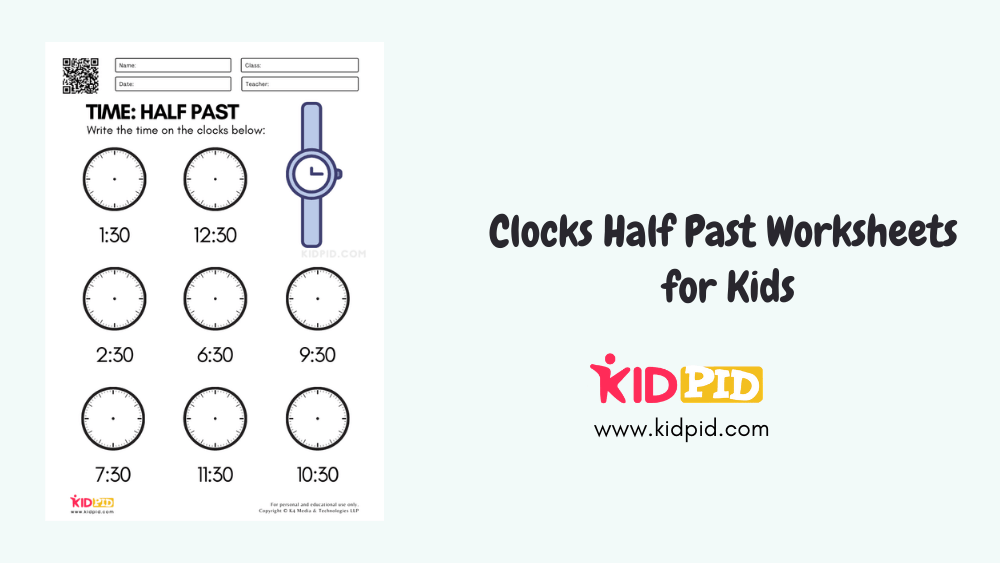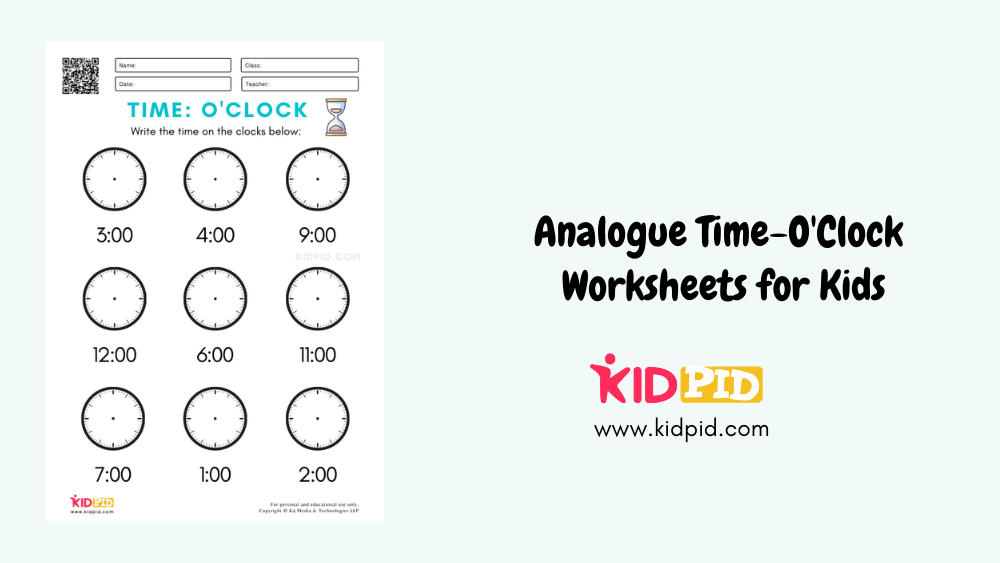
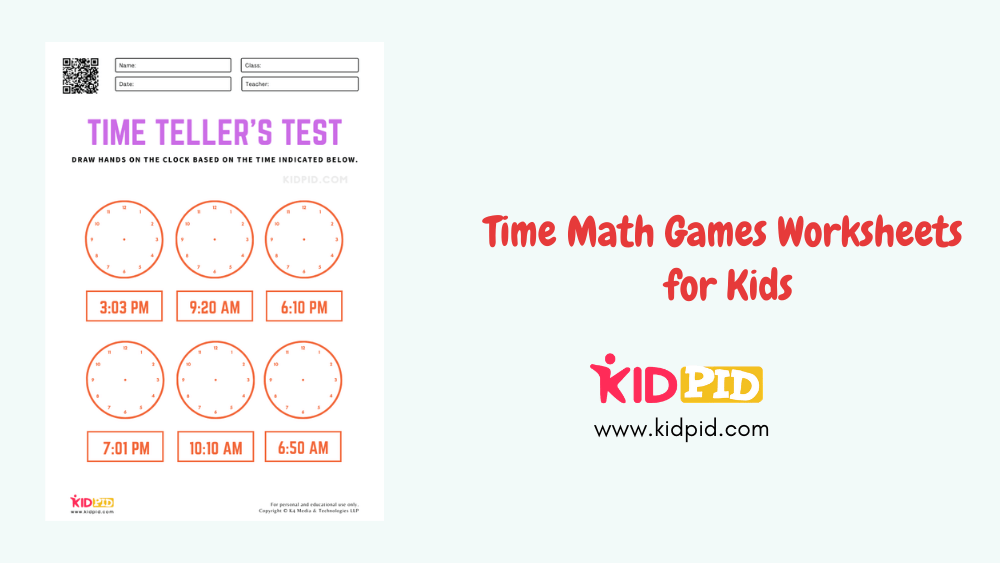
In our lives, time is really important. We may gain experience and improve our abilities through time if we better grasp the time worth. Time can cure things, whether they are external wounds or internal sentiments. Your toddler must draw the hands of the clock according to the time indicated underneath the clock in this worksheet.
Contents
Time Math Practice Worksheets

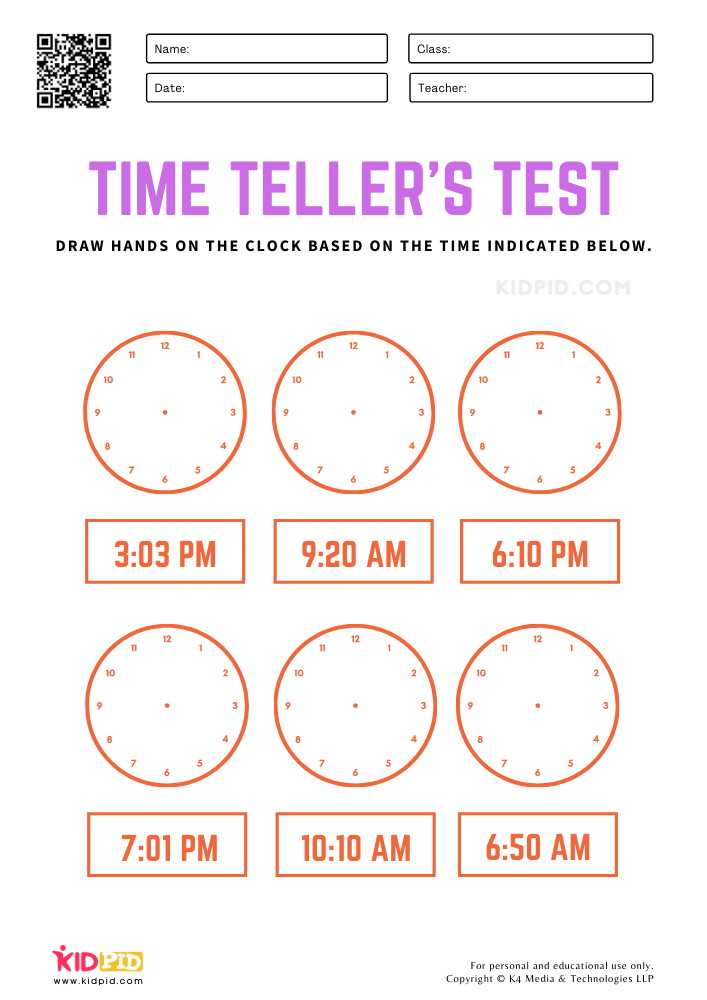
The worksheet is similar to the last one, but it includes a new sum to give your child a broader understanding of the numbers. You may print these worksheets and have your youngster draw the clock hands on them for a clearer perspective.
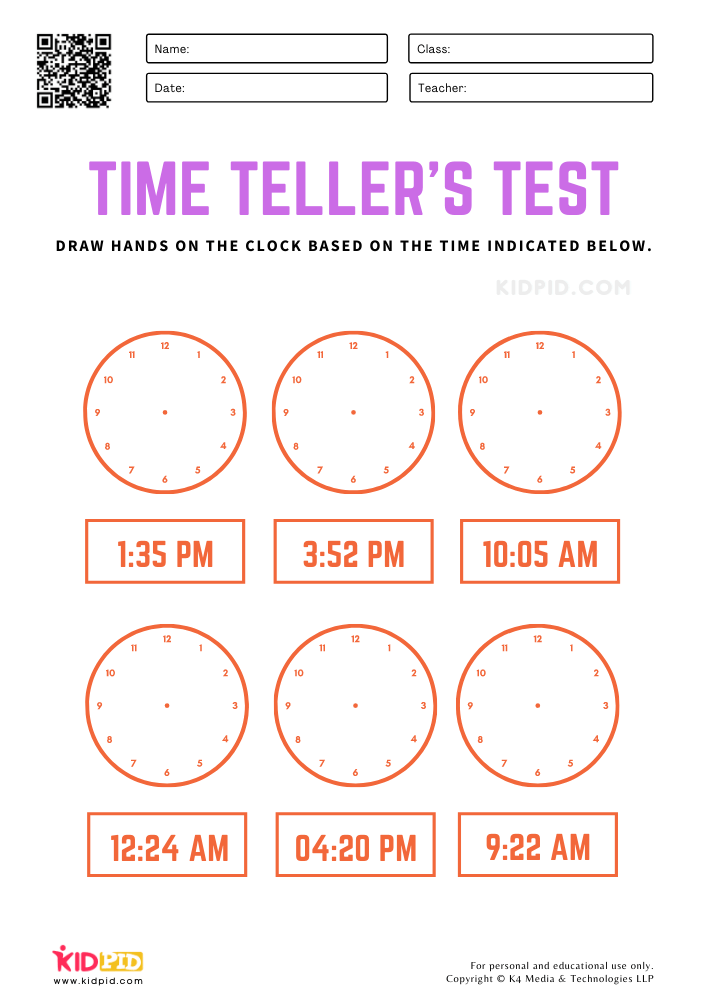
We are conscious of the three stages of time as humans: the past, present, and future. We may learn from the past and prepare for the future, but the present is the only place where we can work. While completing the worksheet, you can help your child grasp the value of time, which will contribute to their knowledge.
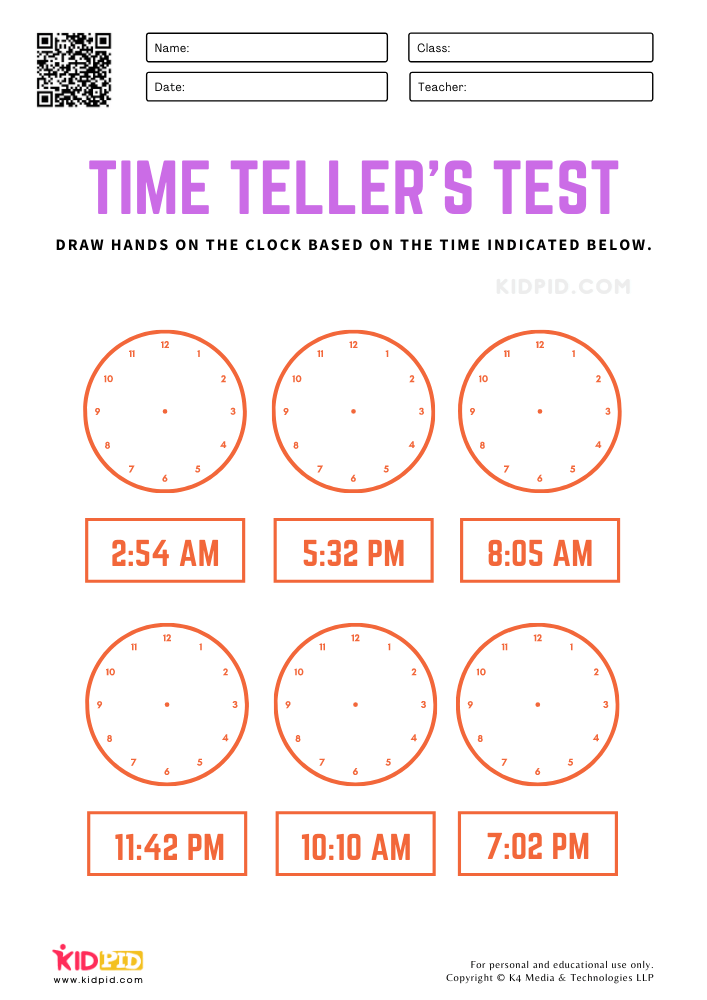
The hour hand, minute hand, and second hand are the three hands that make up a clock. The hour hand is the little hand, and the minute hand is the hand larger than the hour hand. Your youngster will be able to grasp the notion of the hour hand and minute hand to the greatest extent possible.
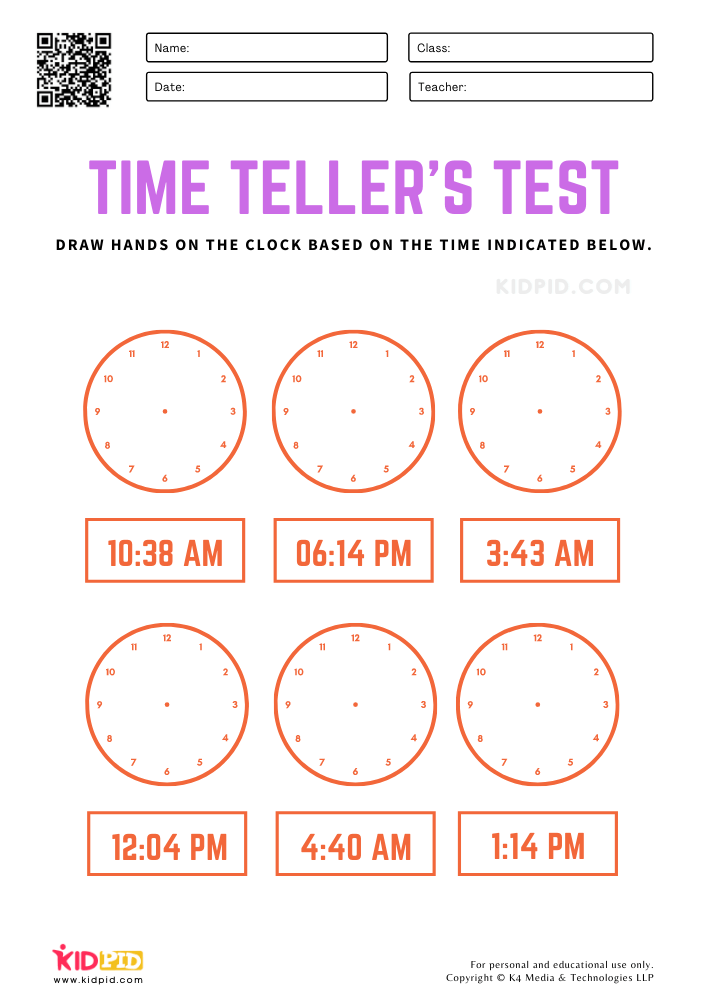
Your youngster will learn how to draw the hands of the clock after completing a large number of worksheets. More worksheets will aid students in honing their abilities and expanding their knowledge. It’s possible to rectify whatever went wrong in the first place. They will pay more attention if they practice and get the right answers, and math may become one of their favorite topics as they become older.
Key Facts About Time Math Games & Worksheets
Learning to tell time is a landmark cognitive milestone for early elementary students. It transitions children from concrete thinking (what they can see right now) to abstract mathematical thinking (intervals, fractions, and spatial math).
- Target Age Group: Best suited for children in Kindergarten through Grade 2 (Ages 5 to 8).
- Core Math Skills: Integrates skip counting by 5s, fractions (halves and quarters), and spatial orientation.
- Dual-Format Visualization: Combines analog clocks (spatial/circular) with digital clocks (numerical/linear).
Parts & Examples of Time Worksheets
To build complete time-literacy, children need to interact with different formats of interactive math activities. A well-rounded curriculum includes three primary worksheet variants:
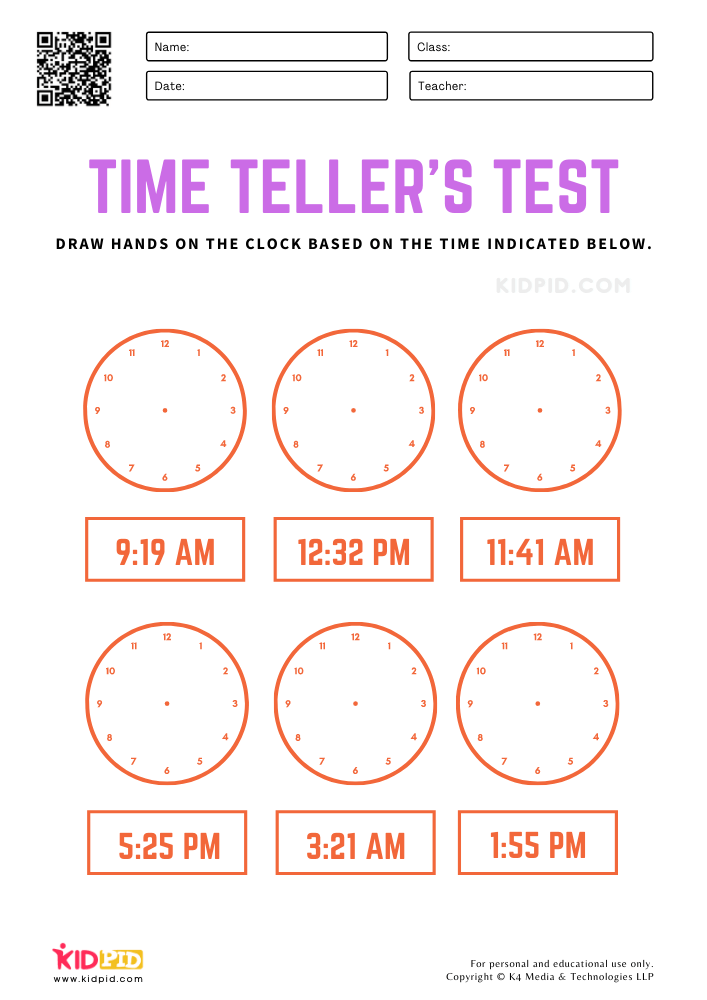
- Draw the Hands: The worksheet provides a digital time readout below a blank clock face. The student must accurately draw the short hour hand and long minute hand.
- Read the Clock: The hands are already printed on the analog face, and children must write out the numerical digital time in an
HH:MMformat. - Matching Games: Draw lines connecting a series of mixed analog faces to their matching digital timestamps or word phrases (like “half past four”).
How Do Time Math Worksheets Work?
These printables turn abstract intervals into physical landmarks. When a child looks at a blank clock template, they are prompted to use visual-spatial reasoning:
- First, they locate the target hour. If the time is 4:00, they must draw a shorter hand pointing directly at the 4.
- Next, they calculate the minute position. They learn that the top of the clock (12) represents zero minutes past the hour.
- By practicing repeatedly across multiple unique printable pages, kids build fine motor skills alongside working memory, transitioning from guessing to instantly recognizing time patterns.
Benefits of Learning About Time
- Promotes Independence: Children who understand time can manage their own daily routines, knowing exactly when recess, lunch, or bedtime arrives without constant parental reminders.
- Reinforces Basic Arithmetic: Telling time is a stealthy way to practice the 5-times table. Counting around the clock face from 1 to 12 teaches children how to group numbers effortlessly.
- Reduces Transition Anxiety: When children can read a clock, warnings like “We are leaving in fifteen minutes” become a measurable concept rather than a stressful surprise.
Learning Objectives
By completing these interactive time math games, students will achieve the following milestones in alignment with early math standards:
- Differentiate between the hour hand (short) and the minute hand (long).
- Read and write time to the nearest hour and half-hour on both analog and digital clocks.
- Demonstrate how to skip-count by 5s around a 12-digit circular perimeter.
Worksheet Instructions
Follow these simple steps to help your learner get the most out of their practice session:
- Gather Supplies: Grab a sharp pencil and a colored pencil or marker.
- Read the Caption: Look closely at the digital timestamp written beneath each blank clock circle.
- Draw the Hour Hand: Draw a short, distinct line starting from the center dot, pointing toward the correct hour number.
- Draw the Minute Hand: Draw a longer line starting from the center dot, extending all the way to the edge mark of the clock. Ensure it looks noticeably longer than your hour hand!
Interesting Facts About Time
- Ancient Sundials: Before modern clocks were invented thousands of years ago, people tracked time by watching how the shadow of a stick moved across the ground as the sun crossed the sky!
- Clockwise Direction: Clocks move to the right because the earliest mechanical clocks were built in the Northern Hemisphere, mimicking the exact path a shadow takes on a northern sundial.
- The Power of 60: We divide hours into 60 minutes because ancient Babylonian mathematicians used a base-60 number system instead of our modern base-10 system!
Vocabulary Words
- Analog Clock: A traditional circular clock that uses moving physical hands pointing to numbers to show the time.
- Digital Clock: A modern display that shows the time using plain numbers separated by a colon.
- Hour Hand: The short, slower-moving hand on a clock face that indicates the current hour.
- Minute Hand: The long, faster-moving hand on a clock face that indicates how many minutes have passed within the hour.
- Interval: A distinct span or block of time between two specific events.
Real-Life Applications
Telling time isn’t just an abstract school subject—it’s used constantly every day!
- Catching the Bus: Knowing when the school bus arrives prevents missing rides in the morning.
- Baking and Cooking: Setting kitchen timers for exactly 20 minutes ensures your favorite cookies bake perfectly without burning.
- Sports & Television: Understanding schedules helps kids tune into their favorite cartoons or make it to soccer practice exactly on time.
FAQs
Q1. At what age should a child learn to tell time?
Answer: Most children begin exploring basic time concepts in Kindergarten (ages 5-6) by learning to identify the hours. By the end of Grade 2 (ages 7-8), they are usually expected to read analog clocks down to 5-minute increments.
Q2. Why do kids find analog clocks harder than digital clocks?
Answer: Digital clocks do the translating work for you by displaying raw numbers. Analog clocks require spatial decoding; a child has to understand that the number “3” actually means “15 minutes” when the long hand is pointing at it. This layer of abstraction takes consistent, focused practice to master.
Q3. How can I make practicing math fun at home?
Answer: Combine these worksheets with an adjustable toy clock! Let your child physically spin plastic gears to match the times written on the page, or build a giant paper-plate clock together using brass brads for movable hands.
Time Math Games Worksheets help children understand clocks, time concepts, and daily schedules through fun, hands-on activities. Kids strengthen time-telling, problem-solving, logical thinking, and confidence while enjoying interactive learning that is perfect for classrooms, homeschooling, and independent practice. Looking for more educational activities? Browse our website for worksheets, flashcards, essays, Quizzes, paragraphs, and exciting learning materials. Don’t miss our latest updates on YouTube and Facebook.
Hope you liked these worksheets. Please visit our other worksheets to make learning more interactive and fun.
This worksheet was crafted by the Content Team to improve learning advancement.
Reviewed By Swati
Read More: