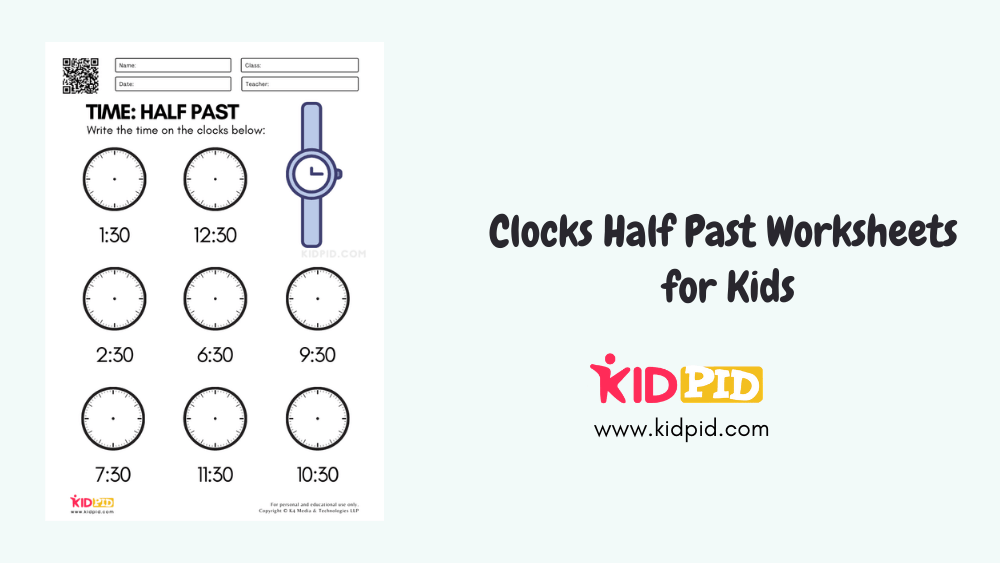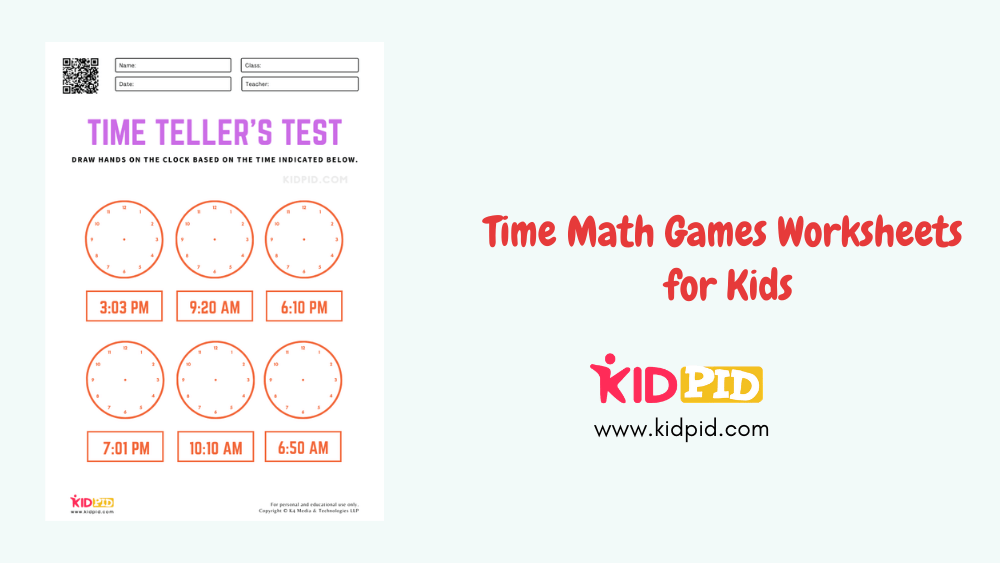
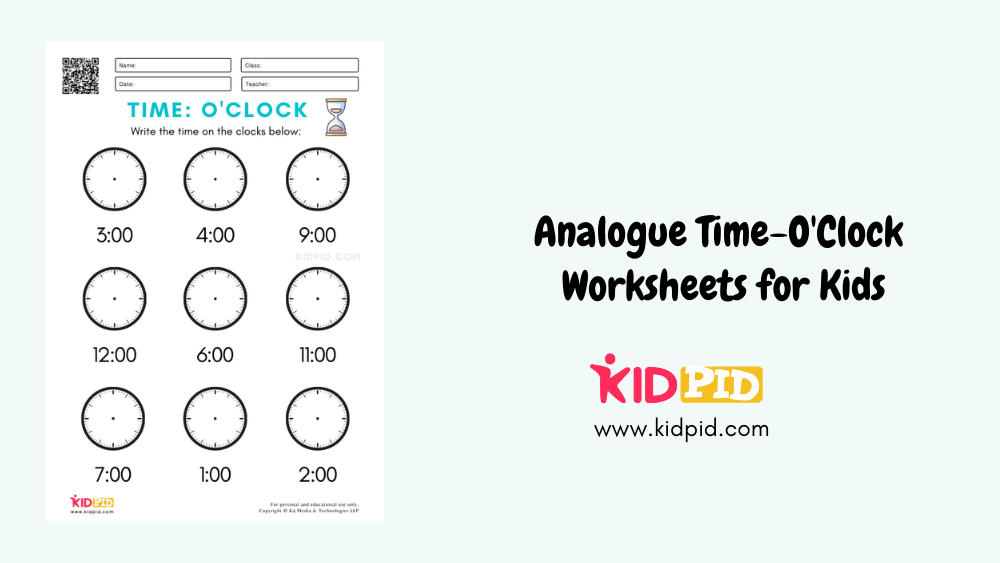
Here’s an edition where we are providing two worksheets to enrich your kids’ brains by developing and improving their basic skills. Nowadays, in the modern world, it is very important to help children introduce the basic concepts of analogue time, so that they can develop their intellectual abilities. Kids develop the strength to understand any concept by the primary tone or sound of the topic, and then move to learn the sound and articulation of the entire thing.
Contents
- Analogue Time Practice Worksheets
- Key Facts About Analogue Time & O’Clock Worksheets
- Parts, Types, and Examples of Analogue Clocks
- How Does an Analogue Clock Work?
- Benefits of Learning About Analogue Time
- Learning Objectives
- Worksheet Instructions
- Interesting Facts About Clocks & Time
- Vocabulary Words
- Real-Life Applications
- FAQs
- Read More:
Analogue Time Practice Worksheets

The first worksheet asks the kid to write the time on the clocks given below. For example, for 3:00, the hour hand would be at 3 and the minute hand at 12. As parents, the kid needs to be looked at, so this is a basic level worksheet that leads the kid if they make a mistake.
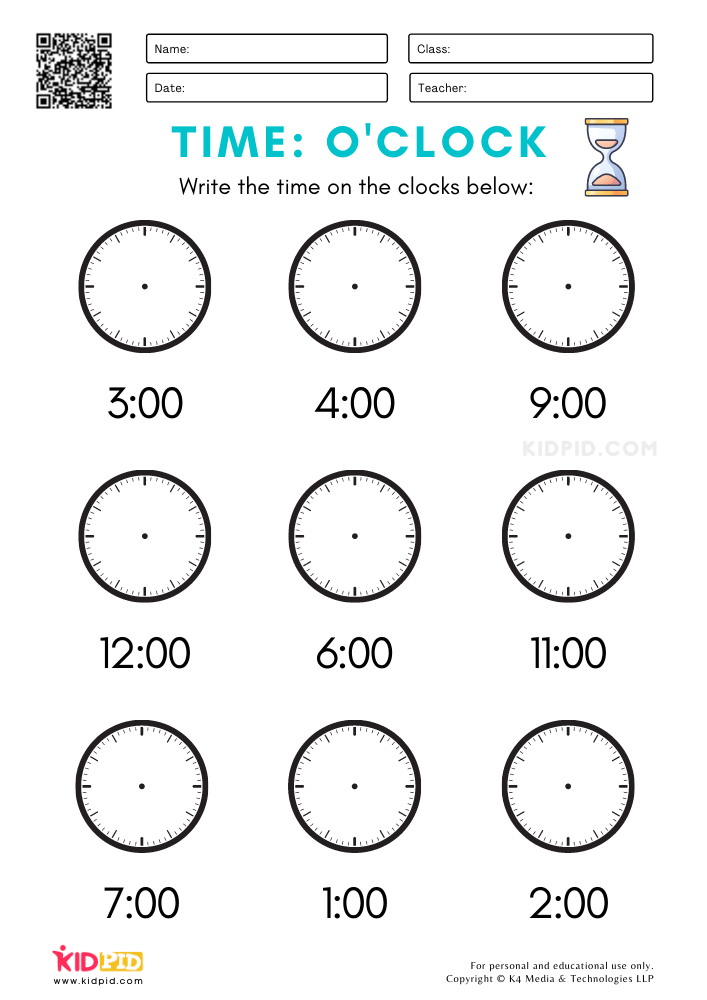
The second worksheet has set out the task for the kid to write the time on the clocks below. This will help them learn new items according to the requirements of the worksheet that makes up the clock, and thereby help them understand how to use them correctly.
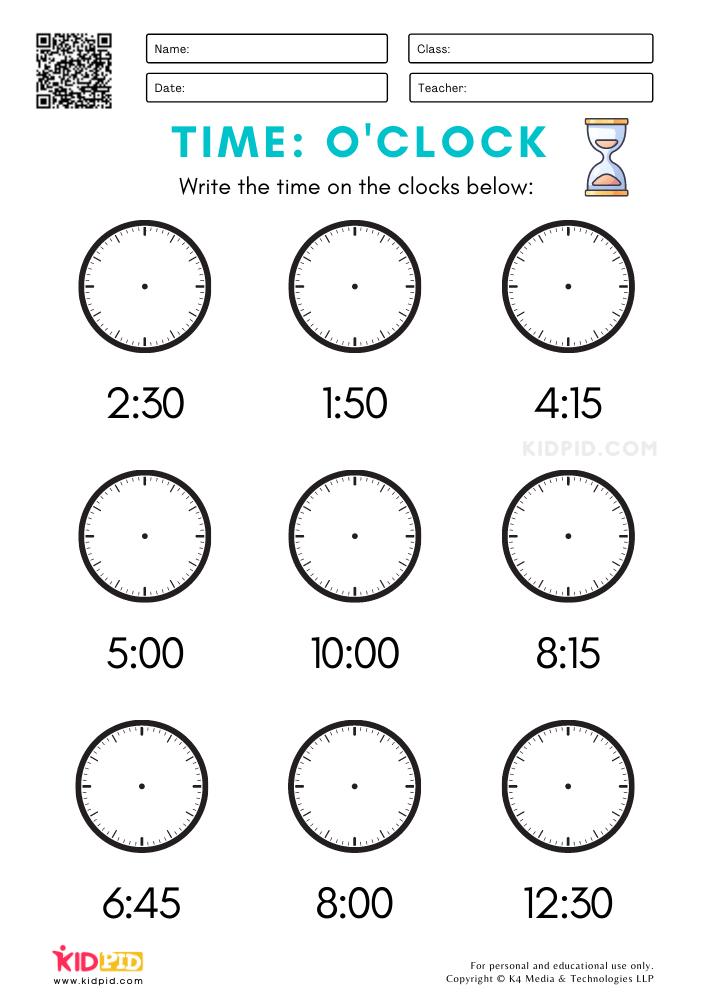
The third worksheet is the same as the first two. Make sure the kid properly places the hour and the minute hand. It is important to make sure that children keep themselves engaged in the worksheets and do not lose their attention. There is one certainty: the kid will not get bored in these Time O’Clock exercises.
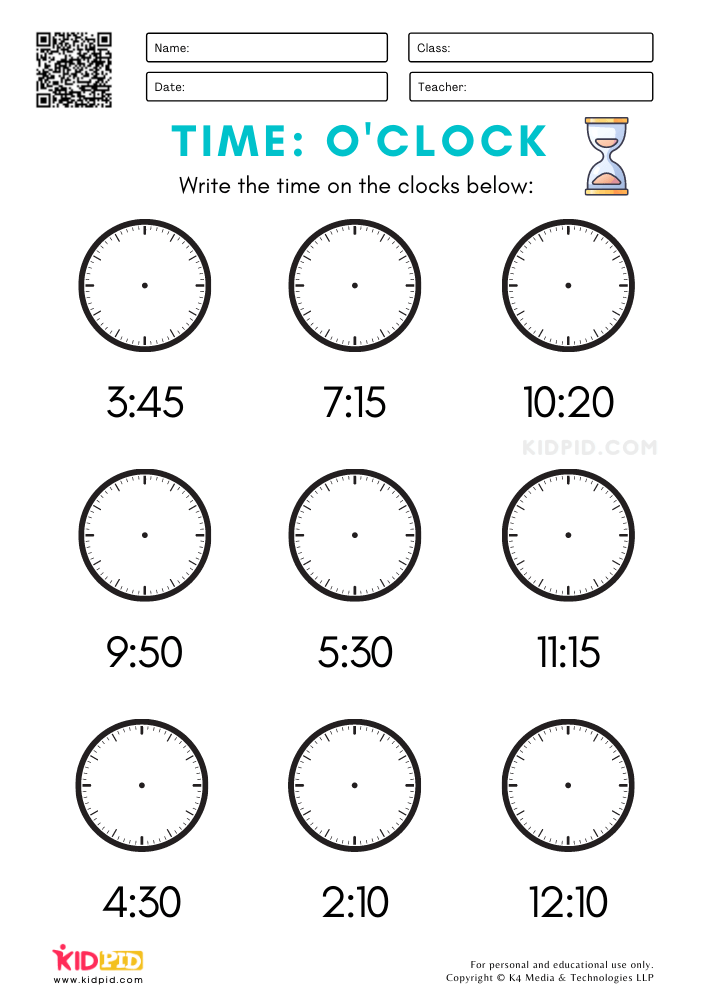
The fourth worksheet asks the kid to write the time on the clocks given below. This becomes easy for the kids after finishing the above worksheet. These are pretty common objects that a kid will understand with ease, and the kids will also become aware of their surroundings with the help of such worksheets.
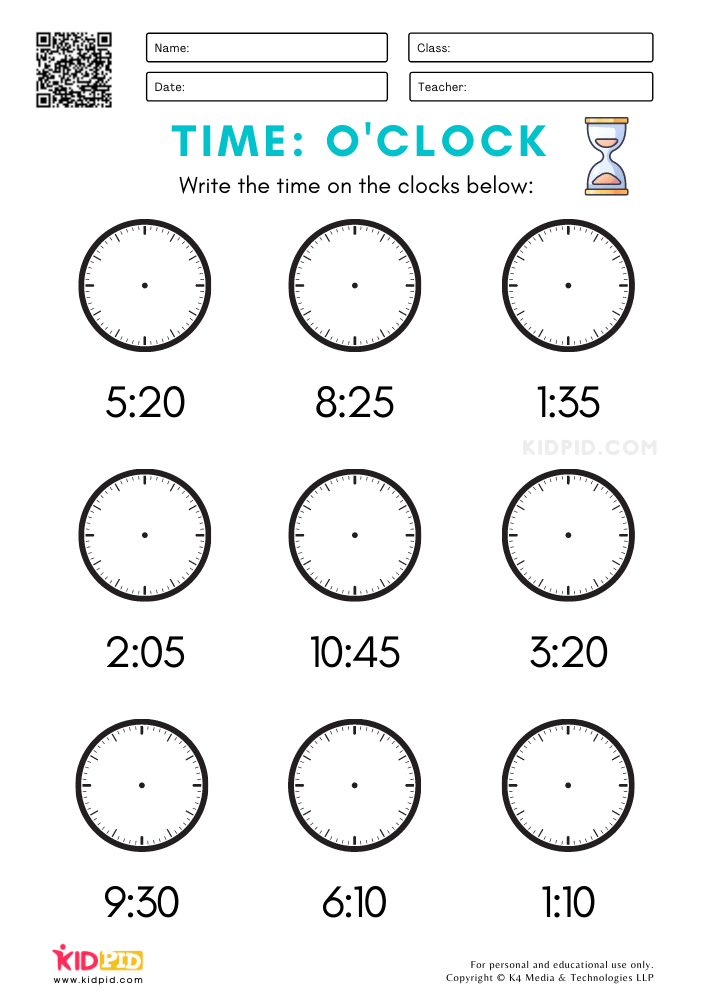
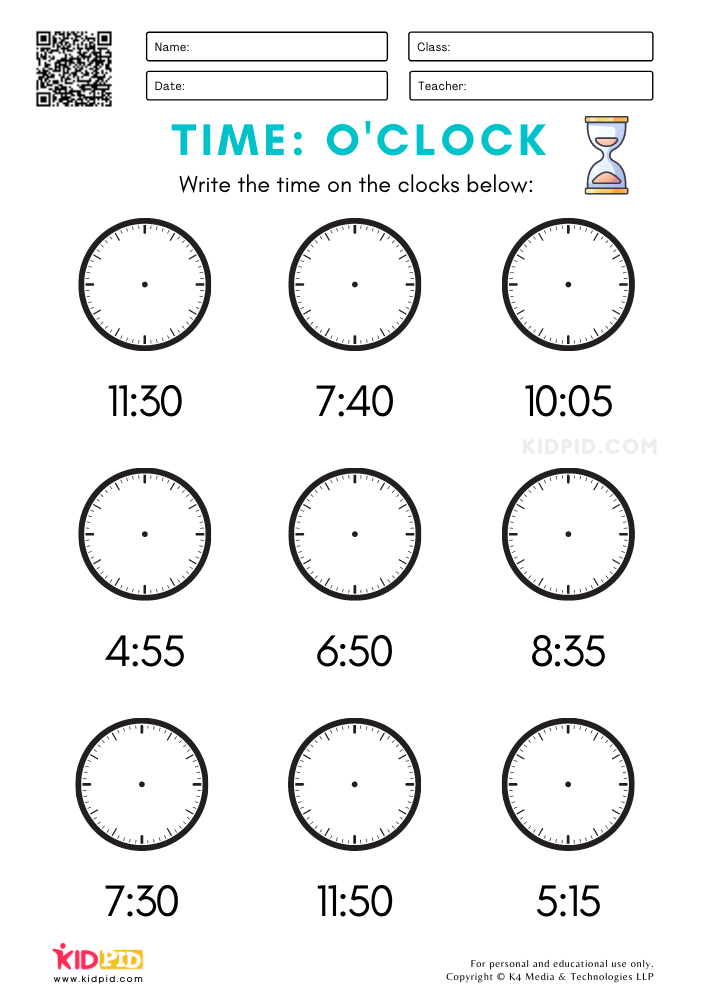
This is the final worksheet; the parents can even get a printout of the worksheet if their child needs some more preparation. It is quite simple to do, and the child should not face any difficulty while solving this, but if they do, the child’s queries need to be answered.
Key Facts About Analogue Time & O’Clock Worksheets
- Foundational Early Math: Learning to read an analogue clock is a critical milestone usually introduced in Kindergarten and mastered in 1st and 2nd Grade.
- The “O’Clock” Milestone: The term “o’clock” is a contraction of the historic phrase “of the clock.” It represents a precise, whole hour with zero remaining minutes (e.g., 4:00).
- Dual-Hand Tracking: Analogue clocks require children to track two moving objects (hands) simultaneously, which rotate at vastly different speeds.
- Visualizing Fractions: Before kids explicitly learn fractions in math class, o’clock worksheets introduce them to the concept of a “whole” circle being divided into segments.
Parts, Types, and Examples of Analogue Clocks
Parts of an Analogue Clock
To complete these worksheets, children must be able to identify three core parts of a traditional clock:
- The Clock Face (Dial): The circular surface displaying the numbers 1 through 12 arranged sequentially.
- The Hour Hand (Short Hand): The thicker, shorter pointer that tells us which hour of the day it is. It moves slowly, completing one full rotation every 12 hours.
- The Minute Hand (Long Hand): The thinner, longer pointer that tracks passing minutes. It moves faster, completing a full rotation every 60 minutes.
Types of Clock Formats Found in Worksheets
- Analogue Format: Time displayed using rotating hands on a numbered dial (e.g., pointing straight up at 12 and horizontally at 3).
- Digital Format: Time displayed using numerical digits separated by a colon (e.g., 3:00).
Examples of O’Clock Times
- 3:00 (Three O’Clock): Minute hand points directly at 12; hour hand points directly at 3.
- 6:00 (Six O’Clock): Minute hand points directly at 12; hour hand points directly down at 6 (forming a straight vertical line).
- 12:00 (Twelve O’Clock): Both the minute hand and the hour hand overlap perfectly, pointing straight up at 12.
How Does an Analogue Clock Work?
An analogue clock breaks down a 24-hour day into two 12-hour cycles (AM and PM). The mechanics rely on a constant ratio: 1 hour equals 60 minutes.
When teaching children how a clock functions for “o’clock” times, explain that the minute hand acts as a reset trigger. Every time the long minute hand finishes its full lap around the clock and lands directly on the number 12, it has completed 60 minutes. At that exact moment, the time is a fresh hour, or “o’clock.” Wherever the short hour hand is pointing at that exact second tells you the name of the hour (such as 1 o’clock, 2 o’clock, or 5 o’clock).
Benefits of Learning About Analogue Time
While digital clocks are everywhere today, practicing with analogue time worksheets offers irreplaceable developmental benefits for young learners:
- Develops Spatial Awareness: Children visualize time as a physical distance traveled across a circle, rather than just abstract changing numbers on a digital screen.
- Reinforces Number Sense & Sequencing: Tracking numbers 1 through 12 sequentially around a dial strengthens early number recognition and counting loops.
- Builds Cognitive Focus: Matching the visual pointers of a physical clock to numerical time builds strong visual-spatial processing and problem-solving skills.
- Prepares for Complex Math: O’clock is the stepping stone. Mastering it paves the way for understanding skip-counting by 5s (minutes), intervals, fractions (half-past, quarter-to), and elapsed time.
Learning Objectives
By completing these Kidpid printable math worksheets, students will achieve the following academic benchmarks:
- Identify the distinct functions of the short hour hand and the long minute hand.
- Recognize that when the minute hand points directly to the 12, the time represents a whole hour (“o’clock”).
- Read an analogue clock face displaying a whole hour and accurately translate it into written digital time (e.g., 8:00).
- Demonstrate fine motor control by accurately drawing hour and minute hands onto blank clock faces to match a given time.
Worksheet Instructions
Parents and educators can read these simple, step-by-step instructions aloud to guide children through each printable activity page:
- Look closely at the clock face. Find the long hand (the minute hand) and the short hand (the hour hand).
- Check the minute hand first. For these worksheets, notice how the big, long hand is always pointing straight up at the 12. This means it is an “O’Clock” time!
- Look at the short hour hand. See which number the little hand is pointing toward.
- Write the time. In the blank box below the clock, write the number the short hand is pointing to, followed by a colon and two zeros. (For example, if the short hand points to 4, write 4:00).
Interesting Facts About Clocks & Time
- Why do clocks run clockwise? Early mechanical clocks were invented in the Northern Hemisphere and designed to mimic the path of a shadow moving across a traditional outdoor sundial!
- The “Of the Clock” History: Hundreds of years ago, people used sundials, stars, and church bells to tell time. To clarify that they were reading a precise mechanical clock, they would say “It is 4 o’clock,” which eventually shortened over the centuries to “4 o’clock.”
- Clocks are Hidden Number Lines: An analogue clock face is simply a 60-point number line bent perfectly into a circle to save space!
Vocabulary Words
- Analogue Clock: A clock that displays time continuously using moving hands pointing to numbers on a circular dial.
- Digital Clock: A clock that displays time using flat digits and numbers instead of hands.
- O’Clock: A phrase used to show that a precise, whole hour has been reached, with no extra minutes passed.
- Hour Hand: The short, slower hand on a clock that tells the current hour.
- Minute Hand: The long, faster hand on a clock that tells how many minutes have passed in the hour.
- Dial: The decorated, numbered face of an analogue clock.
Real-Life Applications
Learning to tell time isn’t just for math class—it connects children directly to the rhythm of their daily lives:
- Daily Routines: Helps kids understand and anticipate their own schedules, such as knowing that school starts at 8:00 AM, lunch is at 12:00 PM, and bedtime is at 8:00 PM.
- Time Management: Teaches children patience and awareness by helping them conceptualize how long an hour actually lasts while waiting for an event.
- Reading Public Clocks: Empowers kids to confidently read traditional wall clocks at school, in libraries, in train stations, and on public buildings without needing a smartphone.
FAQs
Q1. At what age should a child learn to tell time on an analogue clock?
Answer: Children usually start learning the basics of telling time—specifically identifying the clock hands and reading whole hours (o’clock)—between the ages of 5 and 7 (Kindergarten to 1st Grade).
Q2. Why should my child learn analogue time if digital clocks are everywhere?
Answer: Digital clocks only tell a child what time it is right now. Analogue clocks give children a visual map of time, helping them see the relationship between hours and minutes, understand fractions of an hour, and visually conceptualize how much time is left before an activity.
Q3. How can I help my child if they keep confusing the hour and minute hands?
Answer: A great hands-on trick is to color-code a practice clock. Trace the short hour hand in blue and color-code the hour numbers on the dial in blue. Then, trace the long minute hand in red. This physical, visual association makes it much easier for young brains to differentiate their paths.
Q4. What should we learn after mastering these “O’Clock” worksheets?
Answer: Once your child can easily recognize and write whole hours, the next natural step is learning “Half-Past” the hour (e.g., 1:30 or 2:30), where the minute hand points halfway around the circle to the 6, followed by counting intervals of 5 minutes.
We try to bring different worksheets every time just to bring modifications in the learning process of the child. This is all a kid needs in his early days before going to school. It will also encourage them to complete the course of simple Time O’Clock in a very simple way. So, give your best to make your kid smart by not letting him get dull or bored. Find everything your child needs to learn and grow, including worksheets, paragraphs, essays, flashcards, Quizzes, and engaging educational resources. Follow us for more learning fun on YouTube & Facebook.
The Content Team prepared this worksheet to promote academic growth.
Reviewed By Sushmita
Read More: