Good Day to all our readers! In this edition, we have brought some of the worksheets relating to Two-Digit Multiplication. These worksheets will assist and encourage your child in developing and brushing their basic calculation skills.
In this hectic and filled with a worried world, it is essential to help kids understand the basics of counting, and furthermore, they can be well equipped for their early school days.
Contents
- Two-Digit Multiplication Practice Worksheets
- Key Facts About KidPid’s Two-Digit Multiplication Worksheets
- Parts, Types, and Examples of Two-Digit Multiplication
- How Does Two-Digit Multiplication Work?
- Benefits of Learning Two-Digit Multiplication
- Learning Objectives & Worksheet Instructions
- Interesting Facts About Multiplication
- Vocabulary Words
- Real-Life Applications
- Frequently Asked Questions (FAQ)
- Q1. At what grade should a child start learning two-digit multiplication?
- Q2. My child keeps forgetting to add the placeholder zero. How can I help them remember?
- Q3. Should my child master single-digit times tables before moving to two-digit numbers?
- Q4. Can I print these KidPid worksheets out for a classroom setting?
- Read More:
Two-Digit Multiplication Practice Worksheets

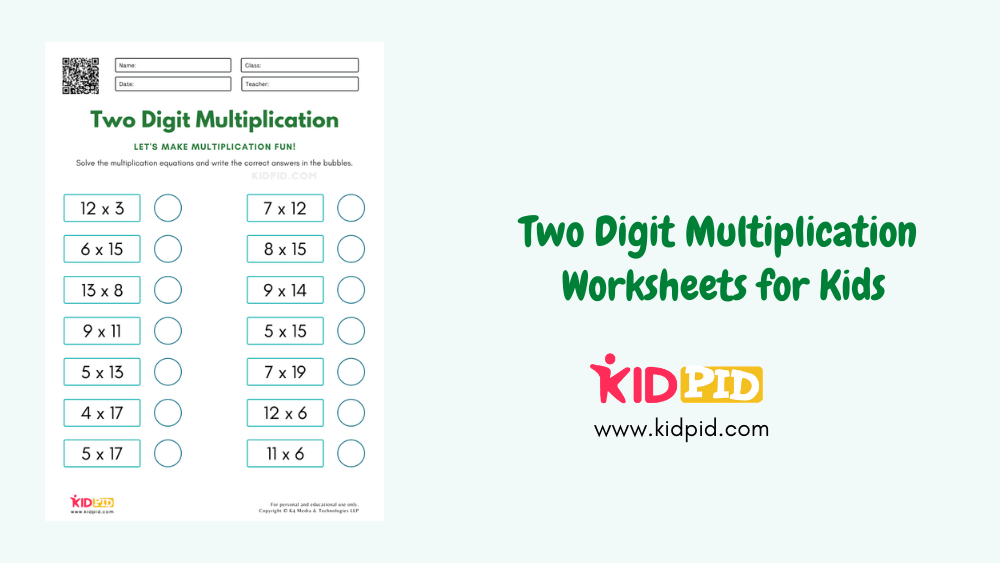
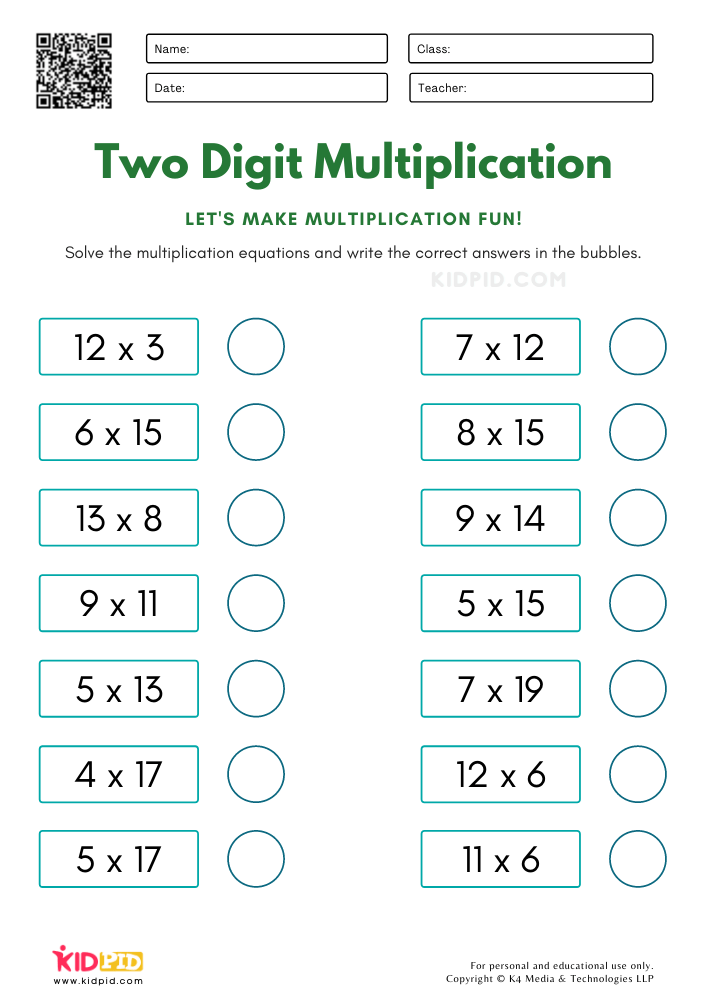
The first worksheet asks the child to solve the multiplication equations and write the correct answers in the bubbles. For example, 12 * 3 = 36. Nowadays, in the modern world, it is very important to help children introduce the basic concepts of addition, subtraction, and multiplication so that they can develop their intellectual abilities.
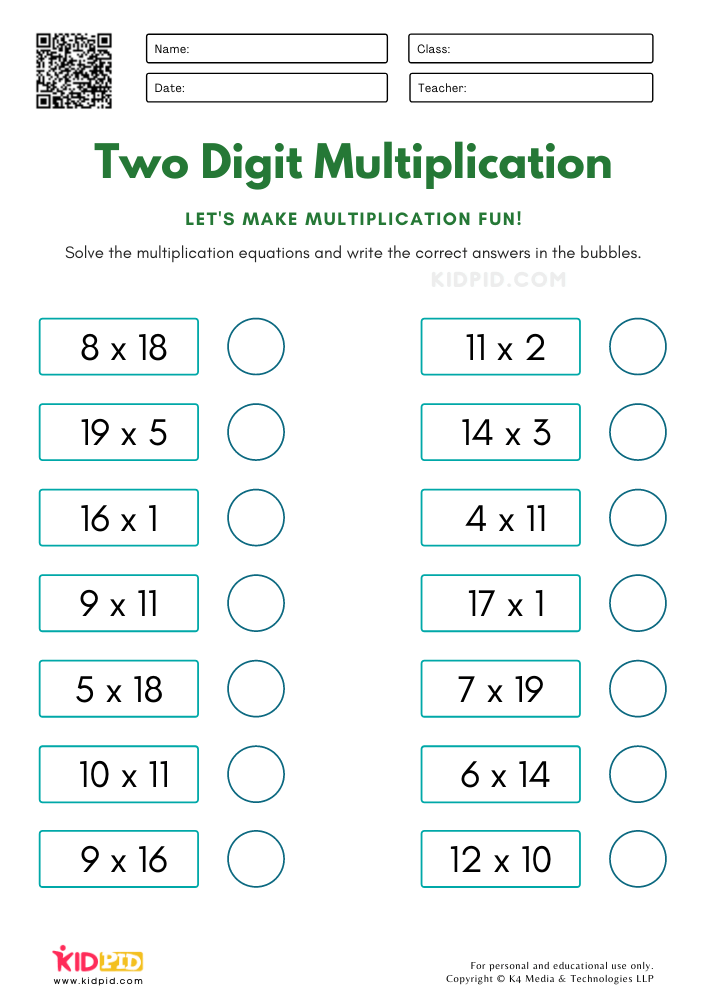
The second worksheet is the same as the first one. For example- 8*18= 144. You can begin with this worksheet if your child is a freshman or a beginner, and you can manage them wherever they do something wrong or get into any difficulty. To clear the basics for a child is very important.
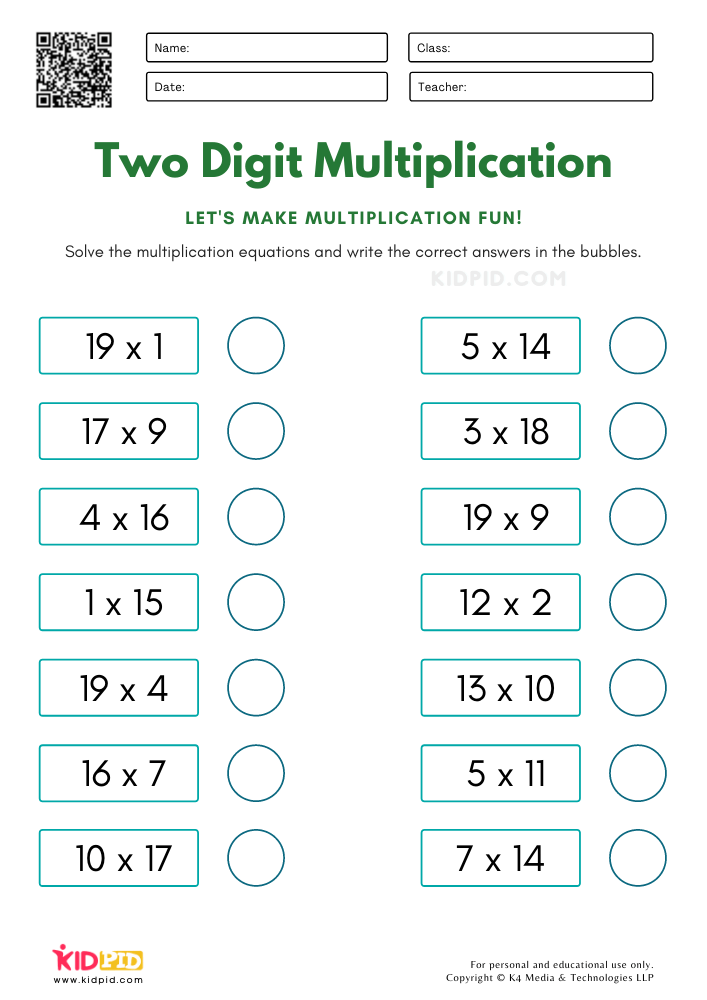
The third worksheet asks the child to solve the multiplication equations and write the correct answers. These worksheets can be used to improve the awareness and intellectual ability of your kid. You can have this worksheet printed out if your child requires some more exercise.
The fourth worksheet also tries to make multiplication fun. It is very simple to do, and your child should not face any obstacles while doing this. Make sure you disclose to them everything necessary and help them with where they are going wrong.
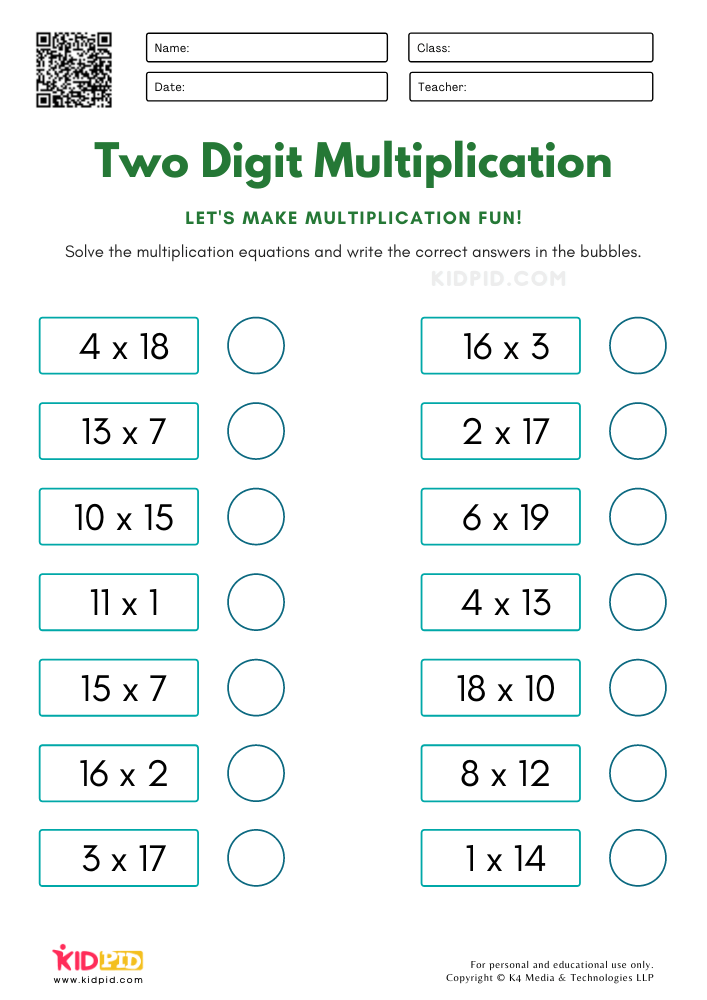
The next worksheet embraces the multiplication portion, really considerably too. The multiplication questions also help children to understand the relationships between different numbers and learn how they are related to each other.
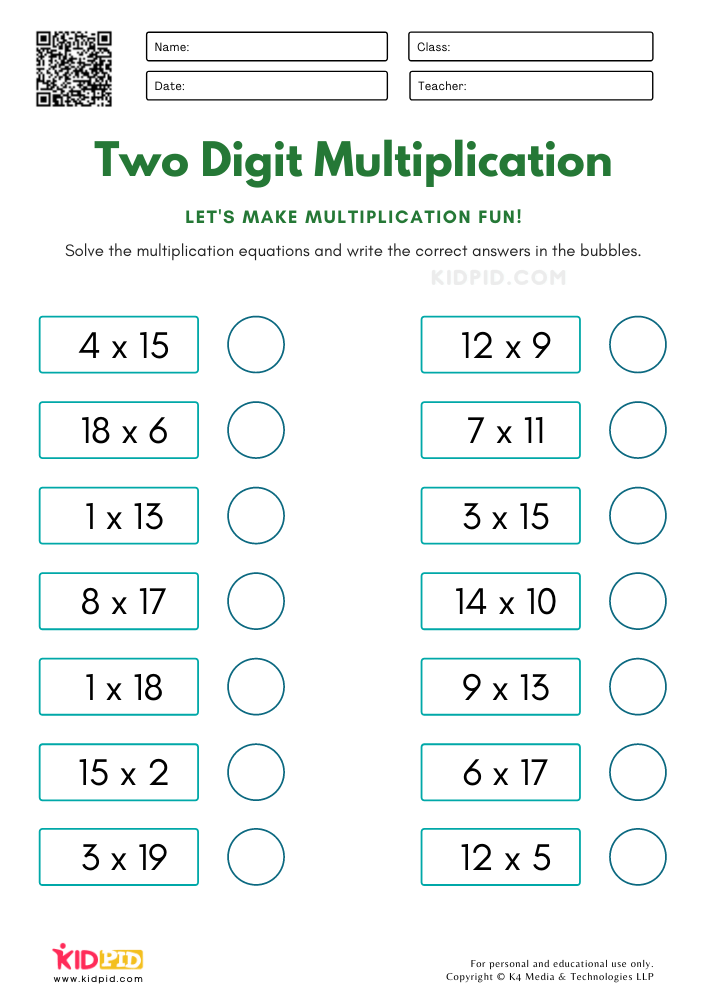
Teachers in school use various learning tactics to help children learn about multiplication concepts and provide fabrication. A requirement for excelling in primary mathematics questions and beyond.
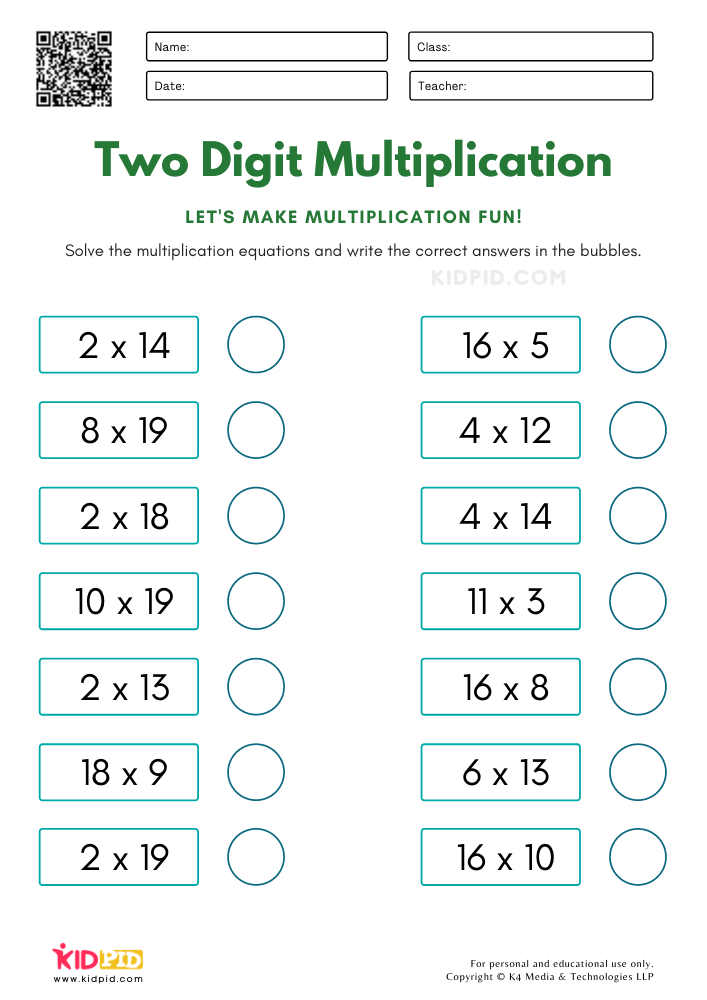
After completing the above worksheets, it will become very easy for the child to solve the remaining questions. It will be extremely effective in developing their education, and they can do this without feeling fatigued. This is all a kid needs in his early days before going to school.
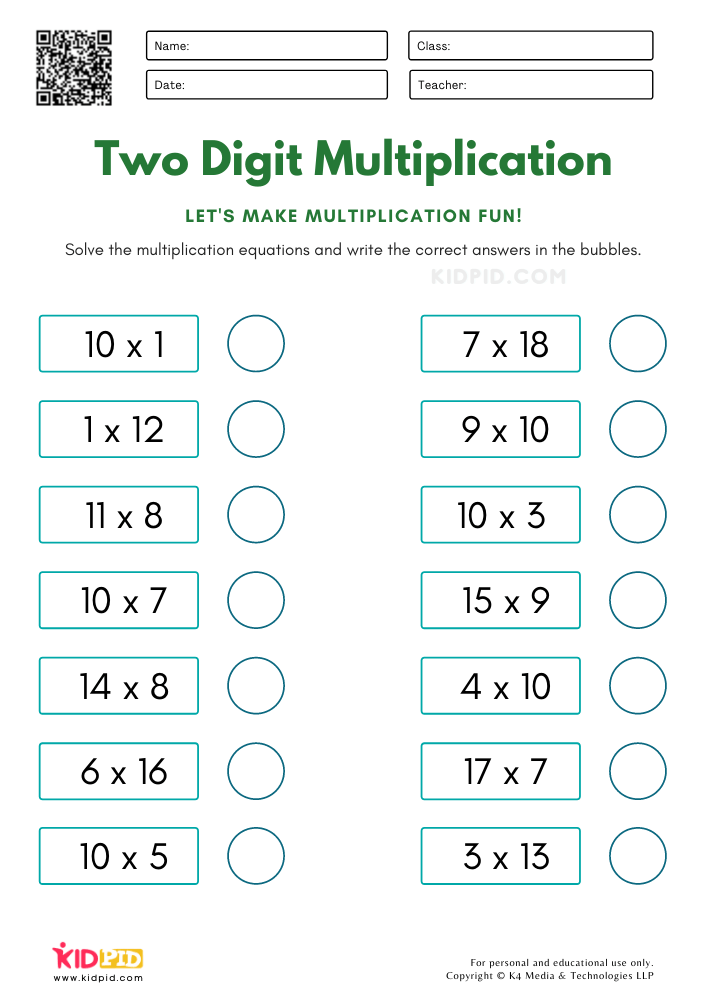
Key Facts About KidPid’s Two-Digit Multiplication Worksheets
To master advanced mathematics, young learners must build a bridge between simple single-digit facts and multi-step algorithms. KidPid’s curated printable resources are purposefully engineered to scaffold this exact transition.
- Target Age Demographics: Perfectly aligned for children in Grade 2 (advanced), Grade 3, and Grade 4 who are comfortable with standard 0–10 times tables.
- Curriculum Alignment: Designed to reinforce the Common Core State Standards (CCSS) for Operations and Algebraic Thinking (specifically standards like 3.OA.C.7 and 4.NBT.B.5).
- Cognitive Scaffolding: Worksheets transition sequentially from basic equations with bubble-answer guides to independent long-multiplication grids.
- Pedagogical Structure: Features a blend of mental math challenges, traditional vertical algorithms, and visually engaging formats that prevent math anxiety and cognitive fatigue.
Parts, Types, and Examples of Two-Digit Multiplication
Multiplication at this level isn’t a one-size-fits-all process. Children learn differently, which is why these worksheets touch upon various structures of multi-digit arithmetic.
1. Types of Math Problems Found in the Worksheets
- Two-Digit by One-Digit ($18 \times 8$): The critical starting milestone where a child practices carrying over (regrouping) tens into the next column for the first time.
- Two-Digit by Two-Digit ($12 \times 34$): The complete long-multiplication process involving partial products and placeholder zeros.
- Double-Digit Multiples of Ten ($20 \times 30$): Mental math boosters that teach kids the “zero trick” (multiplying the base digits and appending the total number of zeros).
2. Core Components of a Two-Digit Equation
Every multiplication problem is broken down into distinct mathematical components that children must identify:
How Does Two-Digit Multiplication Work?
Multiplication is ultimately just accelerated, repeated addition. When a child graduates to two-digit numbers, they use an algorithm to break a large, intimidating problem down into smaller, bite-sized single-digit calculations.
The traditional method relies entirely on the concept of place value (understanding the difference between the ones place and the tens place) and partial products.
The Step-by-Step Long Multiplication Process
When solving a problem like $34 \times 12$:
- Multiply by the Ones: First, multiply the top number ($34$) by the digit in the ones place of the bottom number ($2$). This gives you your first partial product ($68$).
- Add the Placeholder Zero: Before multiplying by the tens digit, place a zero
0in the ones column of the next row. This is vital because you are actually multiplying by $10$, not $1$. - Multiply by the Tens: Multiply the top number ($34$) by the digit in the tens place of the bottom number ($1$). This gives you your second partial product ($340$).
- Sum it Up: Add the two partial products together ($68 + 340$) to find the definitive final product: $408$.
To help your child see exactly how these numbers split and recombine, you can use the interactive area model explorer below to visualize the mechanics behind the math.
Benefits of Learning Two-Digit Multiplication
Mastering multi-digit multiplication acts as a gateway skill in a child’s mathematical development. It serves as the foundational cornerstone for several advanced topics:
- Boosts Working Memory: Executing the multi-step algorithm trains a child’s mind to retain data while processing a secondary task (holding carried-over numbers in mind while multiplying).
- Develops Place Value Competency: It transitions place value from an abstract concept into an essential, practical tool for problem-solving.
- Prepares for Advanced Math: Without a fluid, automatic understanding of two-digit multiplication, children will face steep hurdles when introduced to long division, fractions, percentages, pre-algebra, and calculating geometric area.
Learning Objectives & Worksheet Instructions
To maximize the utility of these printables, educators and parents can target specific benchmarks while utilizing clear framing for the student.
Core Learning Objectives
- Accuracy: The student will accurately compute products of two-digit numbers with an accuracy rate of 80% or higher.
- Procedural Fluency: The student will demonstrate an understanding of when and where to apply regrouping (carrying) and placeholder digits.
- Self-Correction: The student will develop the ability to spot calculation errors by cross-checking their steps.
Worksheet Instructions for Kids
- Prepare Your Workspace: Grab a sharp pencil and an eraser. Space out your work so you can clearly write small numbers above the equations when carrying over.
- Solve Methodically: Start from the right side (ones column) and work your way left.
- Double-Check Your Bubble: If your worksheet has bubbles at the bottom, solve the equation on paper first, then see if your final answer matches one of the provided options!
- Take Your Time: Speed comes with practice. Focus on getting the steps right before trying to finish quickly.
Interesting Facts About Multiplication
- The Ancient Egyptian Way: Ancient Egyptians didn’t memorize times tables! They solved large multiplication problems using a unique system of doubling numbers and adding them together.
- The “Zero” Magic: The placeholder zero used in long multiplication is one of the most powerful inventions in human history. Without a symbol for “nothing,” tracking large columns of numbers would be impossible.
- Brain Architecture: Neuroscientific studies show that as children practice multiplication, their brains shift processing tasks from the effort-heavy prefrontal cortex to the language and memory regions of the parietal lobe—meaning math literally becomes a native language.
Vocabulary Words
| Term | Definition |
|---|---|
| Multiplicand | The top number in a multiplication problem; the quantity that is being scaled or repeated. |
| Multiplier | The bottom number indicates how many times the multiplicand is to be multiplied. |
| Product | The final result or answer obtained by multiplying two or more numbers together. |
| Partial Product | The temporary result obtained when multiplying a multiplicand by an individual digit of a multi-digit multiplier. |
| Regrouping | The process of turning a value into a higher place-value column (commonly called “carrying over”). |
Real-Life Applications
Math is not confined to the classroom. Show your child why these worksheets matter by pointing out how adults use two-digit multiplication every single day:
- Budgeting and Shopping: “If a monthly streaming subscription costs $15, how much will it cost for a full year (12 months)?” ($15 \times 12 = \$180$).
- Event Planning: “We are setting up an auditorium with 15 rows of chairs, and each row has 24 seats. How many people can attend the school play?” ($24 \times 15 = 360$ seats).
- Time Management: Tracking habits or screen time across weeks. “If you practice piano for 45 minutes every single week, how many minutes will you practice over a 12-week semester?” ($45 \times 12 = 540$ minutes).
Frequently Asked Questions (FAQ)
Q1. At what grade should a child start learning two-digit multiplication?
Answer: Most children are introduced to basic two-digit by one-digit multiplication in late 2nd Grade or early 3rd Grade. Complete two-digit by two-digit long multiplication is typically a core focus of the 4th Grade curriculum.
Q2. My child keeps forgetting to add the placeholder zero. How can I help them remember?
Answer: This is the single most common mistake young learners make! Try having them draw a tiny, smiling “happy face” or place a brightly colored sticker in the ones column of the second row before they multiply the tens digit. Framing it as a vital “shield” that protects the place value column can turn it into a fun, memorable habit.
Q3. Should my child master single-digit times tables before moving to two-digit numbers?
Answer: Yes. Fluidity in single-digit multiplication ($0 \times 0$ through $9 \times 9$) is vital. If a child has to pause to calculate $6 \times 7$ in the middle of a complex, long multiplication problem, their working memory becomes overloaded, making procedural mistakes much more likely to happen.
Q4. Can I print these KidPid worksheets out for a classroom setting?
Answer: Absolutely! KidPid’s worksheets are specifically designed as free, high-quality printables meant for home practice, homeschooling environments, and standard elementary classroom resource packets.
The worksheet is developed by the Content Team to improve academic performance.
Reviewed By Gargy
Read More: