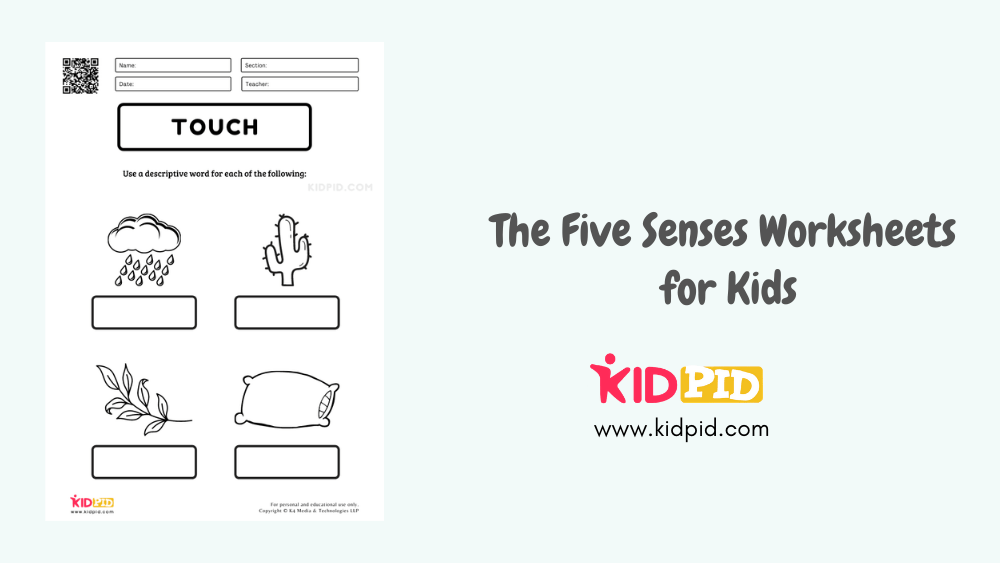
Let’s take a look at some fun and exciting worksheets that will teach your child the basic concept of senses. Human beings have five senses, and they are as follows –
- Touch
- Smell
- Taste
- See
- Hear
We are all using these senses at all times without even realising it. Imagine going outside for a walk- you can feel the cool breeze against your face and hear the sound of traffic and people’s voices. You buy ice cream and immediately feel a cold sensation as you take it in your hand; you can smell the sweet chocolate and taste the delicious flavour as you take a bite.
During these activities, you used all five of your senses. Now, young children need to understand the five senses to express themselves. These worksheets aim at doing just that – there is one worksheet for each sense, and the task is to understand the feeling depicted in each picture and write it down in the provided boxes. So, let’s get started!
Contents
- Five Senses Worksheets
- Key Facts About The Five Senses Worksheets for Kids
- Parts/Types/Examples of The Five Senses Worksheets
- How do the Five Senses Work?
- Benefits of Learning About The Five Senses
- Learning Objectives
- Worksheet Instructions
- Interesting Facts About The Five Senses
- Vocabulary Words
- Real-Life Applications
- FAQs
- Read More:
Five Senses Worksheets

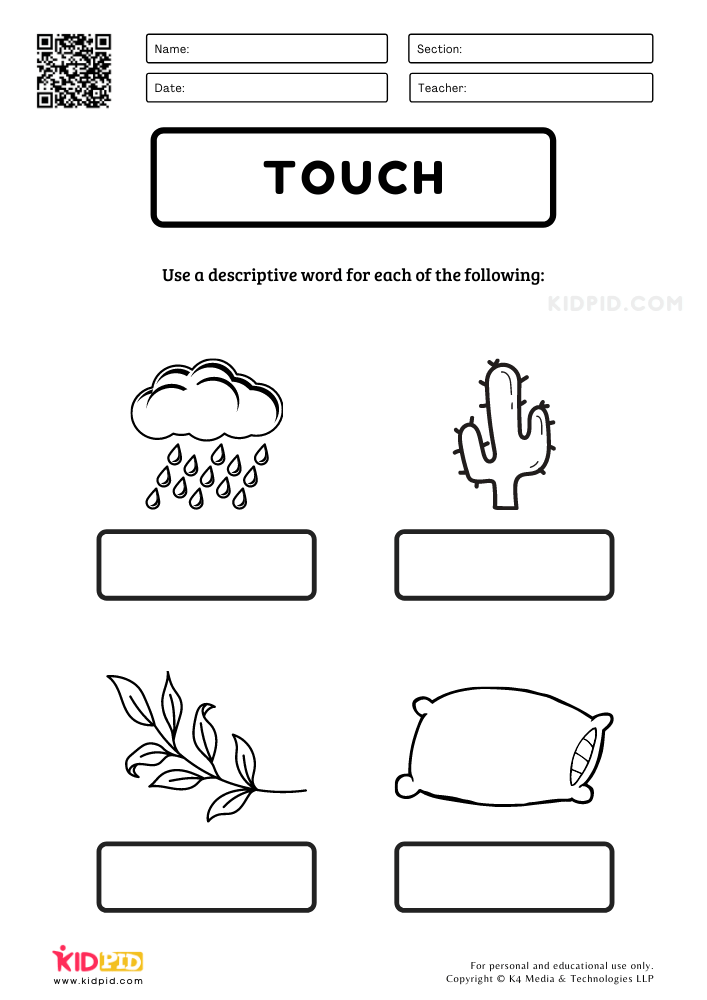
Touch
The first worksheet is for the sense of touch. Certain scenarios have been depicted in these pictures, and children must identify the feeling and write it down.
Smell
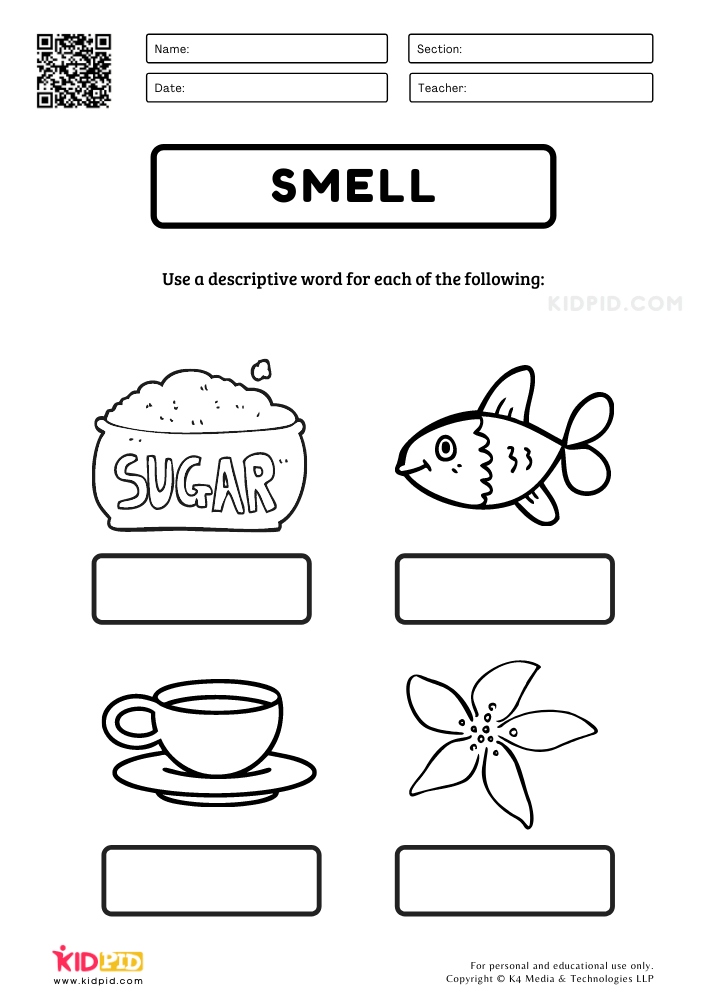
This is the second worksheet, and it is for the sense of smell. Everyone is different and has their own unique perspective; it is important to note that there is no one correct answer for each of these pictures. Each child is entitled to their own opinion, and it is crucial to validate it.
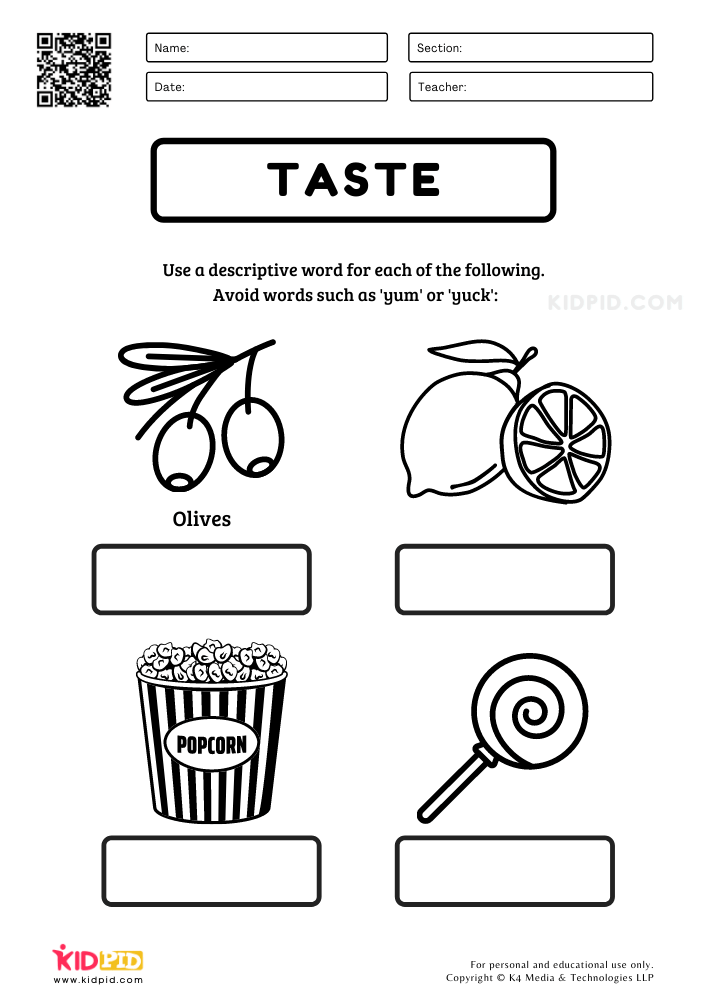
Taste
This is the worksheet for the sense of taste. Again, every child has different preferences when it comes to taste, and so there is no single correct answer. As long as they understand the point of the exercise and have a logical explanation for their answer, there is no wrong or right.
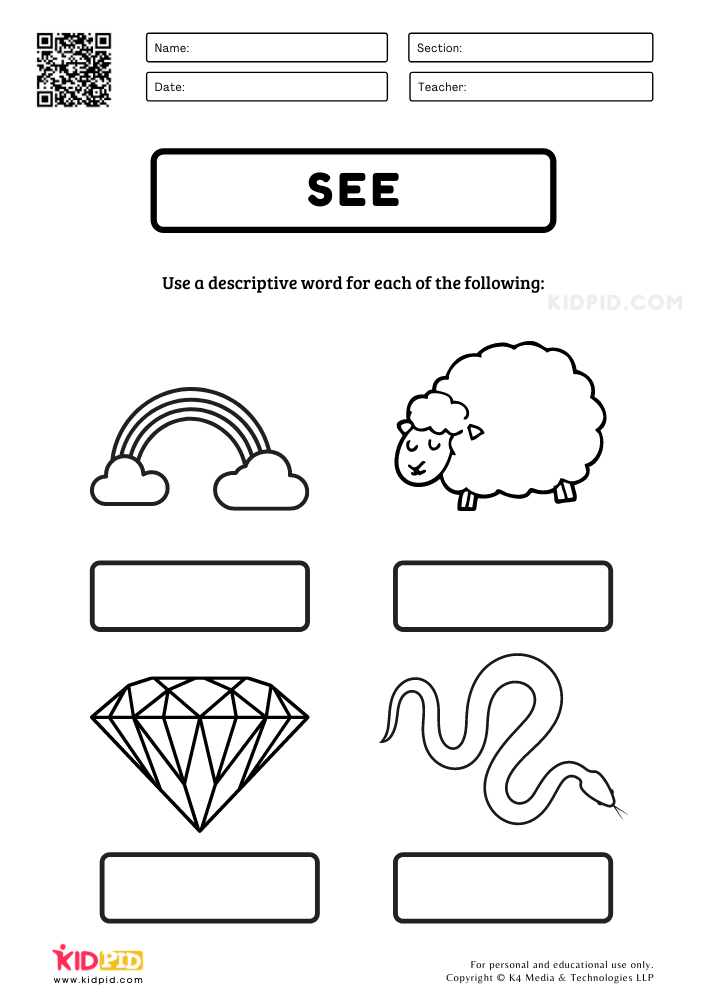
This is the worksheet for the sense of sight. While solving the worksheet, you can also use items in your surroundings to get your child more involved in the activity.
See
Hear
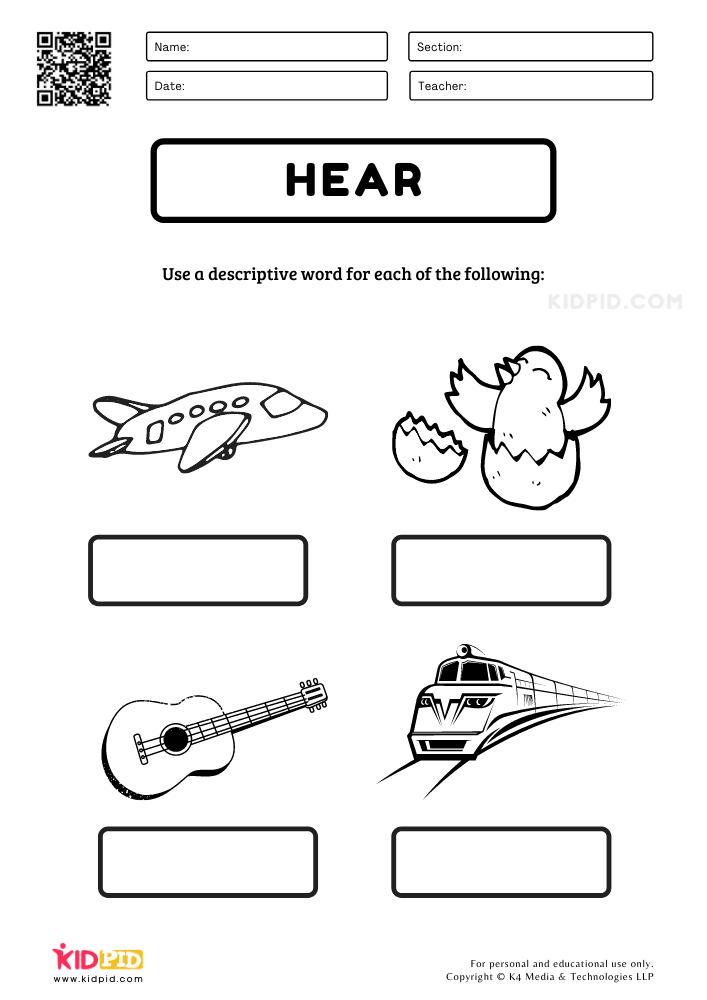
This is the fifth and final worksheet for the sense of hearing. You can use musical instruments and fun songs to help children understand better – it will surely make the activity more fun for them.
Key Facts About The Five Senses Worksheets for Kids
- Target Audience: Perfect for toddlers, preschoolers, kindergarteners, and Grade 1 students (ages 3 to 7).
- Format: Printable, high-quality PDF worksheets designed for tactile, hands-on learning.
- Curriculum Alignment: Aligns with early childhood development goals, foundational Life Science guidelines, and sensory exploration standards.
- Core Concept: Simplifies the abstract concept of human anatomy and neurology into five foundational categories: sight, hearing, smell, taste, and touch.
- Child-Centric Design: Emphasizes open-ended responses, recognizing that children perceive tastes, smells, and textures through their own unique experiences.
Parts/Types/Examples of The Five Senses Worksheets
To provide a comprehensive learning experience, this printable package includes specific, targeted activities for each of our primary sensory receptors:
- Sight Worksheets (The Eyes): Visual identification exercises that challenge kids to look at their surroundings and record what they see, highlighting light, colors, and shapes.
- Hearing Worksheets (The Ears): Auditory awareness trackers where children identify different environmental sounds, musical tones, and volume levels.
- Smell Worksheets (The Nose): Olfactory exploration sheets featuring open-ended prompts to categorize pleasant, pungent, and familiar scents.
- Taste Worksheets (The Tongue): Flavor profile sorting that introduces the foundational concepts of sweet, salty, sour, and bitter.
- Touch Worksheets (The Skin): Texture recognition guides that help children identify physical properties like soft, rough, hot, cold, smooth, and sharp.
How do the Five Senses Work?
Our five senses act as the body’s personal data collectors, constantly sending messages to our brain to help us understand the world around us.
- Receptors Catch the Stimulus: Specialized organs capture environmental data. Your eyes catch light waves, your ears pick up sound vibrations, your nose traps airborne molecules, your tongue reacts to chemical compounds in food, and nerve endings in your skin detect pressure and temperature.
- Signals Travel via the Nervous System: Once a sensory organ captures this data, it converts it into electrical impulses. These impulses travel rapidly through the nervous system.
- The Brain Translates the Data: The brain’s cerebral cortex acts as a supercomputer. It processes these electrical signals instantly, telling you, “That is a bird singing,” or “The stove is hot!”
Benefits of Learning About The Five Senses
Teaching children about their sensory system offers profound cognitive and behavioral benefits:
- Boosts Descriptive Vocabulary: Moves children past basic “good” or “bad” descriptions, giving them the tools to use rich descriptive words like fragrant, rough, bitter, or shrill.
- Encourages Critical Thinking: Promotes scientific observation. Kids learn to categorize data, make predictions, and analyze their immediate physical environment.
- Supports Emotional Regulation: Helping a child identify why an environment feels overwhelming (e.g., “It’s too loud” or “This tag feels itchy”) empowers them to communicate their needs and regulate their emotions.
- Fosters Inclusive Empathy: Introduces the vital concept that not everyone experiences the world the same way, opening up meaningful conversations about blindness, deafness, and adaptive tools like Braille or sign language.
Learning Objectives
By completing these early childhood science worksheets, students will achieve the following benchmarks:
- Identify the five primary sense organs (eyes, ears, nose, tongue, and skin) and pair them correctly with their matching function.
- Classify everyday objects based on their sensory attributes (e.g., sorting foods by taste or textures by touch).
- Communicate personal sensory perspectives confidently, understanding that individual preferences for smells, tastes, and textures vary.
- Demonstrate a foundational respect and sensitivity toward individuals who experience sensory impairments or live with disabilities.
Worksheet Instructions
To get the most out of these educational printables, parents and educators can follow these simple steps:
- Print in High Resolution: Download and print the worksheets on standard printer paper. (Optional: Laminate them for repeated use with dry-erase markers).
- Focus on One Sense at a Time: Do not rush through the entire pack. Dedicate one day or lesson block to a single sense (like “Touch Thursday”) to allow for deep exploration.
- Observe and Write: Have your child look at the scenario depicted in each box. Ask them to think about how that scenario would feel, taste, or sound, and write their observation in the provided response box.
- Validate Every Answer: Remember, there are no wrong answers here! If a child thinks a specific food tastes sour instead of sweet, ask them why. Validate their unique perspective to build confidence.
Interesting Facts About The Five Senses
- Noses Have Memories: The olfactory bulb (responsible for smell) is directly linked to the amygdala and hippocampus—the parts of the brain that handle emotion and memory. That is why a single scent can instantly trigger a vivid childhood memory!
- Taste and Smell are Teammates: Up to 80% of what we perceive as “taste” actually comes from our sense of smell. This is why food tastes completely bland when you have a stuffed-up nose.
- Your Skin is Your Largest Organ: The sense of touch isn’t just in your hands; it’s active across your entire body, thanks to millions of tiny microscopic receptors embedded in your skin.
- The Smallest Bones are in Your Ear: To help you hear, three tiny bones in the middle ear—the malleus (hammer), incus (anvil), and stapes (stirrup)—must vibrate together. The stapes is smaller than a single grain of rice!
Vocabulary Words
Introduce these foundational terms to your young learner to build their scientific vocabulary:
- Sensory Receptors: Tiny parts of the body that take in information from our surroundings.
- Nervous System: The body’s highway system that carries messages back and forth between the brain and the rest of the body.
- Texture: The feel, appearance, or consistency of a surface (e.g., rough, smooth, furry).
- Aroma: A distinctive, typically pleasant smell.
- Flavor Profile: The combination of tastes we experience on our tongue (sweet, salty, sour, bitter, umami).
Real-Life Applications
Connecting worksheets to real-world experiences cements deep learning. Try these quick sensory integration activities at home or in the classroom:
- The Sensory Nature Walk: Take a walk outside and actively pause to check in with the senses. Ask your child: What are three things you can hear right now? What does the bark on that tree feel like?
- The Blindfolded Taste Test: Blindfold your child and place small bites of different foods on their tongue (e.g., a slice of apple, a pretzel, a drop of lemon juice). Have them use their senses of taste and smell to guess the food item.
- The Mystery Sound Box: Hide an object inside a small box (like coins, rice, or Lego bricks) and shake it. Have your child use their auditory skills to deduce what object is hidden inside based solely on the pitch and rhythm of the sound.
FAQs
Q1. What age group are these five senses worksheets designed for?
Answer: These worksheets are thoughtfully crafted for early childhood education, making them ideal for kids aged 3 to 7 (Preschool, Kindergarten, and First Grade).
Q2. Why are there no “correct” answer keys included for some pages?
Answer: We intentionally designed the smell, taste, and touch worksheets to be open-ended. Every child perceives sensory inputs differently based on personal preferences and experiences. The goal is logical connection and self-expression, rather than matching a rigid answer key.
Q3. How can I adapt these worksheets for children with sensory processing sensitivities?
Answer: If a child feels overwhelmed by certain sensory inputs, use these worksheets as a safe conversational tool. Instead of forcing them to experience a triggering sensory input, let them look at the illustrations and discuss the concepts calmly from a distance.
Q4. Are these resources free to download for classroom use?
Answer: Yes! KidPid provides free educational printables designed by our dedicated Content Team to assist teachers, homeschooling parents, and caretakers in boosting academic and developmental progress.
After learning about every sense, it is important to emphasize the fact that while the majority of the people we encounter daily possess all five senses, not everybody does. People who cannot hear are referred to as deaf, whereas people who cannot see are referred to as blind. It is important to teach children from a young age to be sensitive towards all human beings and to look past differences. Visit our website for educational flashcards, worksheets, Quizzes, essays, paragraphs, and engaging classroom resources. Follow us on YouTube & Facebook.
This worksheet is thoughtfully developed by the Content Team to boost academic progress.
Reviewed By Ishika
Read More: