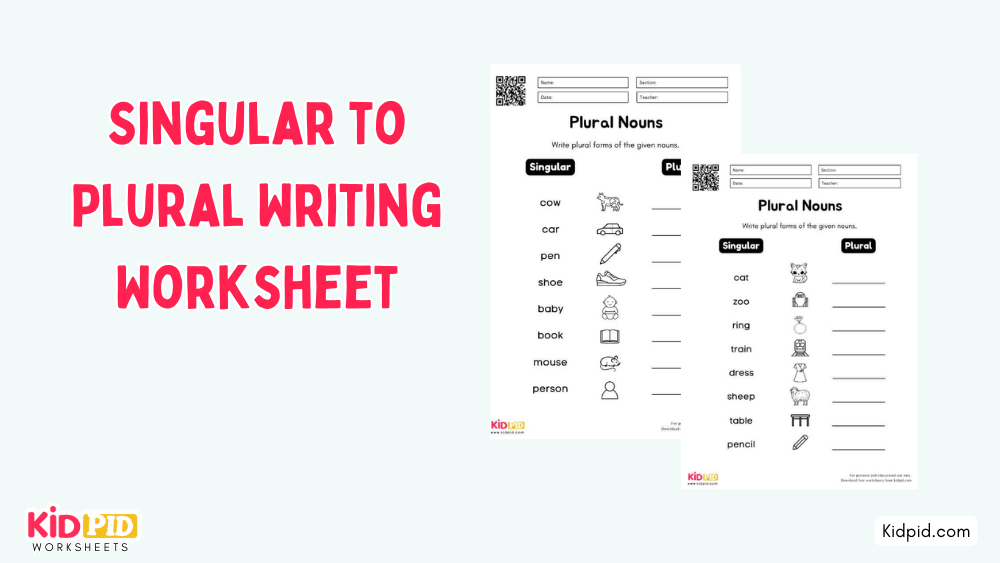
This worksheet challenges you to transform singular nouns into their correct plural forms through writing practice. By converting a variety of nouns from singular to plural, you will deepen your understanding of this essential grammatical concept and strengthen your written communication abilities.
[Scroll Down for Download Link]
Contents
- Write Plural Forms Of the Given Singular Nouns
- Key Facts About the Singular to Plural Writing Worksheet
- Parts, Types, and Examples of Noun Transformations
- How Does the Singular to Plural Writing Worksheet Work?
- Benefits of Learning About Singular and Plural Nouns
- Learning Objectives
- Worksheet Instructions
- Interesting Facts About Plurals & Vocabulary Words
- Real-Life Applications
- FAQs
Write Plural Forms Of the Given Singular Nouns
Read More: Alphabet Handwriting Printable Worksheets

- Fox -> Foxes
- Actor -> Actors
- Writer -> Writers
- Ant -> Ants
- Snake -> Snakes
- Duck -> Ducks
- Bee -> Bees
- Bed -> Beds
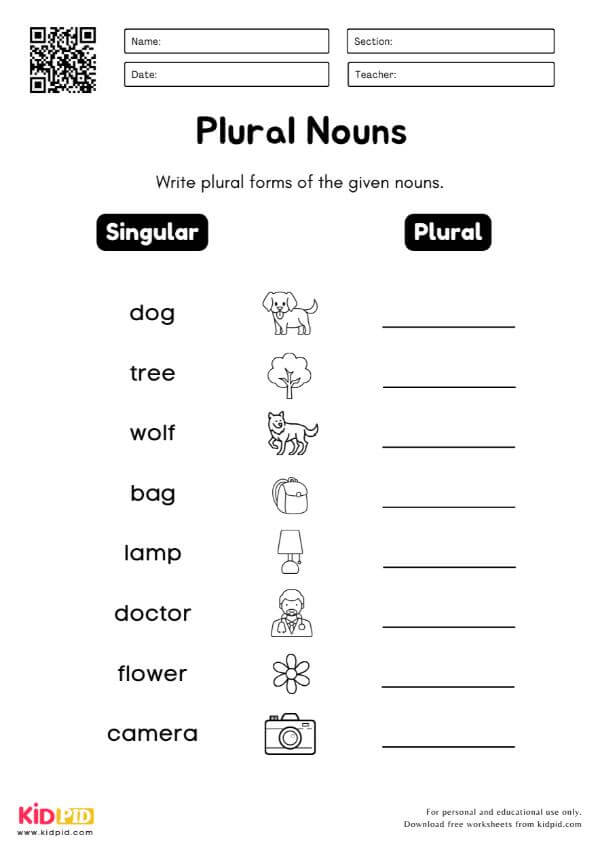
- Dog -> Dogs
- Tree -> Trees
- Wolf -> Wolves
- Bag -> Bags
- Lamp -> Lamps
- Doctor -> Doctors
- Flower -> Flowers
- Camera -> Cameras
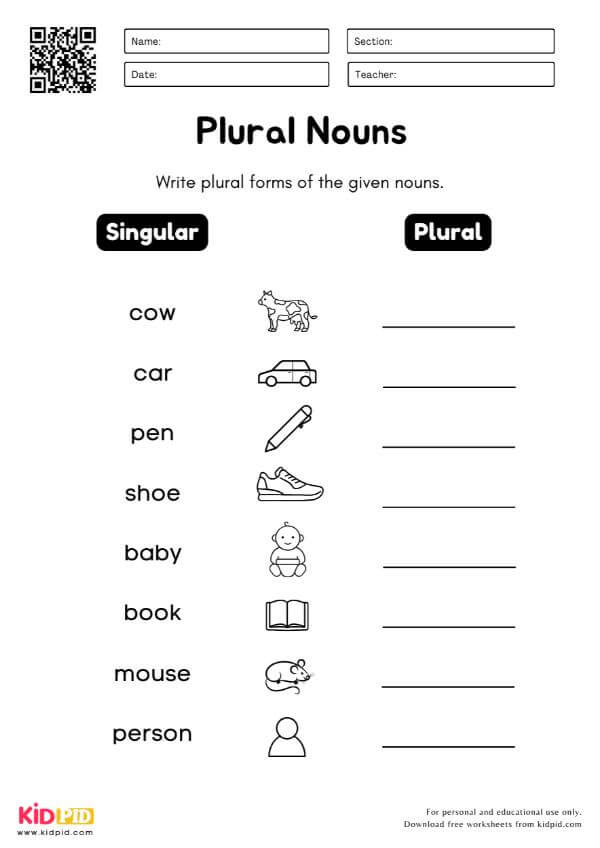
- Cow -> Cows
- Car -> Cars
- Pen -> Pens
- Shoe -> Shoes
- Baby -> Babies
- Book -> Books
- Mouse -> Mice
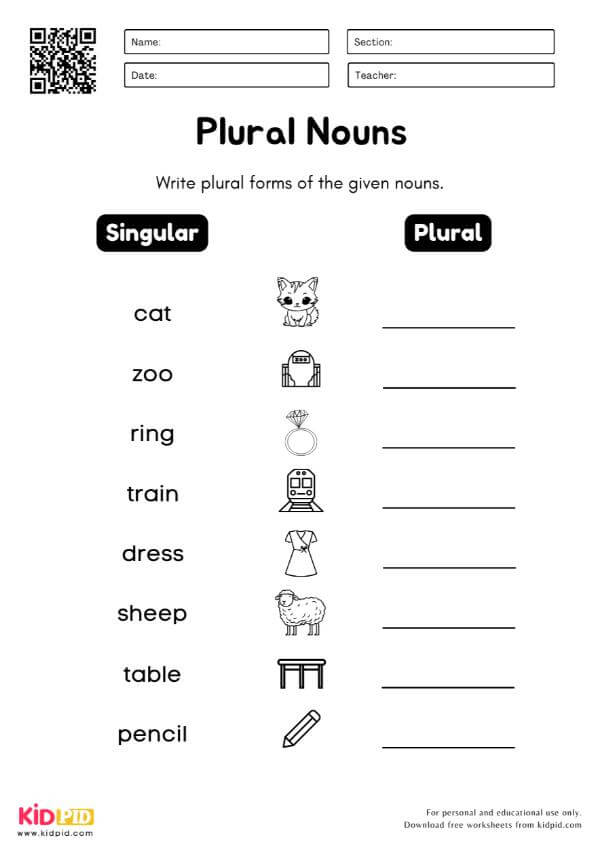
- Cat -> Cats
- Zoo -> Zoos
- Ring -> Rings
- Train -> Trains
- Dress -> Dresses
- Sheep -> Sheep
- Table -> Tables
- Pencil -> Pencils
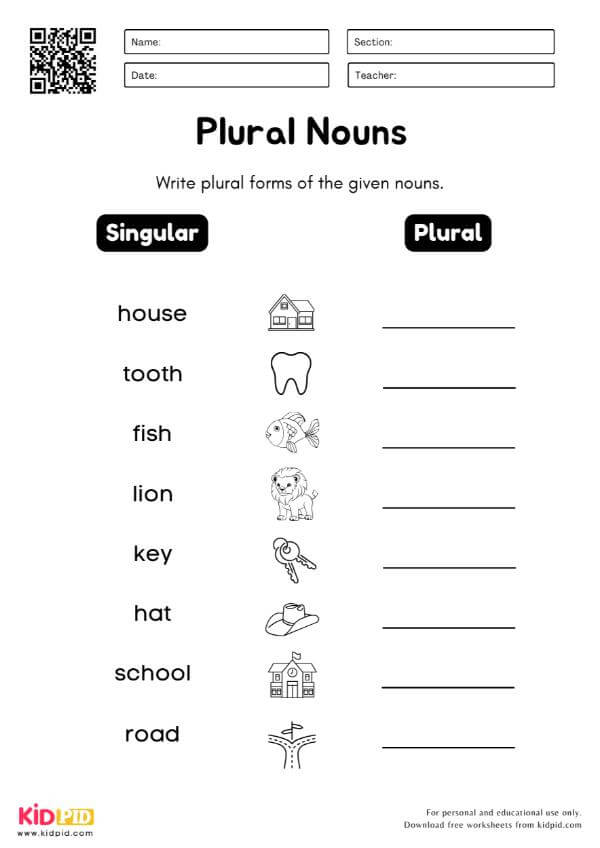
- House -> Houses
- Tooth -> Teeth
- Fish -> Fishes
- Lion -> Lions
- Key -> Keys
- Hat -> Hats
- School -> Schools
- Road -> Roads
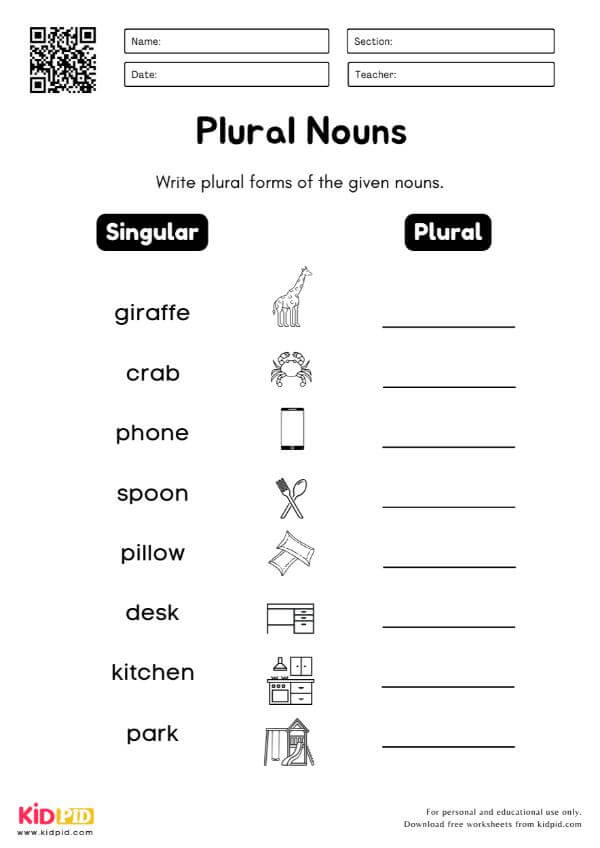
- Giraffe -> Giraffes
- Crab -> Crabs
- Phone -> Phones
- Spoon -> Spoons
- Pillow -> Pillows
- Desk -> Desks
- Kitchen -> Kitchens
- Park -> Parks
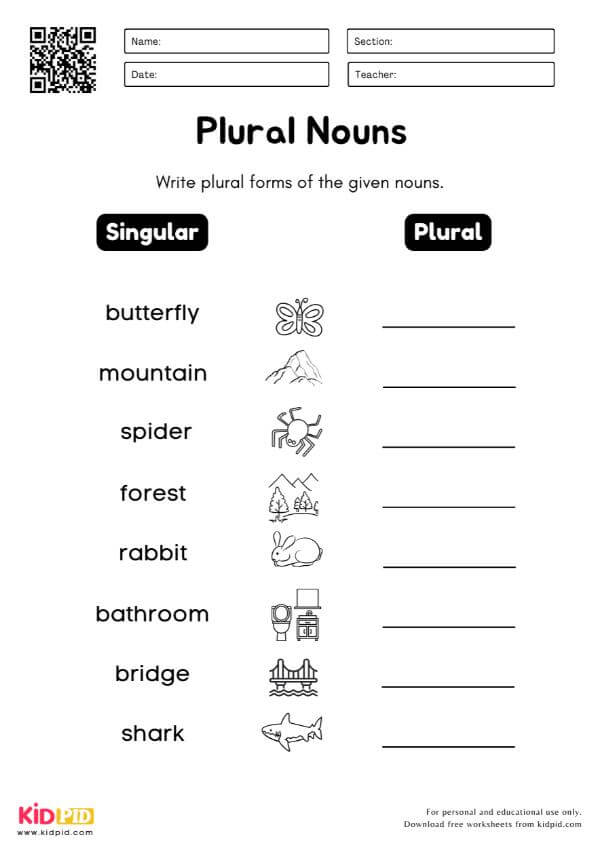
- Butterfly -> Butterflies
- Mountain -> Mountains
- Spider -> Spiders
- Forest -> Forests
- Rabbit -> Rabbits
- Bathroom -> Bathrooms
- Bridge -> Bridges
- Shark -> Sharks
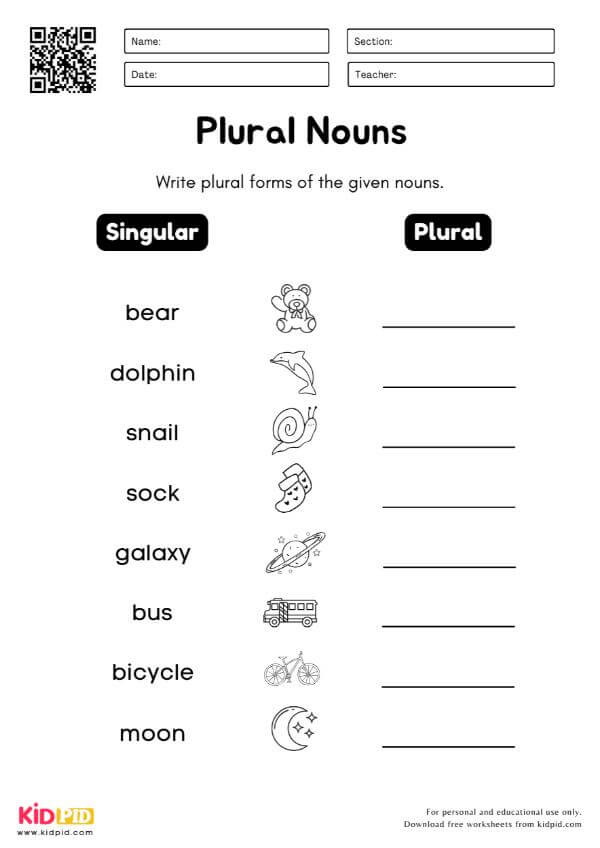
- Bear -> Bears
- Dolphin -> Dolphins
- Snail -> Snails
- Sock -> Socks
- Galaxy -> Galaxies
- Bus -> Buses
- Bicycle -> Bicycles
- Moon -> Moons
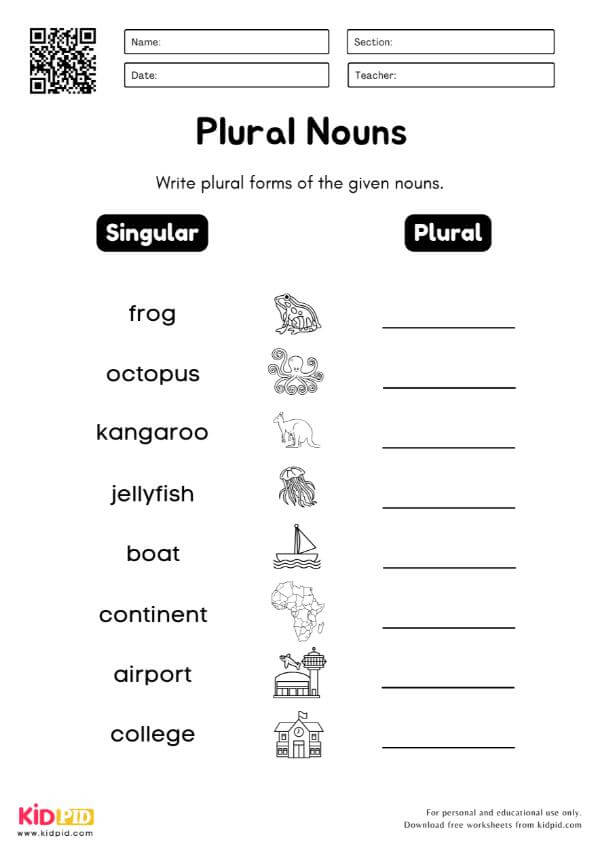
- Frog -> Frogs
- Octopus -> Octopuses
- Kangaroo -> Kangaroos
- Jellyfish -> Jellyfishes
- Boat -> Boats
- Continent -> Continents
- Airport -> Airports
- College -> Colleges
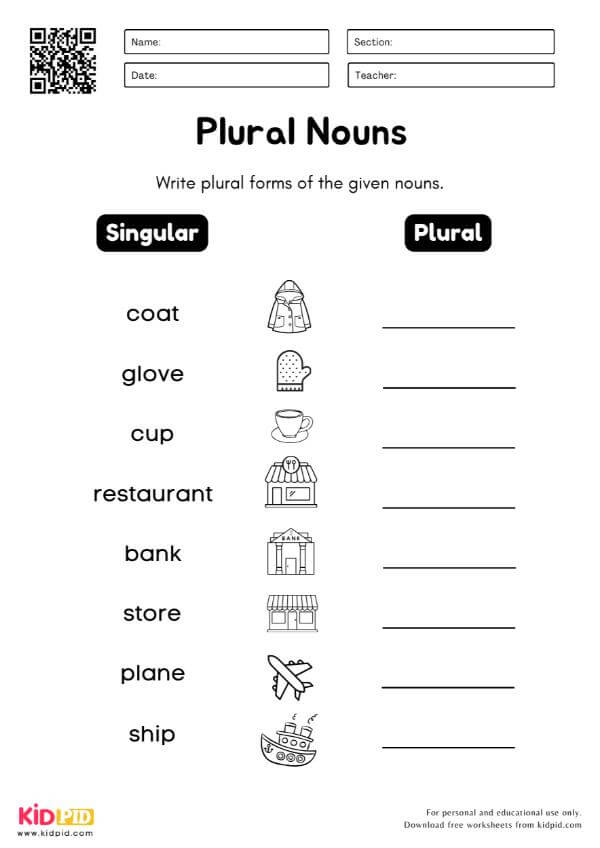
- Coat -> Coats
- Glove -> Gloves
- Cup -> Cups
- Restaurant -> Restaurants
- Bank -> Banks
- Store -> Stores
- Plane -> Planes
- Ship -> Ships
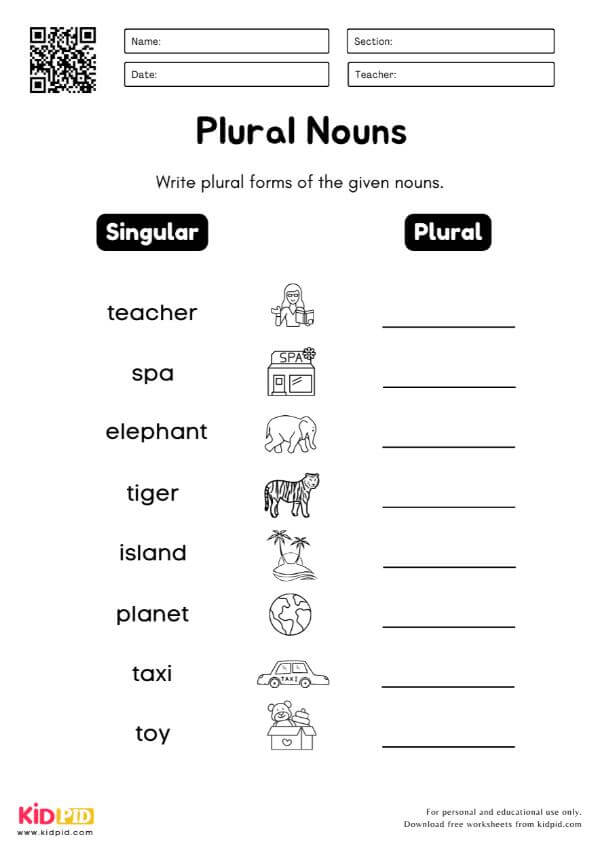
- Teacher -> Teachers
- Spa -> Spas
- Elephant -> Elephants
- Tiger -> Tigers
- Island -> Islands
- Planet -> Planets
- Taxi->Taxies
- Toy -> Toys
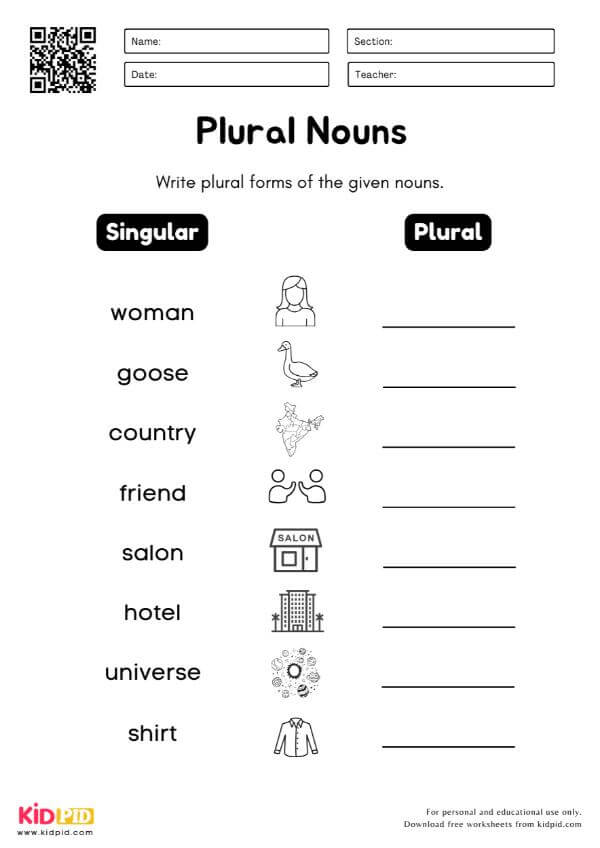
- Women -> Womens
- Goose -> Geese
- Country -> Countries
- Friend -> Friends
- Salon -> Salons
- Hotel -> Hotels
- Universe -> Universe
- Shirt -> Shirts
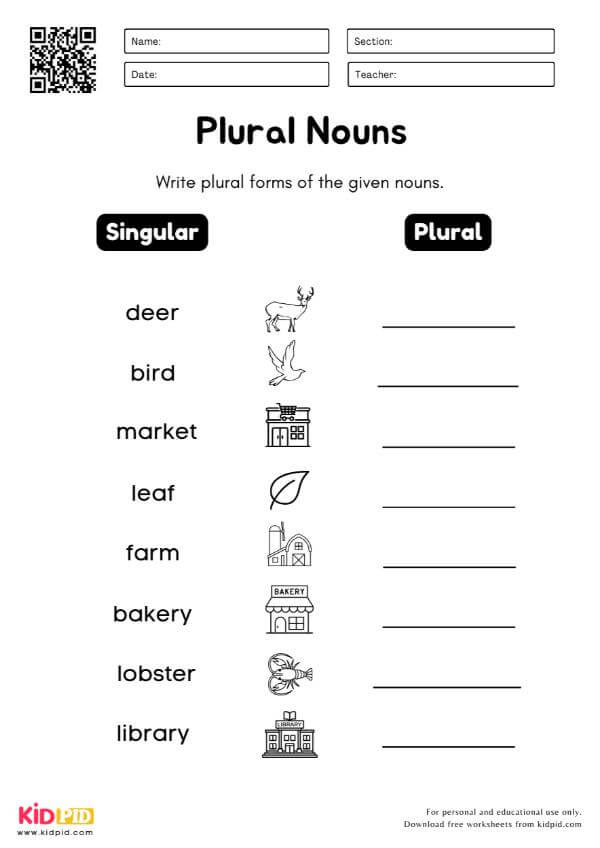
- Deer -> Deers
- Bird -> Birds
- Market -> Markets
- Leaf -> Leaves
- Farm -> Farms
- Bakery -> Bakeries
- Lobster -> Lobsters
- Library -> Libraries
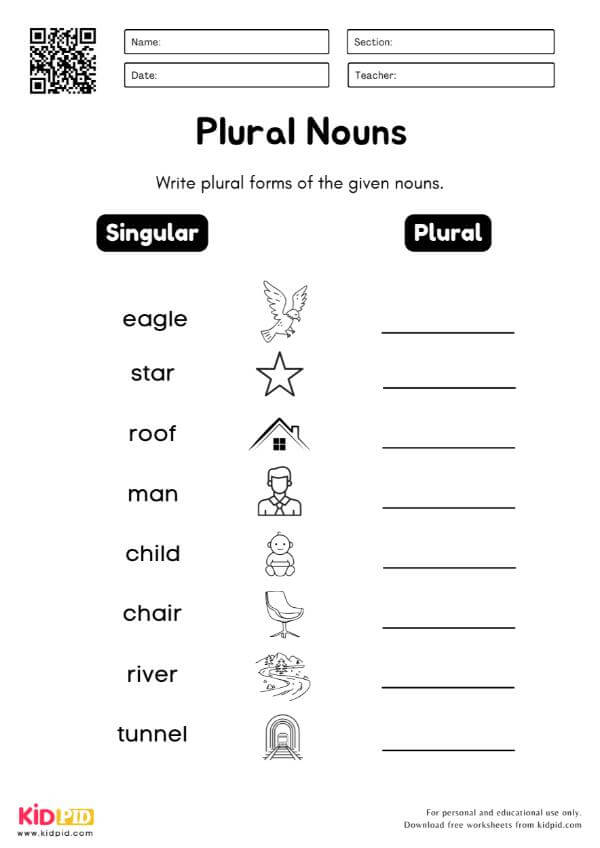
- Eagle -> Eagles
- Star -> Stars
- Roof -> Roofs
- Men -> Mens
- Child -> Children
- Chair -> Chairs
- River -> Rivers
- Tunnel -> Tunnels
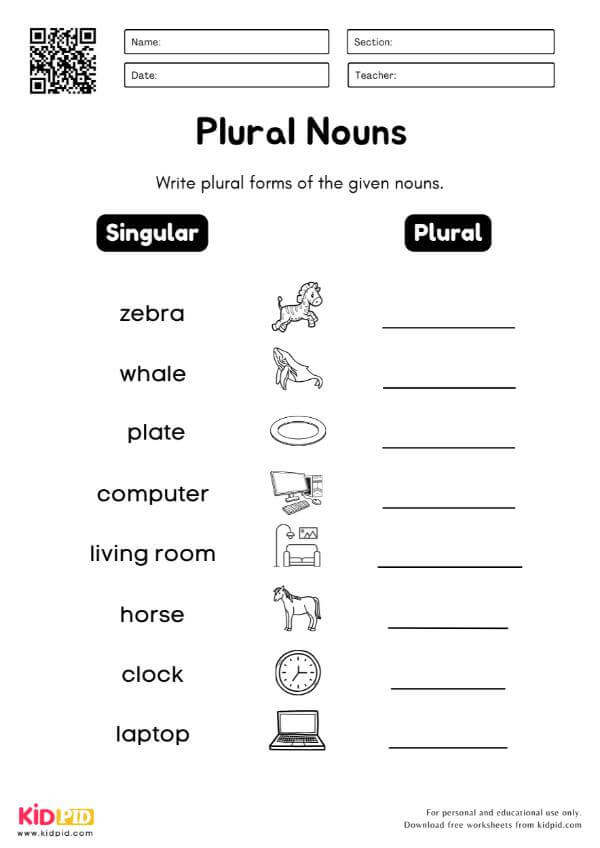
- Zebra -> Zebras
- Whale -> Whales
- Plate -> Plates
- Computer -> Computers
- Living Room -> Living Rooms
- Horse -> Horses
- Clock -> Clocks
- Laptop -> Laptops
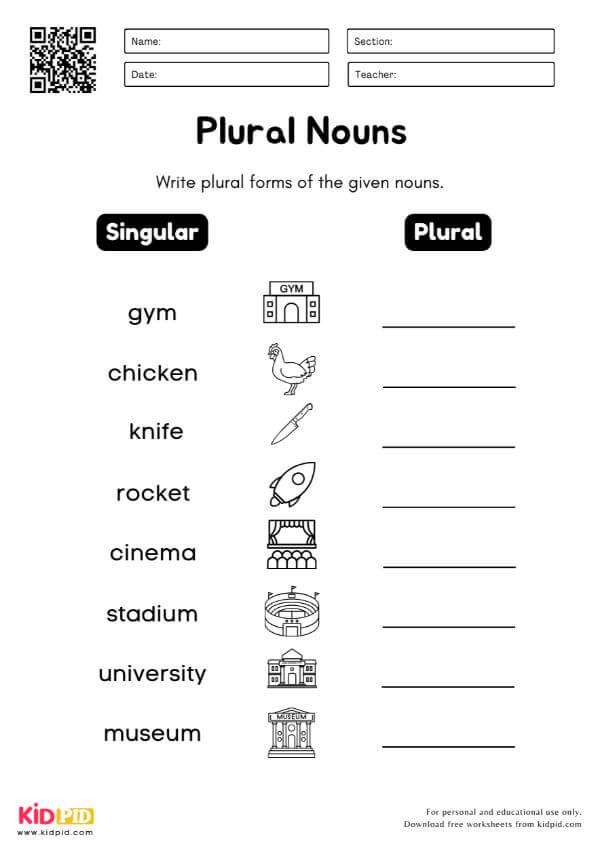
- Gym -> Gyms
- Chicken -> Chickens
- Knife -> Knives
- Rocket -> Rockets
- Cinema -> Cinemas
- Stadium -> Stadiums
- University -> Universities
- Museum -> Museums
Key Facts About the Singular to Plural Writing Worksheet
Understanding the difference between one thing (singular) and more than one thing (plural) is a major milestone in early childhood language development. This worksheet provides a systematic framework for practicing these rules.
- Target Grade Levels: Grade 1 and Grade 2 (Ages 6–8).
- Core Subject: English Language Arts (ELA) — Grammar and Spelling.
- Focus Area: Noun transformations and written handwriting practice.
- Format: Downloadable and printable PDF text worksheets.
- Pedagogical Strategy: Moves from highly predictable regular nouns (adding -s) to complex irregular forms (like mouse to mice), ensuring a natural learning progression.
Parts, Types, and Examples of Noun Transformations
English pluralization isn’t just about adding the letter “s.” This worksheet categorizes nouns into different groups to help children notice spelling patterns.
| Noun Category | The Grammar Rule | Examples from the Worksheet |
|---|---|---|
| Regular Nouns | Add -s to the end of the word. | Tree ➔ Trees, Car ➔ Cows, Doctor ➔ Doctors |
| Sibilant Nouns | Add -es to words ending in x, s, ch, sh, z. | Fox ➔ Foxes, Dress ➔ Dresses, Bus ➔ Buses |
| Changing Y to I | If a word ends in a consonant + y, drop y and add -ies. | Baby ➔ Babies, Butterfly ➔ Butterflies |
| F/FE to V | Change f or fe to -ves. | Wolf ➔ Wolves, Leaf ➔ Leaves, Knife ➔ Knives |
| Irregular Nouns | The word changes completely or mutates its vowels. | Mouse ➔ Mice, Tooth ➔ Teeth, Child ➔ Children |
| No-Change Nouns | The singular and plural spellings are identical. | Sheep ➔ Sheep |
How Does the Singular to Plural Writing Worksheet Work?
This worksheet acts as an active recall tool. Instead of just selecting a multiple-choice answer, children are required to use muscle memory and handwriting skills.
- Isolate the Target Noun: The student reads the singular noun provided on the left side of the page (e.g., Wolf).
- Identify the Rule: The child evaluates the ending of the word to determine which spelling rule applies (e.g., ends in -f, so I need to use -ves).
- Physical Execution: The student writes out the full plural word in the blank space. This dual action of mental processing and physical writing helps lock the spelling pattern into their long-term memory.
Benefits of Learning About Singular and Plural Nouns
Mastering noun quantities early on yields immediate compounding benefits for a young learner’s academic performance:
- Improves Subject-Verb Agreement: Children cannot write correct sentences without matching singular subjects to singular verbs (e.g., The dog barks vs. The dogs bark).
- Boosts Reading Comprehension: Recognizing structural suffixes like -es allows kids to decode unfamiliar vocabulary words much faster while reading.
- Prevents Overgeneralization Errors: It is completely natural for a 6-year-old to say “mouses” or “childs.” Working through these targeted printables explicitly fixes those common speaking mistakes.
Learning Objectives
By completing this writing package, students will fulfill the following curriculum goals:
- Identify the linguistic difference between singular and plural forms.
- Correctly apply basic spelling rules (-s, -es, -ies, -ves) to a diverse list of nouns.
- Demonstrate correct handwriting alignment and clear spacing.
- Expand their working vocabulary by encountering varied nouns ranging from common animals (bear, snail) to environmental spaces (stadium, university).
Worksheet Instructions
Parents and educators can use these straightforward instructions to guide young learners through the printable sheets:
- Prepare Your Materials: Print out the sheets and grab a sharpened pencil and an eraser.
- Read and Say Aloud: Look at the singular word in the left-hand column. Read it aloud cleanly.
- Think of the Group: Ask yourself: Does this word get a simple “-s”, or does it have a special ending like “-x” or “-f”?
- Write Wisely: Carefully write the plural form of the word in the space on the right.
- Check Your Work: Review your final spelling. Make sure your letters are sitting neatly on the lines!
Interesting Facts About Plurals & Vocabulary Words
Language is full of neat historical surprises! Share these fun facts with kids to keep them engaged with their vocabulary terms:
Why do we say ‘Teeth’ instead of ‘Tooths’? Long ago, old Germanic languages changed the inner vowel sound of a word to show there was more than one. This is why we still have pairs like tooth/teeth, goose/geese, and man/men today!
- The Octopus Puzzle: On the worksheet, you will see
Octopus ➔ Octopuses. Even though some adults say octopi, “octopuses” is actually the most accurate English plural because the word originally comes from Greek, not Latin! - The Fake Plural: The word universe is included on these pages. Because it refers to everything that exists as one single unit, it rarely ever takes a plural form in standard conversations.
Real-Life Applications
Grammar isn’t just for tests—we use singular and plural adjustments every single day outside of the classroom:
- Grocery Shopping: If you need one apple, you look for a singular item. If you want a whole bag, you are suddenly looking for apples. Knowing the difference helps kids read store signs and grocery lists.
- Telling Stories: When sharing a playground story, saying “Three wolves chased me” sounds confusing. Correct plurals allow kids to tell clear, exciting stories to friends and family.
- Sharing and Inventory: Counting out toys or dividing snacks requires clear labeling (e.g., “Pass me the markers” versus “Pass me the marker”).
FAQs
Q1. What grade is this singular-to-plural worksheet for?
Answer: This writing pack is designed primarily for students in Grade 1 and Grade 2 (ages 6 to 8). However, it can also serve as an excellent remedial review tool for older students struggling with tricky, irregular spelling adjustments.
Q2. Why does my child keep writing “wolfs” instead of “wolves”?
Answer: This is called overgeneralization. Your child has successfully learned the basic rule of adding “-s” to words and is trying to apply it everywhere. Be patient! Gently point out that words ending in an “f” sound tend to turn into a “v” sound before adding their plural ending.
Q3. How do worksheets help with grammar retention?
Answer: While digital games are fun, the physical act of writing out letters builds strong fine motor skills and neurological connections. Writing out spelling variations by hand forces the brain to process each letter change sequentially, resulting in much higher retention rates.

The Singular to Plural Writing Worksheet helps children understand singular and plural nouns through engaging writing practice. Fun activities strengthen grammar, vocabulary, spelling, and sentence-building skills while boosting confidence in everyday language use. Explore free educational resources featuring worksheets, essays, paragraphs, flashcards, quizzes, and interactive resources that keep kids motivated. Follow our YouTube & Facebook pages.
The Content Team prepared this worksheet to encourage learning success.
Reviewed By Sandra K Udayan
Read More: