Contents
- What is Length?
- How to measure Length?
- Compare Length of Objects Worksheets
- Key Facts About Comparing the Length of Objects Worksheets
- Parts/Types/Examples of Compare Length of Objects Worksheets
- How Do Compare Length of Objects Worksheets Work?
- Benefits of Learning About Comparing the Length of Objects Worksheets
- Learning Objectives
- Worksheet Instructions
- Interesting Facts About Compare Length of Objects Worksheets
- Real-Life Applications
- FAQs
- Q1. What are the Compare Length of Objects Worksheets?
- Q2. Who can use these worksheets?
- Q3.Why are length comparison activities important?
- Q4. Do children need rulers to complete these worksheets?
- Q5. What skills do these worksheets develop?
- Q6. Can these worksheets be used at home?
- Q7. How do these worksheets support future math learning?
- Q8. Are these worksheets suitable for beginners?
- You may like this:
What is Length?
- Length is a measurement of distance. For example, the distance from your home to school.
- The SI unit, or the basic unit of length, is the metre (m).
- A kilometre (km), metre (m), and centimetre (cm) are the common units used to measure length.
- 1m = 100cms
- kilometre ( 1km = 1000m)
- Comparing the length between two objects basically means which of them is the longest.
- Length tells us the size of a particular object from one point to another.
- For example, we can measure the length of anything we want, like the length of a pencil, the length of your copy, etc.
How to measure Length?
- We can measure length with a handspan, ruler, foot span, etc.
- Hand span is the distance from the tip of the thumb to the tip of the little finger of the same hand, as outstretched.
- A small ruler has a length of 15 cm.
Compare Length of Objects Worksheets

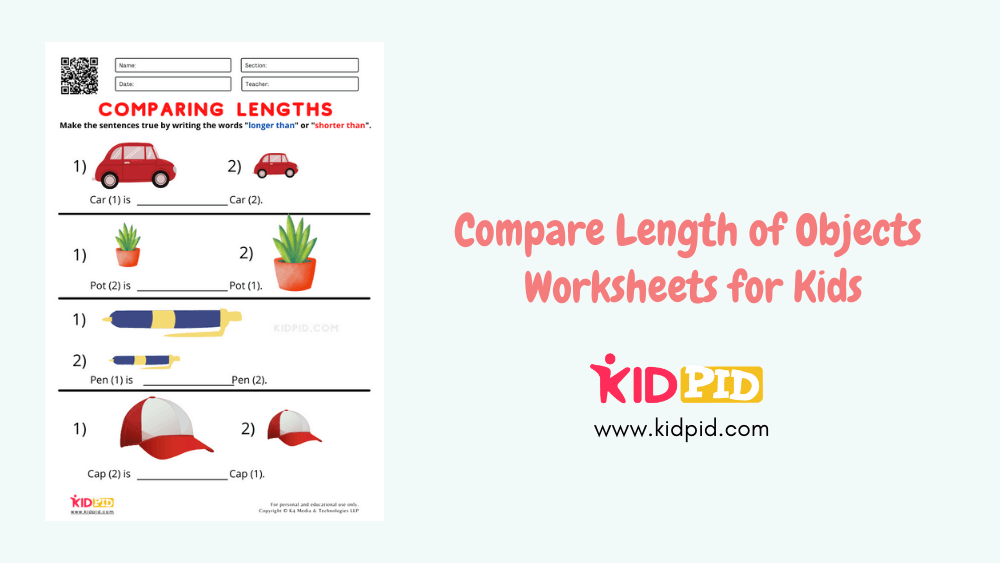
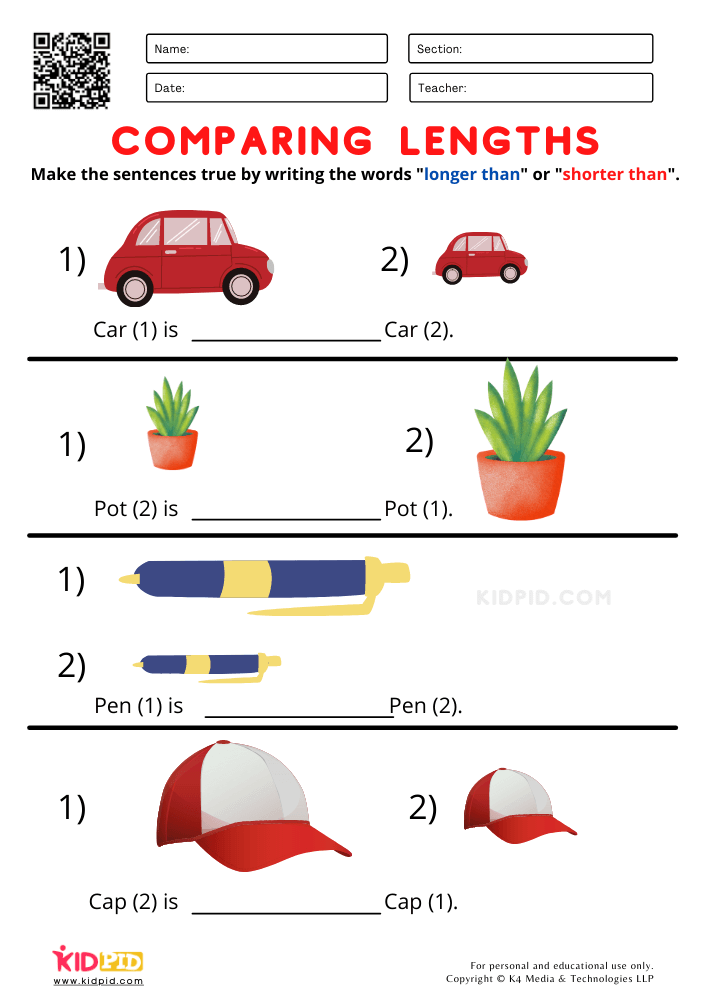
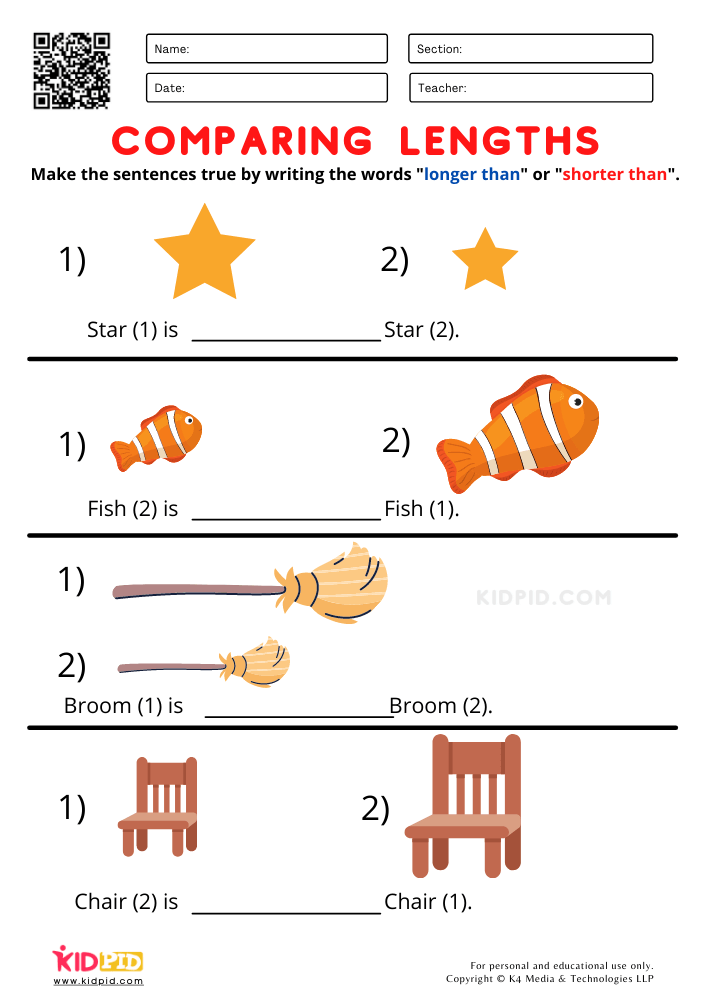
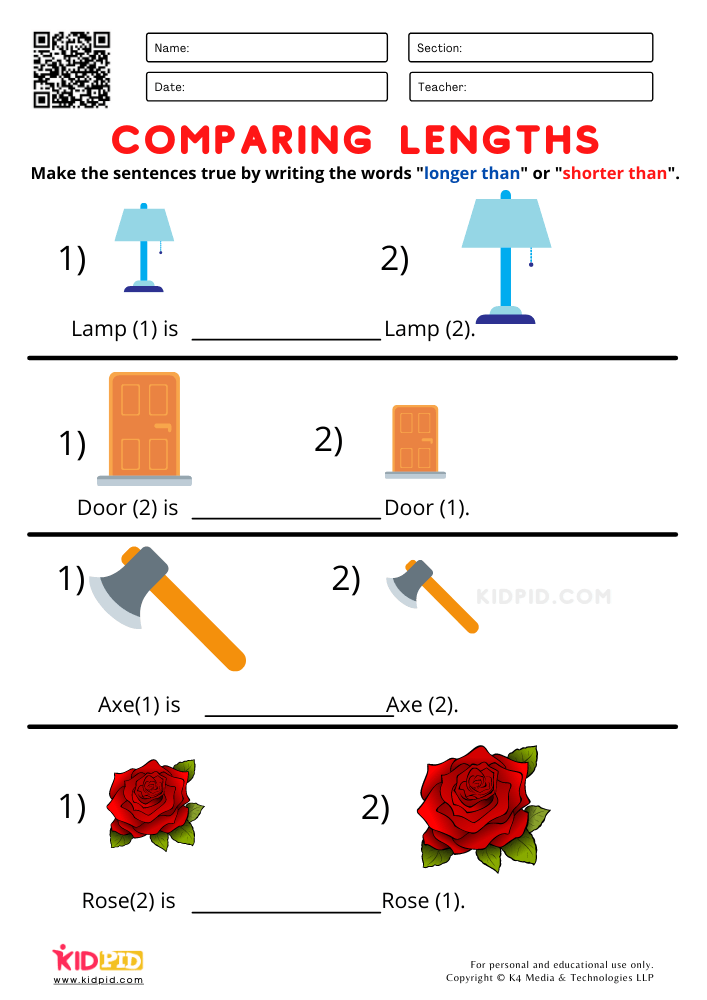
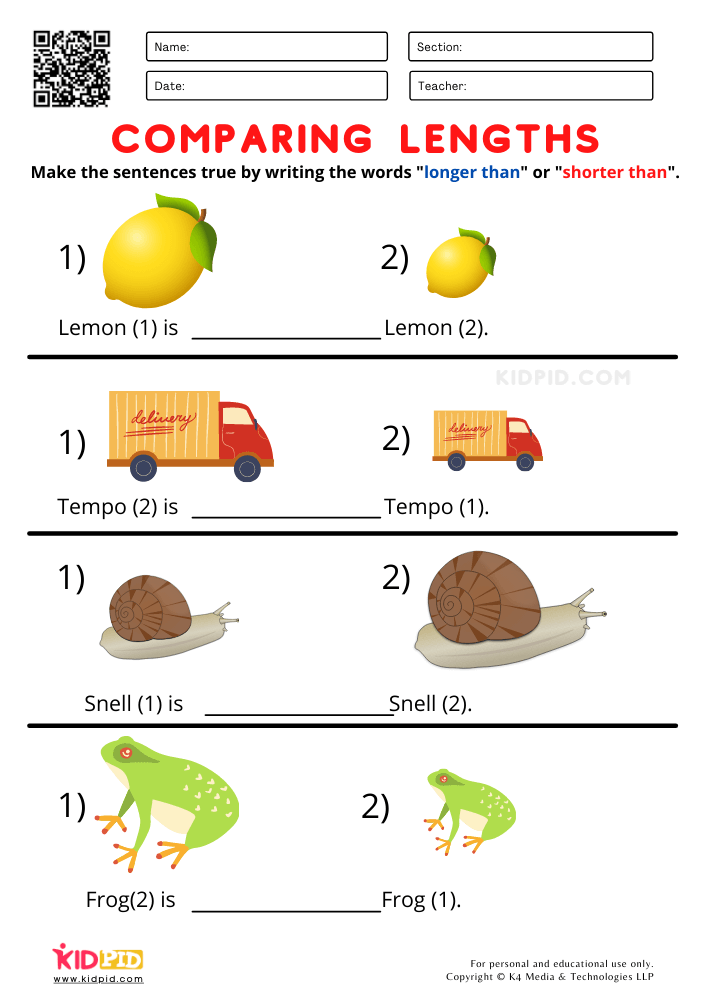
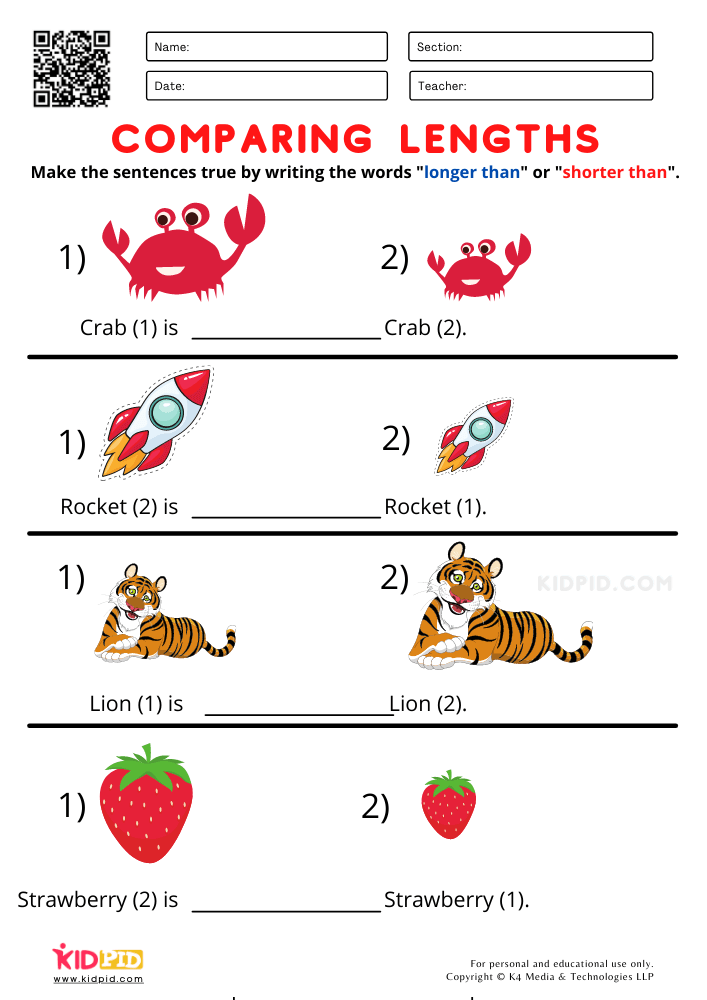
- In the coming worksheet, you have to tell about the longest of the two by framing a sentence.
- For example, if there are pictures of two boys unequal in length, you have to tell which one is longer or shorter than the other.
- If the first boy is longer, then the sentence will be ” the first boy is longer than the second boy, or the second boy is shorter than the first boy.
Apart from this, parents can also give their kids random stuff and tell them to compare the length between them. It will be a fun game for all the kids, and in that process, they will develop their speed of thinking and will also answer the questions quickly.

Key Facts About Comparing the Length of Objects Worksheets
Compare Length of Objects Worksheets help children develop measurement and comparison skills by identifying which objects are longer, shorter, taller, or smaller. These worksheets introduce basic mathematical concepts using visual comparisons that are easy for preschool and kindergarten learners to understand. Students observe different objects, compare their lengths, and select the correct answer through engaging activities. These worksheets strengthen observation skills, logical thinking, and early measurement understanding while preparing children for advanced geometry and measurement topics.
Parts/Types/Examples of Compare Length of Objects Worksheets
Parts of the Worksheets
- Visual images of objects for comparison
- Instructions for identifying longer or shorter items
- Matching and coloring activities
- Multiple-choice questions
- Cut-and-paste exercises
- Writing spaces for answers
Types of Worksheets
- Longer vs. Shorter Worksheets
- Tall vs. Short Activities
- Object Comparison Exercises
- Measurement Sorting Worksheets
- Length Matching Activities
- Real-Life Object Comparison Sheets
Examples
- Compare two pencils and circle the longer one.
- Identify the shorter rope among the three ropes.
- Color the tallest tree in a picture.
- Match objects of equal length.
How Do Compare Length of Objects Worksheets Work?
These worksheets present children with images of objects that differ in length or height. Students carefully observe the objects and determine which one is longer, shorter, taller, or smaller. Activities may include circling the correct object, drawing lines to match items, coloring answers, or writing comparison words. Through repeated practice, children learn to recognize size differences and develop foundational measurement skills.
Benefits of Learning About Comparing the Length of Objects Worksheets
- Builds early measurement concepts.
- Improves visual discrimination skills.
- Strengthens observation and comparison abilities.
- Develops logical and critical thinking.
- Enhances vocabulary related to size and length.
- Supports kindergarten math readiness.
- Encourages independent problem-solving.
- Improves concentration and attention to detail.
Learning Objectives
By completing these worksheets, children will:
- Understand the concepts of longer, shorter, taller, and smaller.
- Compare objects based on length and height.
- Develop visual analysis skills.
- Improve mathematical reasoning abilities.
- Build confidence in measurement-related activities.
- Apply comparison skills to everyday situations.
Worksheet Instructions
- Look carefully at all the objects shown.
- Compare their lengths, heights, or sizes.
- Read the directions before answering.
- Circle, color, match, or mark the correct object.
- Complete all comparison activities.
- Review your answers to ensure accuracy.
Interesting Facts About Compare Length of Objects Worksheets
- Length comparison is one of the earliest measurement skills children learn.
- Young learners understand visual comparisons before using rulers.
- Comparing objects helps develop spatial awareness.
- Measurement activities improve mathematical thinking.
- Everyday items can be used to teach length concepts.
- Early comparison skills support future geometry learning.
- Children naturally compare sizes while exploring their environment.
Real-Life Applications
Children use length comparison skills in many daily activities, including:
- Choosing the longest pencil for writing.
- Comparing the heights of plants in a garden.
- Organizing books by size on a shelf.
- Selecting the right length of ribbon for crafts.
- Comparing the lengths of toy cars or trains.
- Measuring furniture while arranging a room.
- Understanding directions and distances during travel.
These practical experiences help children connect classroom learning with real-world situations.
FAQs
Q1. What are the Compare Length of Objects Worksheets?
Answer: They are educational worksheets designed to help children compare objects based on length, height, and size using visual activities.
Q2. Who can use these worksheets?
Answer: They are ideal for preschool, kindergarten, and early elementary students.
Q3.Why are length comparison activities important?
Answer: They build foundational measurement skills and improve observation and critical thinking abilities.
Q4. Do children need rulers to complete these worksheets?
Answer: No. Most activities rely on visual comparisons rather than actual measurement tools.
Q5. What skills do these worksheets develop?
Answer: They improve measurement understanding, logical reasoning, visual discrimination, and math readiness.
Q6. Can these worksheets be used at home?
Answer: Yes. Parents can use them for homeschooling, homework practice, or extra learning activities.
Q7. How do these worksheets support future math learning?
Answer: They introduce measurement concepts that serve as a foundation for geometry, data analysis, and advanced mathematics.
Q8. Are these worksheets suitable for beginners?
Answer: Yes. They are specifically designed to introduce young learners to basic comparison and measurement concepts simply and engagingly.
We hope you liked these worksheets. Please do check other worksheets as well and share your feedback in the comment section. Improve early measurement skills with these Compare Length of Objects Worksheets. Engaging printable activities help children identify longer and shorter objects, strengthen observation, develop comparison skills, build mathematical thinking, and enhance everyday problem-solving abilities. Discover exciting learning materials, including worksheets, essays, paragraphs, flashcards, quizzes, and interactive resources. Follow us on YouTube & Facebook.
This worksheet is thoughtfully developed by the Content Team to boost academic progress.
Reviewed By Drashti
You may like this: