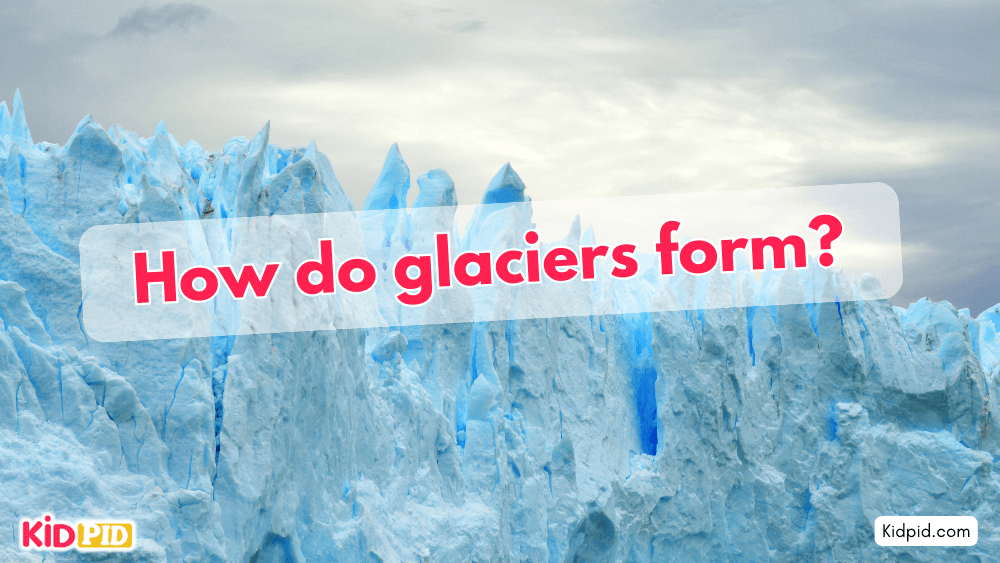
Glaciers form primarily through the compaction and recrystallization of snow, which over time turns into dense ice.

Contents
MCQs
1. Over what time frame can glaciers form?
A. Over a few weeks
B. Over a few years
C. Over many years
D. Overnight
Answer: C. Over many years
Explanation: The formation of glaciers is a prolonged process that occurs over many years, as it requires the accumulation and compression of large amounts of snow.
2. What role does snow play in the formation of glaciers?
A. It provides a reflective surface that aids in melting.
B. It acts as an insulator to keep the glacier cool.
C. It is the primary material that gets compacted into ice.
D. It has no role in the formation of glaciers.
Answer: C. It is the primary material that gets compacted into ice.
Explanation: Snow is the fundamental material in glacier formation, as it undergoes compaction and recrystallization to become dense ice.
3. What happens to the snow during the formation of a glacier?
A. It melts completely and then refreezes.
B. It is compacted and recrystallized into ice.
C. It sublimates directly into vapor.
D. It evaporates under the sun.
Answer: B. It is compacted and recrystallized into ice.
Explanation: During glacier formation, snow undergoes a process of compaction and recrystallization, transforming into dense glacial ice.
4. Can glaciers form in any location where there is snow?
A. Yes, if there is enough snowfall.
B. No, only in areas close to the equator.
C. Yes, but only in high altitudes.
D. No, specific conditions of cold and sufficient snow accumulation are required.
Answer: D. No, specific conditions of cold and sufficient snow accumulation are required.
Explanation: Not all areas with snow can form glaciers. There must be specific conditions such as prolonged cold temperatures and sufficient snow accumulation over time.
Read More
- GK Quiz for Class 1
- English Grammar Quiz Worksheets for Grade 1
- IEO Previous Year Question Paper for Class 7 (English Olympiad 2015, SET B)
- IEO Previous Year Question Paper for Class 5 (2014, SET A)
- IEO Previous Year Question Paper for Class 7 (English Olympiad 2018, SET B)