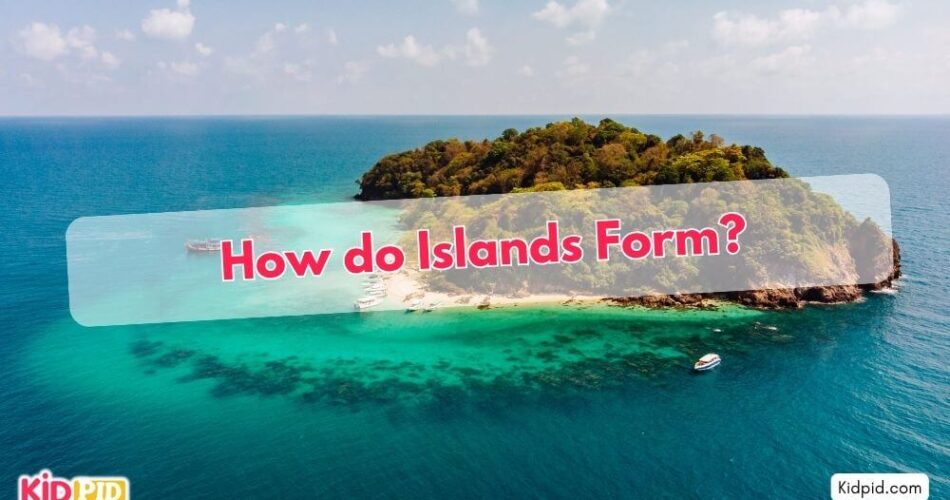
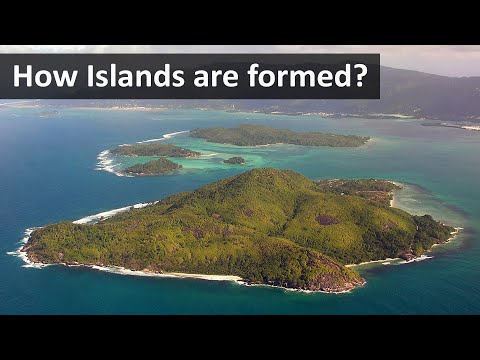
Volcanic activity is a primary way islands form, especially in the ocean. When volcanoes erupt, they can deposit lava in the sea, which cools and solidifies to create new land masses.
Contents
- MCQs
- Fill In The Blanks
- 1. Islands form through __________ activity, where hot magma rises to the surface and forms new land.
- 2. Pieces of land breaking off and forming a separate island is an example of island formation through __________.
- 3. Islands can form when sea levels rise and cover low-lying areas, creating new __________.
- 4. How do islands form? Islands can form through a combination of __________ processes over time.
- 5. What are some ways in which islands can form? One way is through volcanic activity, another way is through erosion of land, and islands can also form when sea levels rise and cover low-lying areas, creating new __________.
- True/False Questions:
MCQs
1. Which type of island is formed from the build-up of coral reefs?
a) Barrier island
b) Coral island
c) Volcanic island
d) Continental island
Answer: b) Coral island
Explanation: Coral islands form from the accumulation of coral debris and skeletons of marine organisms. Over time, these can build up to break the surface of the water, forming islands.
2. How can continental drift lead to the formation of islands?
a) By cooling lava in the ocean
b) By separating landmasses into smaller pieces
c) Through erosion
d) By causing earthquakes
Answer: b) By separating landmasses into smaller pieces
Explanation: Continental drift can lead to the formation of islands by gradually moving continents apart. This process can cause pieces of land to break off, forming islands.
3. What is an example of a volcanic island?
a) Madagascar
b) Hawaii
c) Greenland
d) Australia
Answer: b) Hawaii
Explanation: Hawaii is an example of a volcanic island chain formed by hotspots in the Earth’s crust, where magma has erupted through the sea floor to create islands.
4. Which process describes the formation of barrier islands?
a) Lava solidification
b) Sand accumulation along coastlines
c) Coral reef buildup
d) Continental separation
Answer: b) Sand accumulation along coastlines
Explanation: Barrier islands are formed by the accumulation of sand along coastlines, often due to the action of waves and currents that deposit sand parallel to the shore.
Fill In The Blanks
Choose From These Words: volcanic, geological, erosion, land masses
1. Islands form through __________ activity, where hot magma rises to the surface and forms new land.
Answer: volcanic
2. Pieces of land breaking off and forming a separate island is an example of island formation through __________.
Answer: erosion
3. Islands can form when sea levels rise and cover low-lying areas, creating new __________.
Answer: land masses
4. How do islands form? Islands can form through a combination of __________ processes over time.
Answer: geological
5. What are some ways in which islands can form? One way is through volcanic activity, another way is through erosion of land, and islands can also form when sea levels rise and cover low-lying areas, creating new __________.
Answer: land masses
True/False Questions:
1. Islands can only form from volcanic activity. (True/False)
Answer: False. Islands can form through various processes, including volcanic activity, tectonic plate movement, and the accumulation of sediment.
2. Islands are always connected to a larger landmass. (True/False)
Answer: False. Islands can be surrounded by water, like those in the middle of the ocean.
3. All islands are formed from the same materials. (True/False)
Answer: False. Islands can be formed from a variety of materials, including rock, sand, and coral.
4. Islands can disappear over time. (True/False)
Answer: True. Islands can erode or sink due to natural processes, causing them to disappear.
5. Humans can create artificial islands. (True/False)
Answer: True. Humans have the technology to create artificial islands, like those built in the shape of palm trees or for airports.
Read More: