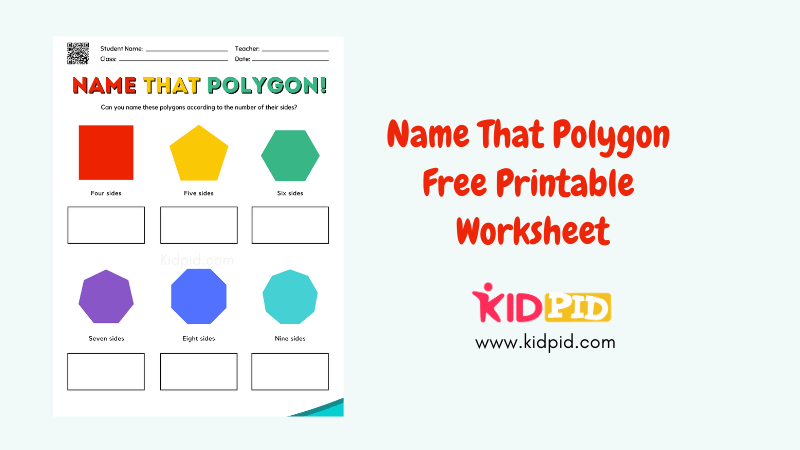
Free Naming of polygon shapes Printable Worksheet to identify and remember the names of different polygons for kids. It is perfect for kindergarteners.
What is a Polygon?
A polygon is a flat figure that is made up of straight lines. It must be enclosed.
- Flat figures are plane figures. It means two-dimensional (2D).
- Straight lines – It connects two points on a plane surface.
- Enclosed – Surrounded or closed off on all sides
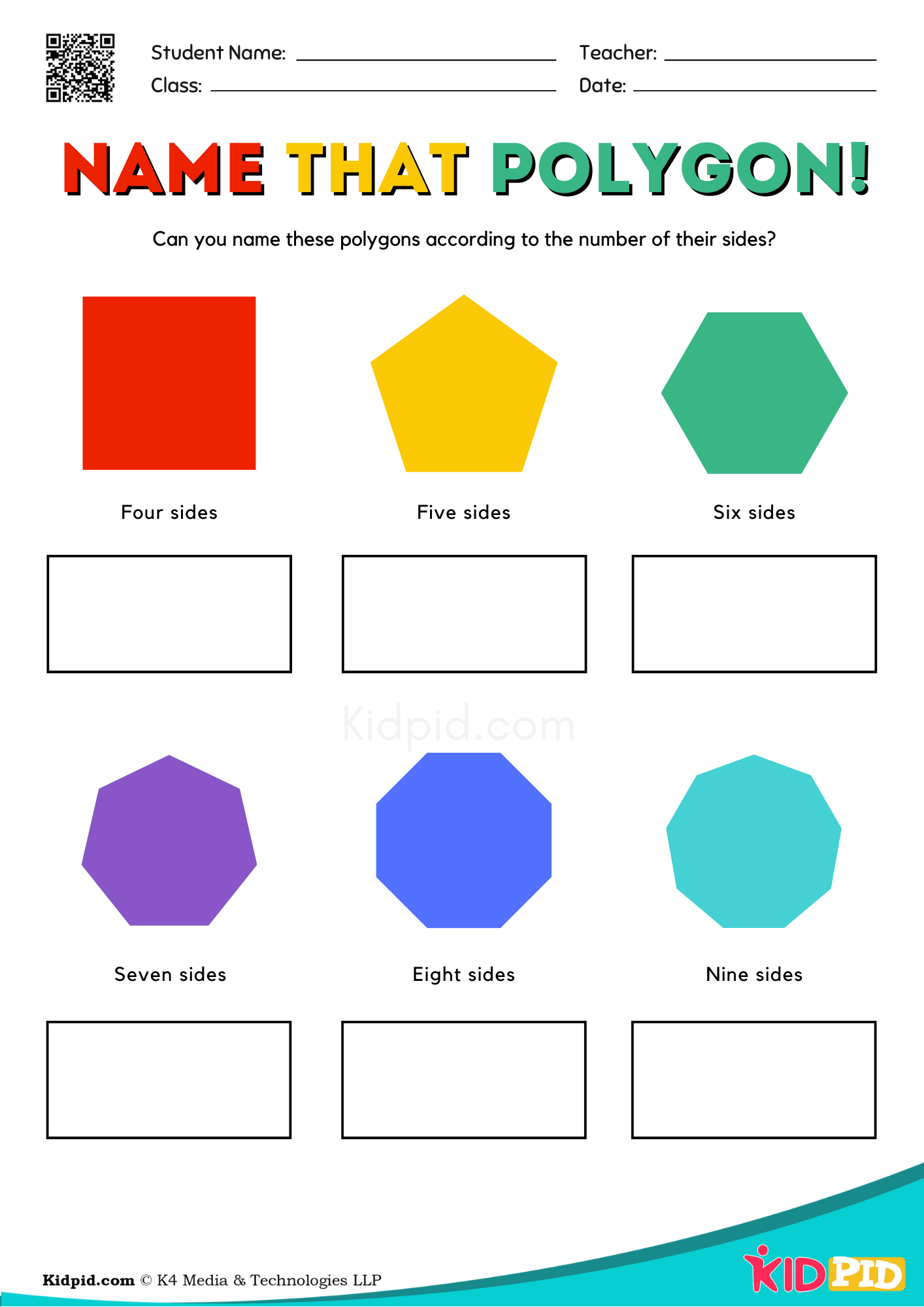
Name That Polygon Free Printable

Can you name these polygons according to the number of their sides?
Key Facts About the “Name the Polygon” Free Printable Worksheet
- Target Grade Levels: Ideal for Elementary and Middle School students (Grades 2 to 5).
- Format: Free downloadable and printable PDF.
- Core Topic: Foundational geometry—focusing on 2D shape identification, counting geometric attributes, and applying proper geometric nomenclature.
- Skill Built: Visual tracking, logical classification, and mathematical literacy.
- Assessment Feature: Includes a clear answer key for instant self-assessment or effortless grading by educators and parents.
Parts, Types, and Examples of Polygons
To master this worksheet, students learn to break down 2D shapes into their fundamental architectural parts and categorize them into specific types.
1. Parts of a Polygon
- Sides: The straight line segments that form the boundary of the flat shape.
- Vertices (Singular: Vertex): The corner points where two straight sides intersect.
- Interior Angles: The angles formed on the inside of the polygon where two sides meet.
2. Types of Polygons
- Regular Polygons: Shapes where all sides are equal in length, and all interior angles are equal (e.g., an equilateral triangle or a square).
- Irregular Polygons: Shapes with sides and angles of varying measurements.
- Convex Polygons: Shapes where all internal angles are less than 180° and all vertices point outward.
- Concave Polygons: Shapes that have at least one interior angle greater than 180°, causing the shape to “cave in.”
3. Common Examples Covered in the Worksheet
- Triangle: 3 Sides, 3 Vertices
- Quadrilateral: 4 Sides, 4 Vertices
- Pentagon: 5 Sides, 5 Vertices
- Hexagon: 6 Sides, 6 Vertices
- Heptagon: 7 Sides, 7 Vertices
- Octagon: 8 Sides, 8 Vertices
How Does the “Name the Polygon” Worksheet Work?
This worksheet utilizes a scaffolded learning approach designed to transition a child from passive viewing to active mathematical analysis.
-
- Observation: The student looks at a specific 2D shape presented on the page.
- Attribute Counting: Instead of guessing, the student systematically counts the number of straight sides or corner vertices.
- Data Matching: The student matches the total count to its corresponding geometric prefix (e.g., 5 sides = Penta-).
- Identification: The student writes the exact name of the polygon in the provided blank line, reinforcing spelling and retention.
Benefits of Learning About Polygons
Mastering the classification of two-dimensional shapes provides several foundational benefits for young learners:
- Advanced Spatial Awareness: Helps children mentally manipulate objects and understand the geometry of physical spaces.
- Pre-Algebra & Higher Math Readiness: Knowing regular and irregular shape attributes is mandatory before moving on to calculating area, perimeter, volume, and coordinate graphing.
- Cognitive Classification Skills: Teaches the brain how to categorize items in the real world based on strict, rule-based attributes.
Learning Objectives
By completing this printable geometry resource, students will be able to:
- Differentiate between standard polygons (closed shapes with straight sides) and non-polygons (open shapes or shapes with curved edges).
- Accurately count the number of sides, vertices, and interior angles of any given two-dimensional figure.
- Memorize and spell the specific names of polygons from triangles up to octagons.
- Classify shapes instantly by linking their structural attributes to the correct geometric terms.
Worksheet Instructions
Instructions for the Student:
- Grab a pencil and find a quiet place to work.
- Look at each shape in the boxes carefully.
- Use your pencil to place a small dot on each side as you count them so you don’t count the same side twice!
- Write down the number of sides you found.
- Use the Word Bank (if provided) or your memory to find the name that matches that number of sides.
- Neatly write the name of the polygon on the line below the shape.
- Once finished, use the Answer Key to check your work and celebrate your correct answers!
Interesting Facts About Polygons
- The Infinite Ultimate Shape: If you keep adding sides to a regular polygon forever (a 100-sided hectagon, a 1,000-sided chiliagon, etc.), the shape gets closer and closer to becoming a perfect circle! However, a true circle is technically not a polygon because it has a curved edge.
- The “Stop” Sign Origin: The iconic red Stop Sign is an octagon (8 sides) specifically because its unique shape makes it easy for drivers to recognize from the back or at night, preventing traffic accidents.
- Nature loves Hexagons: Honeybees build their hives out of perfect hexagons because it is the most efficient geometric shape for packing cells together tightly without wasting any wax or space.
Vocabulary Words
- Polygon: A flat, 2D closed shape made entirely out of three or more straight line segments.
- Vertex: A mathematical corner where two lines meet to form an angle.
- Dimension: A measurable extent of some kind, such as length, breadth, or height (Polygons are strictly 2-dimensional).
- Prefix: A word part added to the beginning of a word to alter its meaning. (In geometry: Tri- means 3, Quad- means 4, Penta- means 5, Hexa- means 6, and Octa- means 8).
- Attribute: A characteristic or feature that belongs to a specific shape, such as its number of sides or angles.
Real-Life Applications of Polygons
Geometry isn’t just a classroom subject—polygons are the building blocks of our daily world:
- Architecture and Construction: Roof trusses use triangles because they are the most rigid polygon and will not deform under heavy structural weight.
- Video Game Design: Every 3D character, environment, and object in modern video games is made out of thousands of tiny connecting triangles and quadrilaterals called a “polygon mesh.”
- Graphic Design and Art: Logo creators use regular polygons to convey trust, symmetry, and balance to consumers.
FAQs
Q1. Is a circle considered a polygon?
Answer: No. A polygon must be made entirely of straight line segments. Since a circle consists of a continuous curve, it does not qualify as a polygon.
Q2. What is the smallest possible polygon?
Answer: A triangle is the smallest possible polygon. You need at least three straight lines connecting with one another to fully close a 2D shape.
Q3. What is the difference between a side and a vertex?
Answer: A side is the straight line edge of the shape. A vertex is the sharp corner point where two of those sides meet.
Q4. Are irregular shapes still considered polygons?
Answer: Yes! As long as the shape is completely closed and made only of straight lines, it is a polygon—even if all the sides and angles are completely different lengths and sizes.
Hope you liked these fruit name printables. At Kidpid, you can find free printable colouring pages, sheets, colouring books, illustrations, printable pictures, clipart, black and white pictures, line art, and drawings for kids. You can find here hard and detailed patterns, advanced animal drawings, simple colorings, or easy outlines. These enjoyable activities encourage strong language foundations. Browse our website for worksheets, essays, paragraphs, flashcards, quizzes, and interactive resources. Follow us on YouTube & Facebook.
This worksheet is thoughtfully designed by the Content Team to promote academic improvement.
Reviewed By Sanjana
More Printables