

English is a global language. It is the official language of several countries. To gain proficiency in the language of English language is no easy feat. But as with everything in this world, it is attainable through enough practice. Speaking and writing in English correctly requires a firm grasp of the concepts of grammar.
The following worksheet consists of exercises related to one of the eight parts of speech in the English language: the noun.
The part of speech indicates how a word functions in meaning as well as grammatically correct within a sentence. The noun is one of the eight parts of speech in the English language.
A noun is defined as a word that names something, such as a person, place, thing, or idea. In simple terms, a noun is a word that refers to someone, somewhere, or something. It functions as the name of a specific object or set of objects, such as places, creatures, objects, etc.
There are several types of nouns:
- Common nouns– Common nouns are words used to denote something. Words like “car,” “man,” and “bridge” are common nouns.
- Proper nouns- A proper noun is a specific name given to a thing, place, or person. Taj Mahal is a proper noun.
- Abstract nouns- Abstract nouns are nouns that refer to things that one cannot see or feel. Anger, fear, and courage are abstract nouns.
- Collective nouns- Collective nouns are nouns such as “team,” “gang,” etc. These are the names given to a collection of things, people, or places.
Contents
- Noun With Pictures Practice Worksheet
- Key Facts About Grade 1 Nouns with Pictures Worksheets
- Parts, Types, and Examples of Nouns for Grade 1
- How Do Nouns with Pictures Worksheets Work?
- Benefits of Learning About Nouns Early On
- Learning Objectives
- Worksheet Instructions for Parents and Teachers
- Interesting Facts About Nouns & Vocabulary Words
- Real-Life Applications
- FAQs
- You may like these:
Noun With Pictures Practice Worksheet

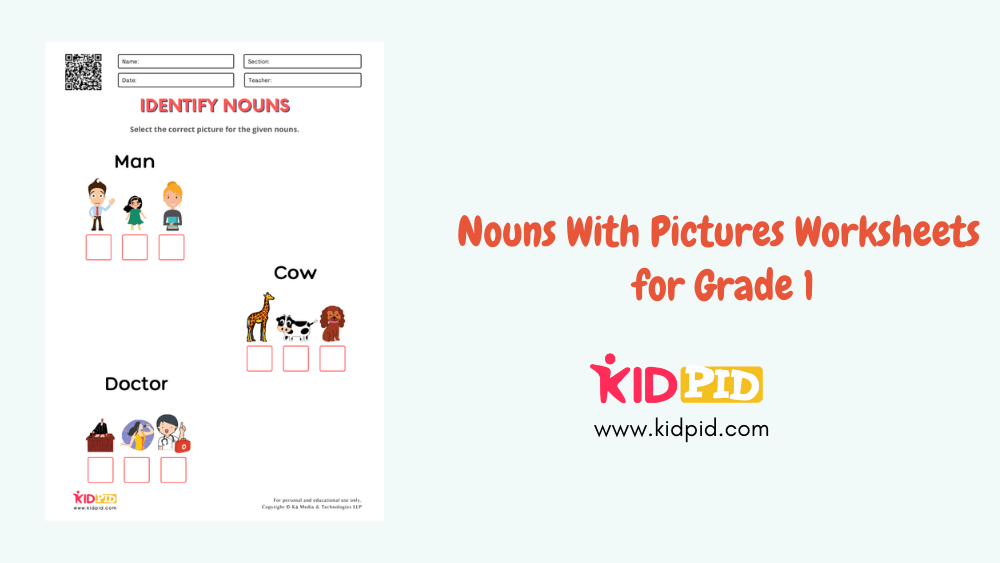
In the following worksheet, children are required to identify the correct nouns from the given picture. For example, in the first worksheet, the first word is “man”. The child has to identify the correct image associated with that and mark the box under the correct picture.
There are 10 different worksheets with three questions each. The worksheet is relatively easy to solve. If the child is unable to do the task at hand, guide him.
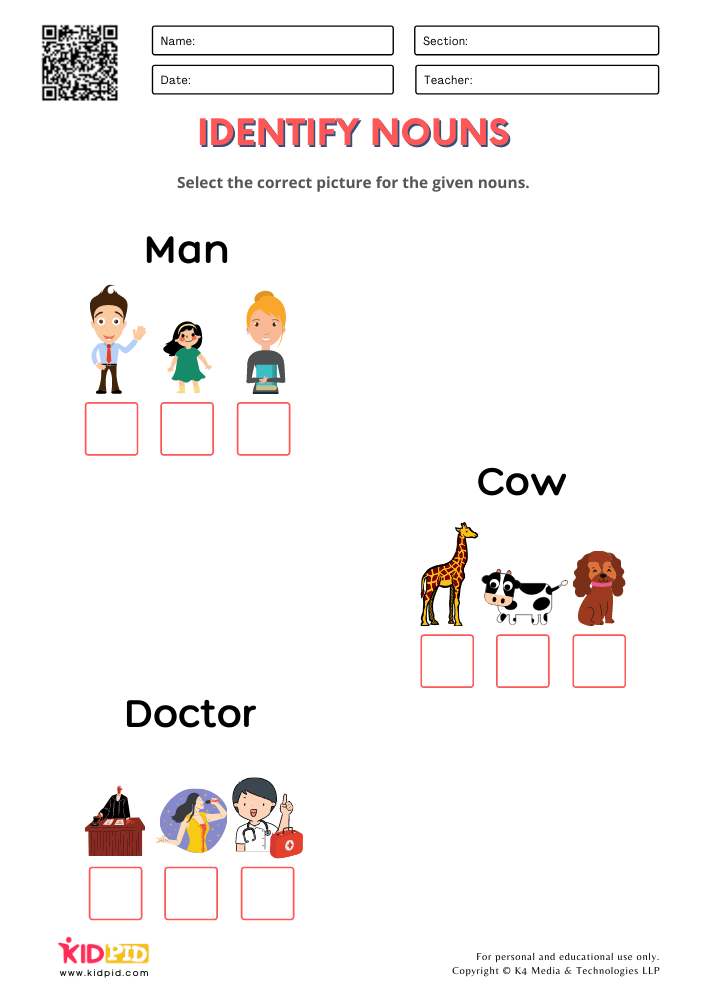
This is the second sheet. The child has to identify a church, a nurse, and a boat.
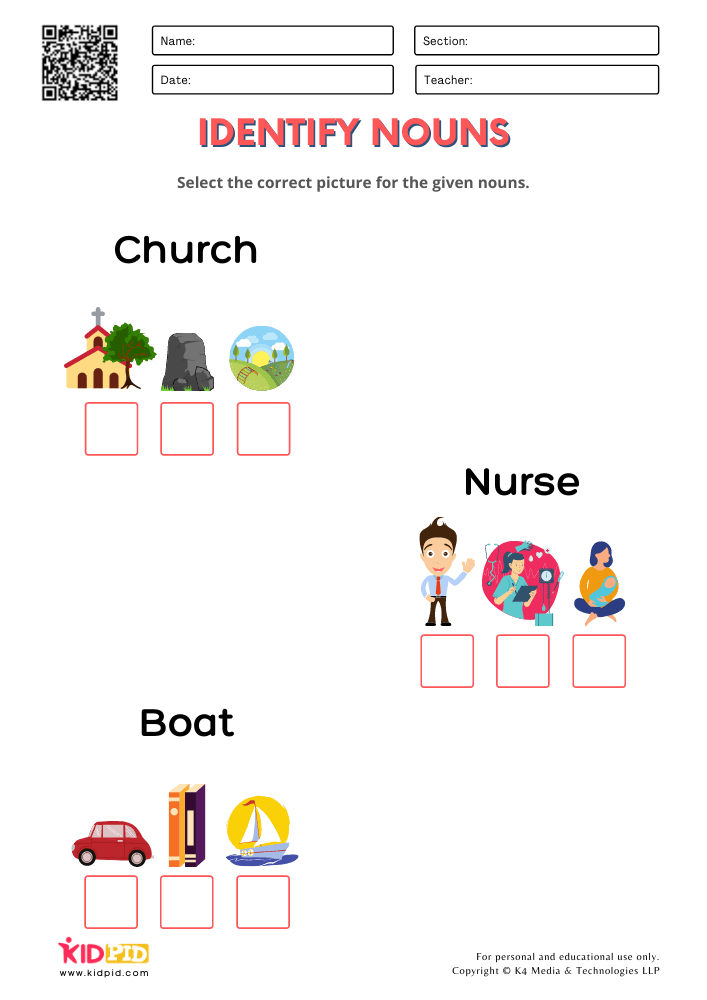
In the third sheet, the kid has to identify a Parrot, an apple, and a rose.
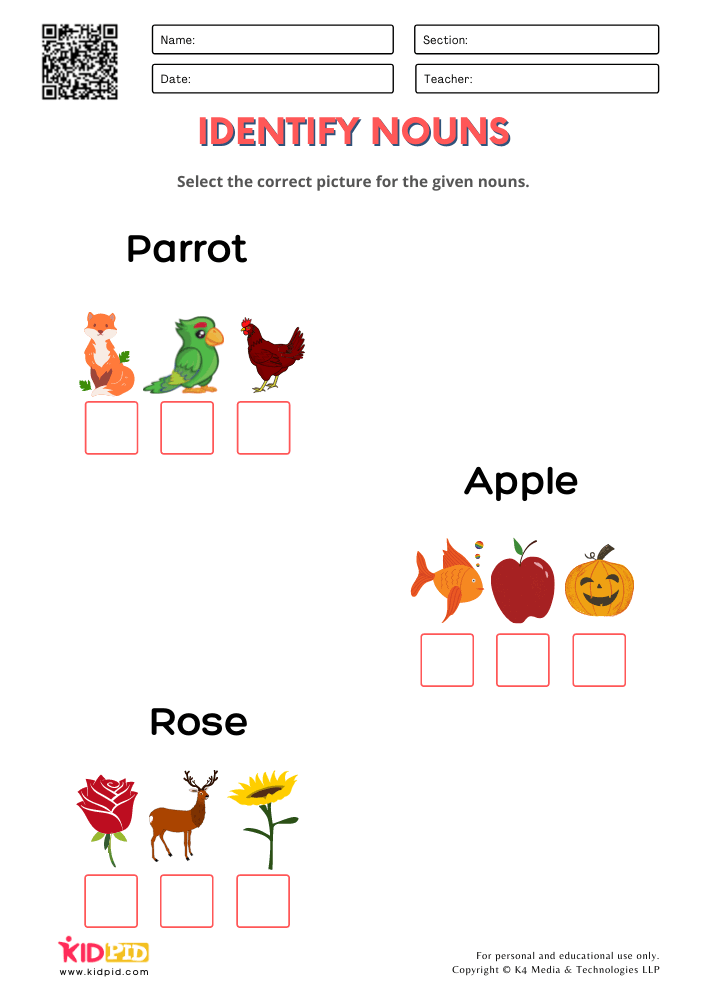
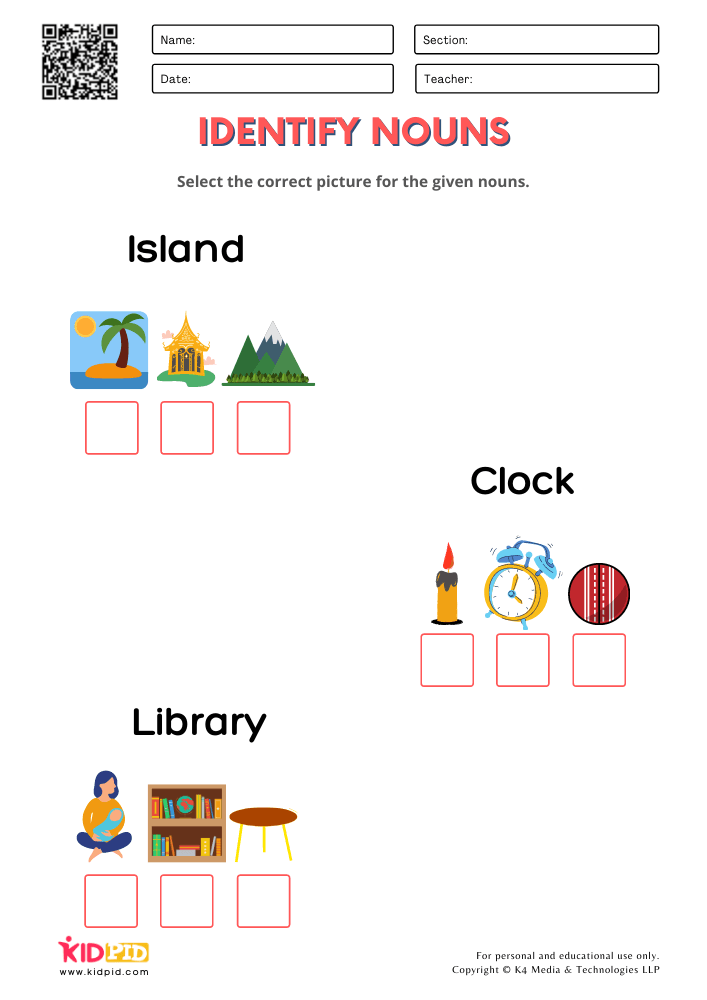
The fourth sheet requires the child to identify an Island, a clock, and a library.
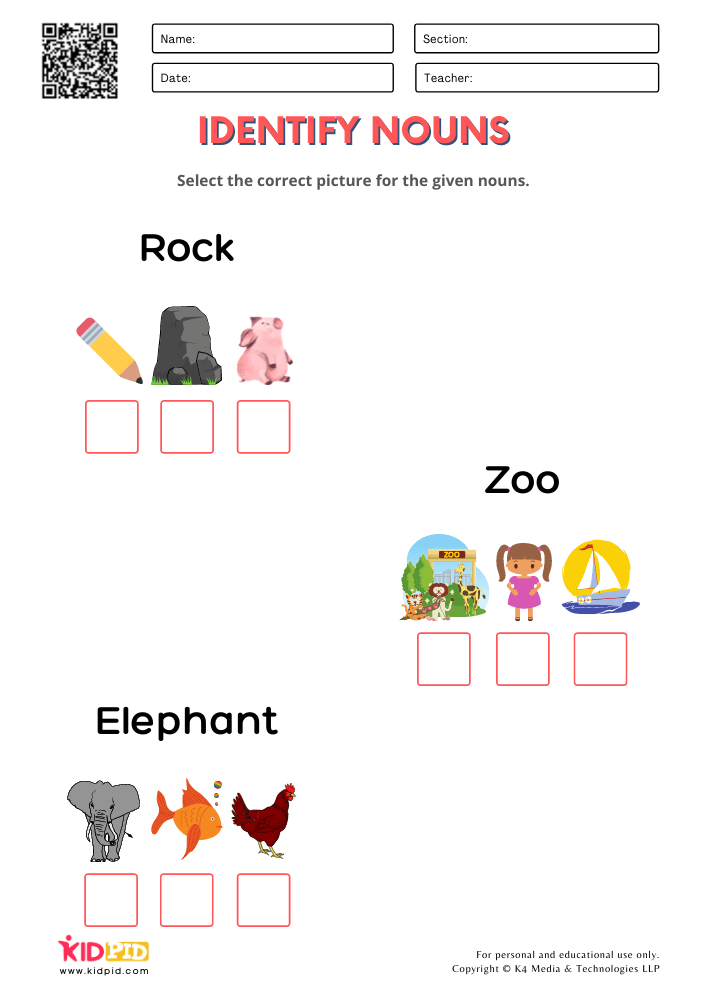
This is the fifth sheet. Here, the child has to identify the nouns such as rock, zoo, and elephant.
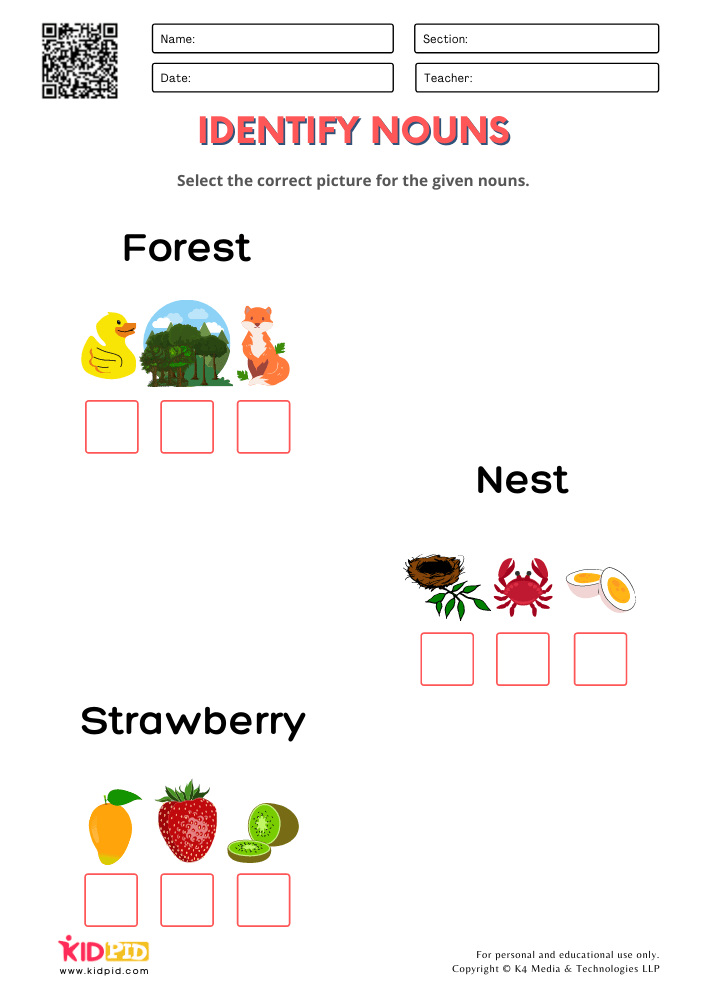
In the sixth sheet, children will be able to identify nouns such as forest, nest, and strawberry. Through these images, a child will develop a better understanding of what nouns are.
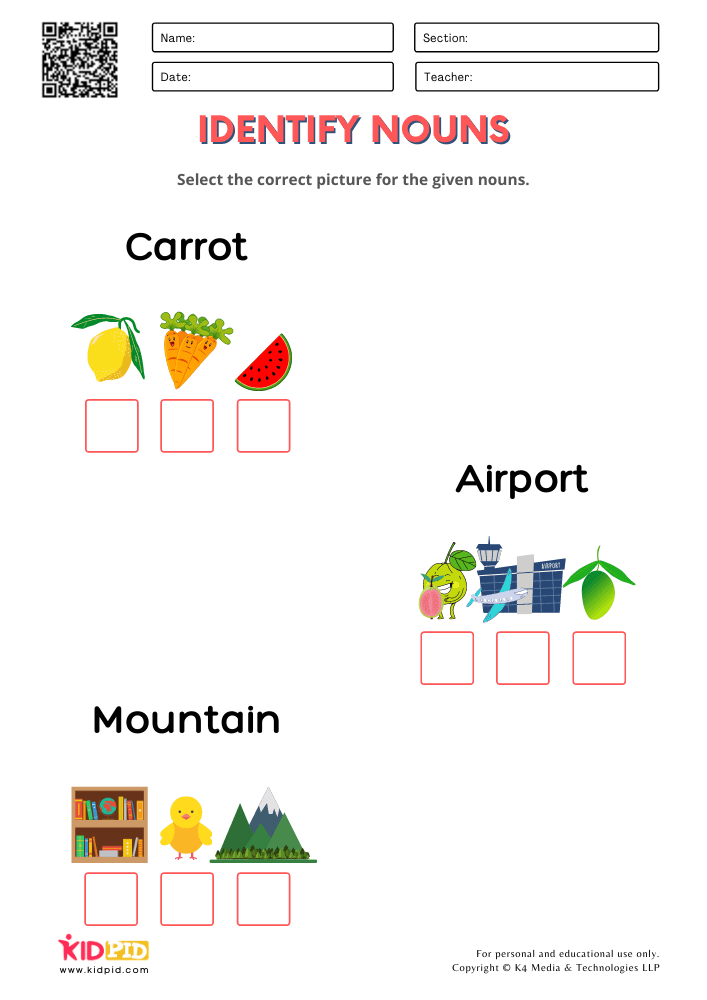
This is the seventh sheet that introduces the child to a carrot, an airport, and a mountain as nouns.
The eighth sheet of the series asks to identify a duck, a village, and a library.
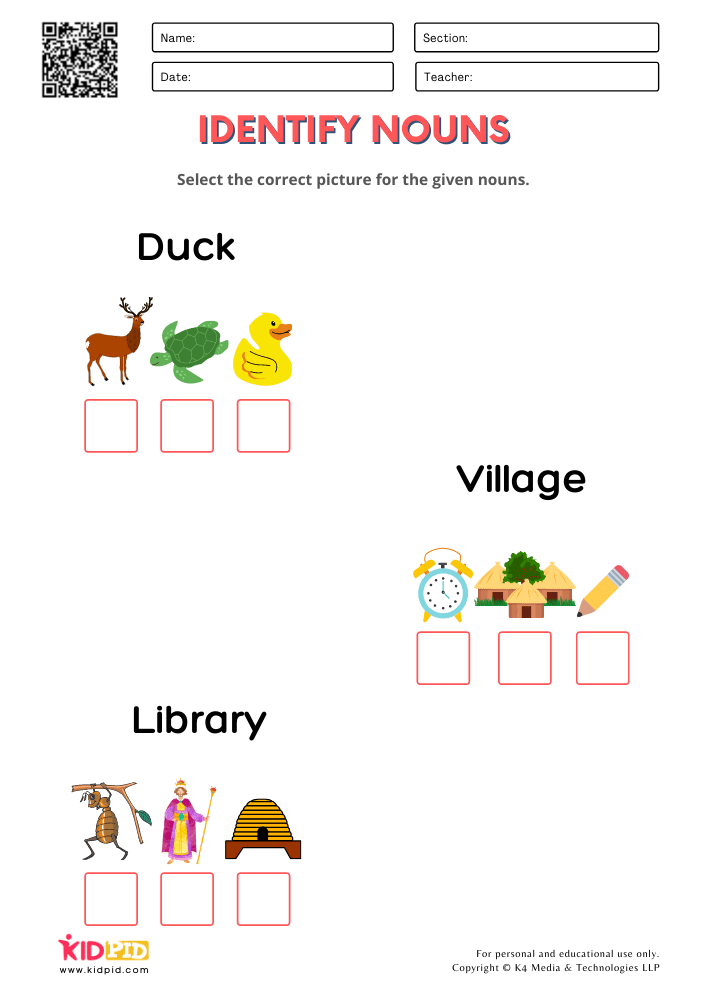
By now, your kid must have developed an understanding of what nouns are. To test his understanding, the following worksheets require him to circle the images of the nouns from the pictures given below.
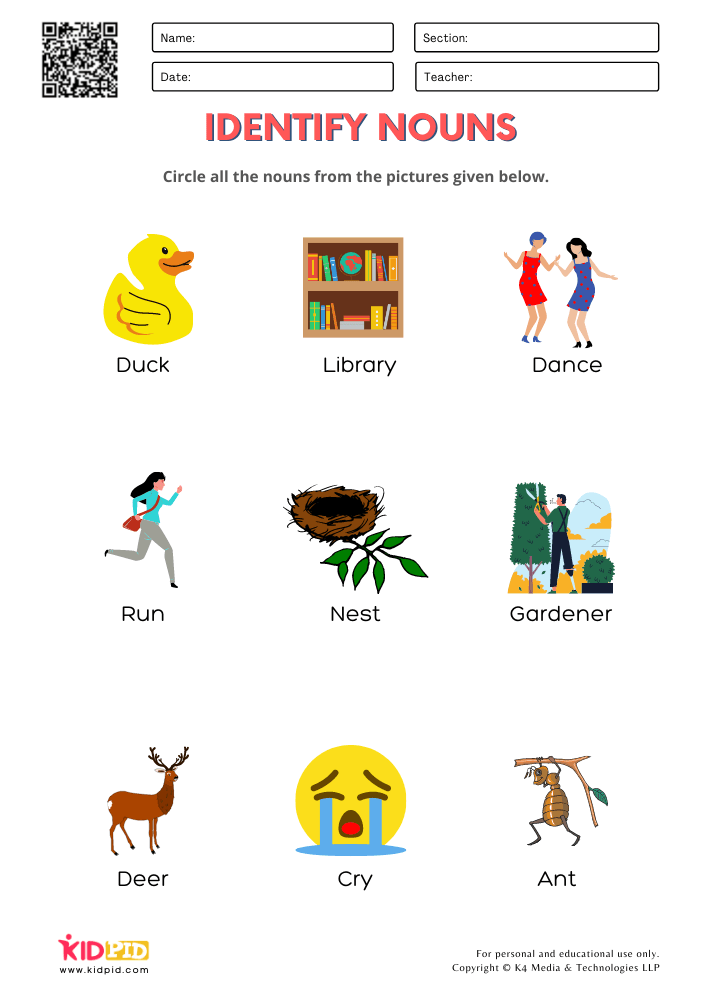
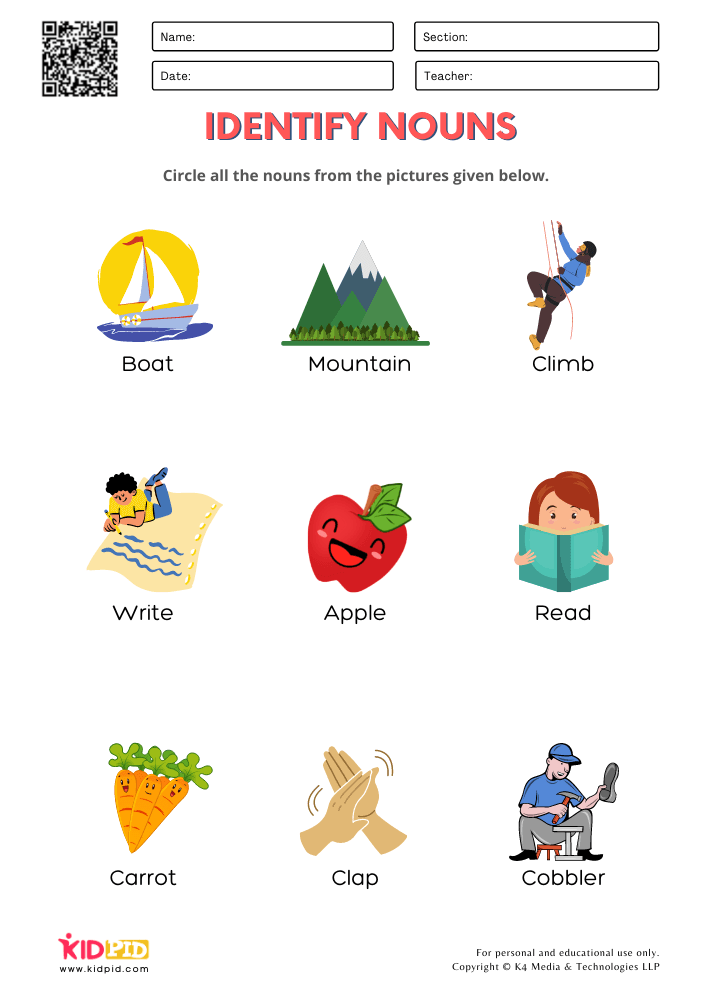
All our worksheets are available for download. These worksheets will enable the children to identify the different types of nouns used in the sentences.
Key Facts About Grade 1 Nouns with Pictures Worksheets
- Target Age Group: 6–7 years old (Grade 1 / Year 2).
- Core Skill Focus: Noun identification and concrete categorization (naming people, places, and things).
- Learning Style Alignment: Visual-spatial and tactile learning through image matching, coloring, and circling activities.
- Curriculum Standard Mapping: Aligns directly with foundational grammar standards, focusing on determining the meaning of words and identifying common parts of speech.
Parts, Types, and Examples of Nouns for Grade 1
At a first-grade level, instruction should avoid abstract concepts and focus entirely on concrete nouns that children can easily see, touch, or interact with. These worksheets categorize nouns into three major buckets:
- People (Who): Examples include a man, a nurse, a baby, a teacher, and an astronaut.
- Places (Where): Examples include church, library, island, zoo, airport, village, forest, mountain.
- Things (What): Examples include boat, parrot, apple, rose, clock, rock, elephant, strawberry, carrot, duck.
Note for Educators: While advanced types like abstract nouns (e.g., love, bravery) or collective nouns (e.g., flock) exist, early childhood literacy research shows that mastering physical, concrete nouns first forms the essential cognitive foundation for sentence structure.
How Do Nouns with Pictures Worksheets Work?
These printables leverage visual scaffolding to build reading confidence. Instead of forcing a six-year-old to decipher dense blocks of text, the worksheets use a simple, two-step cognitive process:
- Visual Recognition: The child looks at a clear, high-quality illustration representing an object or location (e.g., a drawing of a clock or an elephant).
- Grammatical Association: The child connects the visual image to its spoken and written name, recognizing it as a “naming word” (a noun). By checking boxes or circling correct pictures, young learners isolate the part of speech without getting bogged down by complex sentence syntax.
Benefits of Learning About Nouns Early On
- Prevents “Decoding Fatigue”: Traditional grammar exercises require kids to read full sentences to find nouns. Picture-based sheets allow struggling or early readers to learn grammar rules without being limited by their current reading fluency.
- Accelerates Vocabulary Building: By pairing words like island, library, and simpler nouns with pictures, kids expand their receptive vocabulary alongside grammar.
- Improves Sentence Mechanics: Once a child can confidently spot a noun, they can easily locate the subject of a sentence, paving the way for proper capitalization and verb agreement.
Learning Objectives
By completing these 10 structured practice sheets, students will achieve the following developmental milestones:
- Identify everyday people, places, and things from visual prompts.
- Classify written words into their correct noun categories.
- Demonstrate fine motor control through precision marking (circling, checking boxes).
- Express foundational grammar rules by explaining why an object or person qualifies as a noun.
Worksheet Instructions for Parents and Teachers
To maximize engagement and prevent frustration, use these simple instructions when presenting the activities to your child:
- For Sheets 1 to 7 (Word-to-Image Matching): “Read the word printed at the top of the box out loud. Look at the three pictures underneath it. Find the picture that matches the word, and put a big checkmark or an ‘X’ in the small box right below it.”
- For Sheets 8 to 10 (Noun Clustering): “Look closely at the group of pictures on the page. Some are actions, and some are naming words. Use your pencil to draw a clean circle only around the pictures that show a person, a place, or a thing.”
Interesting Facts About Nouns & Vocabulary Words
Did you know that nouns make up more than 50% of the entire English language? It’s true! Here are a few fun vocabulary facts to share with your students while grading their work:
- The “Everything” Word: Almost every single thing you can see, hear, touch, or smell right now is a noun.
- The Word “Noun” itself: The word comes from the Latin word nomen, which literally means “name.” So when you look for a noun, you are just looking for a name!
- First Words: When babies first learn to talk, nearly all of their very first words (Mama, Dada, ball, milk) are nouns.
Real-Life Applications
Grammar isn’t just an abstract school subject—it is how we describe our world. Mastering nouns directly helps first graders in real life by allowing them to:
- Give Clear Directions: Knowing the nouns for places (street, park, school) helps kids communicate location safely.
- Enhance Descriptive Writing: When writing a story or journal entry about their weekend, knowing a wide variety of specific nouns makes their storytelling vivid and interesting.
- Follow Instructions: From reading game rules to following a simple recipe, recognizing the “things” (nouns) tells children exactly what items they need to interact with.
FAQs
Q1. What defines a noun for a first grader?
Answer: Keep it simple. Tell a first grader that a noun is a “naming word.” It is the name of any person, any place, or any thing you can point to or think about.
Q2. Why are pictures included in these grammar worksheets?
Answer: Pictures act as a reading bridge. First graders are still developing their phonetic reading skills. Visual cues ensure that a child’s grammatical understanding isn’t held back by their reading speed or vocabulary decoding limits.
Q3. How long should a child spend on these worksheets?
Answer: Attention spans in Grade 1 typically last between 10 and 15 minutes per task. Because these sheets are divided into small, three-question bites, completing one or two pages per session is ideal for keeping learning fun and productive.
Q4. Are these noun printables suitable for English Language Learners (ELL/ESL)?
Answer: Yes. The direct pairing of clear nouns with visual representations makes these sheets highly effective for vocabulary acquisition and language immersion programs.
Help Grade 1 children strengthen their grammar skills with these noun picture worksheets. Fun, interactive activities improve vocabulary, word recognition, and sentence-building while making language learning enjoyable at home or in the classroom. Discover more educational resources on our website, including worksheets, essays, paragraphs, flashcards, quizzes, and engaging learning activities. Follow us on YouTube & Facebook for fresh educational content every day.
This worksheet is thoughtfully developed by the Content Team to support learning achievement.
Reviewed By Ashima Grover
You may like these:
Person, Place, or Thing – Noun Identification Worksheet in English

This worksheet helps students classify nouns as persons, places, or things, enhancing their understanding of fundamental grammar concepts through structured exercises tailored for English language learners.
Nouns in Our Surroundings Worksheet

Designed to connect learning with real-life contexts, this worksheet encourages students to identify nouns in everyday surroundings, fostering observational skills and reinforcing basic grammatical knowledge effectively.
Worksheet for Identifying Nouns in English
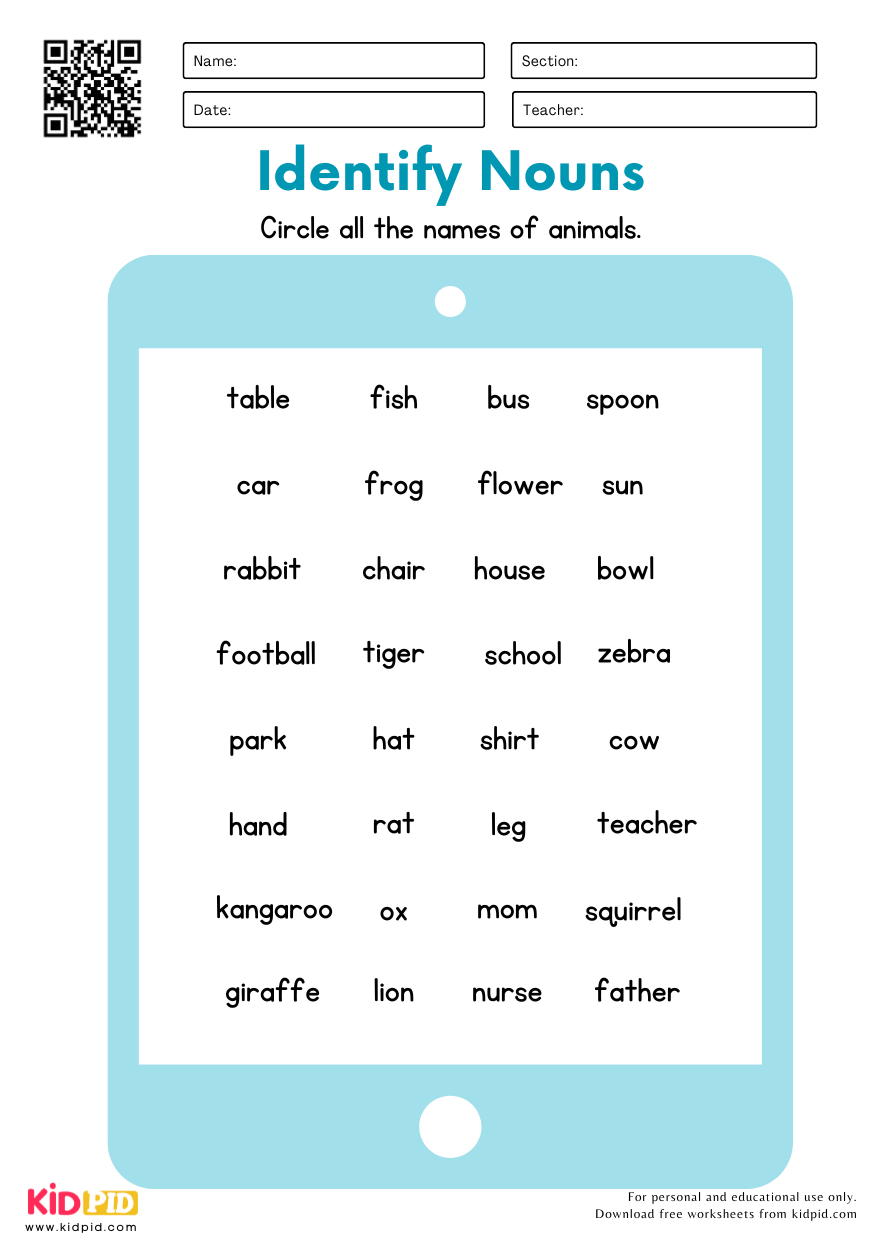
Focus on building foundational language skills. This worksheet provides practice in recognizing nouns within various contexts, helping students improve their vocabulary and grasp of English grammar systematically.
Noun Identification Worksheets for Grade 1
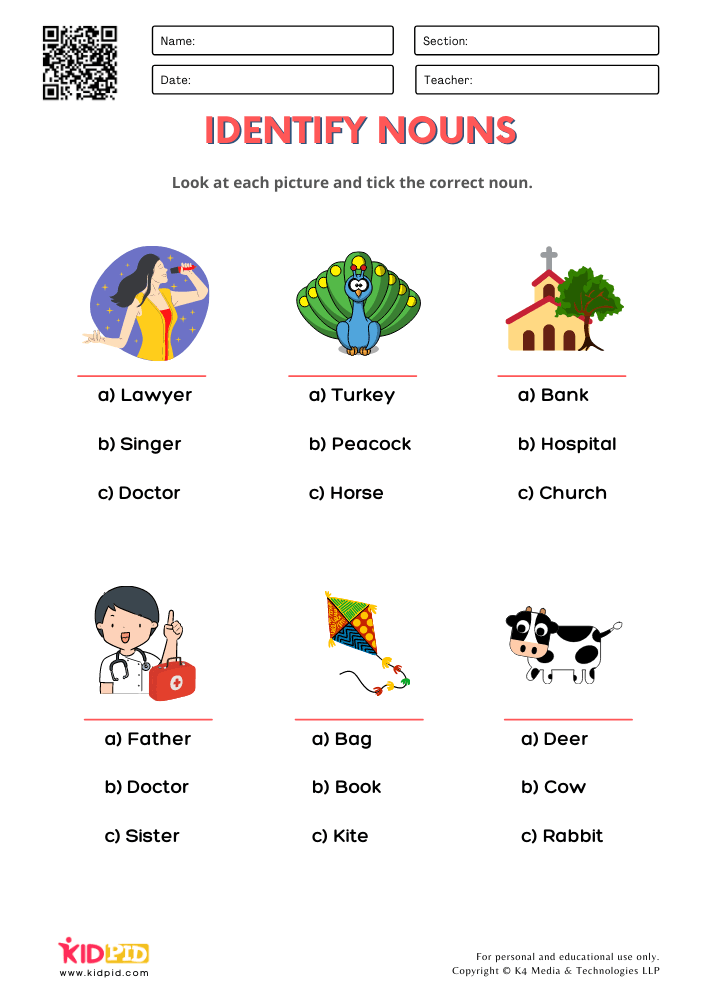
Tailored for first graders, these worksheets introduce the concept of nouns through engaging activities, enabling young learners to identify and categorize nouns confidently while developing early literacy skills.
Worksheets for Identifying Nouns Within Sentences for Grade 1
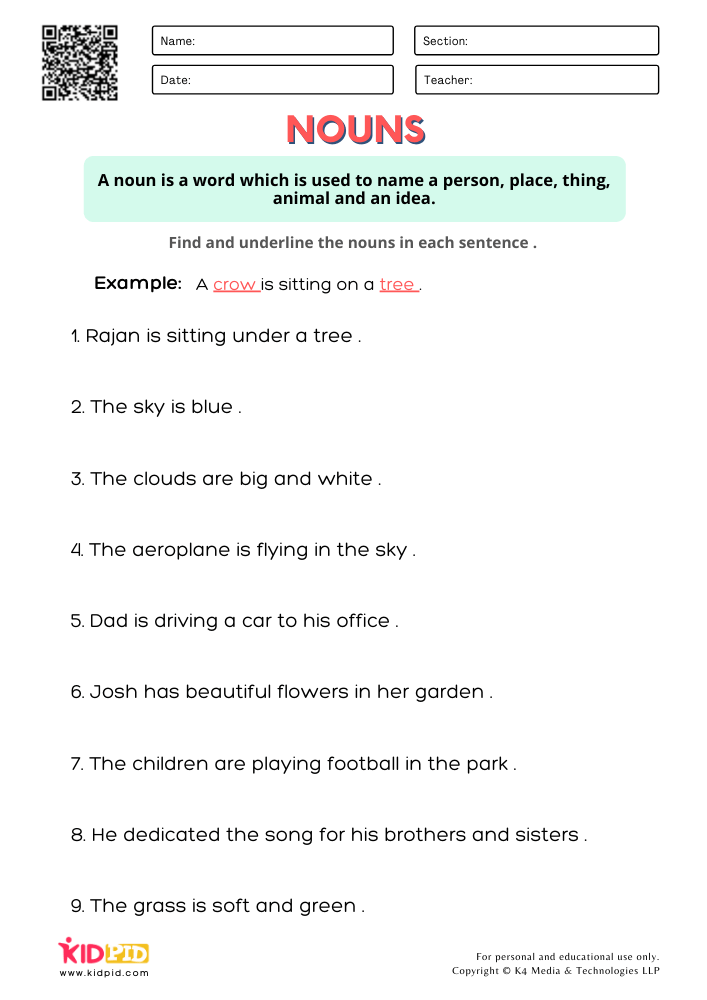
These worksheets guide Grade 1 students in locating nouns within sentences, promoting comprehension of sentence structure and parts of speech while strengthening their overall reading and writing abilities.



