
This worksheet focuses on helping students identify different types of nouns: person, place, thing, and idea. By carefully reading sentences and circling the nouns, then sorting them into categories, students will develop a stronger grasp of this fundamental part of speech.
[Scroll Down for Download Link]
Contents
- Identify Noun Worksheet For Kindergarten
- Key Facts About the Identify Nouns English Worksheet
- Parts, Types, and Examples of Nouns Covered
- How Does the Identify Nouns English Worksheet Work?
- Benefits of Learning About Nouns Early On
- Learning Objectives
- Worksheet Instructions for Parents and Educators
- Interesting Facts About Nouns and Vocabulary Words
- Real-Life Applications
- FAQs
- Q1. At what age should a child start learning to identify nouns?
- Q2. Why does this specific worksheet include animals alongside people, places, and things?
- Q3. How do I help a student who keeps confusing nouns with verbs?
- Q4. Can this worksheet be used for remote learning or homeschooling environments?
- You may like these:
Identify Noun Worksheet For Kindergarten
Read More: Nouns Matching Flashcards
Identify Nouns – People
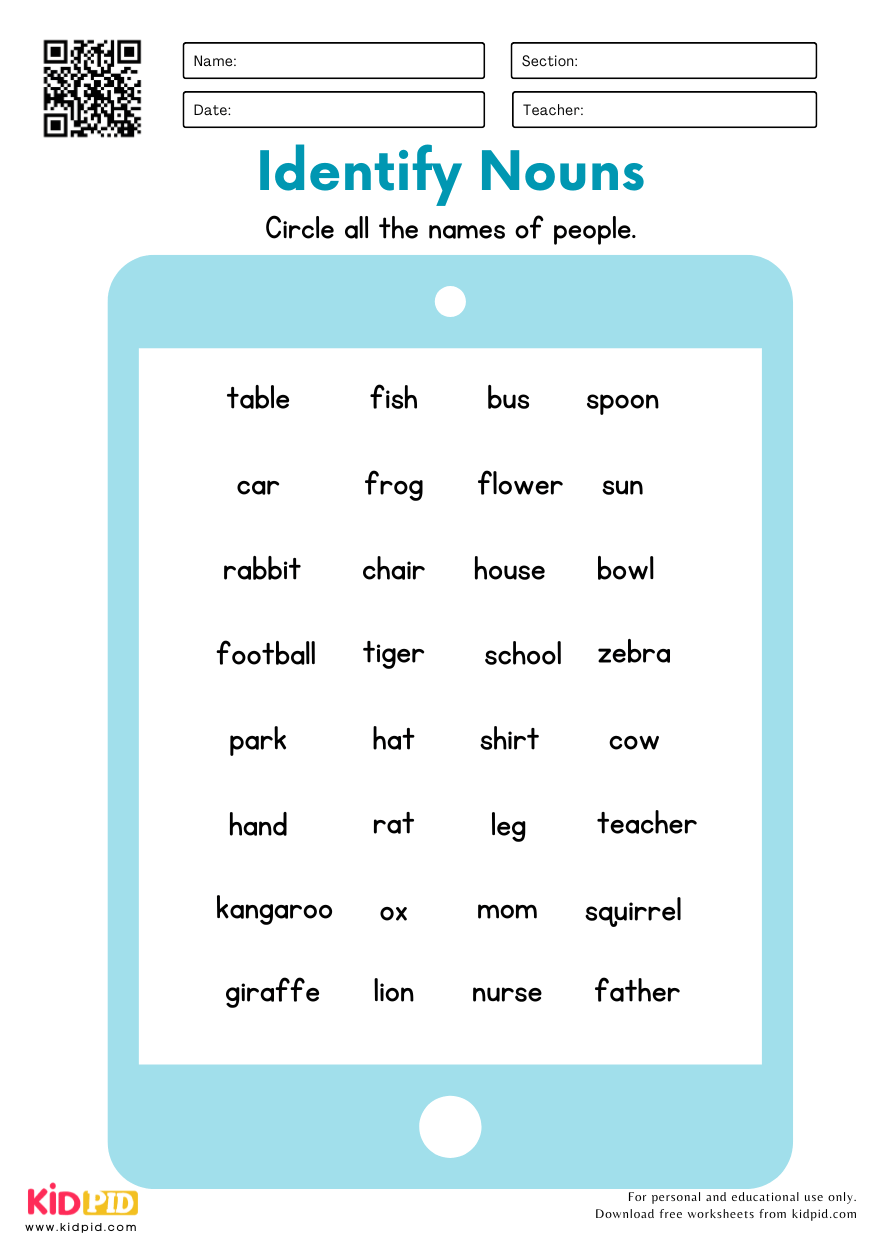
- Teacher
- Mom
- Nurse
- Father
Identify Nouns – Animals
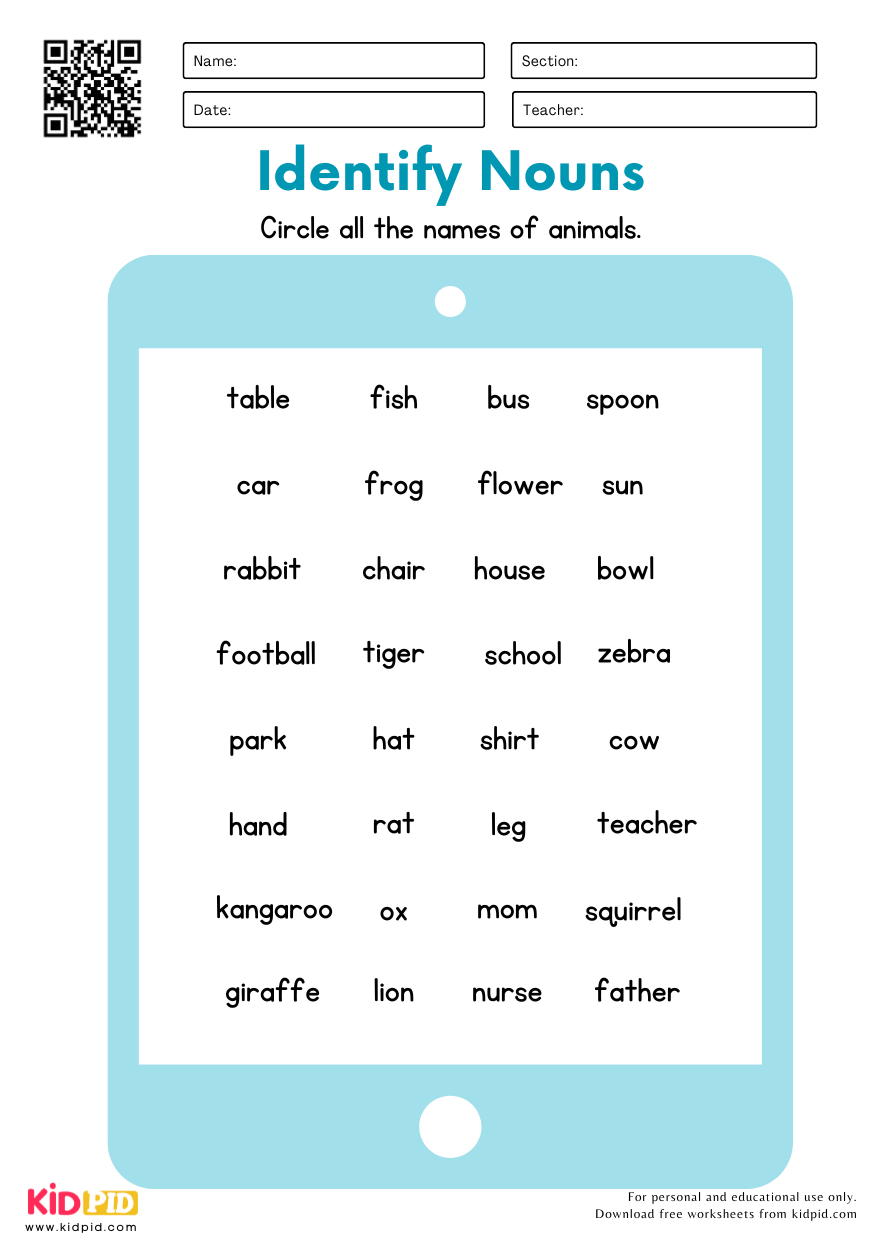
- Fish
- Frog
- Rabbit
- Tiger
- Zebra
- Cow
- Rat
- Kangaroo
- Giraffe
- Ox
- Lion
- Squirrel
Identify Nouns – Places
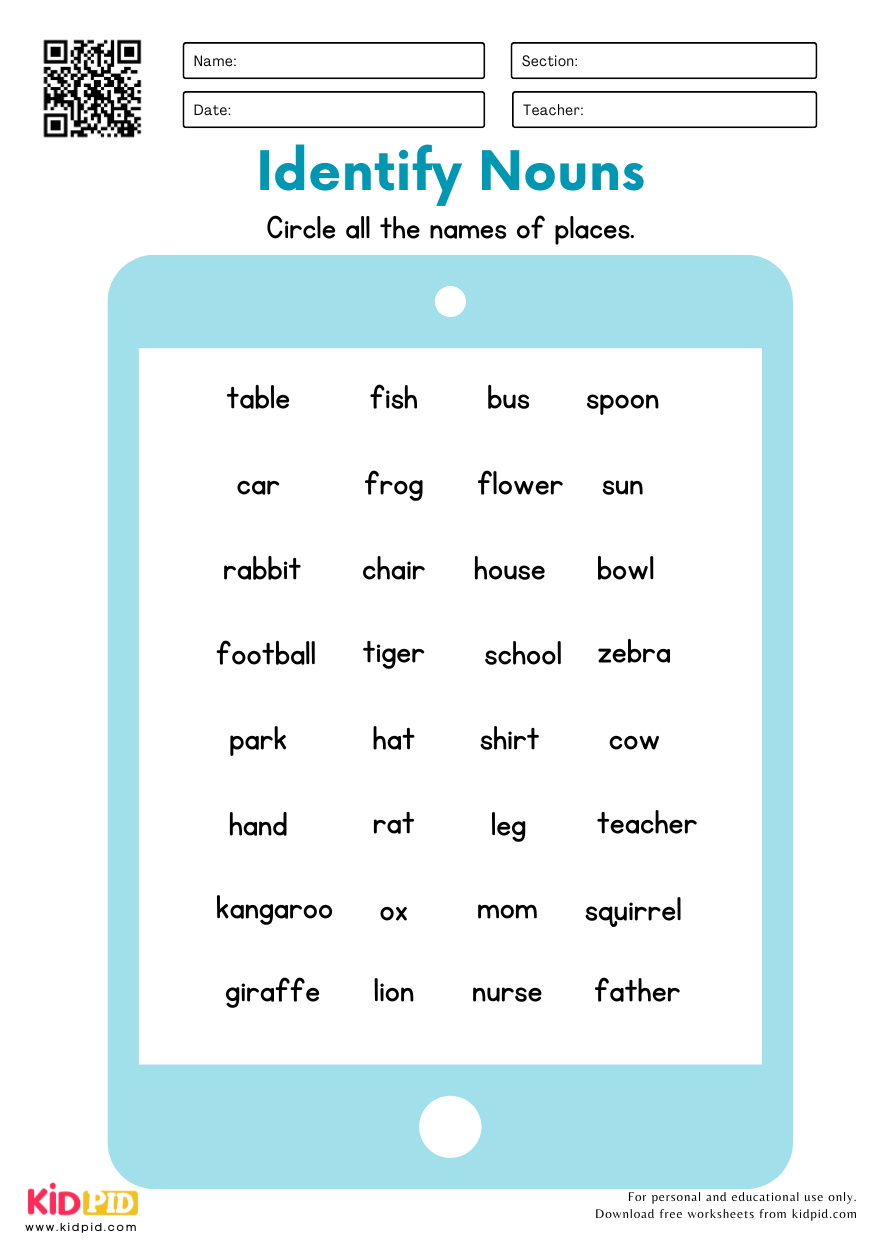
- House
- School
- Park
Identify Nouns – Things
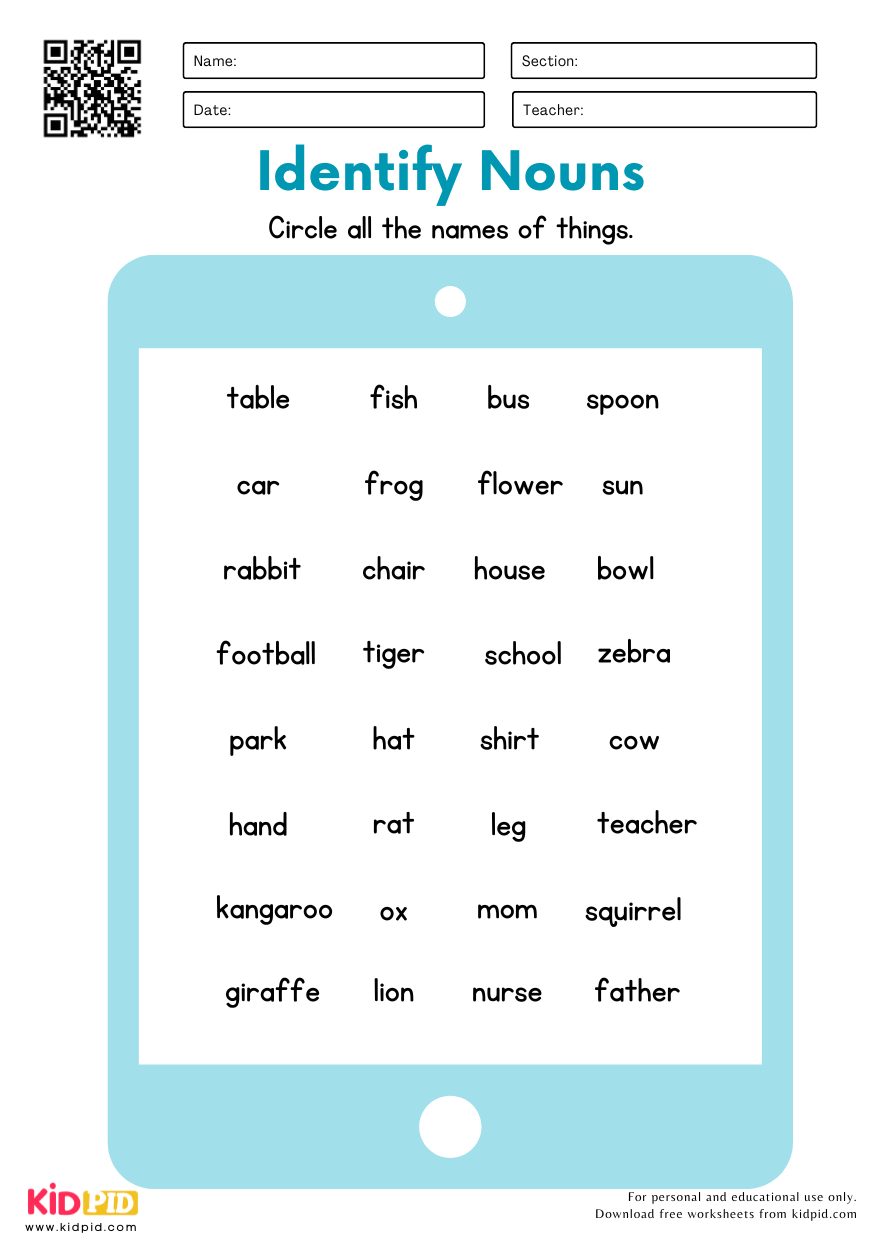
- Table
- Car
- Football
- Hand
- Chair
- Hat
- Bus
- Flower
- Shirt
- Leg
- Spoon
- Sun
- Bowl
The exercises in this worksheet provide an engaging way for students to apply their knowledge of nouns. This practice supports their overall language development and prepares them for more advanced grammar and writing tasks.
Key Facts About the Identify Nouns English Worksheet
- Target Grade Levels: Ideal for early learners, including Preschool, Kindergarten, and Grade 1 students.
- Core Focus: Introduces foundational parts of speech by training young minds to recognize naming words.
- Format: Free, downloadable, and printable high-quality visual worksheets.
- Design: Uses clear typography paired with recognizable real-world illustrations to sustain a child’s attention span and aid contextual association.
- Curriculum Alignment: Developed by educational content specialists to support foundational early literacy and English Language Arts (ELA) framework guidelines.
Parts, Types, and Examples of Nouns Covered
This worksheet breaks down the expansive concept of nouns into four easily digestible, child-friendly categories. Separating nouns into these distinct groups helps children categorize their surroundings and build semantic vocabulary.
- People (Who): Foundational roles and figures children encounter daily.
- Examples included: Teacher, Mom, Nurse, Father.
- Animals (Creatures): Familiar domestic and wild fauna that spark curiosity.
- Examples included: Fish, Frog, Rabbit, Tiger, Zebra, Cow, Rat, Kangaroo, Giraffe, Ox, Lion, Squirrel.
- Places (Where): Locations that represent safety, community, and recreation.
- Examples included: House, School, Park.
- Things (What): Tangible, everyday objects found in a child’s environment.
- Examples included: Table, Car, Football, Hand, Chair, Hat, Bus, Flower, Shirt, Leg, Spoon, Sun, Bowl.
How Does the Identify Nouns English Worksheet Work?
- Visual Recognition & Reading: The child reads the word (or identifies the accompanying picture block) to process the semantic meaning of the noun.
- Tactile Engagement: Students interact with the page by circling, highlighting, or matching the text.
- Categorization & Sorting: Once identified, students actively sort the words into their structural columns (People, Animals, Places, or Things). This sorting movement forces the brain to analyze structural relationships rather than just memorizing words arbitrarily.
Benefits of Learning About Nouns Early On
Mastering nouns is the absolute gateway to functional literacy. Because nouns make up the vast majority of vocabulary words in the English language, early proficiency yields massive educational advantages:
- Accelerated Sentence Construction: A child cannot build a complete thought without a subject. Nouns provide the “who” or “what” that anchors every sentence.
- Enhanced Reading Comprehension: When kids instantly spot nouns, they waste less cognitive energy decoding individual words and focus more on understanding the plot or context of a story.
- Prepares for Advanced Grammar: Early ease with basic nouns creates a smooth transition toward learning verbs, adjectives, and complex singular/plural rules later in Grades 1 and 2.
Learning Objectives
By completing these grammar practice activities, young learners will achieve the following milestones:
- Identify and isolate common nouns found within basic words or introductory sentences.
- Differentiate systematically between a person, an animal, a place, and a physical object.
- Expand everyday expressive and receptive vocabulary bank through image-to-word association.
- Strengthen fine motor coordination through guided writing, tracing, and circling exercises.
Worksheet Instructions for Parents and Educators
To maximize the educational value of this printable resource, try following this simple multi-step teaching sequence:
- Step 1: Introduction: Begin with an oral warm-up. Ask your student to point to an object in the room (a chair) or name a person they love (Mom). Explain that these “naming words” are called nouns.
- Step 2: Guided Practice: Print out the PDF file. Sit with your learner and look at the first section together. Read out loud the first few words (e.g., “Teacher,” “House”) and help them identify if it is a person, animal, place, or thing.
- Step 3: Active Identification: Instruct the child to use a pencil or a colorful crayon to circle the target nouns on the page.
- Step 4: Sorting & Verification: Have the child read through their circled selections and write or place them into the correct labeled columns at the bottom of the activity page.
Interesting Facts About Nouns and Vocabulary Words
- The Origin of the Word: The word “noun” directly originates from the Latin word nomen, which literally translates to “name.”
- Dominating the Dictionary: Nouns make up more than 50% of all words found in the English language dictionary!
- A Natural Starting Point: Psycholinguistic research shows that in almost every human culture, “nouns” are the very first group of words a baby learns to speak (like “Mama”, “Dada”, or “Milk”).
Real-Life Applications
Grammar isn’t just an abstract school subject; it shapes how kids see and navigate their daily lives:
- Following Clear Directions: When a child understands nouns, they can accurately interpret everyday safety instructions (e.g., “Put your shoes in the closet at school” relies on tracking three specific nouns).
- Descriptive Communication: Expressing physical or emotional needs clearly to adults depends entirely on accurately identifying people, locations, and missing objects.
- Creative Storytelling: Allows children to paint vivid pictures during playtime by clearly populating their imaginary worlds with specific characters (people/animals) and settings (places).
FAQs
Q1. At what age should a child start learning to identify nouns?
Answer: Introducing the concept of naming words can start as early as age 3 or 4 (Preschool). Formal structural identification and sorting using worksheets typically begin around ages 5 to 7 (Kindergarten and Grade 1).
Q2. Why does this specific worksheet include animals alongside people, places, and things?
Answer: While traditional advanced grammar definitions group animals under “things” or “living organisms,” early childhood pedagogy separates animals into their own distinct category. Young children possess a natural affinity for wildlife, making separate animal categories highly engaging and easier to categorize mentally.
Q3. How do I help a student who keeps confusing nouns with verbs?
Answer: Use the “Physical Touch Test.” Tell the child: “If you can physically touch it, look at it, or visit it, it is a noun. If it is an action you do with your body (like jump or run), it is an action word (verb).”
Q4. Can this worksheet be used for remote learning or homeschooling environments?
Answer: Absolutely. This download is formatted as a clean, ready-to-print PDF file, making it highly flexible for traditional classroom centers, homework assignments, or structured homeschool morning routines.

The Identify Nouns English Worksheet helps children recognize nouns in sentences through engaging grammar activities. Fun practice strengthens vocabulary, reading comprehension, writing, and language skills while building confidence in using nouns correctly. Enjoy fun-filled educational resources, including worksheets, essays, paragraphs, flashcards, quizzes, and interactive resources, all available for free on our website. Follow us on YouTube & Facebook
The worksheet is created by the Content Team to encourage learning mastery.
Reviewed By Drashti
You may like these:
Identify Plural Nouns Printable Worksheets for Grade 1
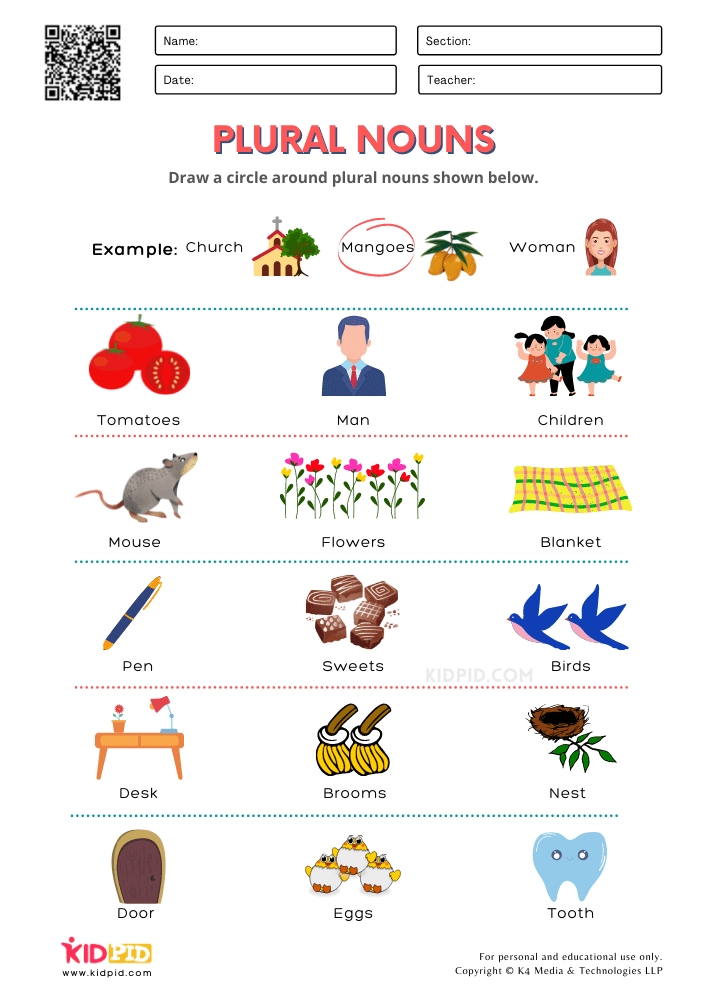
These worksheets help first graders recognize and practice plural nouns, enhancing their grammar skills through engaging exercises designed to build a strong foundation in language concepts.
Identification of Singular and Plural Nouns Printable Worksheets for Grade 1
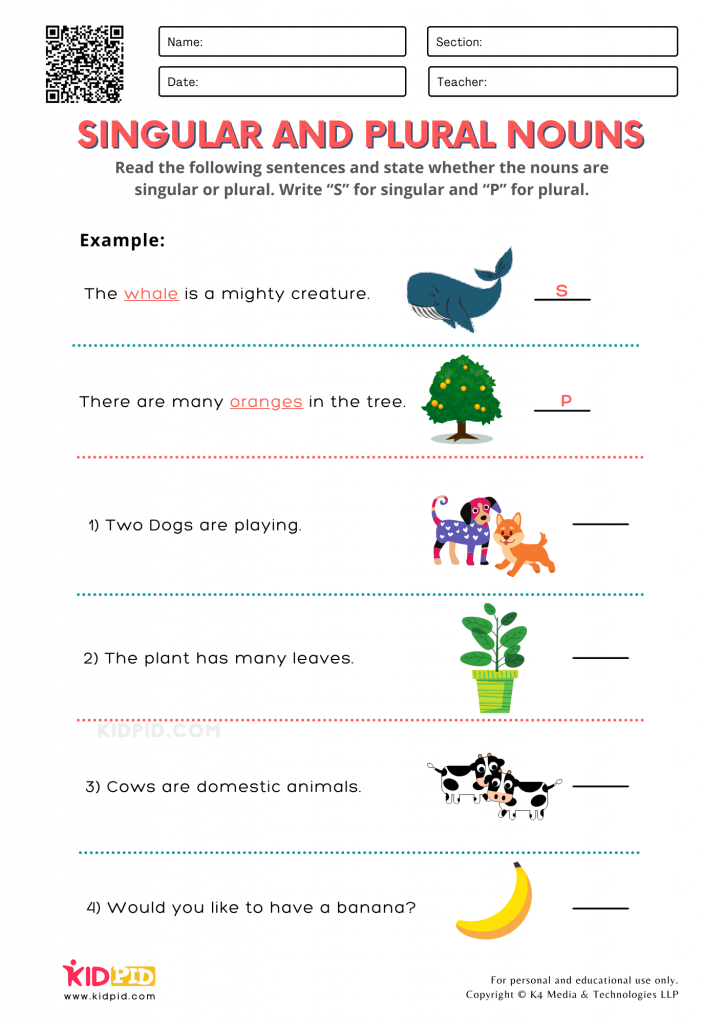
Grade 1 students learn to differentiate between singular and plural nouns, reinforcing their understanding of basic grammar through interactive and educational printable activities.
Irregular Plural Nouns Printable Worksheets for Grade 2
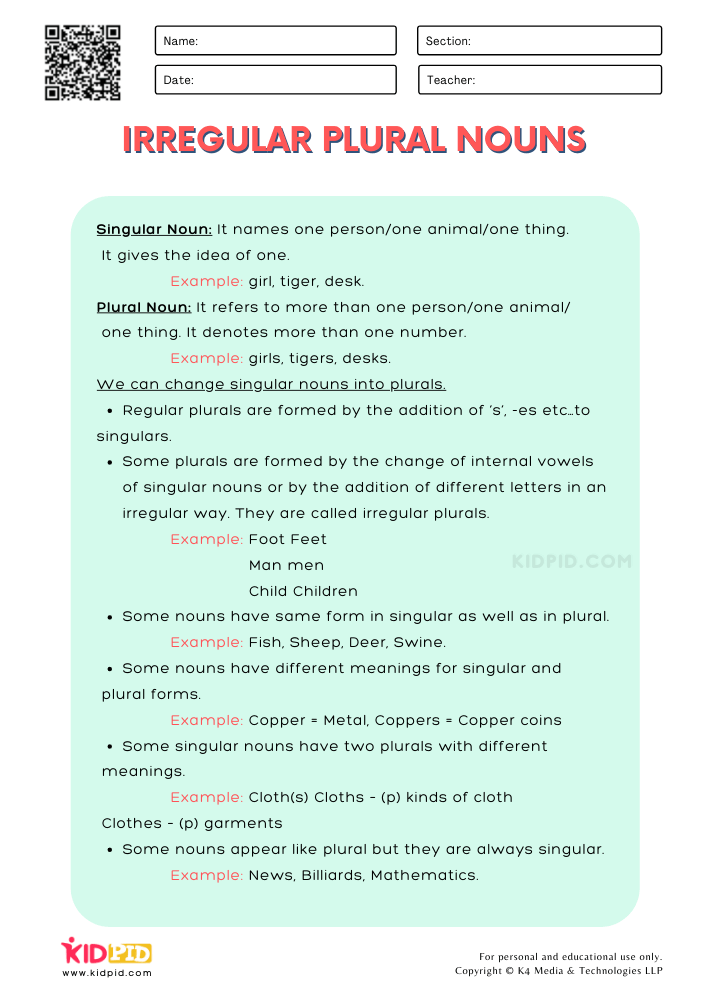
Designed for second graders, these worksheets focus on mastering irregular plural nouns, improving vocabulary, and grammatical accuracy through targeted and structured practice exercises.
Singular and Plural Nouns Exercises for Grade 2
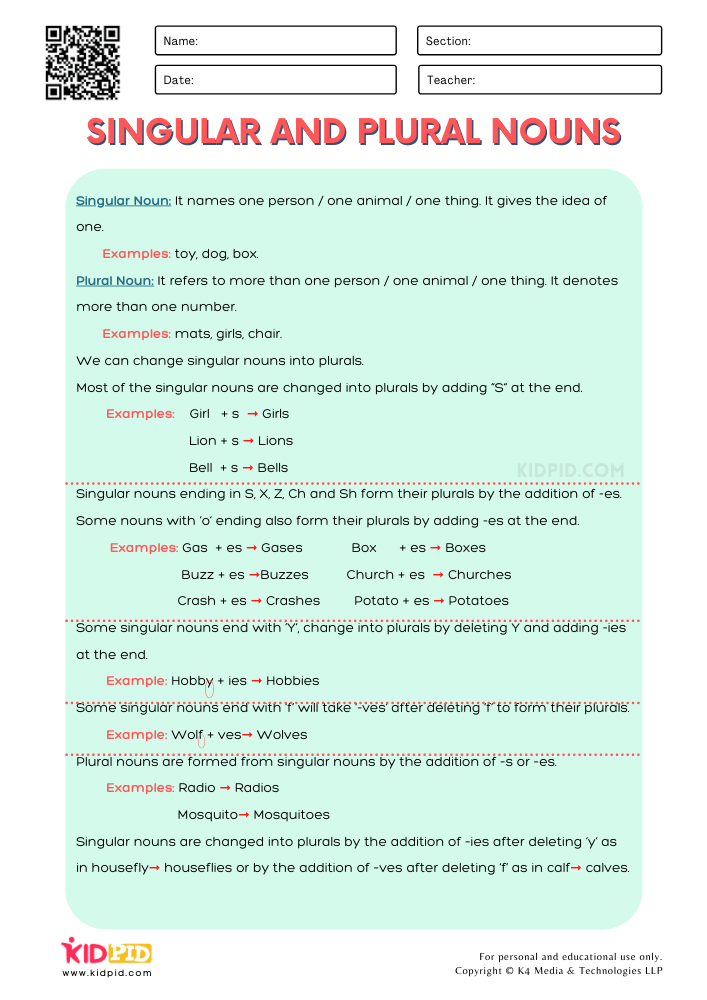
These exercises assist Grade 2 learners in understanding the distinction between singular and plural nouns, fostering language proficiency and strengthening foundational grammar skills effectively.
Match Singular and Plural Nouns: Printable Worksheets for Grade 1
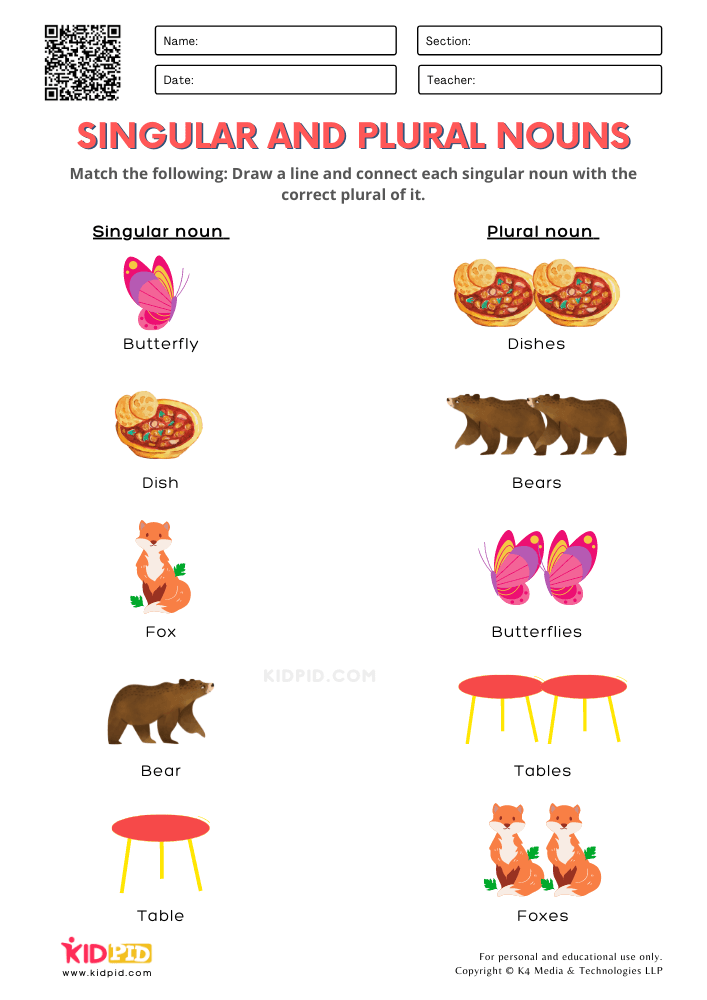
First graders practice matching singular nouns with their plural forms, enhancing their comprehension of noun transformations through fun and educational printable activities.