
Sorting means separating things of a similar type from others. These are sorting objects worksheets for kindergarten kids to learn how to sort objects. It includes several images in which the children have to sort the objects that are mentioned in the given questions. So hurry up and check out these amazing worksheets if you want to learn sorting and improve your knowledge.
Contents
- Identify & Circle The Sorting Object Worksheets For Kindergarten
- Key Facts About Sorting Objects Worksheet for Kindergarten
- Parts/Types/Examples of Sorting Objects Worksheet for Kindergarten
- How Does the Sorting Objects Worksheet for Kindergarten Work?
- Benefits of Learning About the Sorting Objects Worksheet for Kindergarten
- Learning Objectives
- Worksheet Instructions
- Interesting Facts About Sorting Objects
- Vocabulary Words
- Real-Life Applications
- FAQs
- Q1. What is a Sorting Objects Worksheet?
- Q2. Why are sorting activities important for kindergarten students?
- Q3. At what age can children start sorting objects?
- Q4. What skills do sorting worksheets improve?
- Q5. Can sorting worksheets be used at home?
- Q6. Are sorting activities related to mathematics?
- Q7. How often should children practice sorting activities?
- Q8. What materials can be used for sorting besides worksheets?
- Read More:
Identify & Circle The Sorting Object Worksheets For Kindergarten
[Scroll Down for Download Link]
Read More: Recycling Sorting Activity Worksheets



Key Facts About Sorting Objects Worksheet for Kindergarten
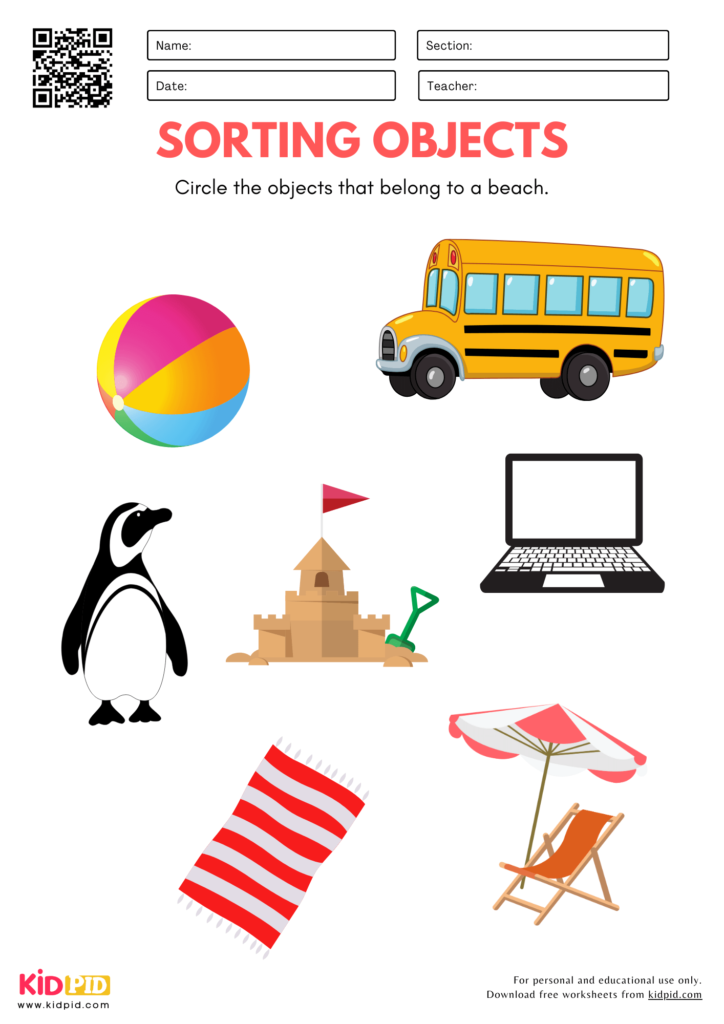
A Sorting Objects Worksheet for Kindergarten is an engaging educational activity that helps young learners identify similarities and differences among objects. Children sort pictures, shapes, colors, animals, foods, or everyday items into groups based on specific characteristics. These worksheets support early mathematical thinking, classification skills, and logical reasoning while making learning interactive and enjoyable.
Key facts include:
- Designed for children aged 4–6 years.
- Develops categorization and observation skills.
- Introduces early math concepts such as grouping and data organization.
- Enhances visual discrimination and critical thinking.
- Supports preschool and kindergarten learning standards.
- Can be used at home, in classrooms, or for homeschooling activities.
Parts/Types/Examples of Sorting Objects Worksheet for Kindergarten
Parts of a Sorting Worksheet
- Pictures or objects to sort
- Sorting categories or labels
- Sorting boxes, circles, or columns
- Instructions for grouping items
- Counting and recording sections
Types of Sorting Worksheets
- Color Sorting Worksheets
- Shape Sorting Worksheets
- Size Sorting Worksheets
- Animal Sorting Worksheets
- Food Sorting Worksheets
- Living and Non-Living Things Sorting Worksheets
- Transportation Sorting Worksheets
- Seasonal Object Sorting Worksheets
Examples
- Sort fruits and vegetables into separate groups.
- Group objects by color (red, blue, yellow).
- Sort animals into farm animals and wild animals.
- Classify shapes as circles, squares, or triangles.
How Does the Sorting Objects Worksheet for Kindergarten Work?
Sorting worksheets present children with a collection of pictures or objects and ask them to place each item into the correct category. Students carefully observe characteristics such as color, shape, size, type, or function before grouping the objects.
- Looking at all the objects.
- Identifying common features.
- Determining the correct category.
- Placing or drawing lines to the matching group.
- Counting objects in each category when required.
Benefits of Learning About the Sorting Objects Worksheet for Kindergarten
- Improves observation and comparison skills.
- Builds early math foundations.
- Develops problem-solving abilities.
- Encourages logical and critical thinking.
- Strengthens visual discrimination.
- Improves concentration and attention to detail.
- Expands vocabulary through object identification.
- Supports cognitive development and memory.
- Enhances readiness for future STEM learning.
- Makes learning interactive and enjoyable.
Learning Objectives
- Identify similarities and differences among objects.
- Classify items into appropriate categories.
- Recognize colors, shapes, sizes, and patterns.
- Develop logical reasoning skills.
- Improve counting and grouping abilities.
- Strengthen observation and analytical thinking.
- Follow simple instructions independently.
- Build confidence in problem-solving activities.
Worksheet Instructions
- Look carefully at all the pictures or objects.
- Read or listen to the sorting categories provided.
- Identify the characteristics of each object.
- Place, circle, draw a line, or cut and paste objects into the correct group.
- Double-check your answers before finishing.
- Count the objects in each category if required.
- Discuss your choices with a teacher, parent, or friend.
Interesting Facts About Sorting Objects
- Sorting is one of the first math skills children learn.
- Babies begin recognizing categories long before they can speak.
- Scientists use sorting and classification to organize living organisms.
- Libraries sort books into categories for easy access.
- Grocery stores arrange products using sorting systems.
- Sorting helps children understand patterns and relationships in the world around them.
- Classification skills are essential in mathematics, science, and technology.
Vocabulary Words
- Sort – To arrange items into groups.
- Category – A group of similar objects.
- Classify – To place things into categories.
- Group – A collection of similar items.
- Compare – To find similarities and differences.
- Shape – The form of an object.
- Color – The appearance of an object based on light.
- Size – How big or small something is.
- Pattern – A repeated arrangement.
- Object – A thing that can be seen or touched.
Real-Life Applications
- Organizing toys by type or color.
- Sorting laundry into dark and light clothes.
- Arranging groceries into food categories.
- Filing books on shelves.
- Organizing classroom supplies.
- Recycling materials into paper, plastic, and glass.
- Categorizing animals and plants in science studies.
FAQs
Q1. What is a Sorting Objects Worksheet?
Answer: A Sorting Objects Worksheet is an educational activity that teaches children to group items based on shared characteristics such as color, shape, size, or type.
Q2. Why are sorting activities important for kindergarten students?
Answer: Sorting develops critical thinking, observation, classification, and early mathematical skills that are essential for future learning.
Q3. At what age can children start sorting objects?
Answer: Most children begin simple sorting activities between ages 2 and 4 and continue developing more advanced classification skills in kindergarten.
Q4. What skills do sorting worksheets improve?
Answer: These worksheets improve logical reasoning, problem-solving, counting, vocabulary, visual discrimination, and concentration.
Q5. Can sorting worksheets be used at home?
Answer: Yes. Parents can use sorting worksheets as fun educational activities to reinforce classroom learning.
Answer: Yes. Sorting is a foundational math skill that helps children understand patterns, sets, grouping, classification, and data organization.
Q7. How often should children practice sorting activities?
Answer: Regular practice through worksheets, games, and everyday activities helps strengthen classification and analytical thinking skills.
Q8. What materials can be used for sorting besides worksheets?
Answer: Children can sort toys, blocks, buttons, leaves, coins, food items, clothing, and classroom objects to develop sorting skills through hands-on learning.
 Organizing objects into groups helps kindergarten learners develop classification skills, sorting objects worksheets, improve observation, strengthen logical thinking, and build early problem-solving abilities through enjoyable activities that support everyday learning and development. Discover a wide range of worksheets, quizzes, essays, flashcards, paragraphs, and interactive resources created to inspire young learners. Stay connected on YouTube & Facebook.
The Content Team designed this worksheet to promote skill reinforcement.
Reviewed By Swati
Read More: