Animals are everywhere around us. For your better understanding, let’s talk about some animals given in this worksheet:
Contents
- Mice:
- Cats:
- Camel:
- Giraffe:
- Elephant:
- Rabbit:
- Snail:
- Dogs:
- Horse:
- Zebra:
- Cow:
- Frog:
- Turtles:
- Monkey:
- Kangaroo:
- Lions:
- Tall & Short Worksheets for Preschool
- Key Facts About Tall & Short Worksheets for Preschool
- Parts, Types, and Examples of Tall & Short Worksheets
- How Do Tall & Short Worksheets Work?
- Benefits of Learning About Tall & Short Concepts
- Learning Objectives
- Worksheet Instructions
- Interesting Facts About Animals & Height
- Vocabulary Words
- Real-Life Applications
- FAQs
Mice:
- Mice is the plural form of the mouse.
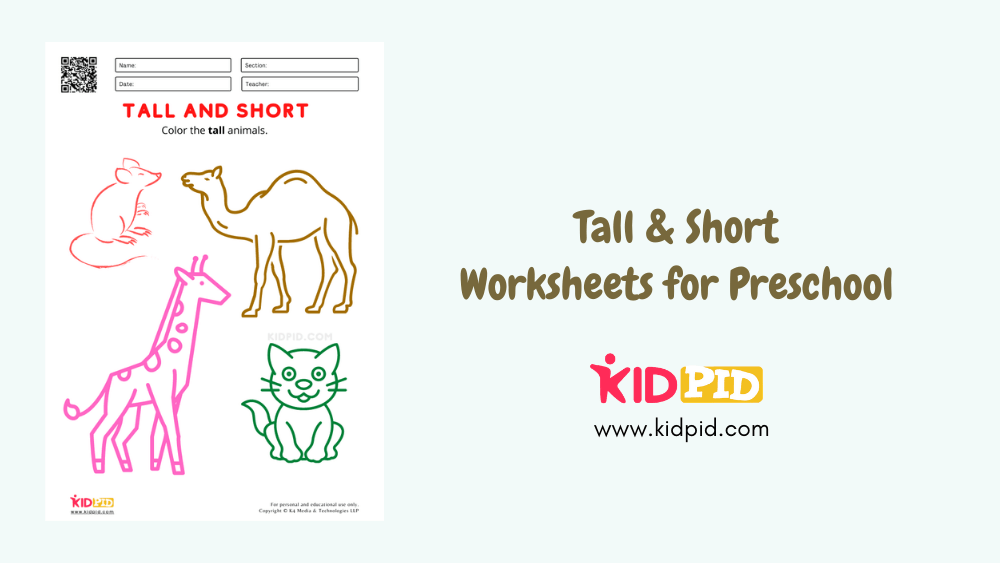
- Mice are one of the smallest animals in the world.
- Mice can be easily found somewhere in your home.
- They come to your house in search of food and shelter.
- Mice are a common food for cats.
- Mice are generally of brown and white colours.
Cats:
- Cats come under domestic species.
- They are carnivorous animals that feed on other animals’ flesh, although they also drink milk as food.
Camel:
- Camels are also domesticated.
- They are used to carry goods.
- Their meat is also eaten in many countries.
- Camels have a hump, which acts as a storage medium for energy.
- Camels are generally found in deserts.
Giraffe:
- A giraffe is the tallest animal.
- Giraffes are generally found in Africa.
- A giraffe has a long neck.
- Giraffes generally feed on leaves and grasses.
Elephant:
- They are the largest land animal.
- Elephants drink water with the help of their trunks.
- Elephants have thick skin.
- Elephants are the most humble creatures in this world.
Rabbit:
- Rabbits are the most silent creatures in this world.
- Rabbits have big ears, which regulate their body temperature.
- Rabbits can see both in front and behind.
- Rabbits are social creatures.
Snail:
- Snails are the slowest creatures and also one of the smallest on this planet.
- Snails are wet all the time.
- Snails are also eaten as food.
Dogs:
- Dogs also come under domesticated animals.
- Dogs are also the most helpful creatures in this world.
- Dogs are friendly in nature, although not all dogs are.
- They have a great sense of smell.
Horse:
- Horses are used for riding and as working animals.
- Horses are also domestic animals.
- Horses have bigger eyes than any other animal.
Zebra:
- Zebras are found in Africa.
- Zebras are wild animals and cannot be domesticated.
Cow:
- The cow is the most common domesticated animal among villagers.
- Cows provide us with milk, which makes our bones strong.
Frog:
- Frogs can live both underwater and on land.
- Frogs absorb water through their skin, so they don’t need to drink water.
Turtles:
- Turtles live for 100-150 years.
- Turtles have a hard shell which keeps their body protected.
Monkey:
- Monkeys can live both on land and in trees.
- Monkeys are afraid of snakes.
Kangaroo:
- Kangaroos can jump very high.
- Kangaroos are generally found in Australia.
Lions:
- Lions are considered the most dangerous species.
- They feed only on other animals’ meat.
- They are also known as the king of the jungle, as every other animal is scared of lions.
So, here was just a list of a few animals. Take your kid to your nearby zoo, and you can explore more. Your child will be able to see different types of animals and will be able to learn about different types of creatures living around.
[Scroll Down for Download Link]
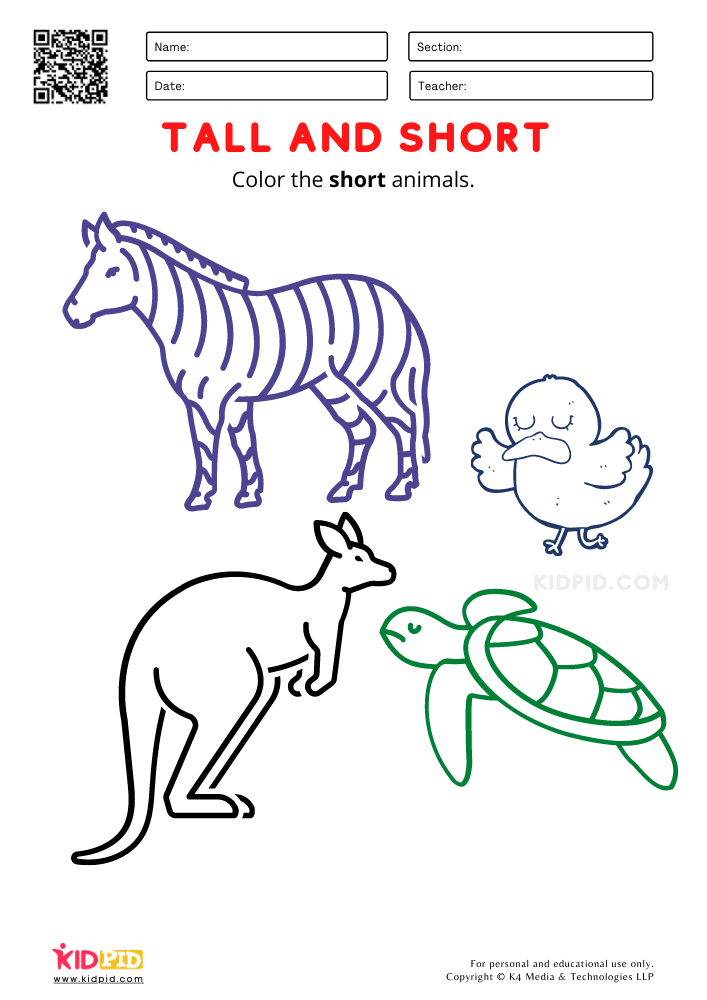
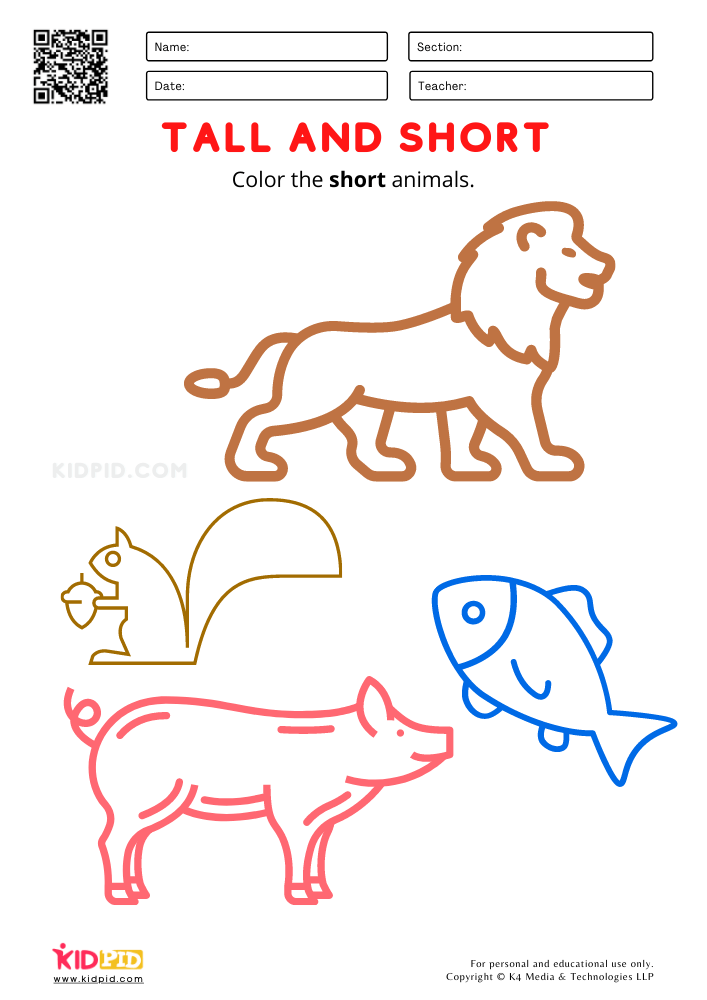
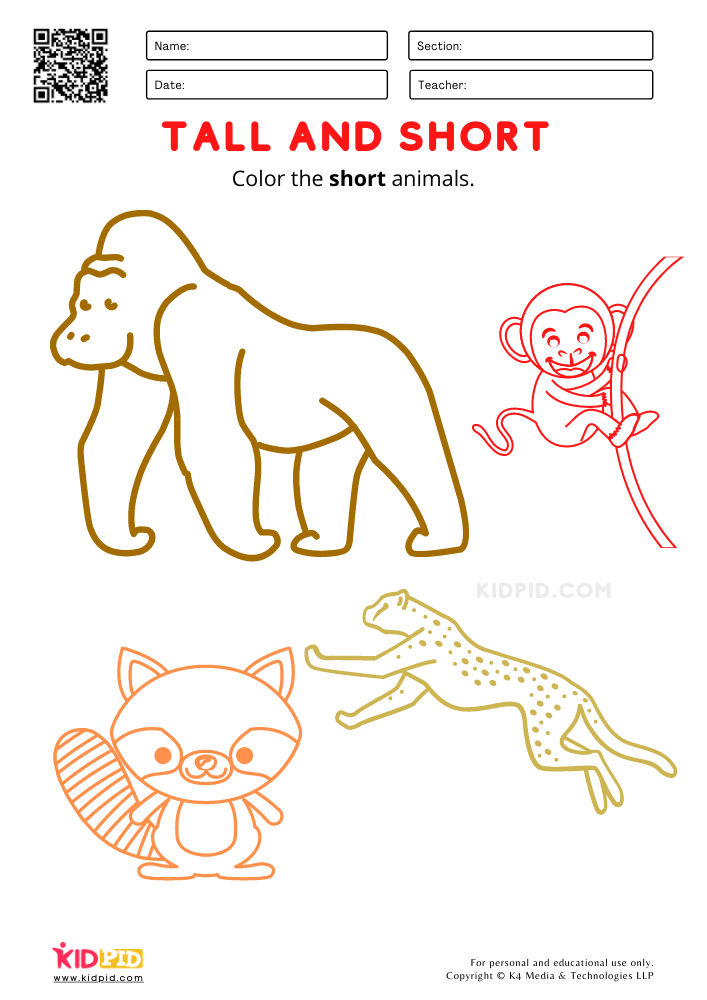
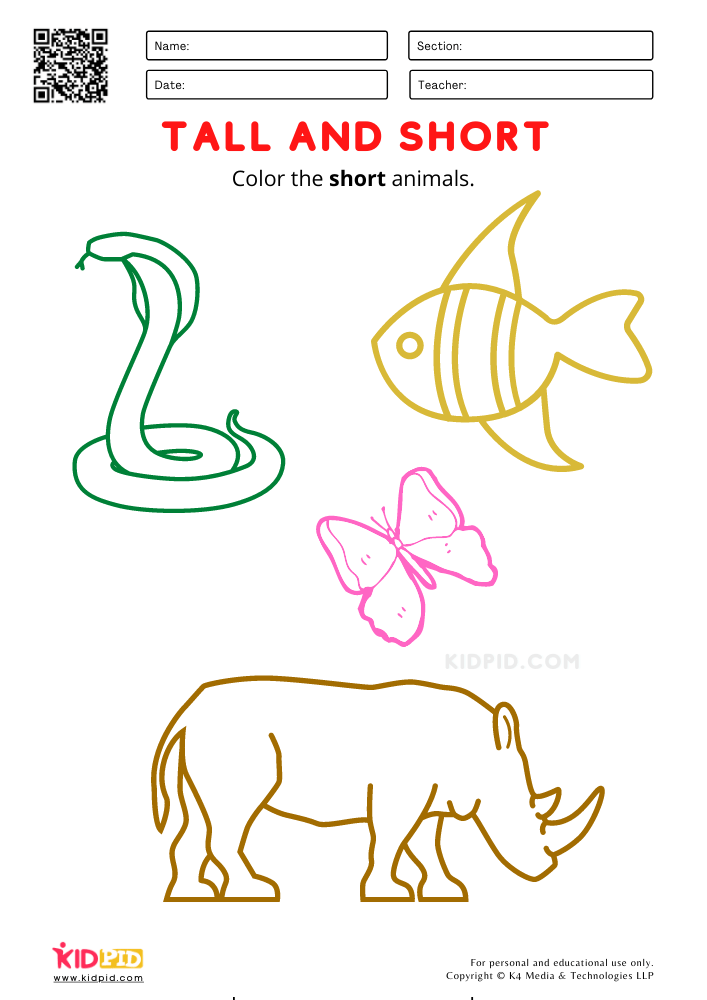
Tall & Short Worksheets for Preschool
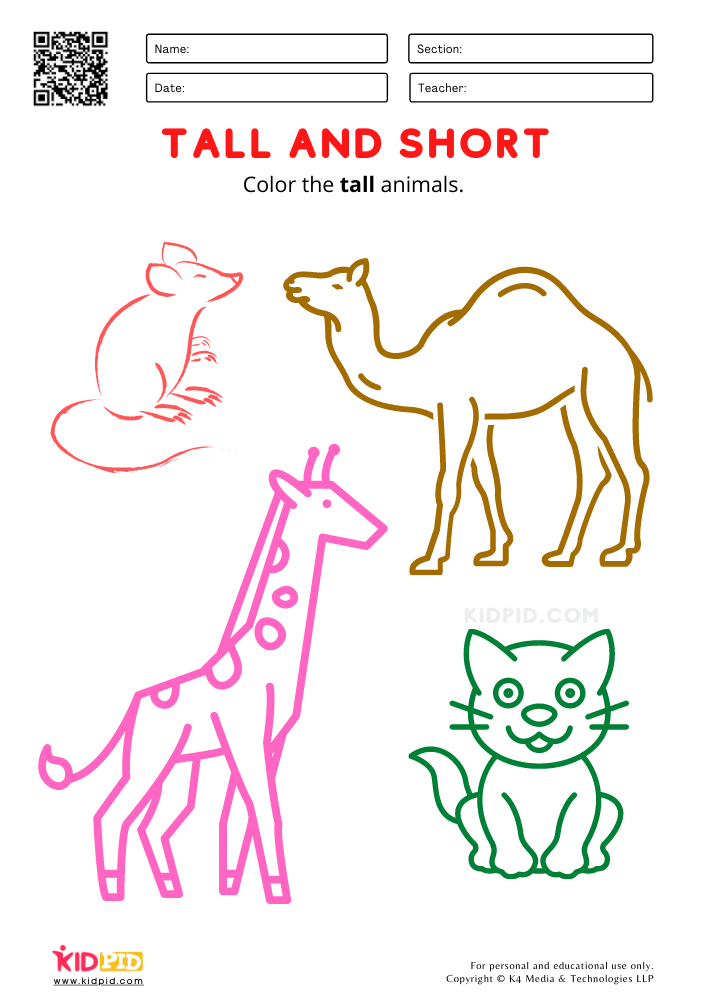
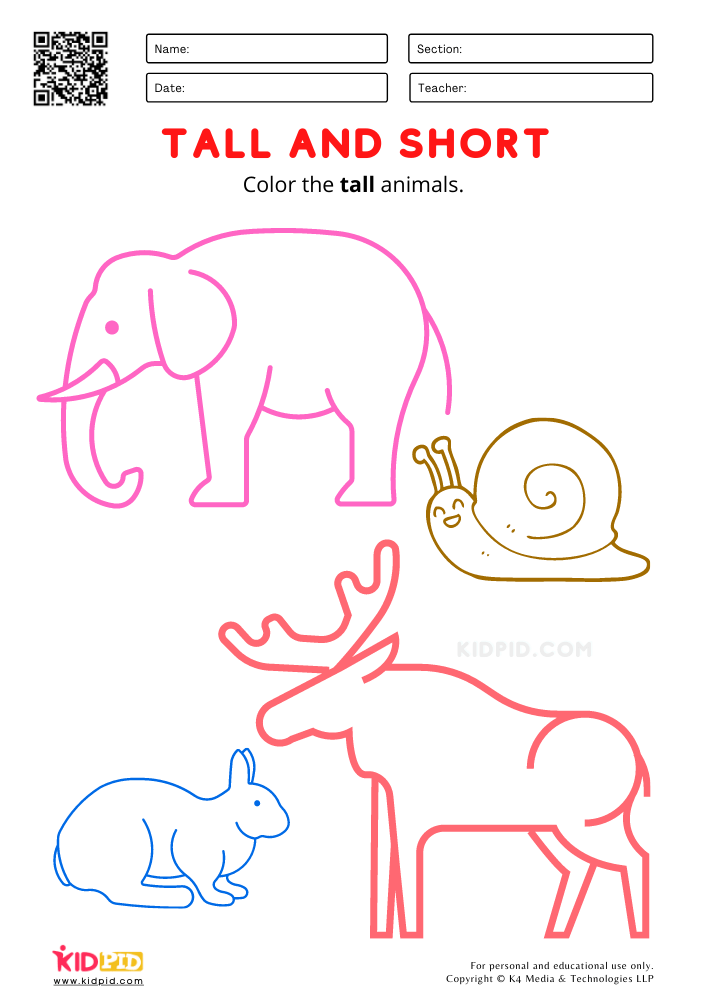
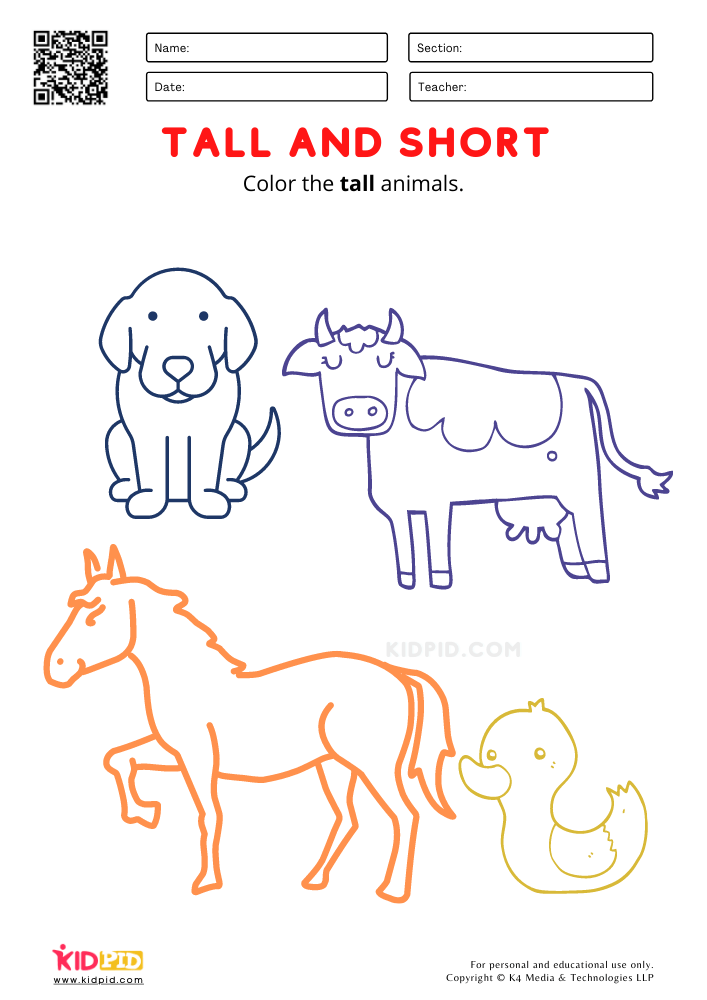
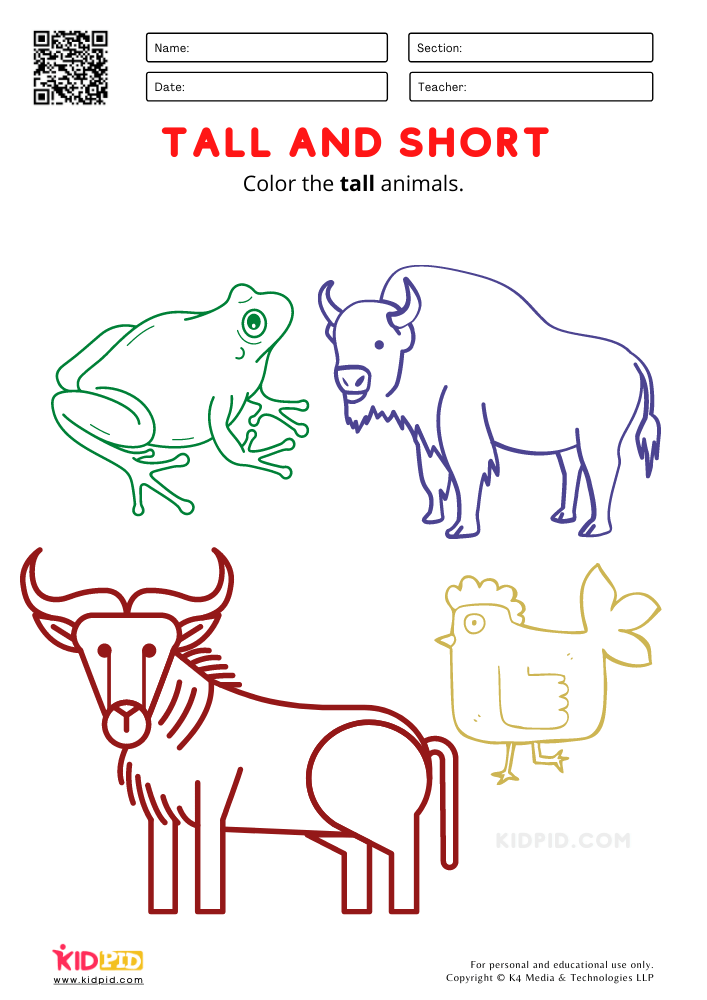
Key Facts About Tall & Short Worksheets for Preschool
Introducing basic measurement concepts to early learners does not require rulers or tape measures. Instead, it relies on visual and non-standard comparison. These worksheets are purposefully built to introduce the abstract concepts of height and size through familiar real-world visuals, such as animals, trees, and everyday objects.
- Target Age Group: Best suited for toddlers, preschoolers, and kindergarteners (ages 3 to 5).
- Core Concept: Direct physical comparison focusing entirely on vertical dimensions (height).
- Skill Progression: Moves young minds from basic visual recognition (“Which is taller?”) to critical thinking and descriptive language (“The giraffe is taller than the mouse”).
- Developmental Stage: Aligns with early childhood milestones for cognitive sorting, spatial reasoning, and pre-math skills.
Parts, Types, and Examples of Tall & Short Worksheets
To keep young minds engaged, a high-quality printable pack includes multiple styles of learning. Variation ensures that children master the concept rather than just memorizing a single pattern.
- “Circle the Tallest / Shortest” Activities: Simple visual recognition tasks featuring distinct height contrasts, such as comparing a tiny snail to an elephant or a short blade of grass to a tall tree.
- Coloring Comparison Pages: Creative tasks where a child is instructed to color the taller object one specific color (e.g., blue) and the shorter object another color (e.g., red). This reinforces multi-step direction following.
- Cut-and-Paste Sequencing: Fine-motor skill builders where children cut out 3 to 4 items and paste them in order from shortest to tallest on a blank grid.
- Animal-Themed Fact Worksheets: Pages that blend basic science with math by highlighting natural animal traits, showcasing that a camel or horse holds a structural height advantage over a frog or rabbit.
How Do Tall & Short Worksheets Work?
These worksheets act as a visual bridge between a child’s physical environment and abstract mathematical concepts. They work by triggering cognitive sorting mechanisms through three key steps:
- Visual Scanning: A child looks at a pair or group of illustrations sharing a baseline. Their eyes naturally track the vertical space each object occupies.
- Side-by-Side Evaluation: The brain processes the difference between the top boundaries of the objects. It identifies which object extends further upward.
- Action Execution: The child marks their choice by circling, coloring, or tracing. This physical response anchors the mental concept, translating a visual realization into a fine-motor milestone.
Benefits of Learning About Tall & Short Concepts
Mastering height comparison early on provides a massive boost across several areas of childhood development:
- Foundational Math Readiness: Long before children learn numbers or units like inches and centimeters, they must master the qualitative vocabulary of measurement. “Tall” and “short” are the foundational blocks of geometry and data sorting.
- Language and Vocabulary Expansion: It shifts kids away from generic descriptors like “big” and “small,” allowing them to use precise spatial language.
- Spatial and Cognitive Awareness: Children learn to perceive depth, scale, and proportions within their surrounding environment, building stronger spatial intelligence.
- Fine Motor Practice: Holding crayons, circling targets, and using safety scissors to cut out worksheet items strengthens the exact hand muscles needed for future handwriting.
Learning Objectives
By completing these interactive printables, young learners will achieve the following developmental milestones:
- Identify and distinguish between “tall” and “short” objects with at least 80% accuracy.
- Demonstrate proper use of comparative terms (taller than, shorter than) when describing pairs of illustrations.
- Analyze a group of three or more objects and successfully organize them by height progression.
- Connect abstract worksheet concepts to physical items found at home, in the classroom, or at the zoo.
Worksheet Instructions
To ensure a frustration-free learning experience, guide your preschooler through the pages using these simple steps:
- Find the Baseline: Point to the bottom of the pictures together. Ensure the child sees that both objects are starting from the same “ground level.”
- Read the Prompt Aloud: Clearly state what the page is asking. For example: “Look at the horse and the dog. Can you point your finger at the taller one?”
- Trace the Height: Have the child run their finger from the bottom to the top of each item to physically feel the difference in scale.
- Complete the Action: Allow the child to use their crayon or pencil to circle, color, or mark the correct answer according to the page instructions.
- Verbally Reinforce: Once they mark the answer, ask them to say the full sentence: “The horse is tall, and the dog is short!”
Interesting Facts About Animals & Height
Integrating fun real-world facts makes the worksheets come alive! Here are some engaging tidbits you can share with your child while they complete their pages:
- The Ultimate Giant: The Giraffe is the tallest animal on land. A newborn baby giraffe is already around 6 feet tall—taller than most adult humans!
- Heavy and High: The Elephant is the largest and tallest land mammal after the giraffe. They use their long trunks like arms to grab leaves from high branches.
- Tiny But Quick: Mice and Snails are some of the shortest creatures featured in early math exercises. Their small size helps them easily hide from bigger animals.
- The Built-In Helmet: Turtles might be short and close to the ground, but their hard shells keep them safe for over 100 years.
Vocabulary Words
Building a strong academic vocabulary early helps children articulate their thoughts. Use these target words during your worksheet sessions:
- Tall: Something that reaches a long way up from the ground.
- Short: Something that does not measure very far from top to bottom; close to the ground.
- Taller: A word used to compare two things when one reaches a higher level than the other.
- Shorter: A word used when one object has less height than another object.
- Compare: To look at two or more things to see how they are alike or different.
- Height: The measurement of how far up something goes.
Real-Life Applications
Learning shouldn’t stop when the worksheet is turned over. You can easily bring the tall and short concept into daily routines:
- Grocery Store Math: Ask your child to look at the shelves: “Can you grab the short box of cereal on the bottom shelf, or should I reach for the tall bottle on the top?”
- The Family Lineup: Have family members stand back-to-back. Let your child judge who is taller and who is shorter.
- Nature Walks: Visit a local park or zoo. Compare the height of a blade of grass to a massive oak tree, or an elephant to a rabbit.
- Toy Block Towers: Build towers using building blocks. Ask your child to build a “tall tower” and a “short tower,” then count how many blocks it took to make each one.
FAQs
Q1: At what age should a child learn the concept of tall and short?
Answer: Most children begin naturally recognizing basic size differences around age 2. By ages 3 and 4 (preschool), they are ready to learn formal comparative language like “taller” and “shorter” through structured worksheets.
Q2: Why does my preschooler confuse “tall” with “big”?
Answer: This is a completely normal developmental stage! “Big” is a general term kids use for overall volume. To help them differentiate, focus their attention purely on the vertical axis: point out that an object can be wide but still short, or thin but very tall.
Q3: How can I make these worksheets more interactive for energetic kids?
Answer: Pair the worksheets with physical objects. Before they circle an animal on the paper, have them act out the animal! They can stretch up high like a giraffe or crouch down tiny like a snail.
Q4: Are these tall and short printables aligned with any school standards?
Answer: Yes. Learning to describe and compare measurable attributes aligns directly with early childhood pre-math foundations and Kindergarten Common Core Mathematics Standards for Measurement & Data.
Develop early measurement skills with these Tall and Short Worksheets for Preschool. Fun printable activities help children compare heights, improve observation, build vocabulary, strengthen visual discrimination, and develop foundational math concepts through engaging learning. Discover fun, educational resources on our website—from flashcards to quizzes—and join our community on YouTube and Facebook.
The Content Team created this worksheet to foster educational improvement.
Reviewed By Parul Rana
Read More: