

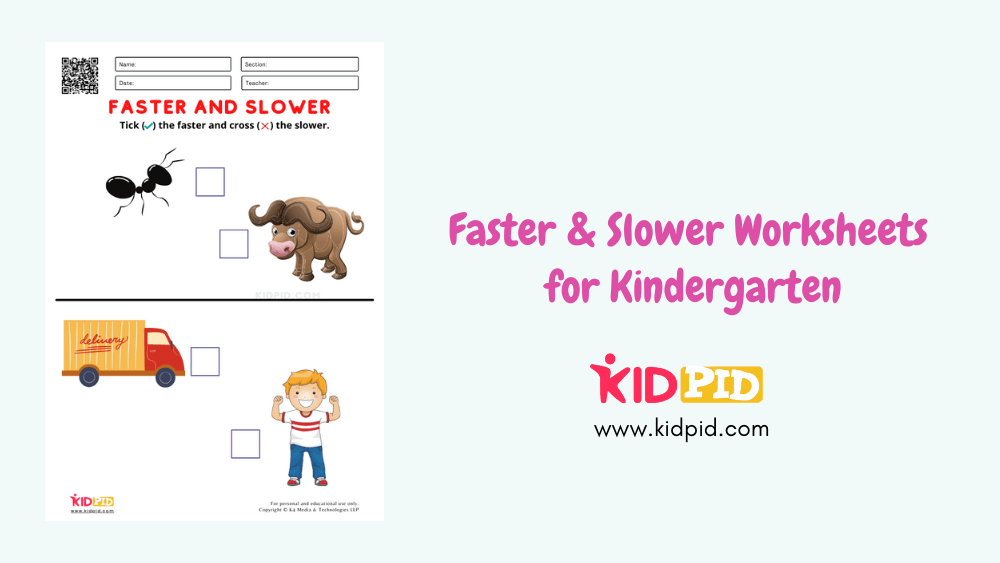
A key step in a child’s learning journey is not only to understand concepts but to be able to express them. In kindergarten, children become more aware of their surroundings and everything around them. They instinctively know that a car is faster than a bicycle or a snail is slower than a horse, but can they use the correct words to express this? Well, that’s exactly what we’re gonna focus on in these worksheets.
Let’s take a look at the Faster and Slower worksheets we have for the kids!
[Scroll Down for Download Link]
Contents
- Faster & Slower Worksheets for Kindergarten
- Key Facts About Faster and Slower Worksheets for Kindergarten
- Parts, Types, and Examples of Faster and Slower Worksheets
- How Do Faster and Slower Worksheets Work?
- Benefits of Learning About Faster and Slower Worksheets
- Learning Objectives
- Worksheet Instructions
- Interesting Facts About Faster and Slower
- Real-Life Applications
- FAQs
- Q1. What are Faster and Slower Worksheets?
- Q2. Who can use these worksheets?
- Q3. Why is learning about speed important?
- Q4. What skills do these worksheets develop?
- Q5. Are these worksheets suitable for home learning?
- Q6. Can these worksheets support science education?
- Q7. How often should children practice these activities?
- Q8. Do Faster and Slower Worksheets make learning fun?
Faster & Slower Worksheets for Kindergarten
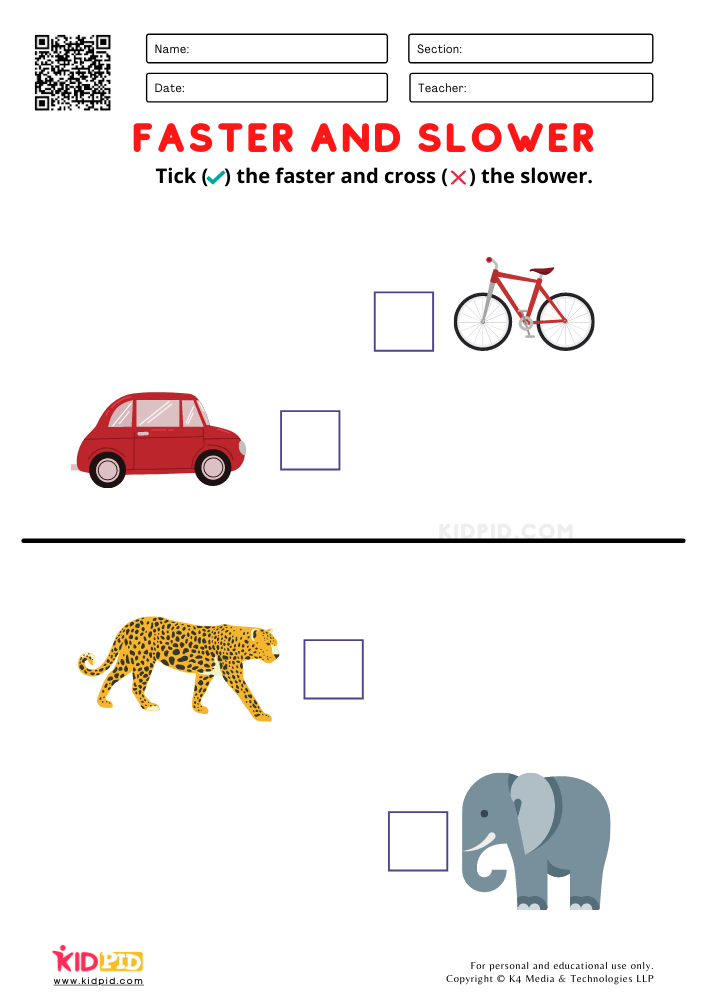
The worksheet shows a car and a bicycle on one panel and a cheetah and an elephant on the other. Vehicles and animals are something that kids at this age are already familiar with. This will make the topic not only approachable but also fun.
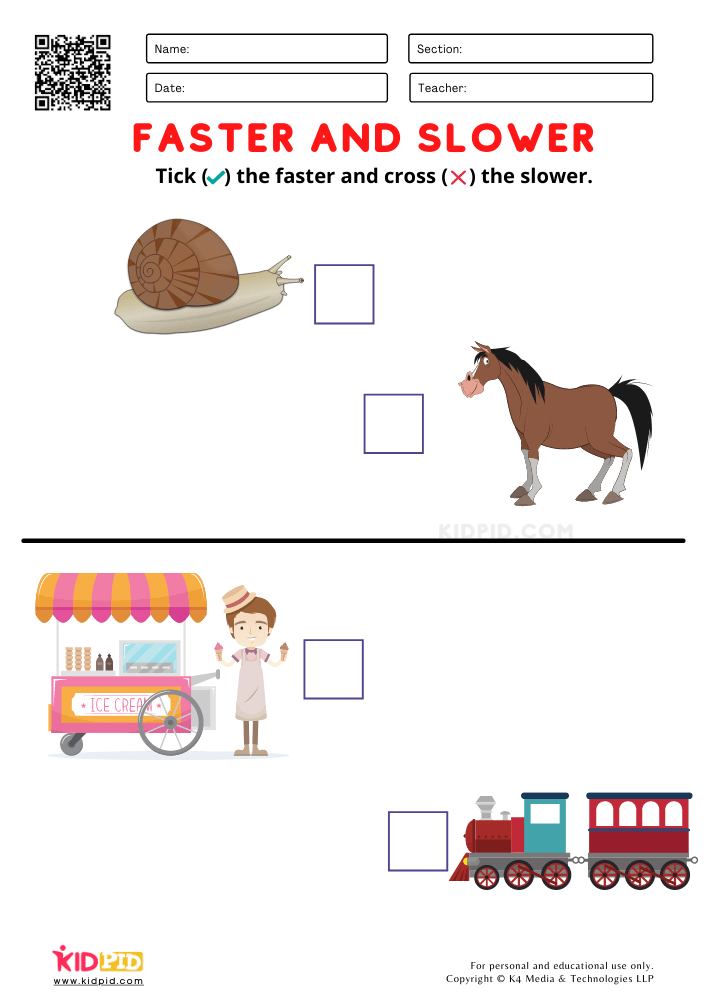
The above worksheet shows things that all kids have seen, either in real life or in a picture. The familiarity piques their interest, and this way, they can have fun and learn simultaneously.
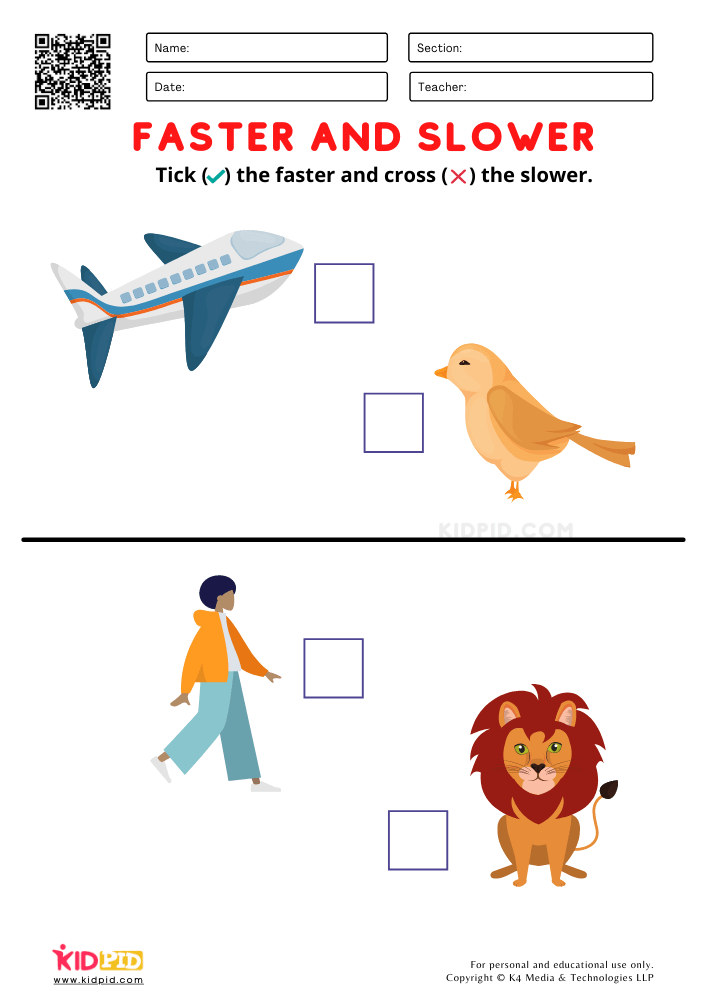
Now, in this worksheet, we have a living and a non-living entity in the same panel. The child needs to notice this difference and learn to apply the terms “faster” and “slower” even in such cases.
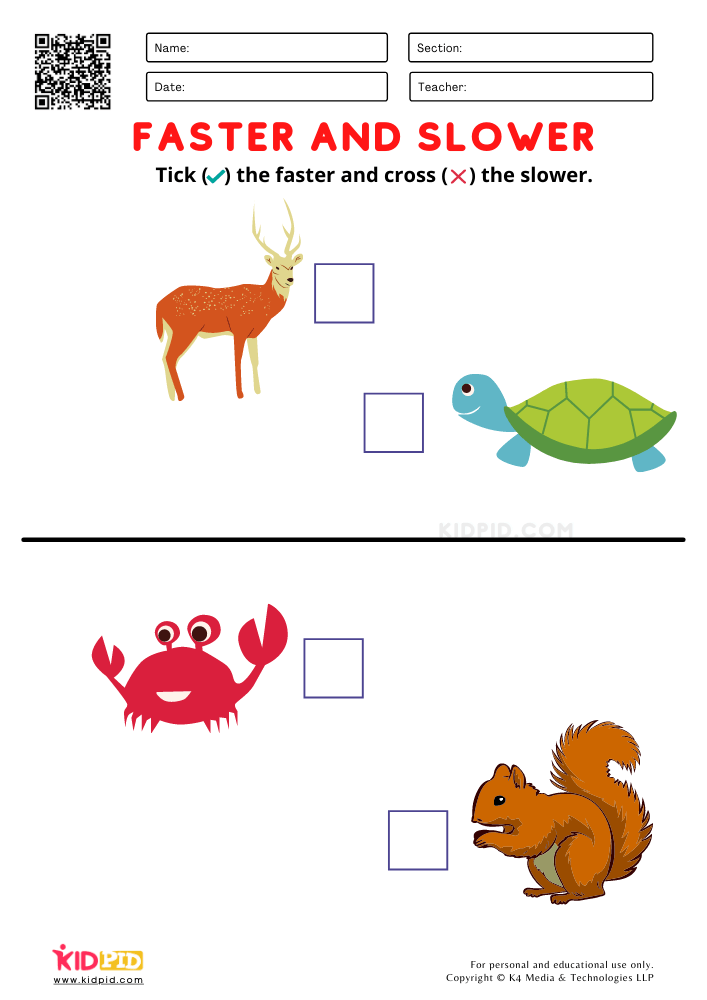
We have four different but common animals in this worksheet. Let the kids identify as many animals as they can, and then have a discussion about which is faster and which is slower among all four of the animals.
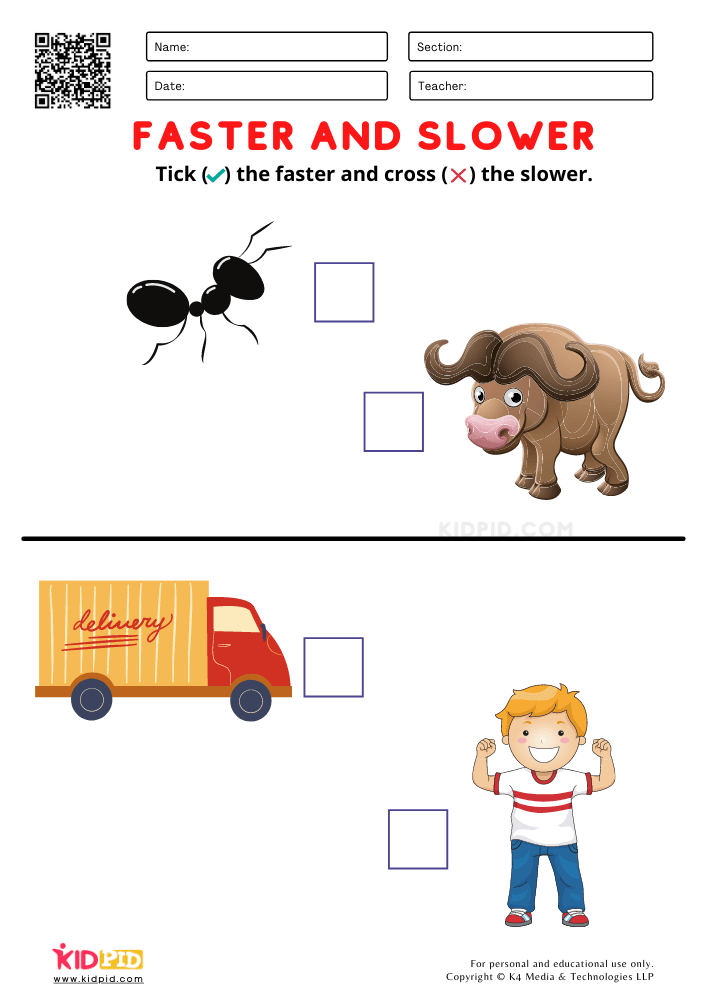
Here we have a combination of living and non-living items. You can use the worksheet to help the children classify the entities into faster and slower, as well as living and non-living.
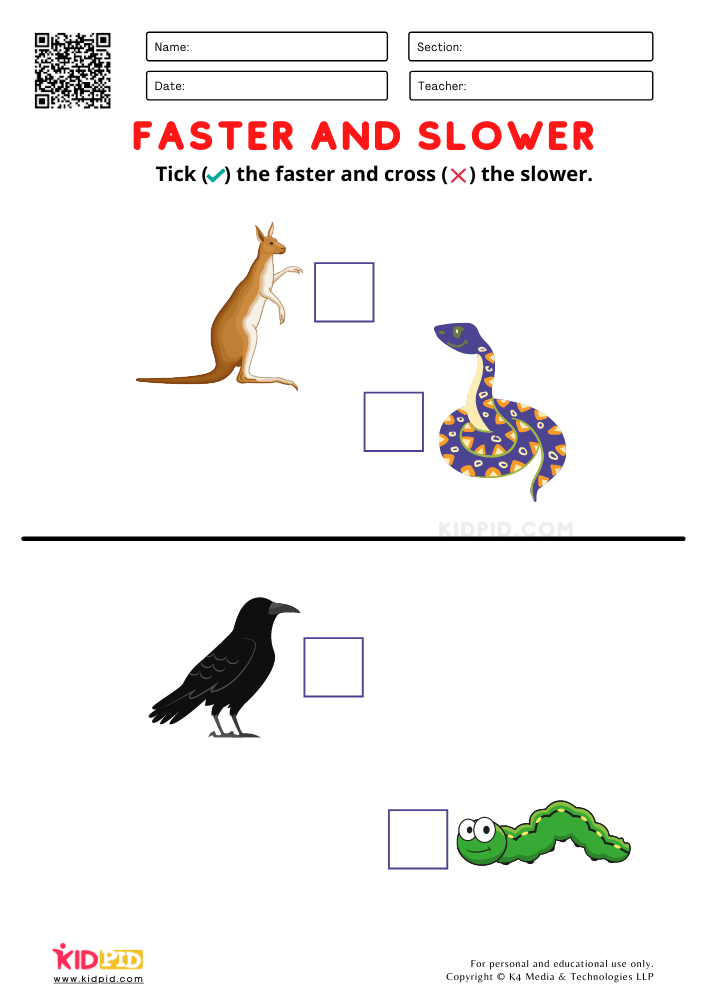
Here we have four different animals. What’s interesting is that two of these are very common, while the other two are quite rare. This worksheet is a fun opportunity to have a discussion about how many of these animals the children have seen in real life, and it will help keep them motivated during the task.
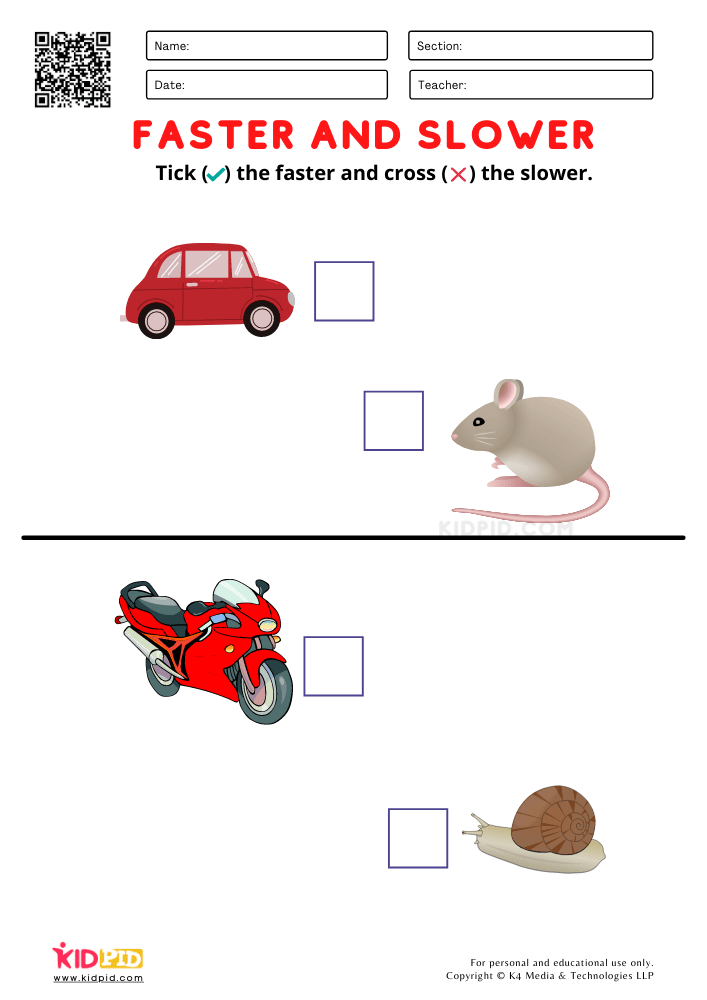
This worksheet shows different modes of transport, which are relatable to most kids. Let the kids recall the names of the modes of transport to make the worksheet even more interesting.
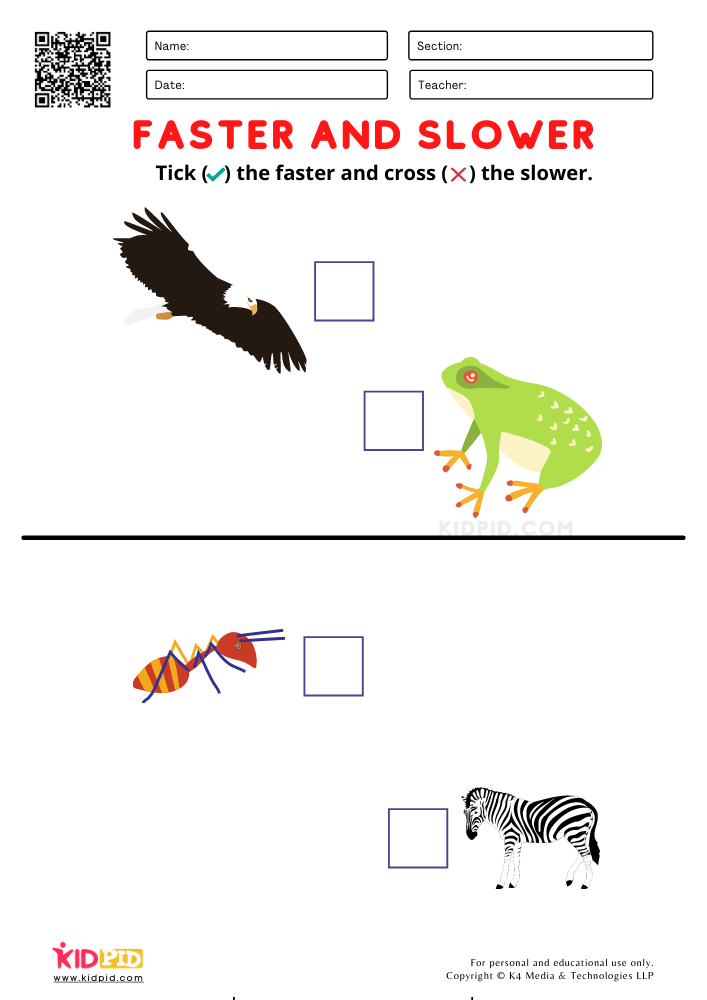
This worksheet shows four colorful and interesting animals. Ask the kids to name the animals. This will exercise their memory while they learn new concepts.
Key Facts About Faster and Slower Worksheets for Kindergarten
Faster and Slower Worksheets for Kindergarten help young learners understand the concept of speed through simple comparison activities. These worksheets introduce children to the idea that different objects, animals, and vehicles move at different speeds. By observing pictures and identifying which item moves faster or slower, children develop critical thinking and observation skills.
Key facts include:
- Designed for kindergarten and early elementary students.
- Introduces the basic concept of speed and movement.
- Uses familiar objects such as cars, bicycles, airplanes, and animals.
- Encourages visual comparison and logical reasoning.
- Supports early science and math learning.
- Helps improve observation and decision-making skills.
- Features engaging illustrations and child-friendly activities.
Parts, Types, and Examples of Faster and Slower Worksheets
Parts of the Worksheets
- Illustrated Images: Pictures of moving objects or animals.
- Comparison Questions: Tasks asking children to identify faster or slower items.
- Matching Activities: Connecting objects based on speed.
- Circle and Color Exercises: Marking the correct answer.
- Sorting Tasks: Categorizing objects into fast and slow groups.
Types of Faster and Slower Worksheets
- Picture Comparison Worksheets
- Fast and Slow Vehicle Activities
- Animal Speed Comparison Worksheets
- Matching and Sorting Exercises
- Cut-and-Paste Speed Activities
- Coloring-Based Learning Sheets
Examples
- Circle the faster vehicle: bicycle or car.
- Identify the slower animal: rabbit or turtle.
- Match fast-moving objects together.
- Sort pictures into “Fast” and “Slow” categories.
How Do Faster and Slower Worksheets Work?
These worksheets present children with visual scenarios involving objects, vehicles, or animals moving at different speeds. Students observe the pictures and compare them to determine which item moves faster and which moves slower.
Children complete activities such as:
- Looking at two or more pictures.
- Comparing movement speeds.
- Selecting, circling, coloring, or matching the correct answer.
- Discussing why one object moves faster than another.
Through repeated practice, children build a clear understanding of speed-related concepts and strengthen analytical thinking skills.
Benefits of Learning About Faster and Slower Worksheets
- Develops early understanding of motion and speed.
- Improves observation and comparison skills.
- Encourages logical and critical thinking.
- Supports foundational science concepts.
- Enhances vocabulary related to movement and transportation.
- Builds confidence in problem-solving activities.
- Promotes visual discrimination and attention to detail.
- Makes learning interactive and enjoyable.
Learning Objectives
By completing these worksheets, children will be able to:
- Understand the meaning of faster and slower.
- Compare the speed of different objects and animals.
- Identify fast-moving and slow-moving items.
- Improve observation and reasoning abilities.
- Develop classification and sorting skills.
- Build foundational science knowledge.
- Expand movement-related vocabulary.
- Strengthen decision-making skills.
Worksheet Instructions
- Look carefully at each picture.
- Compare the objects, vehicles, or animals shown.
- Decide which one moves faster or slower.
- Circle, color, match, or tick the correct answer.
- Complete all activities neatly.
- Ask a teacher or parent for help if needed.
- Review your answers after finishing the worksheet.
Interesting Facts About Faster and Slower
- A cheetah is one of the fastest land animals in the world.
- Turtles are known for moving slowly compared to many other animals.
- Airplanes travel much faster than cars and bicycles.
- Speed helps people and goods travel from one place to another quickly.
- Different animals have unique speeds that help them survive.
- Trains are generally faster than buses over long distances.
- The concept of speed is an important part of science and everyday life.
Real-Life Applications
Understanding faster and slower helps children connect classroom learning to everyday experiences.
- Comparing cars and bicycles on the road.
- Observing animals at the zoo or in nature.
- Watching races and sports events.
- Understanding transportation methods.
- Learning basic science concepts about movement.
- Making decisions during games and activities.
- Recognizing speed differences in everyday situations.
These practical connections make learning more meaningful and engaging.
FAQs
Q1. What are Faster and Slower Worksheets?
Answer: They are educational worksheets that teach children how to compare the speed of different objects, vehicles, and animals.
Q2. Who can use these worksheets?
Answer: They are ideal for kindergarten students, preschool learners, teachers, and parents.
Q3. Why is learning about speed important?
Answer: Learning about speed helps children understand movement, comparison, and basic science concepts.
Q4. What skills do these worksheets develop?
Answer: They improve observation, logical thinking, comparison skills, vocabulary, and problem-solving abilities.
Q5. Are these worksheets suitable for home learning?
Answer: Yes. Parents can easily use them for homeschooling, homework practice, or extra learning activities.
Q6. Can these worksheets support science education?
Answer: Yes. They introduce foundational concepts related to motion, movement, and speed, which are important topics in early science education.
Q7. How often should children practice these activities?
Answer: Regular practice helps reinforce learning and improves understanding of speed comparisons over time.
Q8. Do Faster and Slower Worksheets make learning fun?
Answer: Yes. The colorful illustrations and interactive activities keep children engaged while building important educational skills.
Help children understand when to use uppercase letters, such as at the beginning of a sentence and for proper nouns. By completing these activities, they will confidently identify and distinguish different letters. Explore our website for worksheets, essays, paragraphs, flashcards, quizzes, and interactive resources. Follow us on YouTube & Facebook for exciting learning content.
The Content Team designed this worksheet to promote academic success.
Reviewed By Gargy
Read More:



Nice worksheet n very helpful to kid.work sheets are attractive and kids don’t board at all….
it’s really helpful and useful. Thank you!