As kids begin to learn numbers, they need to understand the concept of less and more as well, in order to build a strong foundation. Kids learn the most when they focus, and what better way to keep kids focused than with colourful worksheets?
So, let’s get started!
[Scroll Down for Download Link]
Contents
- More & Less Worksheets for Kindergarten
- Key Facts About More or Less Worksheets for Kindergarten
- Parts/Types/Examples of More Less Worksheets for Kindergarten
- How Do More or Less Worksheets for Kindergarten Work?
- Benefits of Learning About More and Less Worksheets for Kindergarten
- Learning Objectives
- Worksheet Instructions
- Interesting Facts About More or Less Worksheets for Kindergarten
- Real-Life Applications
- FAQs
- Q1. What are More or Less Worksheets for Kindergarten?
- Q2. Why are more and less concepts important?
- Q3. At what age should children learn more and less?
- Q4. How do these worksheets improve math skills?
- Q5. Can these worksheets be used at home?
- Q6. What skills do children gain from comparison worksheets?
- Q7. How often should children practice more and fewer activities?
- Q8. Are visual worksheets effective for kindergarten students?
- Q9. Do More Less Worksheets support future math learning?
- Q.10 Can teachers use these worksheets in classrooms?
More & Less Worksheets for Kindergarten
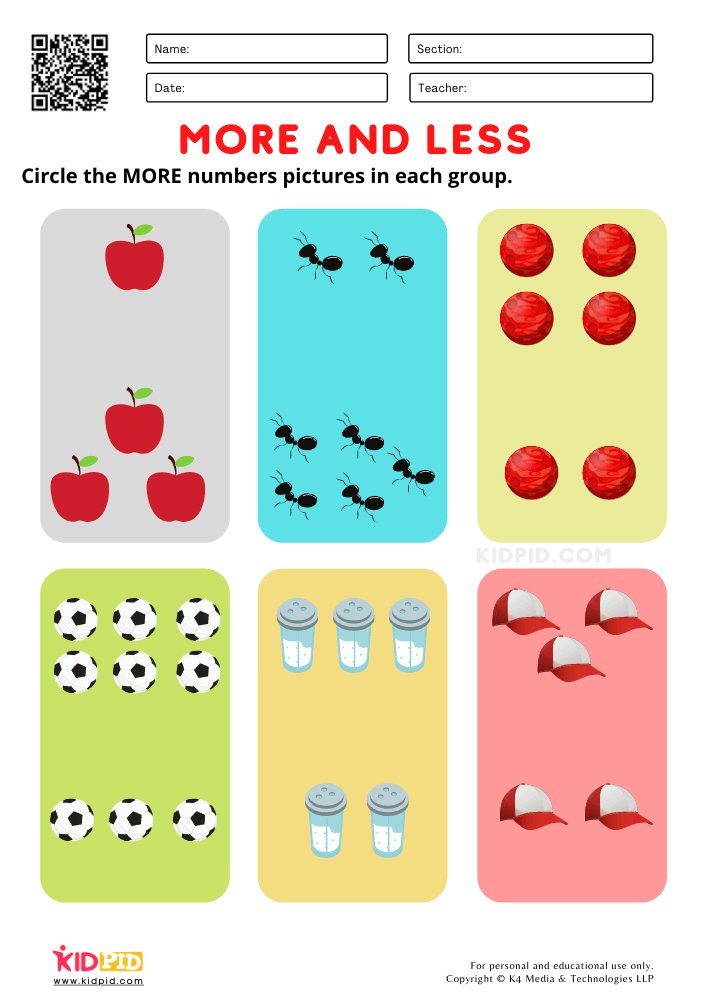
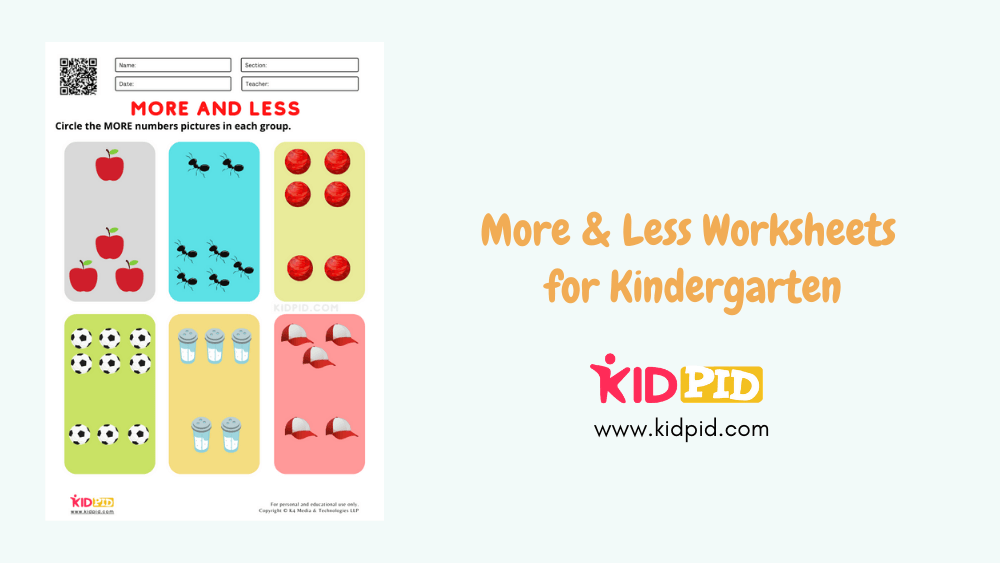
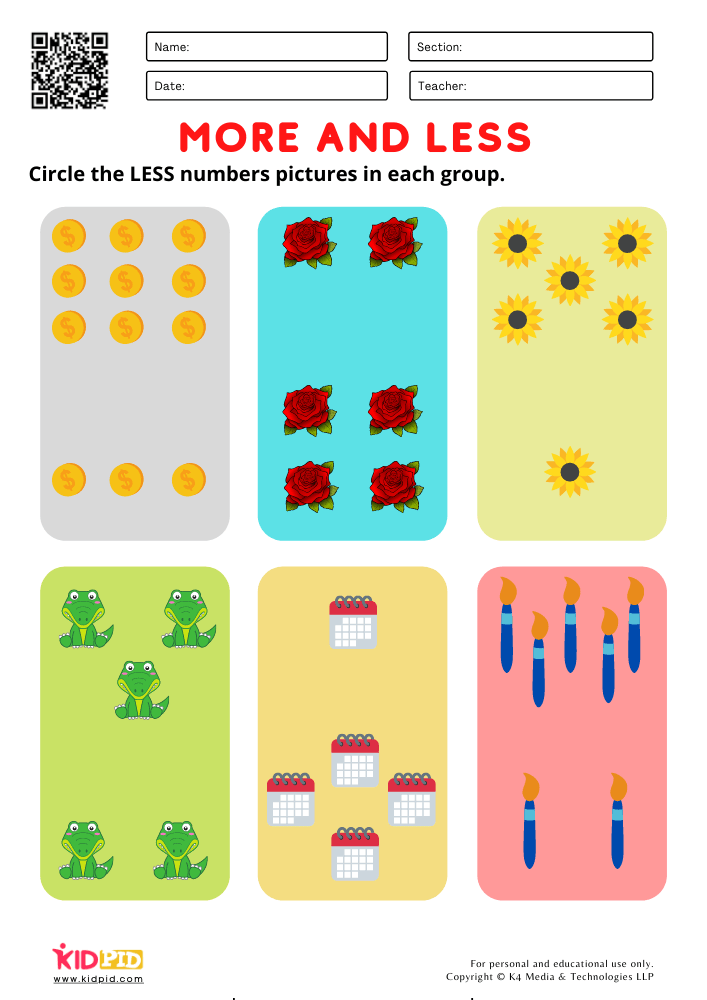
The worksheet shows six different panels with various commonly found items. Let’s take a look at the first panel. There are four apples, but three are on one side, and there is one on the opposite side. The task is to circle the greater number of apples.
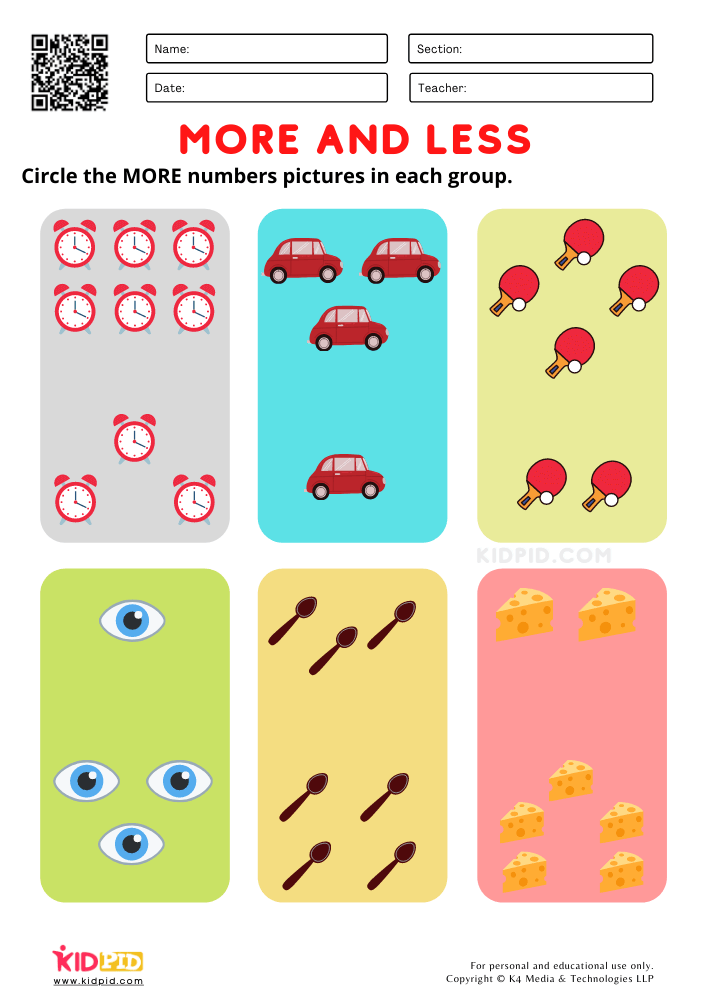
The worksheet shows many common things that kids are familiar with. This helps kids associate things around them with what they’re learning.
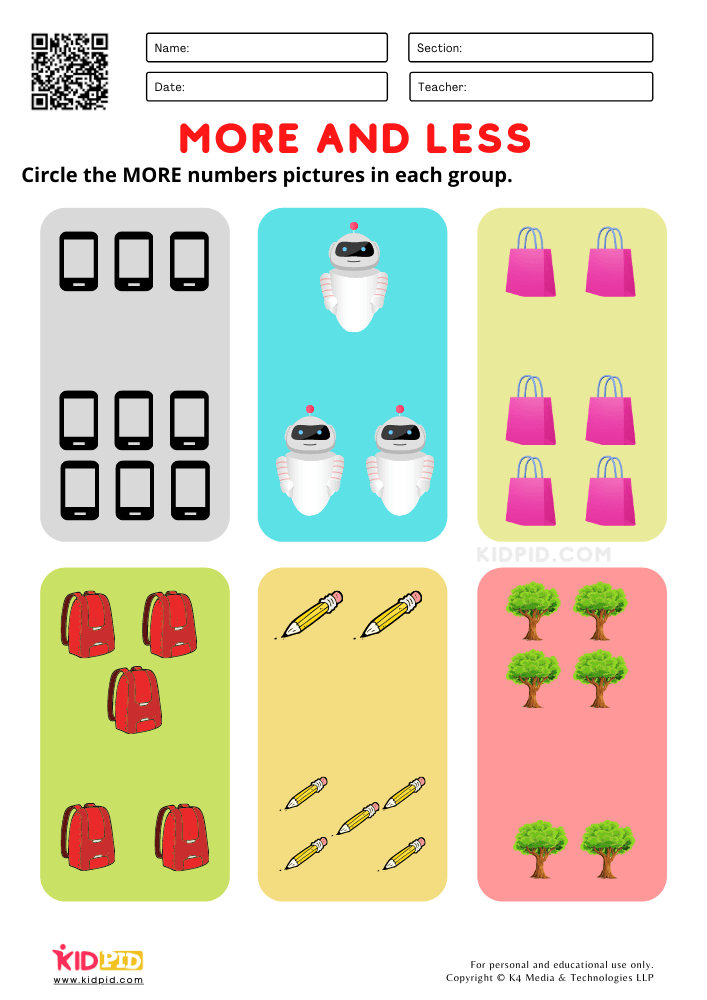
The kids count the number of items in each panel out loud as they solve the worksheet. This will help them recall something they’ve already learnt.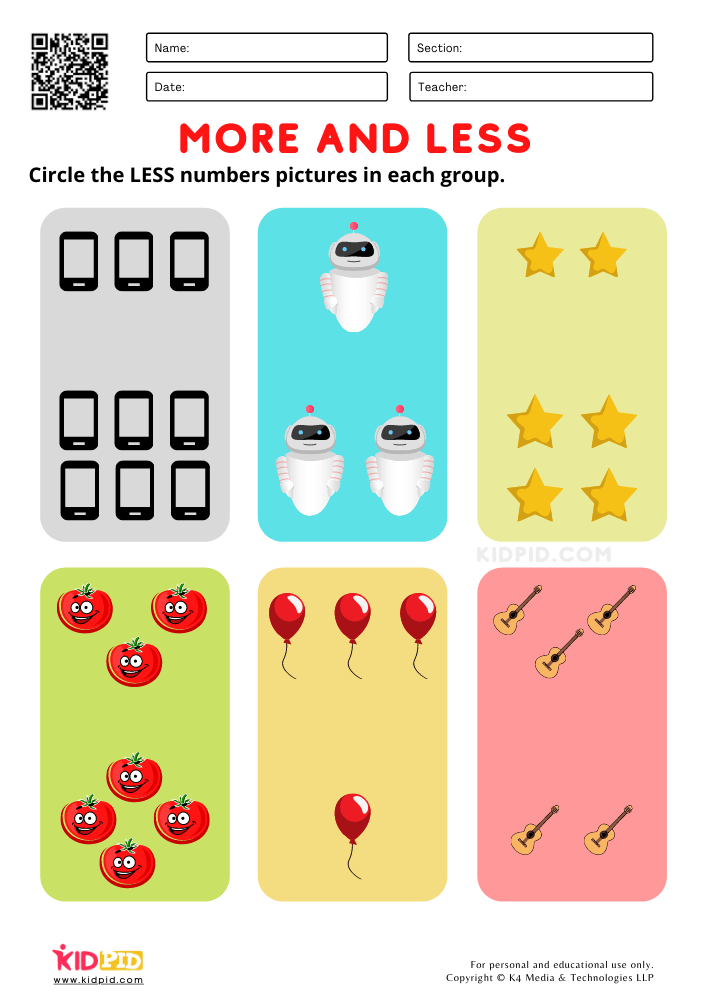
Make sure to circle fewer items in each group in this worksheet. As the kids count the number of items, they will also develop the concept of equal numbers.
Key Facts About More or Less Worksheets for Kindergarten
More Less Worksheets for Kindergarten help young learners understand the basic mathematical concepts of quantity comparison. These worksheets encourage children to identify which group has more items and which has fewer. Through engaging visual activities, students develop counting, observation, and critical-thinking skills while building a strong foundation for future math learning.
Key Facts:
- Designed for kindergarten and early learners.
- Introduces comparison concepts using pictures and objects.
- Enhances counting and number recognition skills.
- Supports early mathematical reasoning.
- Uses fun, interactive exercises suitable for young children.
- Helps prepare children for addition, subtraction, and measurement concepts.
Parts/Types/Examples of More Less Worksheets for Kindergarten
More Less Worksheets come in various formats to keep children engaged while learning comparison skills.
Types of Worksheets:
- Picture Comparison Worksheets: Compare groups of animals, fruits, toys, or shapes.
- Number Comparison Worksheets: Identify larger and smaller numbers.
- Color and Circle Activities: Circle the group with more or fewer objects.
- Cut-and-Paste Worksheets: Match groups according to quantity.
- Counting and Comparing Activities: Count objects before deciding which group has more or fewer.
Examples:
- Circle the basket with more apples.
- Color the group with fewer stars.
- Compare two sets of animals and mark the larger group.
- Count and write whether there are more or fewer objects.
How Do More or Less Worksheets for Kindergarten Work?
These worksheets present two or more groups of objects. Children count the items in each group and determine which group contains more or fewer objects. Visual illustrations make comparison easy and enjoyable.
Learning Process:
- Observe the groups of objects.
- Count the items carefully.
- Compare the quantities.
- Identify the group with more or fewer.
- Complete the activity by circling, coloring, matching, or writing answers.
Regular practice strengthens numerical understanding and comparison skills.
Benefits of Learning About More and Less Worksheets for Kindergarten
Learning more and fewer concepts provides important early math skills that children use throughout their education.
Benefits Include:
- Improves counting accuracy.
- Develops logical thinking abilities.
- Enhances number sense.
- Strengthens observation skills.
- Builds confidence in early mathematics.
- Prepares children for advanced comparison and measurement concepts.
- Encourages independent problem-solving.
These foundational skills contribute to success in future math topics.
Learning Objectives
By completing More Less Worksheets, children will be able to:
- Identify groups with more or fewer objects.
- Count items accurately.
- Compare quantities using visual clues.
- Develop number recognition skills.
- Understand basic mathematical vocabulary.
- Strengthen concentration and attention to detail.
- Build confidence in solving comparison problems.
Worksheet Instructions
Directions for Students:
- Look carefully at each set of objects.
- Count the number of items in every group.
- Compare the quantities.
- Circle or color the group with more objects when instructed.
- Circle or color the group with fewer objects when instructed.
- Complete all questions neatly.
- Check your answers after finishing.
Parents and teachers can encourage children to count aloud for additional practice.
Interesting Facts About More or Less Worksheets for Kindergarten
- Comparison skills are among the earliest math concepts children learn.
- Understanding more and less helps children make everyday decisions.
- Visual comparisons develop before children fully understand numbers.
- More and less activities improve problem-solving abilities.
- These worksheets support both math and critical-thinking development.
- Children often learn comparison concepts through play before formal instruction.
- Quantity comparison forms the basis for future arithmetic learning.
Real-Life Applications
Children encounter more and fewer concepts every day.
Examples Include:
- Compare the number of toys in the two boxes.
- Choosing the plate with more cookies.
- Counting fruits in different baskets.
- Comparing books on shelves.
- Determining which container has fewer crayons.
- Comparing groups during classroom activities.
- Measuring ingredients while helping in the kitchen.
These practical experiences help children connect math to real-world situations.
FAQs
Q1. What are More or Less Worksheets for Kindergarten?
Answer: More or fewer worksheets are educational activities that teach children how to compare quantities and identify groups with more or fewer objects.
Q2. Why are more and less concepts important?
Answer: They build foundational math skills needed for counting, number sense, addition, subtraction, and problem-solving.
Q3. At what age should children learn more and less?
Answer: Most children begin learning these concepts between ages 4 and 6 during preschool and kindergarten.
Q4. How do these worksheets improve math skills?
Answer: They help children count accurately, compare quantities, recognize numbers, and develop logical thinking.
Q5. Can these worksheets be used at home?
Answer: Yes. Parents can use them as fun learning activities to reinforce classroom lessons.
Q6. What skills do children gain from comparison worksheets?
Answer: Children develop counting skills, observation abilities, critical thinking, concentration, and mathematical vocabulary.
Q7. How often should children practice more and fewer activities?
Answer: Short daily practice sessions can effectively strengthen understanding and retention.
Q8. Are visual worksheets effective for kindergarten students?
Answer: Yes. Visual learning helps young children grasp quantity concepts more easily and keeps them engaged during learning activities.
Q9. Do More Less Worksheets support future math learning?
Answer: Absolutely. They create a strong foundation for advanced concepts such as addition, subtraction, measurement, and data comparison.
Q.10 Can teachers use these worksheets in classrooms?
Answer: Yes. They are excellent resources for independent practice, group activities, assessments, and math centers.
These More & Less Worksheets for Kindergarten provide a fun and effective way to strengthen early math skills. Regular practice helps children compare quantities, improve counting, develop number sense, and build confidence in solving everyday mathematical problems. Discover learning made fun with our paragraphs, essays, worksheets, flashcards, quizzes, and interactive activities. Follow us on YouTube & Facebook.
The worksheet is thoughtfully designed by the Content Team to improve academic outcomes.
Reviewed By Komal Singh
Read More: