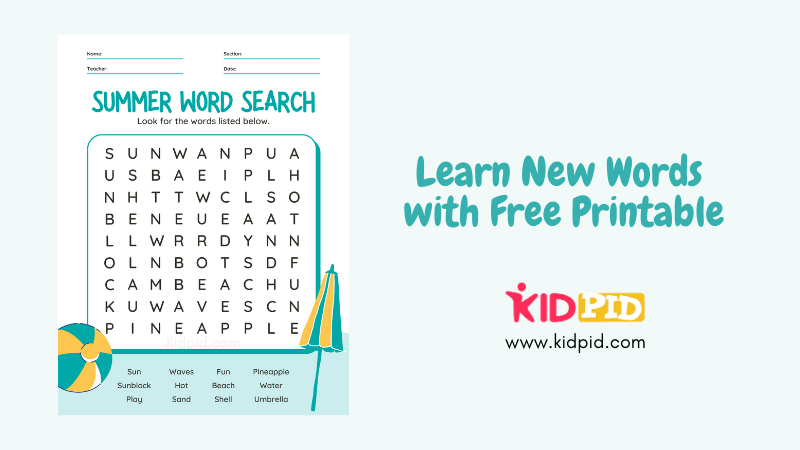
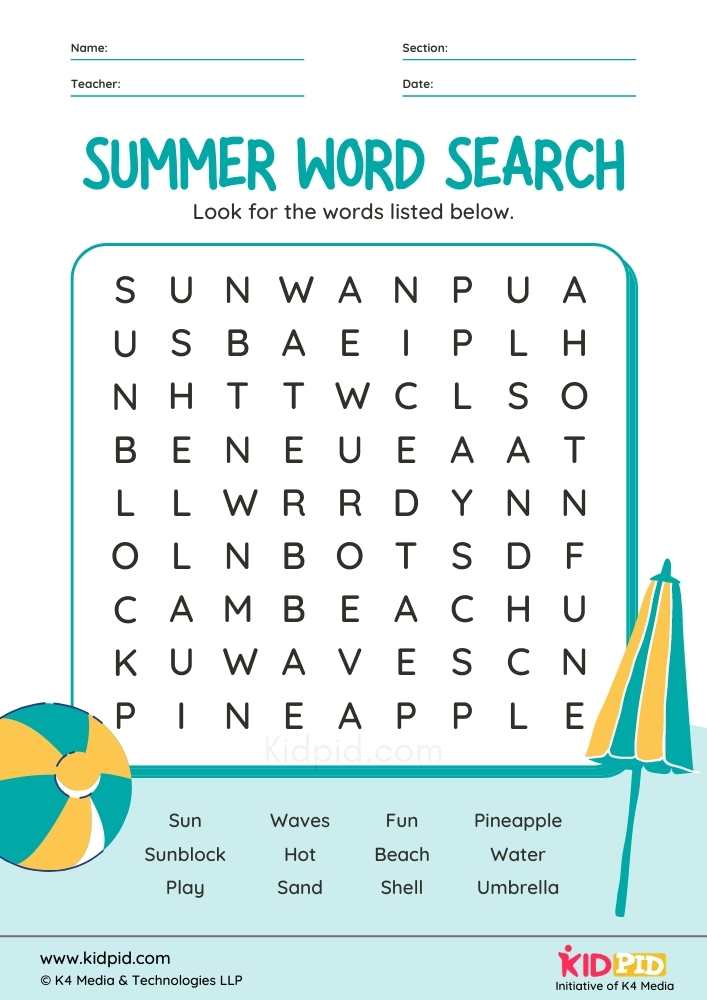
Free printable summer word search worksheets for kids – preschool, kindergarten, and elementary school grades. This worksheet will help your kids to remember words related to the summer season, like Sun, Hot, and Beach, among others, easily by working on the free printable.
Summer Word Search Printable Worksheet

Click here for more printable worksheets.
Key Facts About Summer Word Search Printable Worksheets
- Target Audience: Perfect for preschoolers, kindergarteners, and early elementary school grades (Grade 1 and Grade 2).
- Skills Developed: Letter recognition, visual scanning, pattern matching, fine motor skills, and theme-based vocabulary retention.
- Format: Free, high-quality, downloadable PDF file designed for clean printing on standard A4 or letter-size paper.
- Vocabulary Focus: Contextual seasonal terms like Sun, Hot, Beach, Pool, Summer, and Sand.
Parts and Types of Summer Word Search Puzzles
Educational word puzzles vary by difficulty to match a child’s developmental milestones. The main variations include:
- The Grid: A structured block of letters (typically 8×8 for younger kids or 10×10 for older children) where words are hidden.
- The Word Bank: A visual list of summer-themed vocabulary at the bottom of the page, often accompanied by small illustrations to assist pre-readers.
- Lowercase vs. Uppercase Grids: Preschoolers and kindergarteners benefit most from uppercase grids as the letters are easier to distinguish, while older kids can transition to lowercase grids.
- Directional Types:
- Beginner: Words are only hidden horizontally (left-to-right) and vertically (top-to-bottom).
- Advanced: Includes diagonal placements and backward-spelled words.
How Does a Summer Word Search Worksheet Work?
At its core, a word search is a visual processing game. Here is how the brain tackles the puzzle:
- Targeting: The child looks at a word in the word bank (e.g., “SUN”) and memorizes its shape and starting letter.
- Scanning: The child scans the grid systematically—either row by row or looking for the unique anchor letter “S”.
- Verifying: Once “S” is found, the child checks the surrounding letters in all directions to see if they follow with “U” and “N”.
- Tracking: Using a crayon, pencil, or highlighter, the child traces a line through the letters to visually “lock in” the found word.
Benefits of Learning About Summer Vocabulary Through Puzzles
Using puzzles instead of rote memorization transforms language acquisition into a playful, stress-free activity.
- Prevents the “Summer Slide”: Keeps young minds sharp during the long school break, ensuring spelling and reading habits don’t decline.
- Boosts Working Memory: Children must hold the spelling of a word in their mind while actively searching for its letters in a chaotic visual field.
- Enhances Executive Functioning: Teaches children persistence, focus, and a systematic approach to solving problems.
- Improves Spatial Awareness: Helps young learners recognize how letters arrange themselves spatially to form words.
Learning Objectives
By completing this summer word search worksheet, students will be able to:
- Identify and read key seasonal words associated with summer.
- Demonstrate improved visual discrimination by isolating hidden words from a field of random letters.
- Strengthen fine motor control by neatly circling or highlighting lines of text.
- Expand their thematic vocabulary to help them write simple sentences about summer activities.
Worksheet Instructions
Follow these simple steps to help your child get the most out of this printable activity:
- Print the Sheet: Download the free Kidpid worksheet and print it out. Highlighters or colored pencils work best!
- Review the Word Bank First: Read the words at the bottom of the page aloud with your child. Ask them what each word means to establish context.
- Search Systematically: Encourage your child to scan from left to right, starting at the top row, rather than looking at the grid randomly.
- Cross It Off: Once a word is found and circled in the grid, have your child cross it off the word bank list. This provides a satisfying sense of progress!
Interesting Facts About Word Search Puzzles & Summer
- A Relatively Modern Invention: The very first word search puzzle was created by Norman E. Gibat and published in the Selenby Digest in Norman, Oklahoma, on March 1, 1968. It was designed to keep shoppers engaged!
- Brain Care: Psychologists note that word puzzles release a small burst of dopamine (the “feel-good” hormone) every time a word is successfully found, reinforcing positive learning habits.
- Vitamin D Season: Summer words often revolve around the outdoors because the summer solstice marks the longest day of the year, maximizing our sunlight exposure.
Summer Vocabulary Words to Know
Introduce these essential terms to your child to build their seasonal language bank:
- Sun: The star at the center of our solar system that gives us light and warmth.
- Beach: A sandy area of land right next to a body of water, like an ocean or lake.
- Hot: Having a high temperature; the signature feel of summer days.
- Pool: A man-made tank of water built for swimming and cooling off.
- Ice Cream: A sweet, frozen food made from dairy that is a favorite summer treat.
Real-Life Applications
Learning vocabulary through a printable sheet isn’t just an academic exercise—it connects directly to a child’s everyday world:
- Summer Journaling: After finding the words on paper, kids can use them to write a short story or diary entry about their own summer vacation or a trip to the park.
- Travel Companion: These printables serve as perfect, screen-free road trip activities or quiet-time games during long flights and restaurant waits.
- Conversational Prompts: Use words like “Beach” or “Pool” from the puzzle to spark a conversation. Ask your child: “What are three things we need to pack when we go to the beach?”
FAQs
Q1. What age group is this summer word search best for?
Answer: This specific worksheet is tailored for kids aged 4 to 8 (Preschool through 2nd Grade). The words are kept short and are placed in straightforward directions to avoid frustration.
Q2. How do word searches help with spelling?
Answer: Word searches require children to look at the exact sequencing of letters. By hunting for the specific order of characters, they naturally internalize how the word is spelled.
Q3. Are these worksheets free to use in the classroom?
Answer: Yes! Kidpid provides these printable activities as free resources. Teachers are welcome to print multiple copies for classroom use, summer camps, or take-home packets.
Q4. My child is struggling to find the words. How can I help?
Answer: Try guiding them by focusing on the first letter of the word. Have them trace their finger along the rows, just looking for that one letter. You can also place a ruler horizontally under each line to help them focus on one row at a time.
These Summer Word Search printable worksheets make learning fun by helping children improve vocabulary, spelling, concentration, and word recognition. Enjoy engaging summer-themed activities that build language skills while keeping young learners entertained and motivated. Browse our website for worksheets, essays, paragraphs, flashcards, quizzes, and interactive resources. Follow us on YouTube & Facebook.
This worksheet is designed by the Content Team to nurture academic improvement.
Reviewed By Srijony Das
More Printables