


This is a number tracing and writing (1-25) worksheet designed for first-grade students. They will first trace the numbers in the second column and then write the numbers on their own in the other column. It will help them to learn and practice numbers, as it will be easy for them to solve questions in higher classes. So check out these worksheets and enhance your learning.
[Scroll Down for Download Link]
Contents
- Trace & Write The Number Worksheets For Grade 1
- Key Facts About Number Tracing & Writing (1-25) Worksheets
- Parts/Types/Examples of Number Tracing Worksheets
- How Does This Worksheet Work?
- Benefits of Learning About Number Tracing
- Learning Objectives
- Worksheet Instructions
- Interesting Facts About Number Vocabulary
- Real-Life Applications
- FAQs
Trace & Write The Number Worksheets For Grade 1
Read More: Lowercase Letter Tracing Worksheet For Preschool
Tracing & Writing Numbers 1 to 5
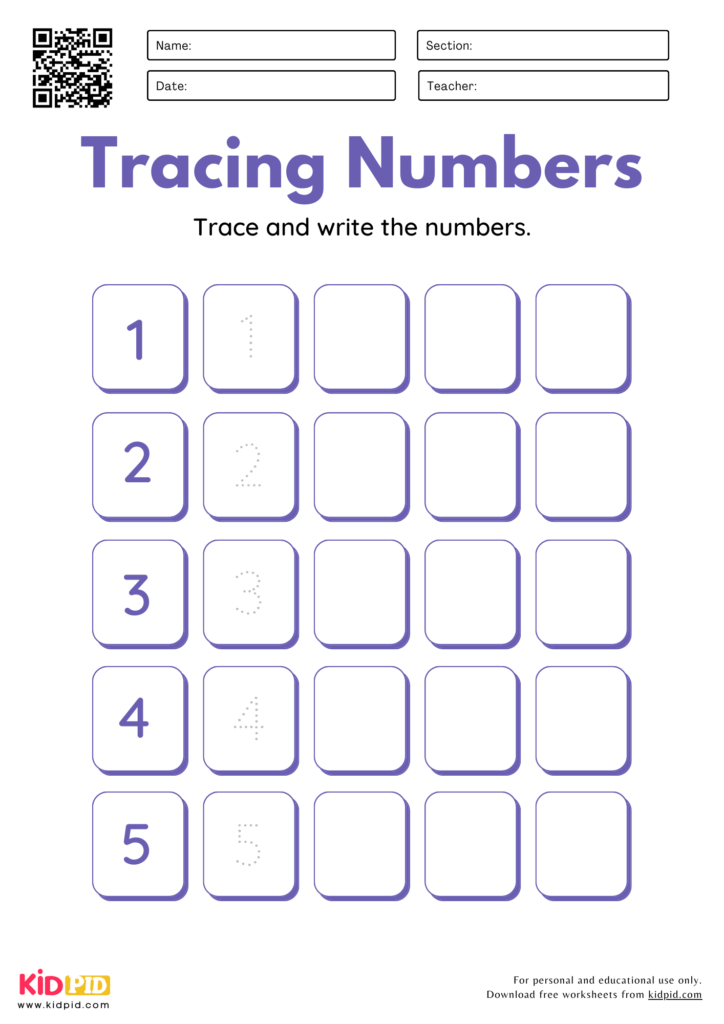
In this tracing number worksheet, first-grade students will first trace the numbers in the second column and then write the numbers on their own in the other columns. It includes numbers from one to five in this worksheet.
Tracing & Writing Numbers 6 to 10

This is a tracing and writing number worksheet. Students have to first trace the numbers in the second column and then write the numbers on their own in the other columns. It includes numbers from six to ten in this worksheet. This will help them to learn them proficiently.
Tracing & Writing Numbers 11 to 15

First-grade students will practice tracing and writing the numbers in the worksheet. They have to first trace the numbers in the second column and then write the numbers on their own in the other columns. This worksheet includes numbers from eleven to fifteen.
Tracing & Writing Numbers 16 to 20

Tracing and writing the numbers will help the first-grade students to learn fast. They will practice the numbers by first tracing the numbers in the second column and then writing the numbers on their own in the other columns. It includes numbers from sixteen to twenty.
Tracing & Writing Numbers 21 to 25

This is a tracing and writing number worksheet to learn and practice numbers. Students will learn them by tracing the numbers in the second column and then writing the numbers on their own in the other columns. This worksheet consists of numbers from twenty-one to twenty-five.
Key Facts About Number Tracing & Writing (1-25) Worksheets
- Target Audience: Specifically designed for first-grade students transitioning from basic recognition to fluent writing.
- Scope: Covers numerical progression from 1 to 25, structured in logical sets (1-5, 6-10, etc.) to prevent cognitive overload.
- Design Philosophy: Employs a “scaffolded learning” approach, where tracing acts as a muscle-memory bridge to independent writing.
- Pedagogical Purpose: Enhances fine motor skills and spatial awareness, which are precursors to complex mathematical operations.
Parts/Types/Examples of Number Tracing Worksheets
These worksheets are organized into five distinct modules to ensure mastery of each numerical cluster:
- Foundational Set (1–5): Focuses on basic stroke formation and number recognition.
- Intermediate Sets (6–10, 11–15): Increase complexity by introducing two-digit number formation.
- Advanced Sets (16–20, 21–25): Solidifies consistency in spacing and size alignment.
- Example Structure: Each section features a dual-column format:
- Column A: Guided tracing paths with directional arrows.
- Column B: Blank grid cells for independent practice, encouraging self-correction.
How Does This Worksheet Work?
The worksheet utilizes a Scaffolded Learning Method. It begins with visual imitation, where the child follows pre-drawn paths to understand the shape and “flow” of each digit. This repetition builds the neural pathways necessary for hand-eye coordination. By transitioning from tracing to independent writing within the same worksheet, students move from “assisted learning” to “autonomous performance,” which is critical for classroom success in early mathematics.
Benefits of Learning About Number Tracing
- Motor Skill Development: Refines the grasp and control necessary for handwriting.
- Numerical Fluency: Repeated exposure helps children recognize numbers automatically without counting.
- Confidence Building: The clear, measurable progress from 1 to 25 provides a sense of accomplishment.
- Cognitive Foundation: Mastering these numbers prepares students for future concepts like addition, subtraction, and place value.
Learning Objectives
Upon completing these worksheets, students will be able to:
- Correctly identify digits 1 through 25.
- Demonstrate proper pencil control through consistent tracing.
- Independently reproduce numbers 1–25 with correct alignment and spacing.
- Understand the sequential order of numbers.
Worksheet Instructions
For optimal results, follow these steps:
- Preparation: Ensure the child has a well-sharpened pencil and a comfortable, upright seating position.
- Guided Tracing: Start with the first column. Encourage the child to follow the direction of the lines slowly to maximize muscle memory.
- Independent Practice: Move to the second column. Encourage them to visualize the shape they just traced before drawing it independently.
- Feedback Loop: If a number is written incorrectly, calmly point to the traced model above it for comparison rather than simply erasing it.
Interesting Facts About Number Vocabulary
- Etymology: The number “one” stems from the Old English an, while numbers like “eleven” have roots meaning “one left” (over ten), highlighting the history behind our base-10 system.
- Symbolic Evolution: The shapes we use today are known as “Arabic Numerals,” which evolved significantly from ancient Brahmi scripts to become the universal standard for mathematics.
Real-Life Applications
Number literacy extends far beyond the classroom:
- Daily Organization: Telling time, using calendars, and reading room numbers.
- Commercial Interaction: Understanding prices, counting money, and identifying quantities in shopping.
- Digital Literacy: Inputting codes, navigating device settings, and interacting with basic computer interfaces.
FAQs
Q1. At what age should a child start these worksheets?
Answer: These are specifically curated for Grade 1 (ages 6-7), though they can be used for younger children if they have already mastered basic fine motor control.
Q2. How many times should a student repeat these worksheets?
Answer: Consistency is key. Completing one set per day is more effective than attempting all 25 numbers in one session, as it prevents hand fatigue.
Q3. Can these be used for students with dysgraphia?
Answer: Yes, the guided tracing paths are particularly helpful for students who need extra structural support for letter and number formation.

Learning to trace and write numbers 1–25 helps Grade 1 students build strong number recognition and handwriting skills. These fun worksheets improve fine motor control, counting confidence, and early math readiness through regular practice. Learn, practice, and grow with printable worksheets, paragraphs, quizzes, essays, flashcards, and interactive resources. Join us on YouTube, Telegram, and Facebook.
Our Content Team created this worksheet to help students progress in learning.
Reviewed By Nausheen Fatima
Read More:



