


Here is the activity for tracing and writing numbers from twenty-six to fifty. First-grade students will learn to count numbers by first tracing the numbers given in the second column and writing the numbers on their own in the other columns. So check out these worksheets to enhance your knowledge, as it is the first step to practicing maths questions of maths and solving them.
[Scroll Down for Download Link]
Contents
- Trace & Write The Number Worksheets For Grade 1
- Key Facts About Number Tracing & Writing (26-50) Worksheets
- Parts, Types, and Examples
- How Does Number Tracing & Writing Work?
- Benefits of Learning About Number Tracing (26-50)
- Learning Objectives
- Worksheet Instructions
- Key Vocabulary
- Real-Life Applications
- FAQs
Trace & Write The Number Worksheets For Grade 1
Read More: Tracing Animals Fine Motor Tracing Skill Book Worksheet
Tracing & Writing Numbers 26 to 30
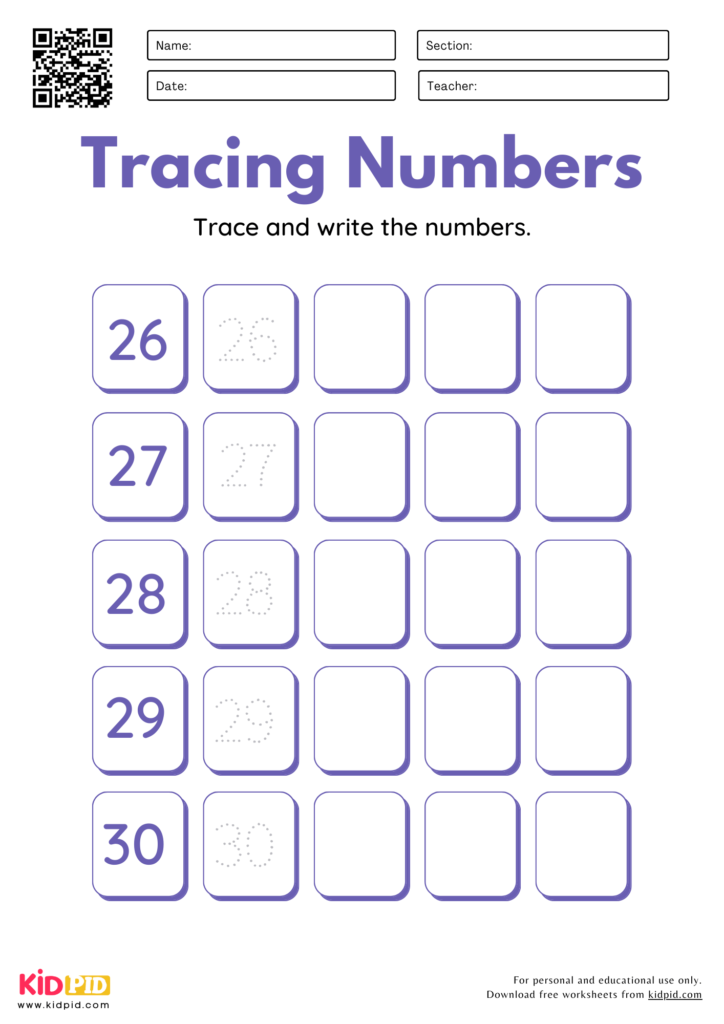
This tracing and writing number activity will teach students about numbers. They have to first trace the numbers given in the second column and write the numbers on their own in the other columns. It includes numbers from twenty-six to thirty.
Tracing & Writing Numbers 31 to 35
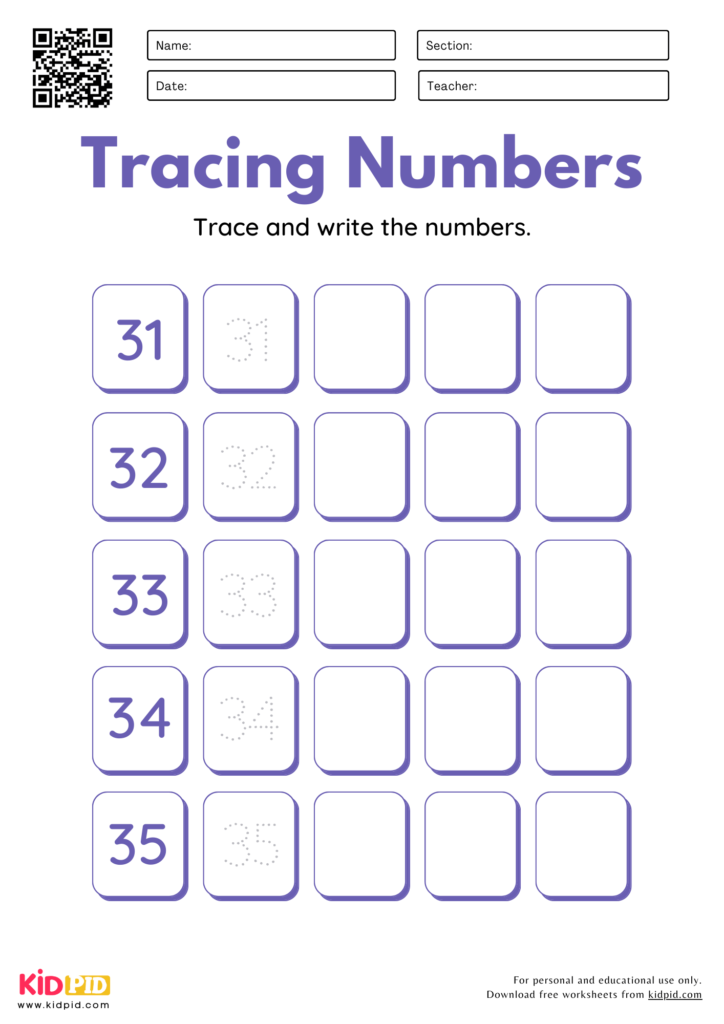
First-grade students will practice the tracing and writing number worksheet. They have to first trace the numbers in the second column and then write the numbers on their own in the other columns. This worksheet includes numbers from thirty-one to thirty-five.
Tracing & Writing Numbers 36 to 40
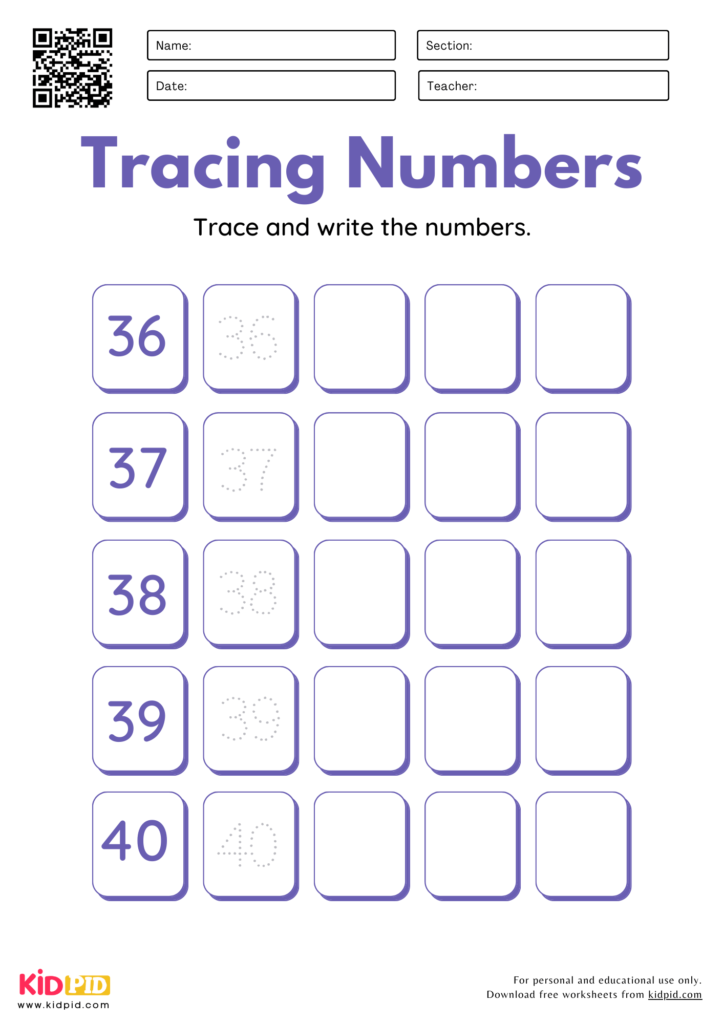
In this tracing and writing worksheet, students have to first trace the numbers in the second column and then write the numbers on their own in the other columns. This worksheet includes numbers from thirty-six to forty.
Tracing & Writing Numbers 41 to 45
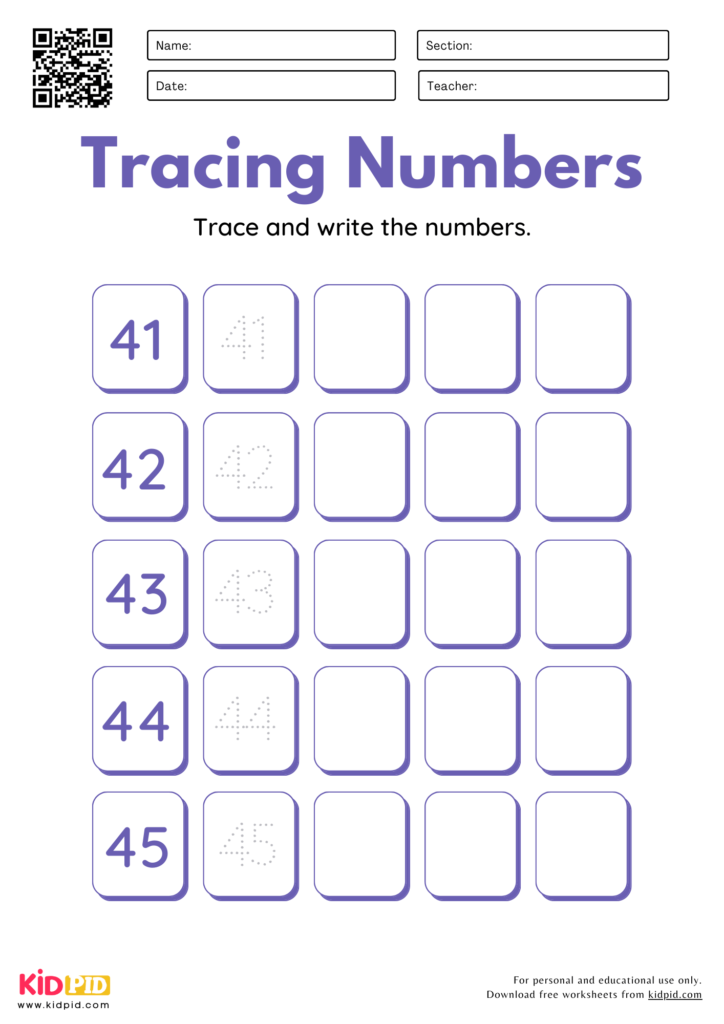
Students will trace and write the numbers in this worksheet from forty to forty-five. They will practice them by first tracing the numbers given in the second column and writing the numbers on their own in the other columns.
Tracing & Writing Numbers 46 to 50
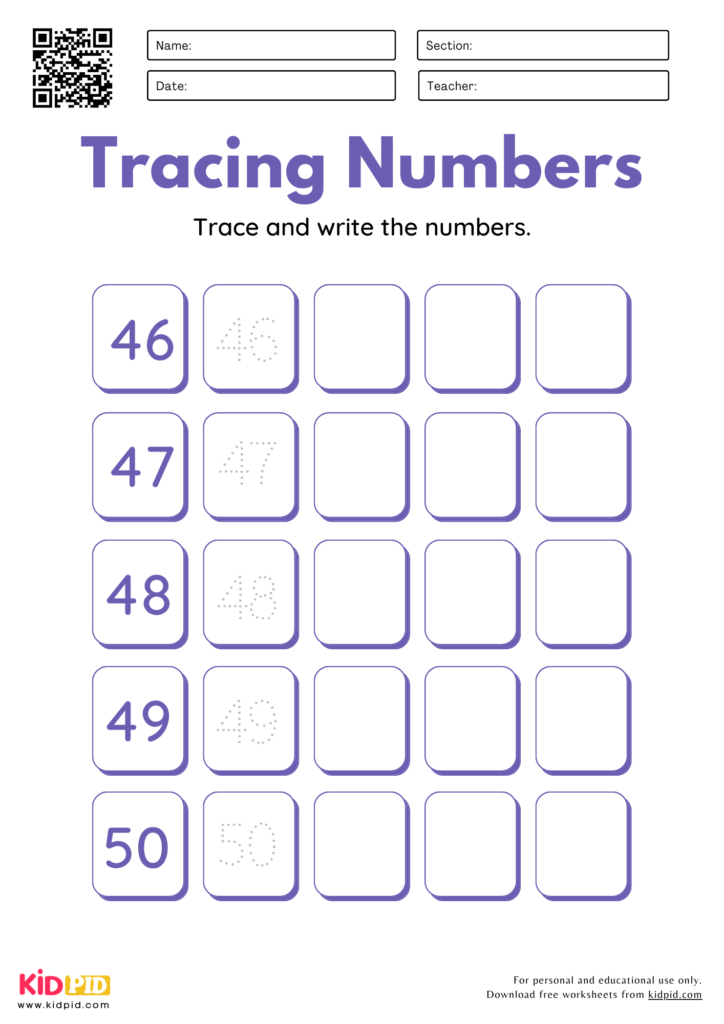
This is a tracing and writing number worksheet for first-grade students. To practice the questions, they will first trace the numbers given in the second column and write the numbers on their own in the other columns. It includes numbers from forty-six to fifty.
Key Facts About Number Tracing & Writing (26-50) Worksheets
- Target Audience: Specifically designed for Grade 1 students (approx. 6–7 years old) transitioning from basic counting to mastering larger sequences.
- Skill Focus: Targets fine motor development, proper pencil grip, and structural number formation.
- Educational Alignment: Aligns with standard primary math curricula, focusing on recognition, sequencing, and writing fluency.
- Content Scope: Covers 26 to 50, segmented into manageable blocks (e.g., 26–30, 31–35) to prevent cognitive overload.
Parts, Types, and Examples
- Structured Practice Blocks:
- Guided Tracing: Lightly printed numerals providing a visual guide.
- Independent Writing: Blank spaces or primary-ruled lines for practice without visual aids.
- Sequence Types: Organized into logical sets (26-30, 31-35, 36-40, 41-45, 46-50).
- Visual Supports: Uses clear, large-font numerals to aid visual-spatial development.
How Does Number Tracing & Writing Work?
The methodology employs a “scaffolded learning” approach:
- Modeling: The student observes the correct formation of the number.
- Guided Practice (Tracing): Tracing builds muscle memory and motor coordination.
- Independent Application (Writing): Transitioning to writing reinforces long-term cognitive retention.
Benefits of Learning About Number Tracing (26-50)
- Fine Motor Development: Strengthens hand muscles, improving handwriting quality across all subjects.
- Numerical Fluency: Internalizing sequences is essential for future concepts like addition and subtraction.
- Confidence Building: Completing sets provides a sense of achievement, fostering a positive attitude toward math.
Learning Objectives
- Recognize and identify numerals from 26 to 50 accurately.
- Master the physical stroke order for digits 0–9.
- Write numbers independently within a given space.
- Maintain proper number orientation (avoiding reversals).
Worksheet Instructions
- Prepare: Ensure a sharpened pencil and a comfortable seating position.
- Trace: Follow the guide column, emphasizing the correct direction of pen strokes.
- Write: Move to empty columns to attempt independent writing.
- Review: If a number is reversed, gently erase and have the student trace it again.
Key Vocabulary
- Cardinal Numbers: Describe the quantity of things.
- Digit Placement: Learning “Tens” and “Ones” places (e.g., in “26,” 2 represents two tens and 6 represents six ones).
- Sequence: Bridging the gap between basic counting and double-digit operations.
Real-Life Applications
- Daily Organization: Reading clocks, page numbers, and house numbers.
- Money Management: Foundational for counting change and understanding currency.
- Measurement: Practical application for reading scales, rulers, and thermometers.
FAQs
Q1. At what age should a child start these worksheets?
Answer: Typically Grade 1 (age 6–7), though they are excellent for kindergarteners showing readiness.
Q2. Can I reuse these worksheets?
Answer: Yes! Laminate them or use clear plastic sheet protectors with dry-erase markers.
Q3. My child reverses their numbers. Is this normal?
Answer: Yes, it is very common. Consistent tracing practice helps standardize stroke direction.
Q4. How many pages should a child do at once?
Answer: One to two segments (e.g., 26–35) per session is sufficient to maintain focus.

Tracing and writing numbers 26–50 helps Grade 1 students develop neat handwriting, number recognition, and counting skills. These engaging worksheets support fine motor development while making early math practice fun and effective. Strengthen classroom learning with printable worksheets, paragraphs, quizzes, essays, flashcards, and interactive resources. Follow us on Facebook, YouTube, and Telegram.
Designed by our Content Team, this worksheet promotes strong learning foundations.
Reviewed By Minakshi
Read More:



