


Today, first-grade students will learn to trace and write numbers from seventy-six to one hundred with the help of these worksheets. They will first trace the numbers given in the second column and write the numbers on their own in the other columns. To build the foundation of the child in maths, this is the right activity for him. So check out these worksheets and boost your knowledge.
[Scroll Down for Download Link]
Contents
- Trace & Write The Numbers 76 to 100 Worksheets for Grade 1
- Key Facts About Number Tracing & Writing (76–100) Worksheets
- Parts/Types/Examples of Number Tracing & Writing Worksheets
- How Does Number Tracing & Writing Work?
- Benefits of Learning About Number Tracing & Writing
- Learning Objectives
- Worksheet Instructions
- Interesting Facts About Number Vocabulary
- Real-Life Applications
- FAQs
Trace & Write The Numbers 76 to 100 Worksheets for Grade 1
Read More: Tracing Animals Fine Motor Tracing Skill Book Worksheet
Tracing & Writing Numbers 76 to 80
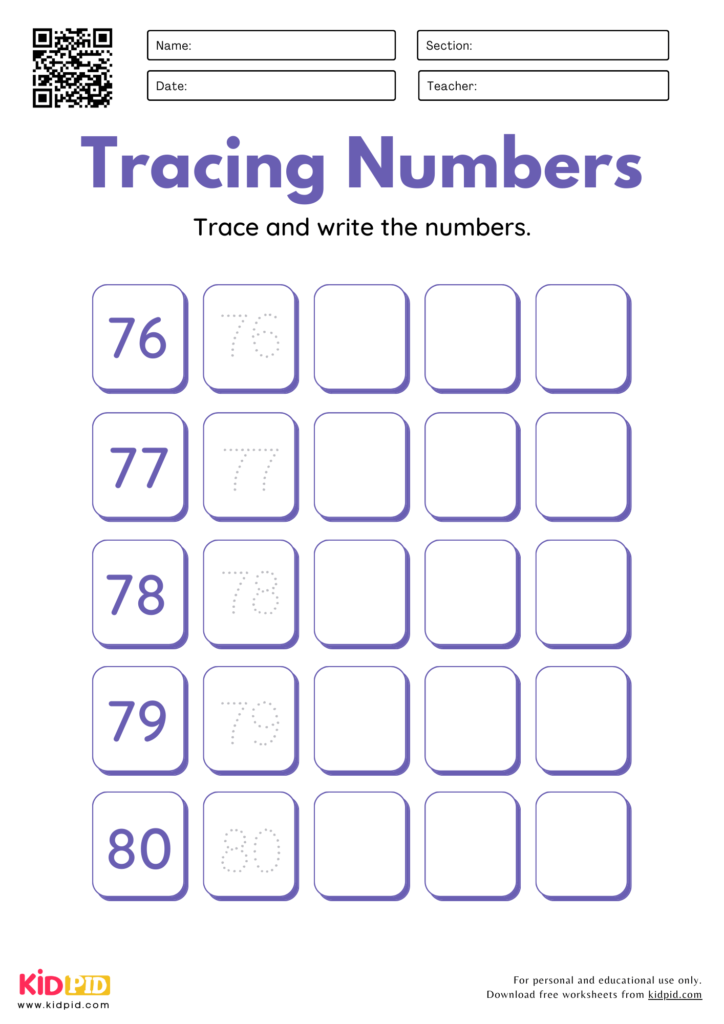
This is the tracing and writing worksheet for students to practice and learn about numbers. They have to trace the numbers given in the second column and write the numbers on their own in the other columns. It includes numbers from seventy-six to eighty.
Tracing & Writing Numbers 81 to 85
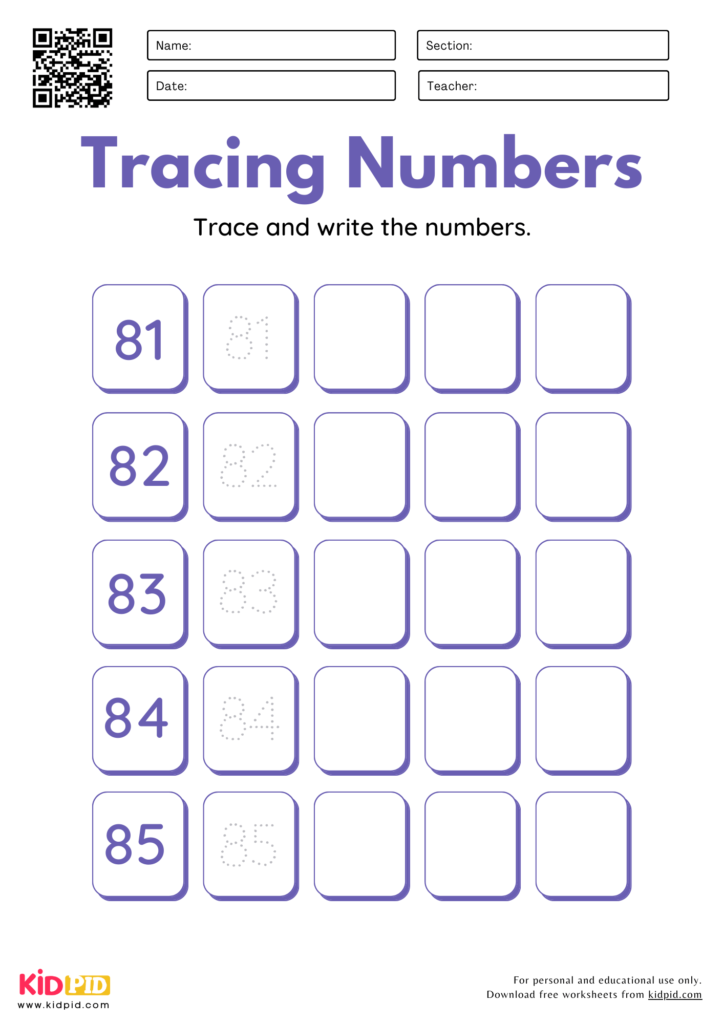
First-grade students will practice this tracing and writing numbers worksheet. They will first trace the numbers given in the second column and write the numbers on their own in the other columns. This worksheet includes numbers from eighty-one to eighty-five.
Tracing & Writing Numbers 86 to 90
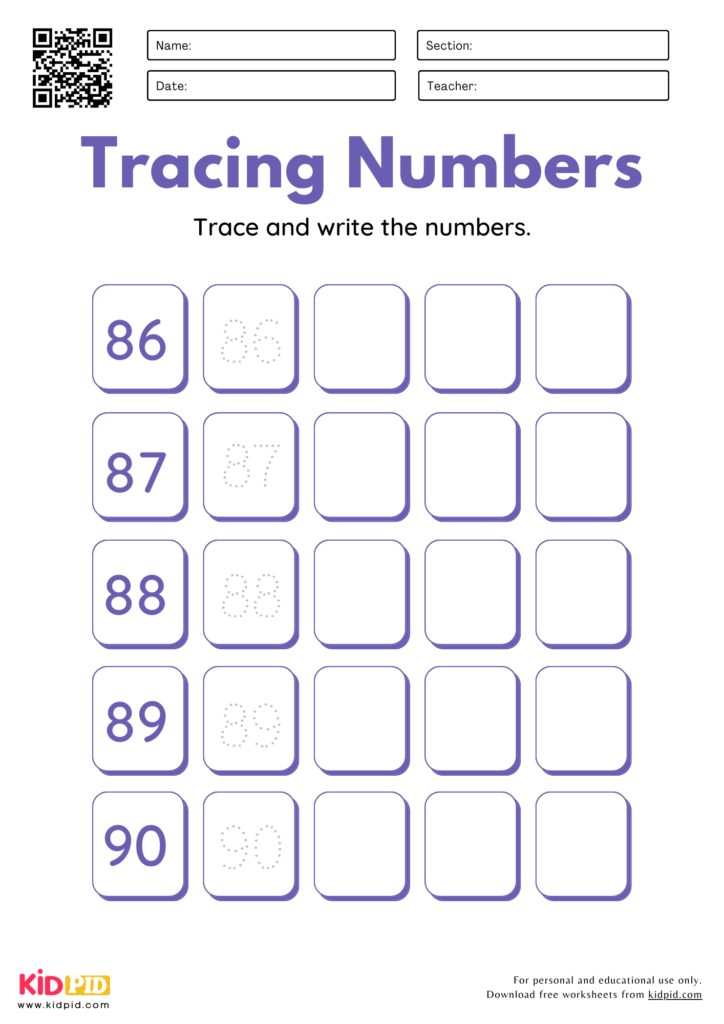
This is a tracing and writing number worksheet for first-grade students. They will learn and practice the numbers by tracing the numbers given in the second column and writing the numbers on their own in the other columns. This worksheet includes numbers from eighty-six to eighty-nine.
Tracing & Writing Numbers 91 to 95

Students practice the questions of number tracing and writing in this worksheet. To learn the numbers, students will first trace the numbers given in the second column and write the numbers on their own in the other columns. Numbers included in this worksheet are from ninety-one to ninety-five.
Tracing & Writing Numbers 96 to 100
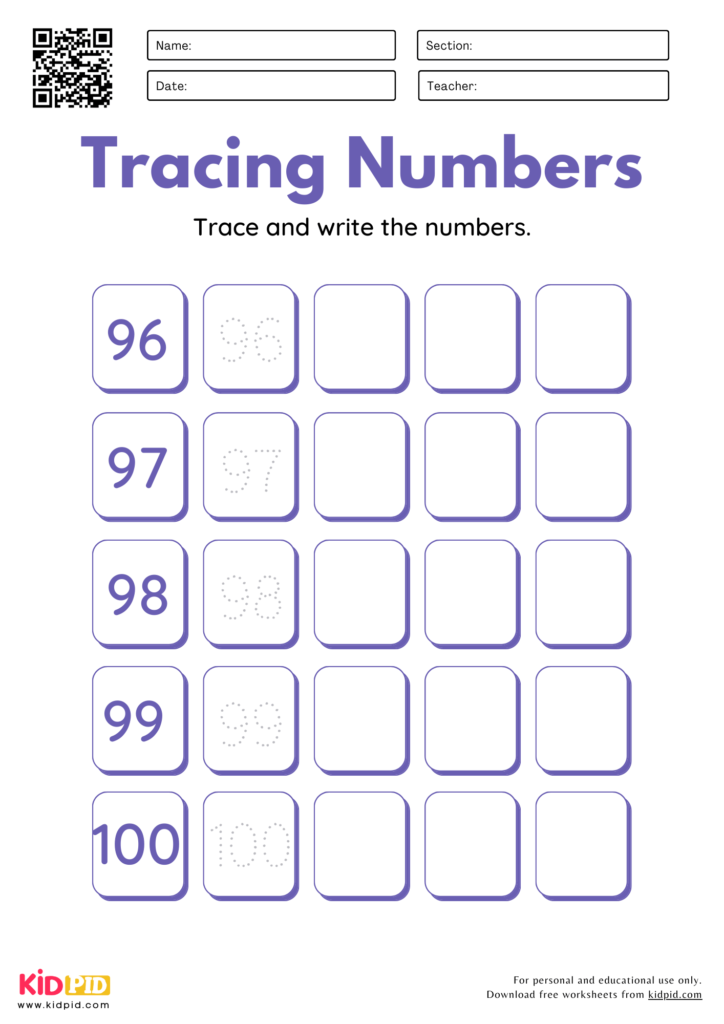
This worksheet includes numbers for tracing and writing from ninety-five to a hundred. They will practice them by first tracing the given numbers in the second column and writing the numbers in the other columns.
Key Facts About Number Tracing & Writing (76–100) Worksheets
- Target Audience: Specifically designed for Grade 1 students to bridge the gap between early numeracy and complex number recognition.
- Focus Area: Mastering the sequence of numbers from 76 to 100, which is a foundational milestone for primary math.
- Methodology: Combines guided tracing (to build muscle memory and stroke precision) with independent writing (to reinforce retention).
- Accessibility: These are high-quality, printable resources, making them ideal for both classroom use and homeschooling environments.
Parts/Types/Examples of Number Tracing & Writing Worksheets
These worksheets are segmented into logical chunks to prevent cognitive overload for young learners:
- Categorized Sets:
- 76–80 (Foundational tens)
- 81–85 (Introduction to the 80s)
- 86–90 (Mastering the 80s sequence)
- 91–95 (Transition to the 90s)
- 96–100 (Reaching the milestone of 100)
- Format: Each worksheet features a guided column for tracing and adjacent blank columns to facilitate independent practice, ensuring a step-by-step transition from guided to autonomous learning.
How Does Number Tracing & Writing Work?
The process utilizes a scaffolded learning approach:
- Guided Practice (Tracing): By following the path of the numbers, students internalize the correct stroke order and directional orientation, which is crucial for legible handwriting.
- Cognitive Reinforcement: As students trace, they verbally identify the numbers, linking visual symbols with auditory names.
- Autonomous Application: The empty columns challenge students to recall the number shapes from memory, transforming passive tracing into active mathematical knowledge.
Benefits of Learning About Number Tracing & Writing
- Fine Motor Development: Improves pencil control and hand-eye coordination.
- Mathematical Fluency: Builds a solid foundation for more complex operations like addition, subtraction, and place value.
- Confidence Building: Mastering the number sequence up to 100 gives first graders a significant sense of achievement.
- Pattern Recognition: Helps students identify the recurring patterns in digits (e.g., the repeat of 1–9 in each decade).
Learning Objectives
By the end of these activities, students will be able to:
- Accurately recognize and name all integers between 76 and 100.
- Demonstrate correct digit formation and stroke sequence.
- Sequence numbers correctly within the 76–100 range.
- Write numbers independently without visual cues.
Worksheet Instructions
- Preparation: Print the worksheets on standard paper. Ensure the child has a sharpened pencil and a good eraser.
- Guided Phase: Start with the tracing column. Encourage the child to say the number aloud as they trace it.
- Independent Phase: Move to the writing columns. If the child struggles, guide their hand once before letting them try alone.
- Consistency: Practice one set per day rather than all at once to maintain focus and prevent fatigue.
Interesting Facts About Number Vocabulary
- Base-10 Structure: Numbers 76–100 rely entirely on the base-10 system, where the first digit represents “tens” and the second represents “ones.”
- The “Century” Milestone: Reaching 100 is a major developmental threshold in early childhood math, often perceived as a “big number” that represents a complete set.
- Naming Conventions: English number names from 76–99 follow specific phonetic rules (e.g., seventy-six), while “one hundred” introduces the concept of a three-digit number.
Real-Life Applications
- Measuring Time: Understanding numbers up to 100 helps children understand minutes in an hour or days in a month.
- Money Management: Identifying these numbers is vital for counting higher denominations of coins or bills.
- Organizing: Using number sequences for sorting books, household items, or classroom supplies.
FAQs
Q1. At what age should a child start these worksheets?
Answer: These are typically aligned with Grade 1 (ages 6–7), but can be used for advanced kindergarteners or for extra practice for struggling learners.
Q2. Can these be used for remote learning?
Answer: Absolutely. These are printable PDFs designed for parents and teachers to download and use in any learning environment.
Q3. How many times should a child repeat these?
Answer: Repetition builds mastery. We recommend completing each set at least twice to ensure the muscle memory is solidified.
Q4. Are these worksheets aligned with math standards?
Answer: Yes, they support standard early numeracy curricula focusing on counting and writing numerals up to 100.
Practicing numbers 76–100 helps Grade 1 students improve number formation, handwriting, and counting skills. These engaging tracing and writing worksheets build confidence, accuracy, and a strong foundation for future math learning. Explore engaging learning resources featuring printable paragraphs, quizzes, worksheets, essays, flashcards, and interactive resources. Connect with us on YouTube, Telegram, and Facebook.
Our Content Team developed this worksheet to support students’ educational journey.
Reviewed By Mahak Agarwal
Read More:



