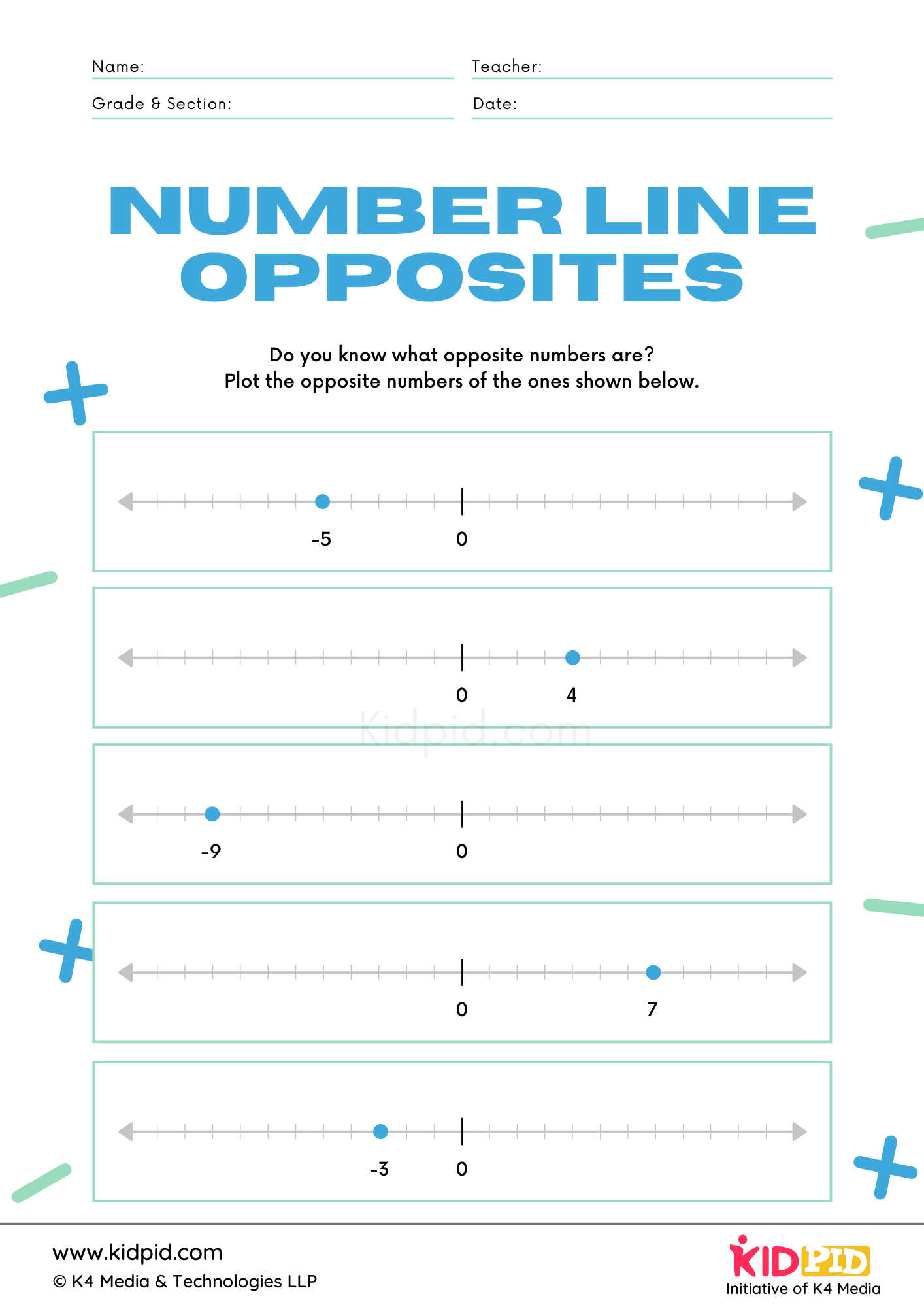
Do you know what opposite numbers are? Plot the opposite numbers of the ones shown in the printable worksheet.

Opposite Numbers Math Activity Printable Worksheet


Click here for more printable worksheets.

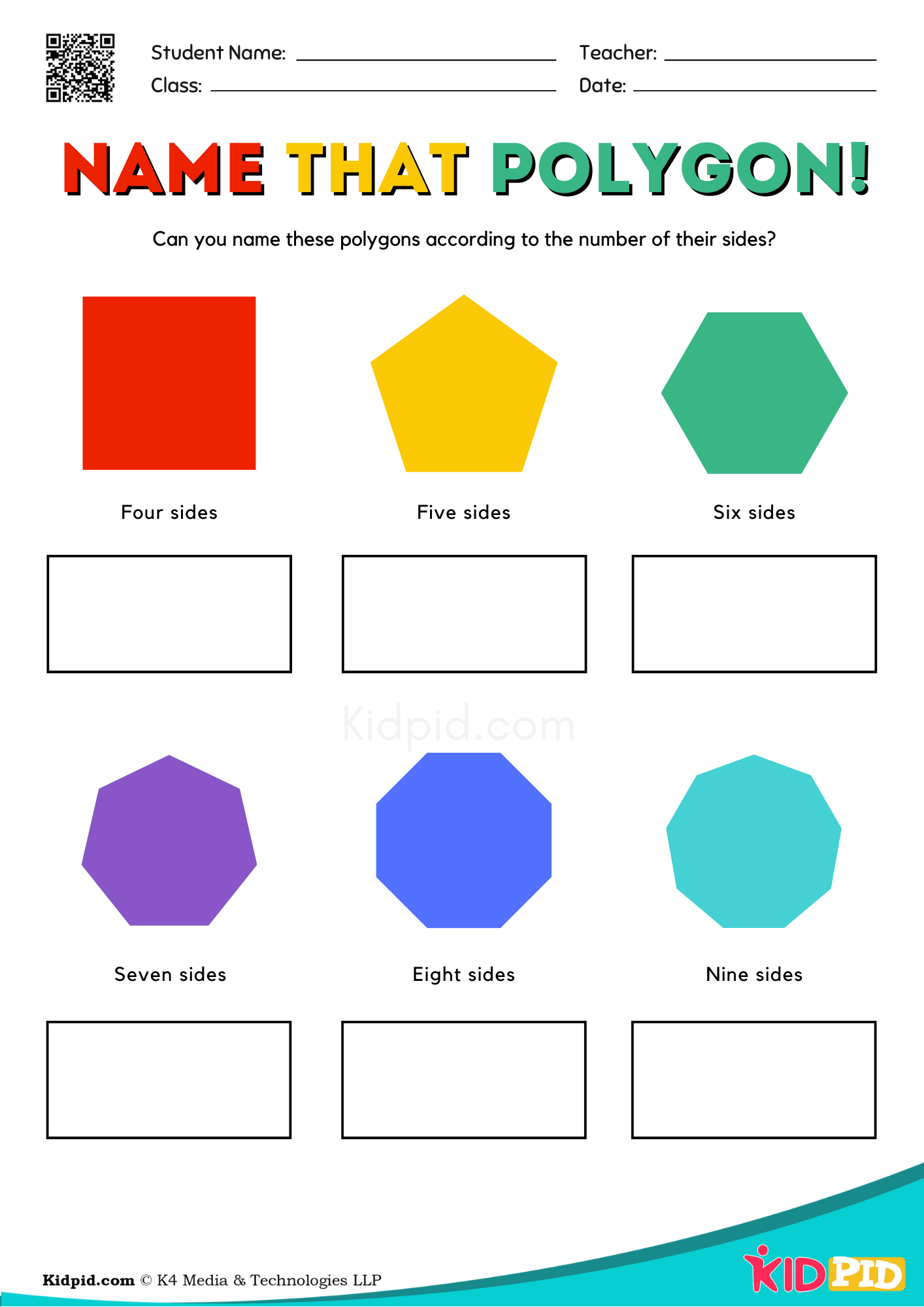
Name That Polygon Free Printable Worksheet

Key Facts About Opposite Numbers

  • Definition: An opposite number (also called an additive inverse) is a number that is the same distance from zero on a number line as another number, but in the opposite direction.
  • The Zero Rule: When you add any number to its opposite, the sum is always exactly zero (a + (-a) = 0).
  • Zero’s Status: Zero is the only number that is its own opposite. It has no positive or negative sign.
  • Symmetry: Every real number has exactly one unique opposite. For example, the opposite of a positive number is a negative number, and the opposite of a negative number is a positive number.

Parts, Types, and Examples of Opposite Numbers

Understanding opposite numbers requires recognising how they appear across different number systems.

  • Whole Number Pairs: These are basic integers taught in early algebra.
    • Example: The opposite of +5 is -5.
    • Example: The opposite of -12 is +12.
  • Fraction and Decimal Pairs: The rule of opposites applies to rational numbers just as it does to whole numbers.
    • Example: The opposite of \frac{2}{3} is -\frac{2}{3}.
    • Example: The opposite of -4.5 is +4.5.
  • Visualising on a Number Line: Think of the number line as a mirror, where zero is the glass. If you stand at +3, your reflection stands at -3.

How Does the Opposite Numbers Worksheet Work?

This printable worksheet uses a visual and kinesthetic approach to help young learners grasp abstract negative numbers.

    1. Identify the Base Number: The worksheet presents the child with a specific integer plotted or listed on the page.
    2. Locate Zero: Students use the central zero mark on the provided number line as their starting anchor point.
    3. Count the Distance: Children count the intervals from zero to the given number to find its “absolute value” (distance from zero).
    4. Mirror and Plot: Turning in the opposite direction, the student counts out that same number of spaces and plots the opposite number, cementing the concept of spatial symmetry in math.

Benefits of Learning About Opposite Numbers

Mastering this concept is a vital bridge between elementary arithmetic and higher-level mathematics.

  • Foundational for Pre-Algebra: It prepares students to understand integers, coordinate planes, and algebraic expressions.
  • Simplifies Subtraction: Learning opposites helps children realise that subtracting a number is the same thing as adding its opposite (7 – 3 is the same as 7 + (-3)).
  • Builds Spatial Intelligence: Mapping numbers to the left and right of zero enhances visual-spatial processing and mental number line flexibility.

Learning Objectives

By completing this math activity worksheet, students will achieve the following curriculum standards:

  • Identify and write the opposite of any given integer, fraction, or decimal.
  • Plot positive and negative integers accurately on a horizontal number line.
  • Demonstrate understanding that a number and its opposite have the same absolute value (distance from zero).
  • Apply the concept of additive inverses to solve basic addition and subtraction problems.

Worksheet Instructions

Parents and Teachers: For best results, ensure the student has a pencil and an eraser before beginning.

    1. Write your name and the date at the top of the page.
    2. Look at the given number in the first problem.
    3. Find zero on the number line. Count how many steps it takes to reach the given number.
    4. Go back to zero. Count the same number of steps in the opposite direction.
    5. Draw a neat, solid dot on that spot and write the correct number symbol (make sure to include the negative sign if you are on the left side of zero!).

Interesting Facts About Opposite Numbers

  • The Double Negative Effect: The opposite of an opposite brings you right back to where you started! For example, the opposite of -5 is +5. In mathematical terms, -(-5) = 5.
  • Ancient Roots: The concept of negative numbers and their opposites dates back to the Nine Chapters on the Mathematical Art in ancient China (around 200 BCE), where red rods were used for positive numbers and black rods for negative numbers.
  • Absolute Value Connection: Even though opposite numbers are on completely different sides of the number line, they share the same absolute value. Both |-7| and |+7| equal 7.

Vocabulary Words

  • Integer: A whole number that can be positive, negative, or zero (no fractions or decimals allowed).
  • Additive Inverse: The technical mathematical term for an opposite number; the number that balances another out to equal zero.
  • Absolute Value: The distance a number is from zero, always written as a positive value.
  • Origin: The point on a number line marked by zero where positive and negative numbers meet.
  • Negative Number: Any number that is strictly less than zero.

Real-Life Applications

Opposite numbers aren’t just symbols on a page—we use them every single day to calculate balances and changes in the real world:

  • Banking and Finance: If you deposit \$20 into your bank account (+20) and then spend \$20 on a toy (-20), your net change is zero.
  • Elevation: Sea level is our real-world “zero.” A mountain climber standing 500 feet above sea level (+500) is at the opposite altitude of a scuba diver swimming 500 feet below sea level (-500).
  • Temperature: On a freezing winter day, a temperature of 10^\circ\text{F} above zero (+10) is the exact temperature opposite of 10^\circ\text{F} below zero (-10).

FAQs

Q1: Is zero a positive or a negative number?

Answer: Neither! Zero is neutral. It divides the positive numbers from the negative numbers and does not carry a sign.

Q2: What is the difference between an opposite number and a reciprocal?

Answer: An opposite number changes the sign of the number (5 becomes -5). A reciprocal flips the number upside down into a fraction (5 becomes \frac{1}{5}).

Q3: Can a negative number have an opposite?

Answer: Yes! The opposite of a negative number is a positive number. For example, the opposite of -9 is +9.

Q4: Why do kids need to use a number line to learn opposites?

Answer: Negative numbers are abstract concepts. A number line provides a concrete, physical map that allows children to visually see the symmetry of math, which dramatically improves retention and prevents confusion.
Hope you liked these opposite number math activity printables. These Opposite Numbers Math Activity printable worksheets help children understand the concept of opposite values while improving number sense and critical thinking. Fun practice strengthens math skills, builds confidence, and supports a strong foundation in early mathematics. At Kidpid, you can find worksheets, essays, paragraphs, flashcards, quizzes, and interactive resources.  You can find here hard and detailed patterns, advanced animal drawings, simple colourings, or easy outlines. Follow us on YouTube & Facebook.

The Content Team crafted this worksheet to improve educational outcomes.

Reviewed By Swati

You may like these:

About the Author

Content Team

Kidpid Content Team is a team of experienced educators, curriculum researchers, and child-focused content creators specializing in early childhood and primary education. The team develops high-quality, research-based worksheets, learning activities, and educational articles aligned with age-appropriate learning standards. Every resource is carefully reviewed to ensure accuracy, clarity, and educational value, making Kidpid a trusted platform for parents, teachers, and schools worldwide.

View All Articles