

In this edition, we have brought some worksheets that are going to help your child learn about combining numbers and work on the ones and Tens place. These worksheets are easy to understand, and if you want, they can be printed out as well. This will help your child to understand the basic concept of the mathematical number system.
Contents
- Combining Tens and Ones Place Value Worksheets
- Key Facts About Combining Tens and Ones Place Value Worksheets
- Parts, Types, and Examples of Combining Tens and Ones Place Value Worksheets
- How Does Combining Tens and Ones Place Value Worksheets Work?
- Benefits of Learning About Combining Tens and Ones Place Value Worksheets
- Learning Objectives
- Worksheet Instructions
- Interesting Facts About Combining Tens and Ones Place Value
- Real-Life Applications
- FAQs
- Q1. What are Combining Tens and Ones Place Value Worksheets?
- Q2. Why is place value important for Grade 1 students?
- Q3. What skills do these worksheets develop?
- Q4. How can parents help children practice place value at home?
- Q5. At what age should children learn tens and ones?
- Q6. Are visual models helpful for learning place value?
- Q7. How do these worksheets support future math learning?
- You may like this:
Combining Tens and Ones Place Value Worksheets

WORKSHEET 1
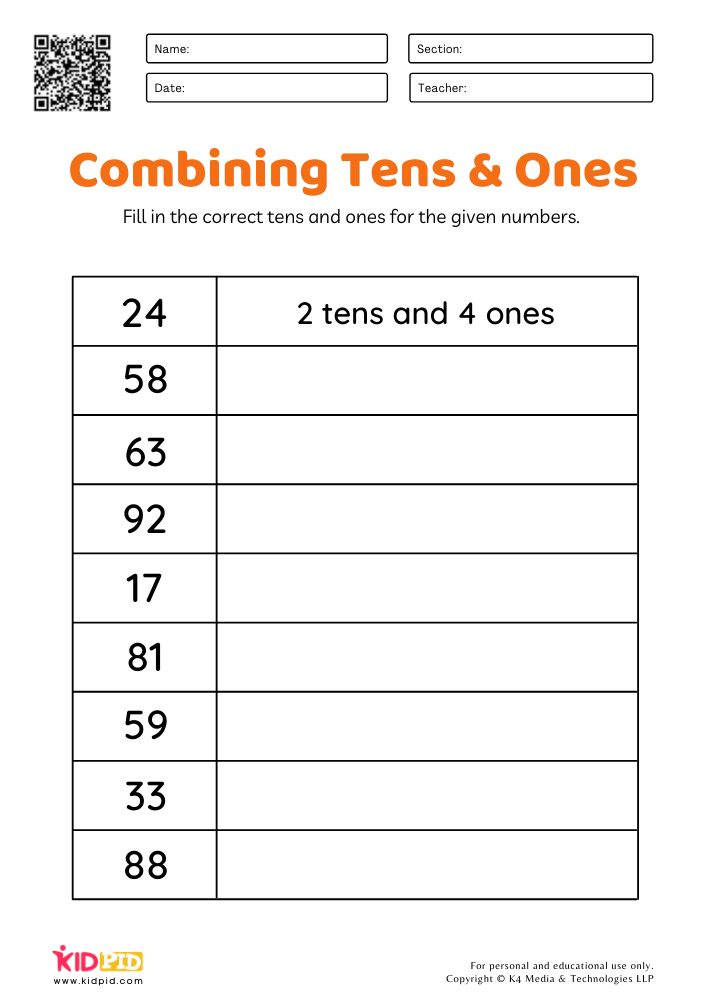
The first worksheet will have the kids work on combining tens and ones. The child has to fill in the correct tens and ones for the given number. As shown in the worksheet, an example is given as well- 24 will be spilled into 2 tens and 4 ones. Similarly, 58 will be 5 tens and 8 ones. And the rest could be carried out with ease.
WORKSHEET 2
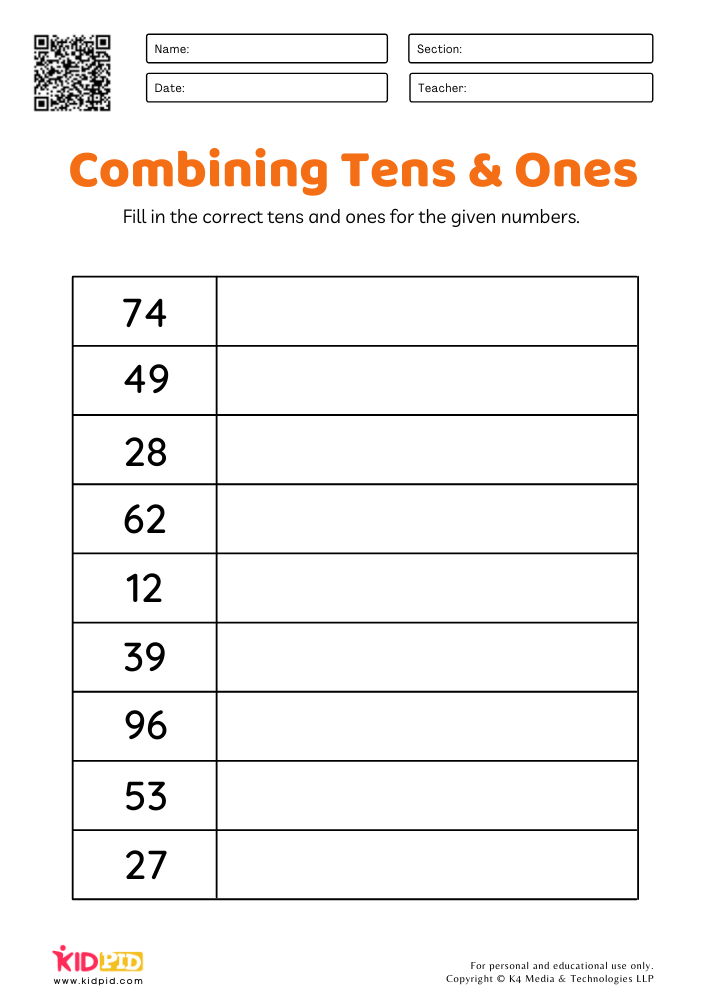
The second worksheet works in the same way. The kid needs to combine the tens and ones for the given number. For example, 74 will be written as 7 tens and 4 ones. These worksheets are easy to solve; the kid should not face any trouble, but if he does, the queries need to be answered.
WORKSHEET 3
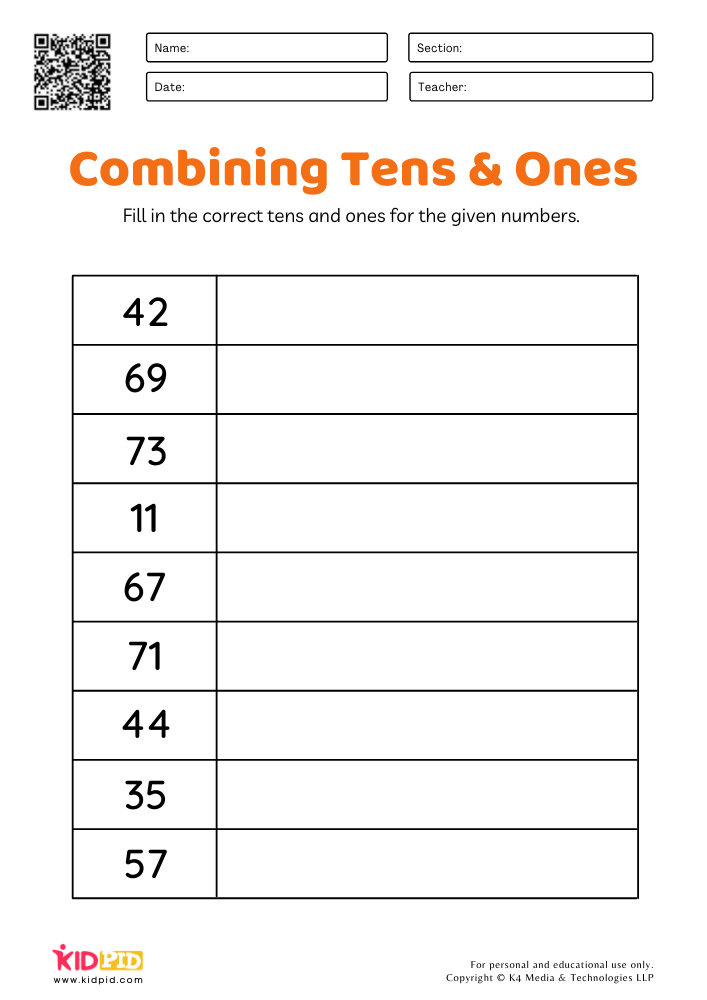
The third worksheet will ask the kid to work on some more numbers and then combine them into tens and ones. For example, 42 will be written as 4 tens and 2 ones. This concept is easy to understand only if the kid pays complete attention. That is essential.
WORKSHEET 4
A few additional numbers are in this worksheet, which will keep brushing up on the child’s mathematics skills. As a parent, it is important not to let your child break concentration, because these are some of the most important concepts of the Number system.
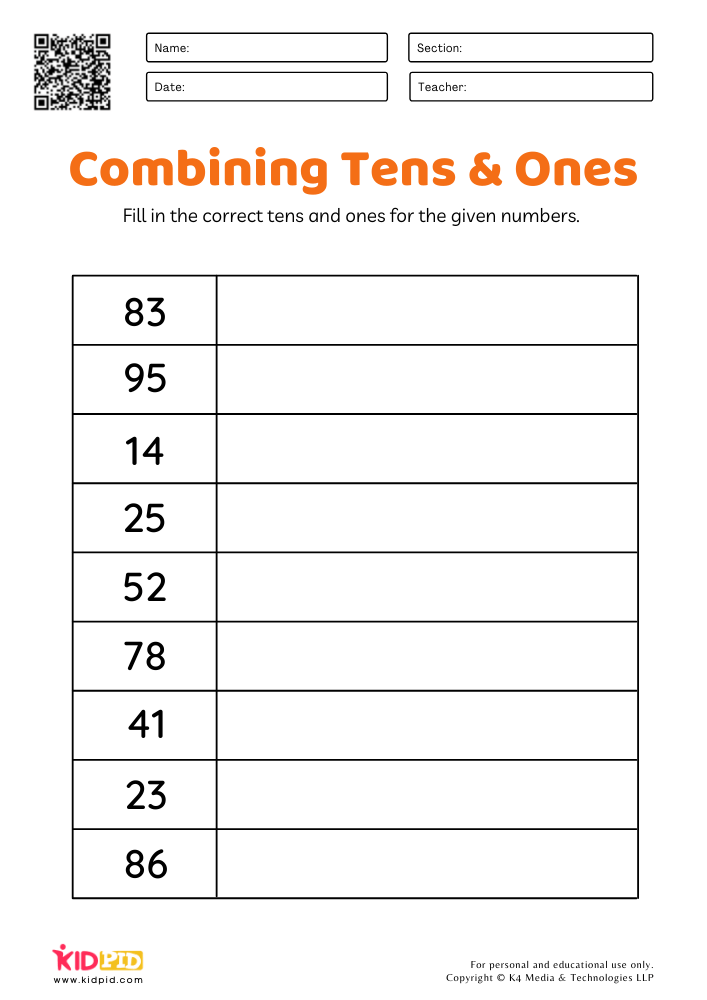
WORKSHEET 5
The fifth worksheet will also work on the same. Combine tens and ones, and fill out the numbers. For example, 37 will be written as 3 tens and 7 ones. The parents need to help them with these worksheets and analyze how the kid approaches these words. It is very important to help children introduce the basic concepts and to develop their intellectual abilities.
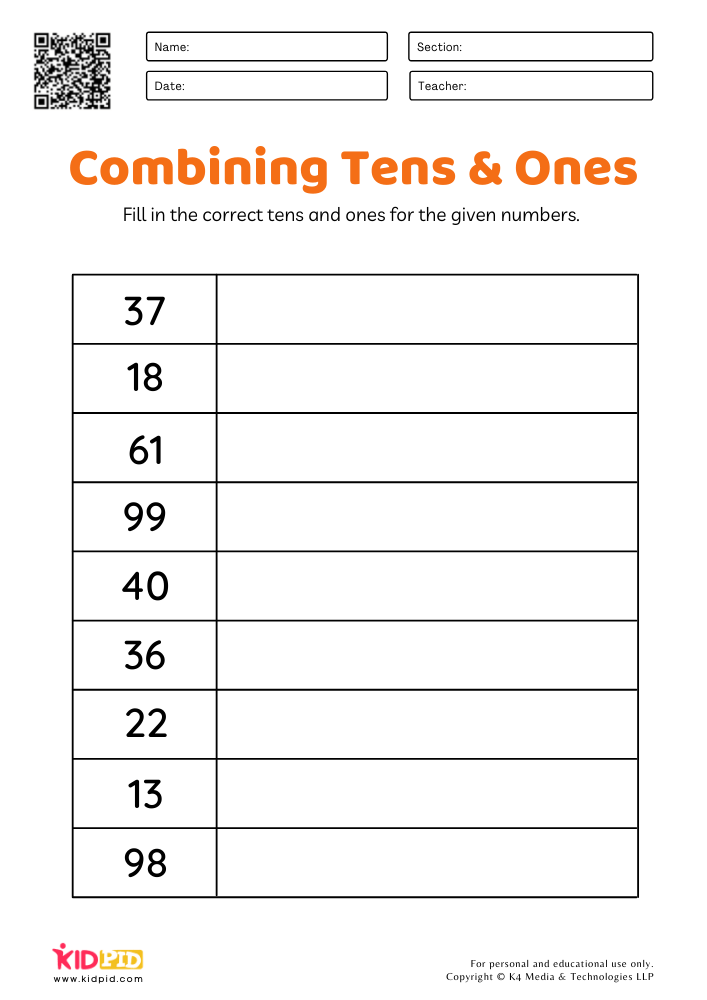
WORKSHEET 6
This is the sixth worksheet, and here some of the numbers are even repeated from the above worksheets. So, in a way, the kid’s learning skills can be tested with ease. As parents, the kid needs to be looked at, so this is a basic level worksheet that leads the kid if they make a mistake.
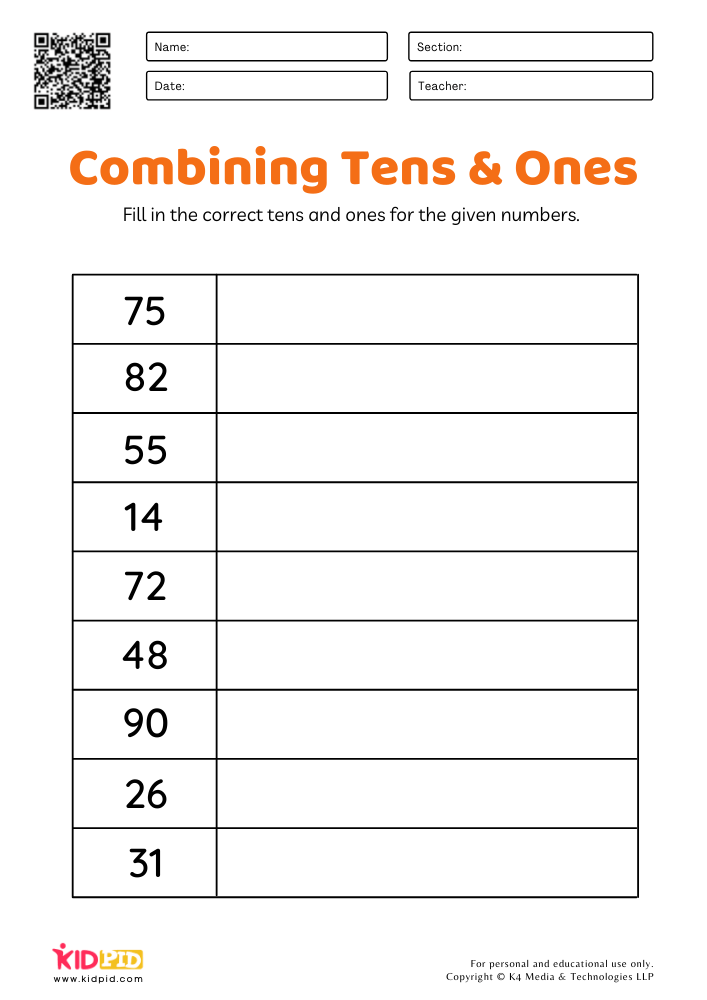
WORKSHEET 7
Help the kid understand the concepts and then make him finish the task. When the first few worksheets are completed, the rest will be done in the same manner. The parents can even get a printout of the worksheet if their child needs some more preparation.
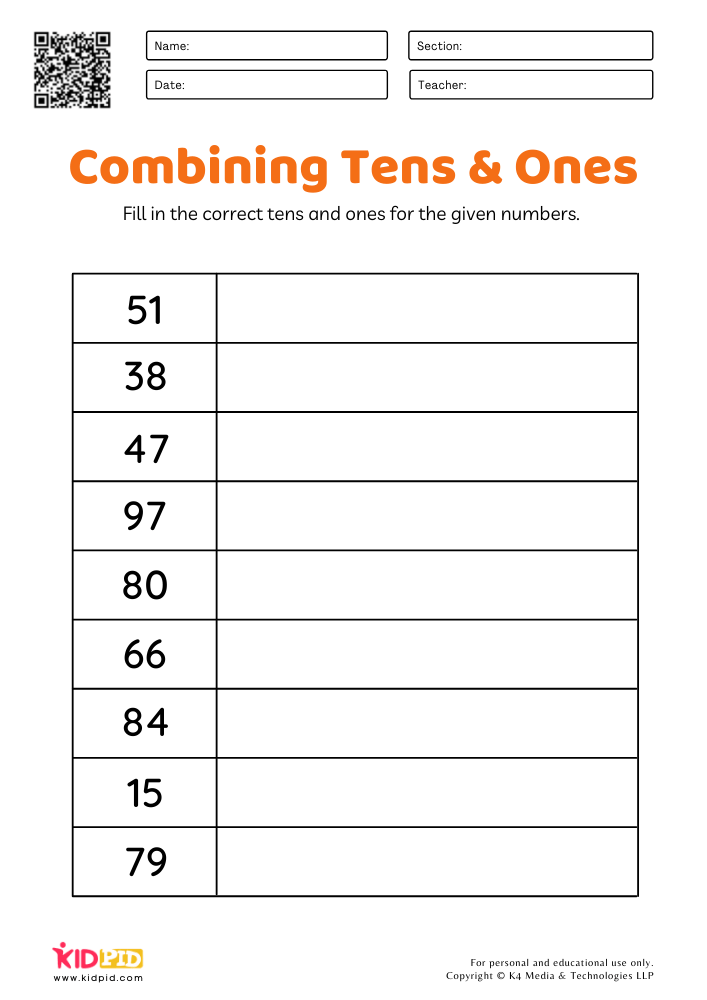
WORKSHEET 8
Solving these questions could be difficult for the child at first, and that is understandable. And when they find such difficulties, the child’s queries need to be answered. But once the kid understands the concept, it’ll be just a piece of cake.
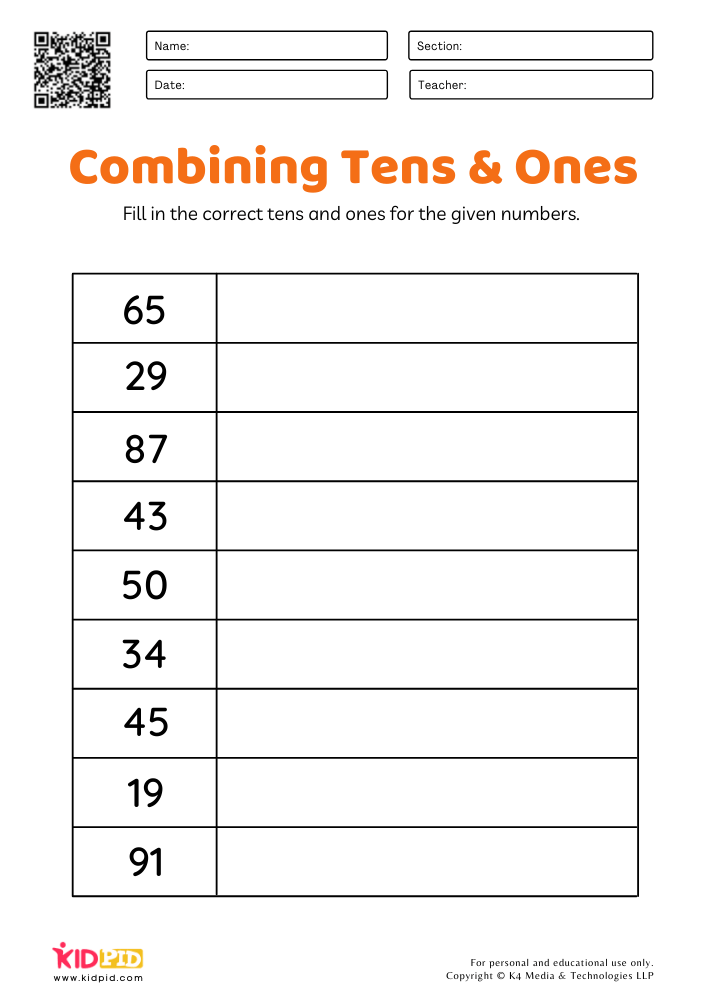
These worksheets are the ideal resolution. The task is divided into various stages that become easier by allowing children to push themselves further with every step. This is a way to make education convenient for them. Once the worry and stress are taken away, they can learn with all the fun and pleasure.
Key Facts About Combining Tens and Ones Place Value Worksheets
Combining Tens and Ones Place Value Worksheets for Grade 1 helps young learners understand how two-digit numbers are formed. These worksheets teach students to combine groups of tens and individual ones to create numbers, strengthening their place value knowledge. Children learn that the position of a digit determines its value, which is a foundational concept in mathematics. Through engaging exercises, visual models, and number-building activities, students gain confidence in reading, writing, and understanding numbers up to 100. These worksheets support early math development and prepare children for addition, subtraction, and higher-level number concepts.
Parts, Types, and Examples of Combining Tens and Ones Place Value Worksheets
Parts of the Worksheets
- Tens and ones place value charts
- Base-ten block illustrations
- Number-building exercises
- Matching activities
- Fill-in-the-blank questions
- Number representation tasks
Types of Worksheets
- Visual tens and ones worksheets
- Count and combine activities
- Place value chart exercises
- Write the number worksheets
- Color-and-count place value activities
- Cut-and-paste number-building tasks
Examples
- 3 tens and 5 ones = 35
- 6 tens and 2 ones = 62
- 4 tens and 9 ones = 49
- 1 ten and 8 ones = 18
How Does Combining Tens and Ones Place Value Worksheets Work?
These worksheets guide students through identifying groups of tens and individual ones. Children count the tens first, then add the ones to determine the complete number. Visual aids such as base-ten blocks, rods, and place value charts make learning easier and more interactive. As students practice combining place values, they develop a deeper understanding of number composition and numerical relationships. Repeated exercises help improve accuracy, number sense, and confidence in working with two-digit numbers.
Benefits of Learning About Combining Tens and Ones Place Value Worksheets
- Builds a strong foundation in place value concepts.
- Improves number recognition and understanding.
- Develops counting and grouping skills.
- Supports addition and subtraction readiness.
- Enhances logical thinking and problem-solving abilities.
- Increases confidence with two-digit numbers.
- Encourages independent learning and practice.
- Strengthens overall mathematical fluency.
Learning Objectives
By completing these worksheets, students will be able to:
- Identify tens and ones in two-digit numbers.
- Combine place values to form numbers correctly.
- Read and write two-digit numbers.
- Use place value charts effectively.
- Understand the relationship between digits and their positions.
- Develop early number sense and math reasoning skills.
- Apply place value knowledge to basic arithmetic operations.
Worksheet Instructions
- Carefully observe the groups of tens and ones shown.
- Count the tens rods or groups first.
- Count the individual ones.
- Combine the tens and ones to form the number.
- Write the correct number in the answer box.
- Check your work for accuracy.
- Complete all exercises neatly and independently.
Interesting Facts About Combining Tens and Ones Place Value
- Our number system is based on the decimal (base-10) system.
- Every ten ones can be grouped into one ten.
- Place value helps us understand large numbers easily.
- The same digit can have different values depending on its position.
- Place value is one of the most important concepts taught in Grade 1 mathematics.
- Understanding tens and ones makes mental math easier.
Real-Life Applications
Children use place value skills in many everyday situations, including:
- Counting money and understanding the values of coins and notes.
- Reading house numbers and addresses.
- Keeping score in games and sports.
- Counting classroom objects and supplies.
- Understanding prices while shopping.
- Organizing collections such as toys, stickers, or books.
- Reading numbers on clocks, calendars, and charts.
These real-world applications help students see the practical importance of combining tens and ones.
FAQs
Q1. What are Combining Tens and Ones Place Value Worksheets?
Answer: These are educational worksheets that teach children how to form two-digit numbers by combining groups of tens and individual ones.
Q2. Why is place value important for Grade 1 students?
Answer: Place value helps children understand how numbers are structured and prepares them for future math concepts like addition, subtraction, multiplication, and division.
Q3. What skills do these worksheets develop?
Answer: They improve counting, number recognition, place value understanding, problem-solving, and mathematical reasoning.
Q4. How can parents help children practice place value at home?
Answer: Parents can use coins, blocks, toys, or household objects to create groups of tens and ones for hands-on learning.
Q5. At what age should children learn tens and ones?
Answer: Most children begin learning basic place value concepts between ages 6 and 7, typically during Grade 1.
Q6. Are visual models helpful for learning place value?
Answer: Yes. Visual aids such as base-ten blocks and place value charts help children understand abstract number concepts more easily.
Q7. How do these worksheets support future math learning?
Answer: A strong understanding of place value forms the foundation for addition, subtraction, regrouping, multiplication, division, and overall number sense.
A strong place value foundation begins with understanding tens and ones. These Grade 1 worksheets encourage flexible number thinking, improve calculation readiness, and make learning numbers more meaningful. Find everything from flashcards and essays to quizzes, paragraphs, and worksheets designed to support fun learning. Follow us on YouTube & Facebook for new ideas every day.
The Content Team designed this worksheet to improve learning attainment.
Reviewed By Nausheen Fatima
You may like this:



