

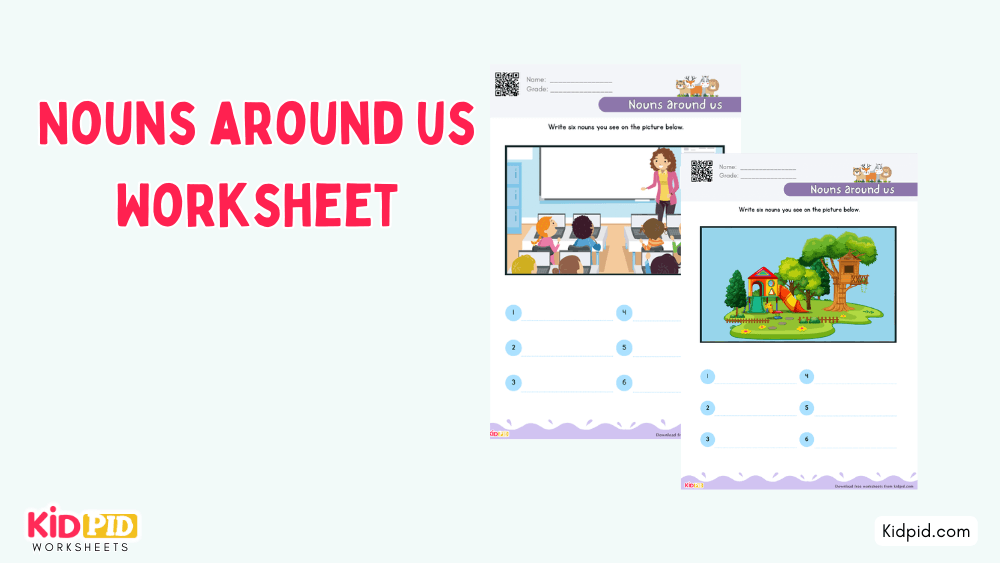
Nouns are all around us, from the objects in our homes to the people and places we encounter daily. This worksheet will help you practice identifying different types of nouns in your everyday environment, building your vocabulary and language skills.
[Scroll Down for Download Link]
Contents
- Noun Worksheet For Grade 1
- Key Facts About the Nouns Around Us Worksheet
- Parts, Types, and Examples of Nouns in the Worksheet
- How Does the Nouns Around Us Worksheet Work?
- Benefits of Learning About Nouns Early On
- Learning Objectives
- Worksheet Instructions
- Interesting Facts About Nouns
- Vocabulary Words
- Real-Life Applications
- FAQs
- You may like these:
Noun Worksheet For Grade 1
Read More: Nouns Matching Flashcards

- Bag
- Computer
- Book
- Table
- Clock
- Apple

- Teacher
- Desk
- Student
- Clothes
- Laptops
- Boards
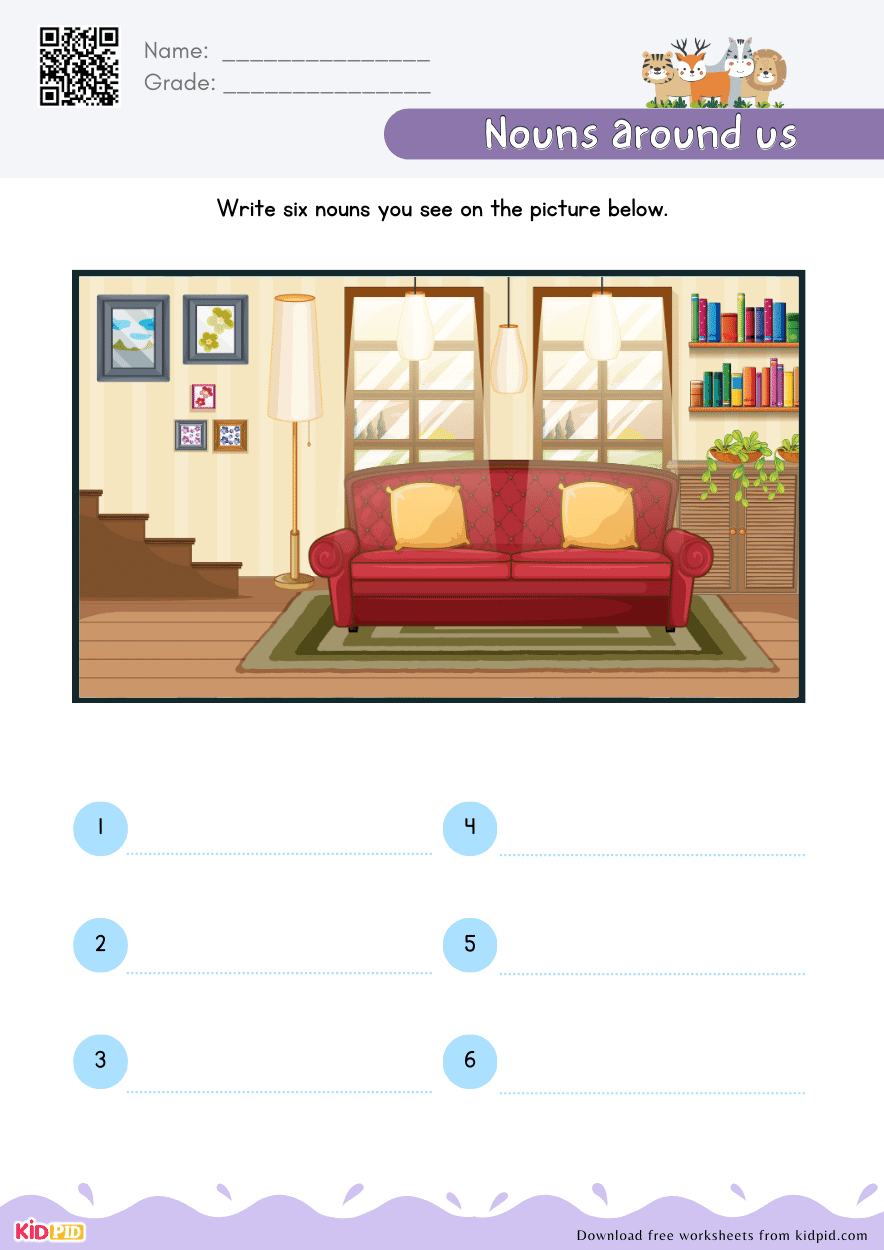
- Lamp
- Stair
- Plant
- Window
- Frame
- Couch
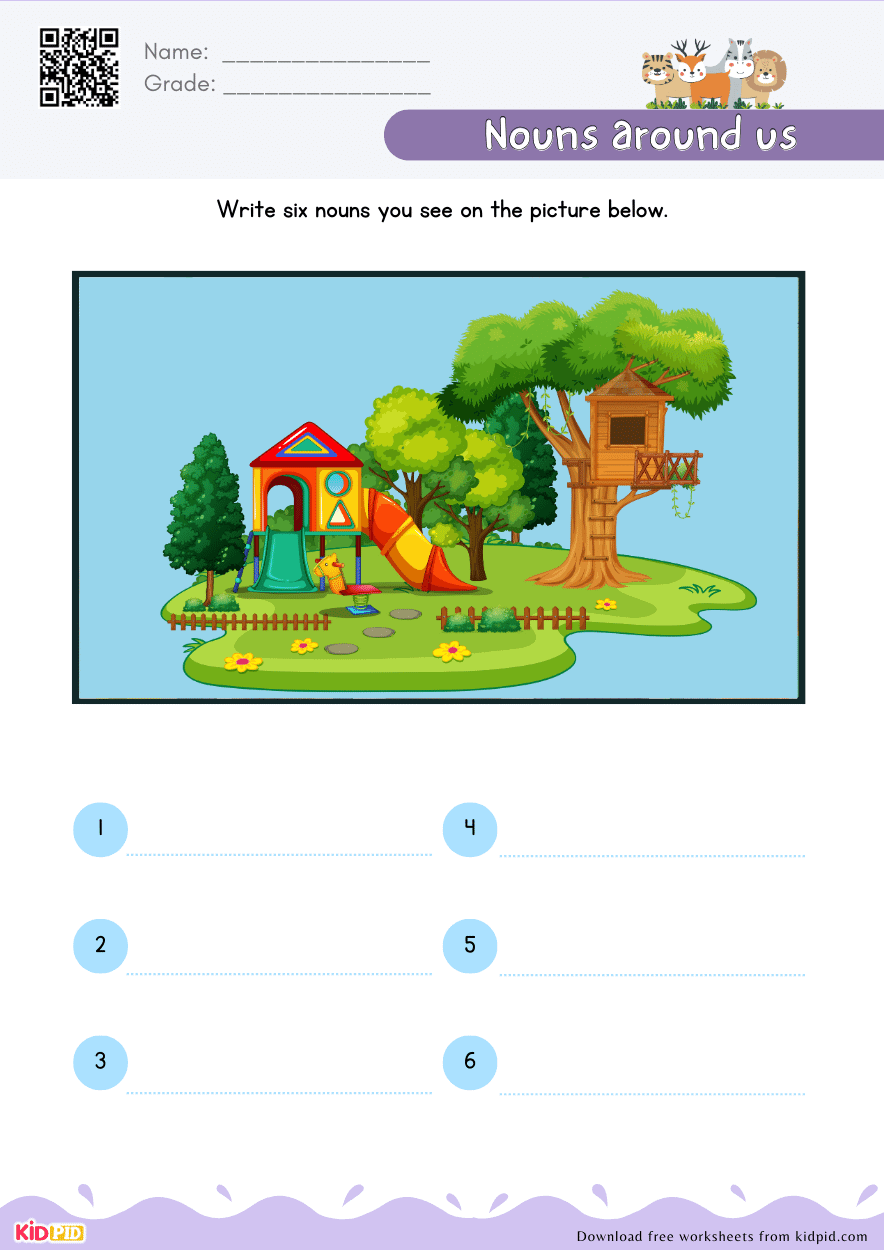
- Park
- Tree
- Flower
- Glass
- Slide
- Tree House
Key Facts About the Nouns Around Us Worksheet
- Target Audience: Grade 1 and Grade 2 students (Ages 6–8), English Language Learners (ELL).
- Skill Level: Foundational English Grammar.
- Core Focus: Identifying and classifying nouns within everyday environments (home, school, park).
- Format: Free printable PDF activity pages with vibrant, relatable illustrations.
- Curriculum Alignment: Enhances core foundational literacy and primary grammar standards for early elementary education.
Parts, Types, and Examples of Nouns in the Worksheet
This resource breaks down nouns into bite-sized, identifiable categories based on a child’s immediate world. It highlights the basic rule that a noun names a person, place, thing, or animal:
- At Home (Things & Objects): Examples include a computer, a book, a table, a clock, an apple, a lamp, a couch, a window frame, and a plant.
- At School (People & Objects): Examples include teacher, student, desk, clothes, laptops, and boards.
- At the Park (Places & Nature): Examples include a tree, a flower, a glass, a slide, a park, and a treehouse.
How Does the Nouns Around Us Worksheet Work?
The worksheet leverages contextual learning and visual association. Instead of memorizing rigid rules, children look at familiar scenes or lists of everyday objects:
- Isolate: Students read the word or look at the illustration of an item.
- Identify: They determine if the object represents a person, place, or thing.
- Classify: Children sort, match, or write down the words into designated categories, solidifying their understanding of how parts of speech exist in the real world.
Benefits of Learning About Nouns Early On
Mastering nouns is the absolute bedrock of a child’s language development journey.
- Stronger Sentence Building: You cannot build a sentence without a subject. Learning nouns gives children the necessary building blocks to form complete thoughts.
- Expanded Vocabulary: By actively observing their surroundings for nouns, kids naturally expand their descriptive vocabulary.
- Boosted Reading Comprehension: Recognizing nouns helps young readers identify who or what a story is about, significantly improving text comprehension.
Learning Objectives
By completing this printable grammar activity, young learners will be able to:
- Define what a noun is in simple terms (a naming word for people, places, and things).
- Successfully locate and identify nouns within a list of everyday vocabulary words.
- Differentiate between nouns and other parts of speech (like verbs or adjectives).
- Develop environmental awareness by spotting real-world nouns in their immediate surroundings.
Worksheet Instructions
Parents and teachers can guide children through the activity using these simple steps:
- Look and Read: Have the child look at the pictures on the worksheet (like the couch, clock, or teacher) and read the corresponding word aloud.
- The “What Is It?” Test: Ask the child: “Is this a person, a place, or a thing?”
- Fill It In: Instruct the student to write the word under its correct category or trace/color the images as specified by the worksheet page.
- The Real-World Extension: Once finished, have the child look around the room they are sitting in and shout out three more nouns they see right now!
Interesting Facts About Nouns
- The Most Common Words: Nouns make up the largest percentage of words in the English dictionary (thousands more than verbs or adjectives!).
- Ancient Roots: The word “noun” comes from the Latin word nomen, which literally means “name.”
- Everything Has One: Absolutely every tangible object you can see, touch, or interact with right now is a noun.
Vocabulary Words
Introduce your learners to these foundational terms featured across the worksheets:
- Home Items: Table, Clock, Apple, Lamp, Stair, Couch, Window, Plant.
- School Items: Teacher, Student, Desk, Clothes, Laptop, Board.
- Outdoor Items: Park, Tree, Flower, Glass, Slide, Treehouse.
Real-Life Applications
Grammar isn’t just for the classroom! Learning nouns directly translates to everyday life:
- Writing & Communication: Whether writing a letter to grandparents or speaking to a friend, kids use nouns to explain exactly what they need or what they did.
- Following Directions: Understanding nouns helps children follow complex tasks (e.g., “Please put the book on the table” relies entirely on identifying the nouns).
FAQs
Q1: What grade level is the “Nouns Around Us” worksheet for?
Answer: This worksheet is ideally designed for Grade 1 and Grade 2 students, but it also serves as an excellent remedial or review tool for Grade 3 or English Language Learners (ELL).
Q2: Why is it called “Nouns Around Us”?
Answer: Because it uses everyday objects that children interact with daily—like a desk, a park, or a laptop—making abstract grammar concepts concrete and easy to grasp.
Q3: How do I introduce nouns to a child before using this worksheet?
Answer: Start with a game of “I Spy.” Say, “I spy with my little eye something blue that you can sit on (Couch).” Once they guess it, explain that the couch is a “noun” because it is a thing!
Q4: Is this worksheet free to download?
Answer: Yes! KidPid offers a variety of free printable educational worksheets designed by experienced content creators and educators to support remote learning, homeschooling, and classroom teaching.
Completing this “Nouns Around Us” worksheet has allowed you to observe and recognize the abundance of nouns present in your daily life. Identifying these parts of speech is an essential step in developing stronger reading, writing, and communication abilities. Browse our website for printable worksheets, essays, paragraphs, flashcards, quizzes, and interactive resources that support joyful learning for kids. Stay inspired through YouTube & Facebook.
The Content Team prepares this educational worksheet to promote learning progress.
Reviewed By Nausheen Fatima
You may like these:
Identify Collective Nouns Printable Worksheets for Grade 2
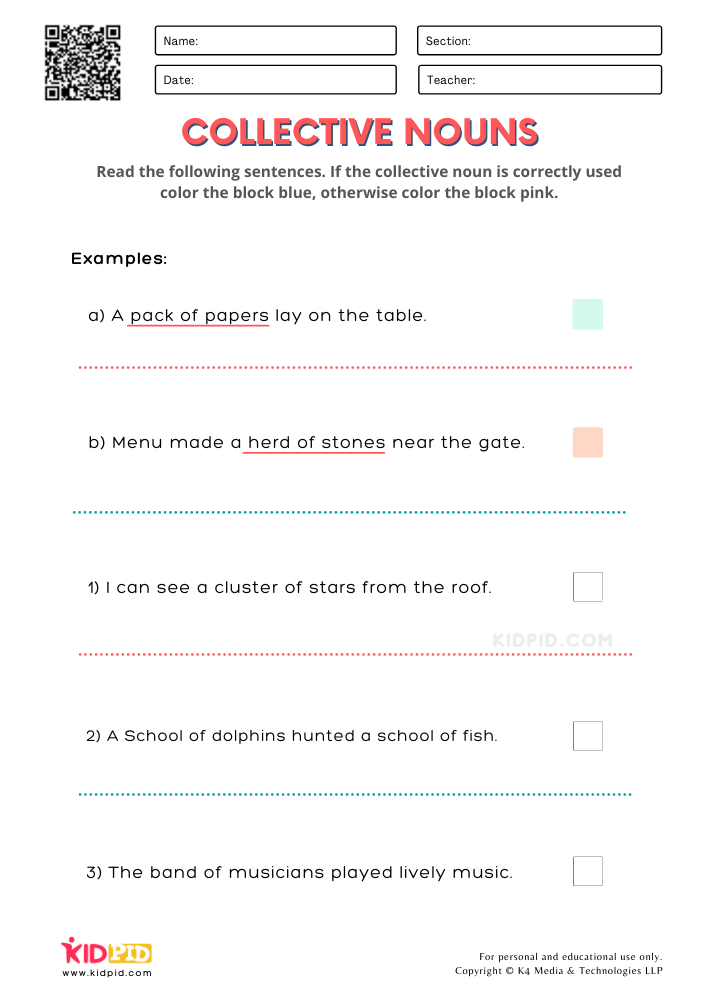
These worksheets help Grade 2 students recognize and understand collective nouns, enhancing their vocabulary and grammar skills through engaging printable exercises tailored for young learners.
Word Sorting Exercises – Nouns and Verbs Worksheets for Children
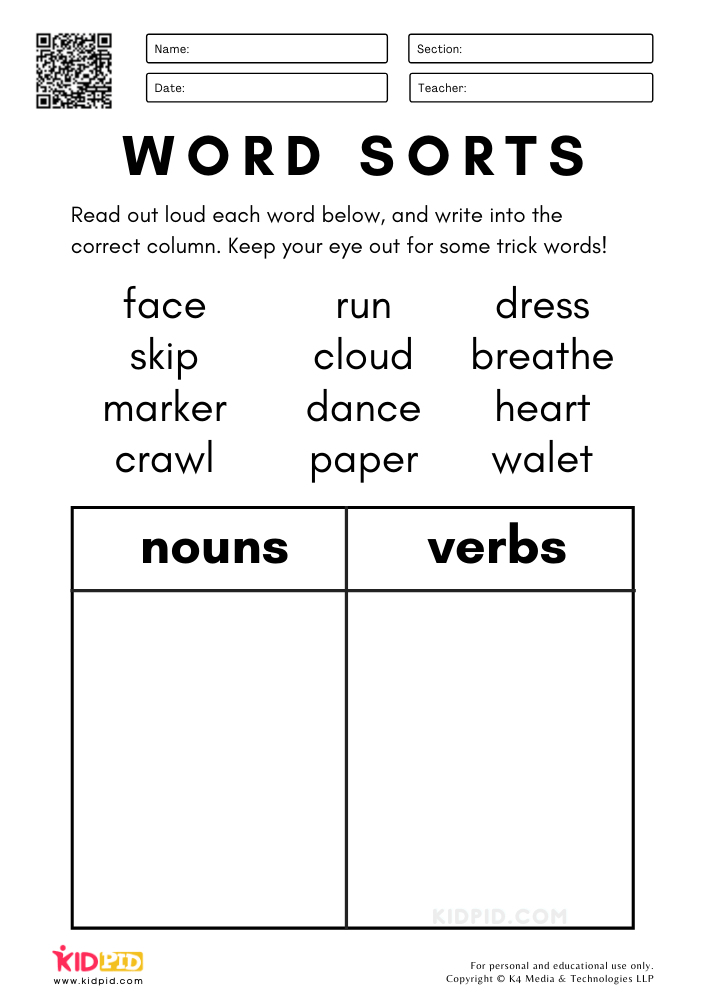
These worksheets focus on distinguishing nouns and verbs through sorting activities, helping children develop foundational language skills while improving their understanding of parts of speech.
Nouns Matching Flashcards
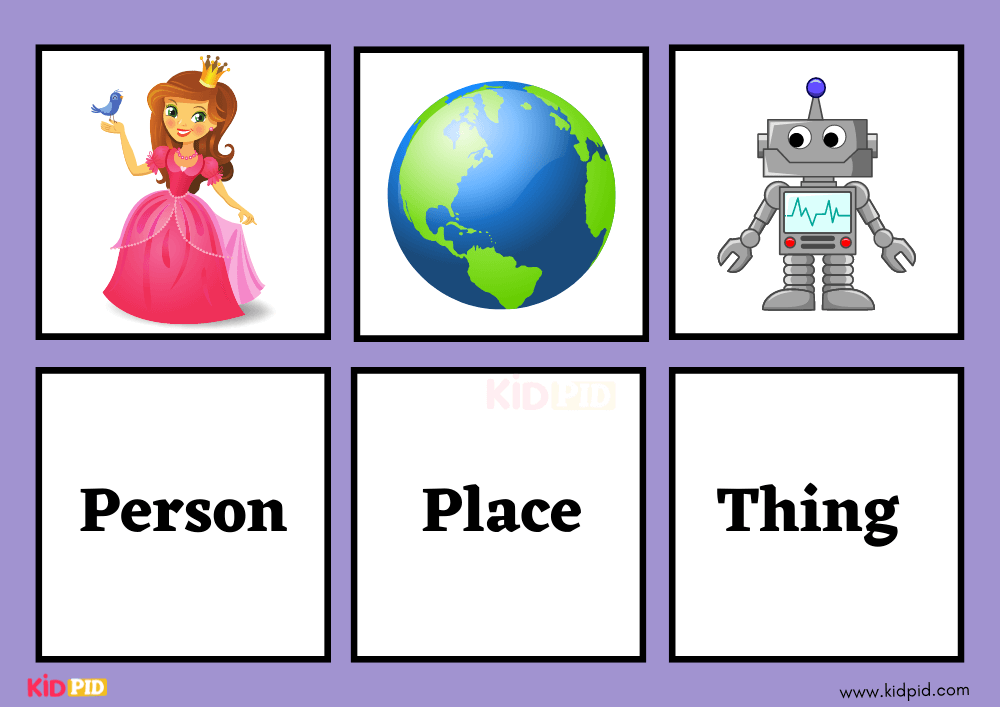
Flashcards designed to reinforce noun recognition by matching words with corresponding images, aiding visual learning and strengthening vocabulary retention in an interactive format.
Grouping Nouns Printable Worksheets for Grade 2
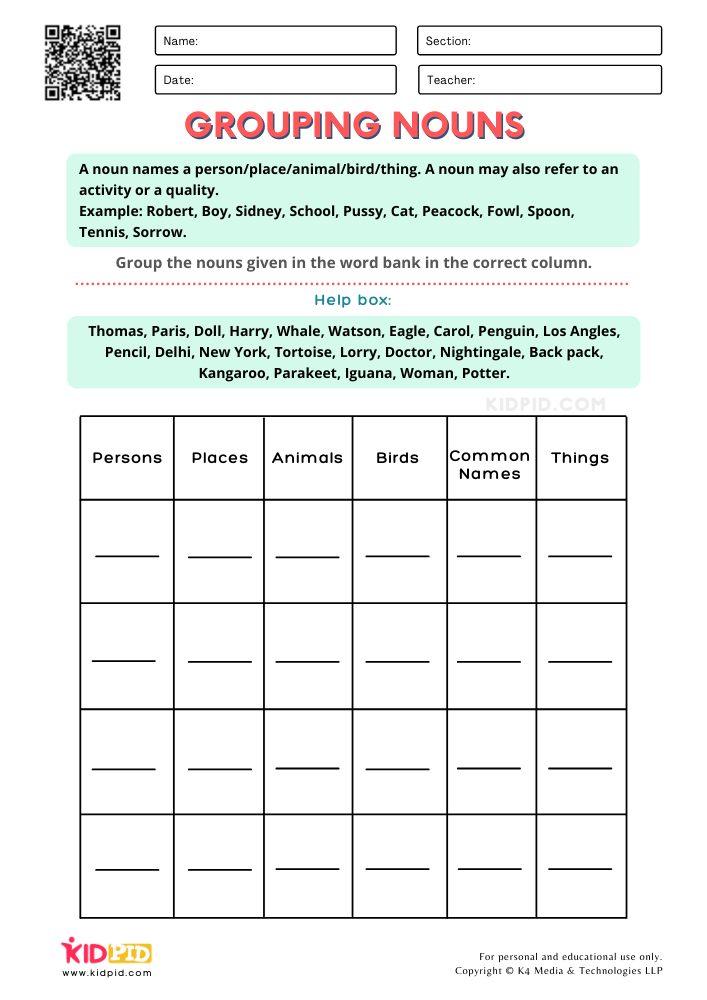
Grade 2 students practice classifying nouns, promoting better comprehension of word types, and enhancing organizational and grammatical skills through structured, printable exercises.
Writing Plural Nouns: Printable Worksheets for Grade 1
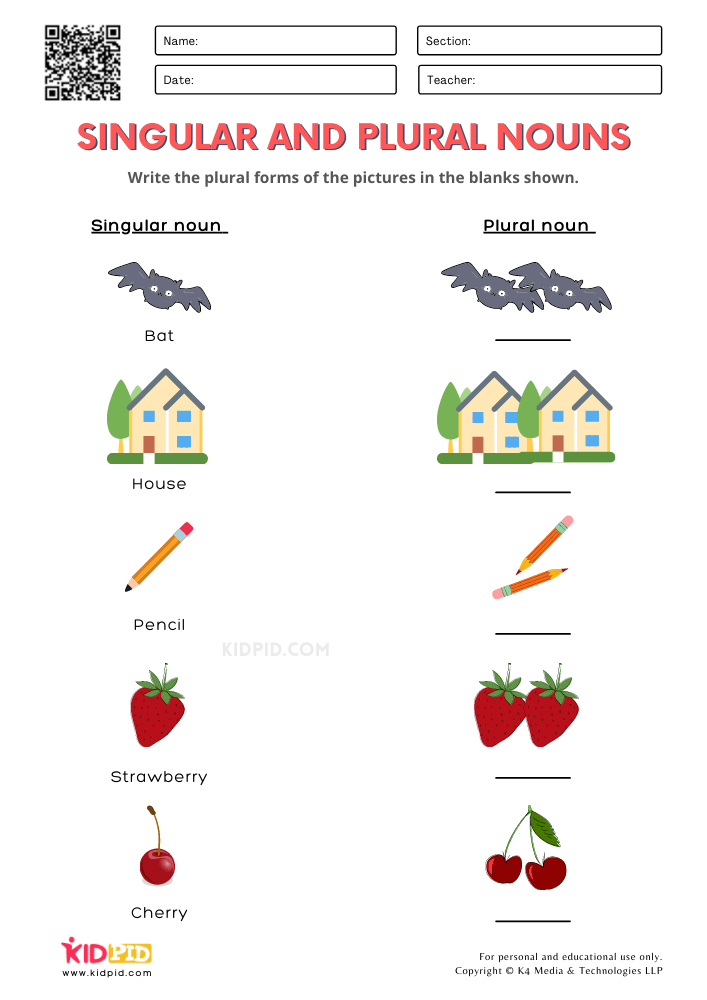
Help first graders learn plural nouns with fun printable worksheets! Engaging activities teach -s, -es, and irregular plurals, improving grammar skills through interactive exercises, coloring, and word matching. Perfect for classroom or homeschool use!



