
This sorting activity will have you practice differentiating between singular and plural nouns. You will need to carefully examine each noun and determine whether it represents one item or multiple items, then sort them into the appropriate categories.
[Scroll Down for Download Link]
Contents
- Sort The Singular & Plural Words
- Key Facts About Singular & Plural Nouns Sorting Worksheet
- Parts/Types/Examples of Nouns in the Worksheet
- How Does the Singular & Plural Nouns Sorting Worksheet Work?
- Benefits of Learning About Singular & Plural Nouns
- Learning Objectives
- Worksheet Instructions
- Interesting Facts About Nouns & Vocabulary Words
- Real-Life Applications
- FAQs
- Q1. What is the simplest way to explain a singular and plural noun to a first grader?
- Q2. Why do some words use “-es” instead of just “-s” for their plural form?
- Q3. How can I help a student who keeps adding “-s” to irregular words (like writing “childs” or “deers”)?
- Q4. At what age should a child fully master basic plural noun sorting?
- Write Plural Nouns: Fun Worksheets for Grade 1
- Is It a Person, Place, or Thing? Noun Worksheet
- Find the Nouns: English Worksheet
- Spot Nouns in Sentences: Worksheets for Grade 1
- Nouns Star: Fun Worksheets for Grade 2
Sort The Singular & Plural Words
Read More: Singular & Plural Flashcards for Kids

Singular
- Shoe
- Dog
- Book
- Woman
- Wolf
- Sheep
- Fish
- Flower
- Lion
- Tree
- Friends
- Wolves
- Flowers
- Cars
- Dogs
- Foxes
- Books
- Teeth
- Mice
- Pens

Singular
- Deer
- Teacher
- Chair
- Person
- Student
- Horse
- Writer
- Actor
- Parent
- Bee
Plural
- Bees
- Parents
- Countries
- Elephants
- Farmers
- Cities
- Doctors
- Geese
- Teachers
- Deer

Singular
- City
- Actress
- Baby
- Farmer
- Doctor
- Goose
- Elephant
- Singer
- Country
- Bird
Plural
- Chairs
- Birds
- Horses
- Writers
- Persons
- Singer
- Babies
- Students
- Actors
- Actresses

Singular
- Table
- Pen
- Mouse
- Child
- Cat
- Man
- Car
- Fox
- Friend
- Tooth
Plural
- Children
- Sheep
- Lions
- Fishes
- Tables
- Shoes
- Trees
- Cats
- Women
- Men

Singular
- Bat
- Pig
- Monkey
- Dreess
- Ring
- Plate
- Shirt
- Ant
- Hat
- Belt
Plural
- Hats
- Phones
- Snakes
- Ants
- Tigers
- Cups
- Coats
- Dresses
- Bats
- Bags

Singular
- Tiger
- Boot
- Bag
- Cup
- Snake
- Coat
- Phone
- Cow
- Glove
- Pencil
Plural
- Plates
- Gloves
- Cows
- Monkeys
- Shirts
- Pencils
- Rings
- Pigs
- Boots
- Belts

Singular
- Chicken
- Frog
- Butterfly
- Snail
- Bed
- Camera
- Crab
- Beer
- Room
- Spider
Plural
- Spiders
- Sharks
- Socks
- Dolphins
- Forks
- Ducks
- Keys
- Girrafes
- Zebras
- Spoons

Singular
- Leaf
- Lamp
- Clock
- Wall
- Laptop
- Window
- Desk
- Floor
- Computer
- Kitchen
Plural
- Wives
- Pillows
- Kitchens
- Knives
- Blankets
- Parks
- Kangaroos
- Walls
- Doors
- Clocks

Singular
- Kangaroo
- Blanket
- Eye
- Rabbit
- Garden
- Door
- Bathroom
- Pillow
- Roof
- Planet
Plural
- Windows
- Bathrooms
- Computers
- Roofs
- Rooms
- Desks
- Leaves
- Lamps
- Rabbits
- Gardens

Singular
- Zebra
- Giraffe
- Dolphin
- Duck
- Fork
- Knife
- Sock
- Whale
- Spoon
- Shark
Plural
- Whales
- Crabs
- Chickens
- Butterflies
- Snails
- Frogs
- Beds
- Beers
- Laptops
- Cameras

Singular
- Ocean
- Road
- Beach
- Lake
- Universe
- Star
- Bus
- Train
- Galaxy
- Bedroom
Plural
- Buses
- Stars
- Suns
- Moons
- Mountains
- Roads
- Oceans
- Planets
- Beaches
- Forests

Singular
- Living Rooms
- Street
- Moon
- Boat
- Sun
- Mountain
- Key
- Forest
- Store
- Island
Plural
- Islands
- Trains
- Galaxies
- Lakes
- Bedrooms
- Streets
- Rivers
- Universe
- Boats
- Living Rooms

Singular
- University
- Rocket
- Tunnel
- Helicopter
- Goat
- Hospital
- Motorcycle
- Cafe
- Bridge
- Library
Plural
- Airports
- Stores
- Schools
- Cinemas
- Colleges
- Highways
- Bicycles
- Museums
- Ships
- Taxes

Singular
- Market
- Hotel
- Pub
- Spa
- Farm
- Dessert
- Pool
- Bank
- Resort
- River
Plural
- Gyms
- Desserts
- Taxis
- Goats
- Salons
- Hotels
- Fields
- Camels
- Zoos
- Pubs

Singular
- Zoo
- Toy
- Stadium
- Camel
- Bakery
- Gym
- Taxi
- Restaurant
- Field
- Salon
Plural
- Farms
- Restaurants
- Resorts
- Subways
- Fans
- Markets
- Pools
- Stadiums
- Toys
- Bakeries

Singular
- College
- Cinema
- Bicycle
- Ship
- Airport
- Museum
- School
- Plane
- Fan
- Highway
Plural
- Banks
- Hospitals
- Universities
- Cafes
- Bridges
- Libraries
- Rockets
- Motorcycles
- Tunnels
- Spas
Key Facts About Singular & Plural Nouns Sorting Worksheet
- Target Audience: Kindergarten, 1st Grade, and 2nd Grade students (Ages 5–8).
- Subject Area: English Language Arts (ELA), Basic English Grammar, Parts of Speech.
- Skill Focus: Morphological awareness, reading decoding, categorization, and foundational syntax (subject-verb agreement).
- Format: Printable hands-on cut-and-paste or color-coded sorting activity sheets.
- Alignment: Correlates with Common Core State Standards (CCSS) for English Language Arts, specifically under CCSS.ELA-LITERACY.L.K.1.C (Form regular plural nouns orally by adding /s/ or /es/) and CCSS.ELA-LITERACY.L.1.1.C (Use singular and plural nouns with matching verbs in basic sentences).
Parts/Types/Examples of Nouns in the Worksheet
To build comprehensive language mechanics, the sorting worksheet is divided into clear linguistic patterns. It incorporates both predictable phonetic changes and structural variations that early readers need to master:
1. Regular Nouns (The Basic “-s” Rule)
These words form the backbone of early grammar instruction. Students learn that adding a simple suffix signals a change in quantity.
- Singular Examples: Dog, Book, Flower, Car, Tree, Pen
- Plural Examples: Dogs, Books, Flowers, Cars, Trees, Pens
2. Regular Nouns Ending in Sibilants (The “-es” Rule)
Words that end in hissing or buzzing sounds (-ch, -sh, -x, -s, -z) require an extra vowel marker so they can be easily pronounced.
- Singular Examples: Fox, Dress, Actress, Bus, Box
- Plural Examples: Foxes, Dresses, Actresses, Buses, Boxes
3. Irregular Nouns (Vowel Mutation & Mutated Stems)
These high-frequency words break the typical rules entirely. Teaching these alongside regular nouns helps young learners develop cognitive flexibility in reading and decoding.
- Singular Examples: Child, Man, Woman, Tooth, Mouse, Goose, Foot
- Plural Examples: Children, Men, Women, Teeth, Mice, Geese, Feet
4. Base-Plural Nouns (No Change / Zero Inflection)
Some nouns maintain identical spellings and sounds whether they represent a singular entity or an entire group. Spotting these helps prevent overgeneralization errors (like saying “sheeps”).
- Singular Examples: Sheep, Fish, Deer
- Plural Examples: Sheep, Fish, Deer
How Does the Singular & Plural Nouns Sorting Worksheet Work?
- Visual Scan & Decoding: The student reads a standalone noun printed at the bottom or on a separate cut-out strip of the worksheet.
- Quantitative Determination: The learner asks themselves a fundamental tracking question: “Does this word represent one item, or does it represent more than one?”
- Morphological Cue Spotting: The child inspects the ending of the word. They check for grammatical markers like an
-sor-es, or check their mental lexicon for an irregular plural change (e.g., mouse becoming mice). - Physical Sorting & Categorization: The student physically groups the word into its correct landing zone—either under the column labeled “Singular” (One) or the column labeled “Plural” (More than one) using scissors and glue, or by drawing connecting lines.
Benefits of Learning About Singular & Plural Nouns
- Prevents Subject-Verb Disconnect: If a child cannot instantly tell if a noun is plural, they will consistently struggle with subject-verb agreement in writing (e.g., writing “The dogs run” instead of “The dogs run”).
- Improves Structural Reading Fluency: Developing a strong eye for word endings helps young readers scan text faster, rather than stalling out on suffixes and word changes.
- Expands Vocabulary Awareness: Sorting pushes children to process words as fluid concepts that adapt based on context, rather than viewing every single word as an isolated string of letters to memorize.
- Encourages Analytical Grouping: Sorting tasks help train the brain’s executive functioning by requiring kids to compare objects, find rules, and group data systematically.
Learning Objectives
By systematically completing these sorting worksheets, students will achieve the following developmental milestones:
- Identify the difference between a singular noun (naming one person, place, or thing) and a plural noun (naming multiple people, places, or things) with at least 90% accuracy.
- Demonstrate an understanding of basic spelling transformations by successfully applying regular plural endings (
-sand-es). - Recognize common, high-frequency irregular nouns that change completely in their plural forms without using standard rules.
- Analyze and sort a mixed bank of nouns into clean grammatical categories based entirely on morphological markers and context.
Worksheet Instructions
Teachers and parents can read these step-by-step guidelines aloud to guide students through the activity smoothly:
- Write Your Details: Start by writing your name and the current date clearly at the very top of your sheet.
- Prepare Your Tools: Grab a pair of safety scissors, a glue stick, and your favorite pencil or coloring crayon.
- Read and Say Aloud: Carefully read the first noun in your word bank. Say it out loud to help your brain process whether it sounds like one object or many.
- Cut or Color: If this is a cut-and-paste worksheet, carefully cut along the dotted lines to separate your words. If it is a coloring layout, pick two different colors (like blue for singular and orange for plural).
- Sort and Secure: Place each word into its matching column. Check your work one last time before using your glue stick to glue down the piece securely in its final home!
Interesting Facts About Nouns & Vocabulary Words
- The Shape-Shifters: Some nouns change their internal vowels instead of adding a suffix to become plural. This linguistic phenomenon is called a mutation or umlaut plural (such as foot changing to feet).
- The “Invisible” Plural: Words like sheep and deer are known as invariant plurals or base plurals. They haven’t changed their plural form in hundreds of years!
- A “People” Problem: The word person is a perfectly normal singular noun, but its natural plural counterpart is people. However, in rare legal documents, you might still spot the regular rule used as persons!
Real-Life Applications
Grammar shouldn’t just stay on a piece of paper; it lives in everything we say and do. Here is how this worksheet translates directly to daily life:
- Retail and Grocery Shopping: Understanding plurals helps children read and follow shopping lists accurately (knowing the difference between picking up one apple versus a bag of apples).
- Inventory Tracking & Sharing: Kids use this logic when communicating quantities during playtime, such as organizing toys (“I have three trucks, you have one car”).
- Following Multi-Step Directions: School safety rules, recipes, and board game instructions rely heavily on plurals. A child must accurately parse text like “Put the blocks back in the boxes” to execute tasks properly.
FAQs
Q1. What is the simplest way to explain a singular and plural noun to a first grader?
Answer: Think of it like a numbers game! A singular noun means there is exactly one of something (like one cat). A plural noun means there are two or more of that item (like two cats). We usually add a little hissing sound (-s) to the end of the word when there is more than one.
Q2. Why do some words use “-es” instead of just “-s” for their plural form?
Answer: We use -es when a word ends in a sound that makes it awkward or hard to say with just a regular -s. Try saying the word foxs without stopping—it’s tough! Adding the extra vowel sound makes it fox-es, which flows much more naturally when speaking.
Q3. How can I help a student who keeps adding “-s” to irregular words (like writing “childs” or “deers”)?
Answer: This is a very normal stage of language learning called overregularization. It actually shows that the child understands the primary rule! To help them adjust, create a small “Rule Breakers” chart on the wall. Practice reading these words as a matching game (“One child, two children”) to help their brains memorize the exceptions visually.
Q4. At what age should a child fully master basic plural noun sorting?
Answer: Most children begin identifying basic singular vs. plural concepts orally around ages 3 to 4. However, the written mastery required to accurately sort words, navigate irregular spellings, and write them down correctly develops during Kindergarten and is fully solidified by the end of 2nd Grade (ages 6 to 8).
Completing the “Singular & Plural Nouns Sorting” worksheet has sharpened your skill in recognizing the distinction between singular and plural noun forms. This ability to properly identify the number of items a noun represents is essential for building strong language and communication abilities. Find a huge collection of free paragraphs, essays, worksheets, flashcards, and quizzes created to inspire young learners. Join us on YouTube & Facebook for fresh learning content.
The Content Team crafts this worksheet to boost learning outcomes.
Reviewed By Parul Rana
Write Plural Nouns: Fun Worksheets for Grade 1
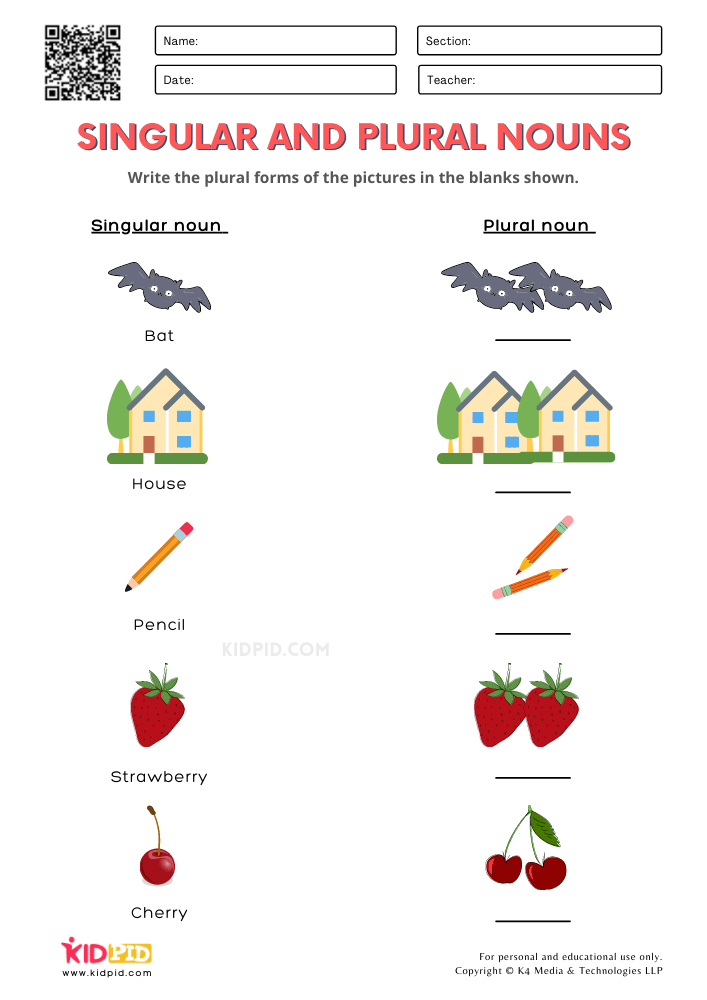
Help Grade 1 kids learn how to make words plural with these fun worksheets! They’ll practice turning one thing into many, like “dog” to “dogs.” A simple way to build grammar skills!
Is It a Person, Place, or Thing? Noun Worksheet

Help kids learn nouns with this fun worksheet! They’ll decide if a word is a person, place, or thing. Perfect for Grade 1 to build grammar skills simply and engagingly!
Find the Nouns: English Worksheet
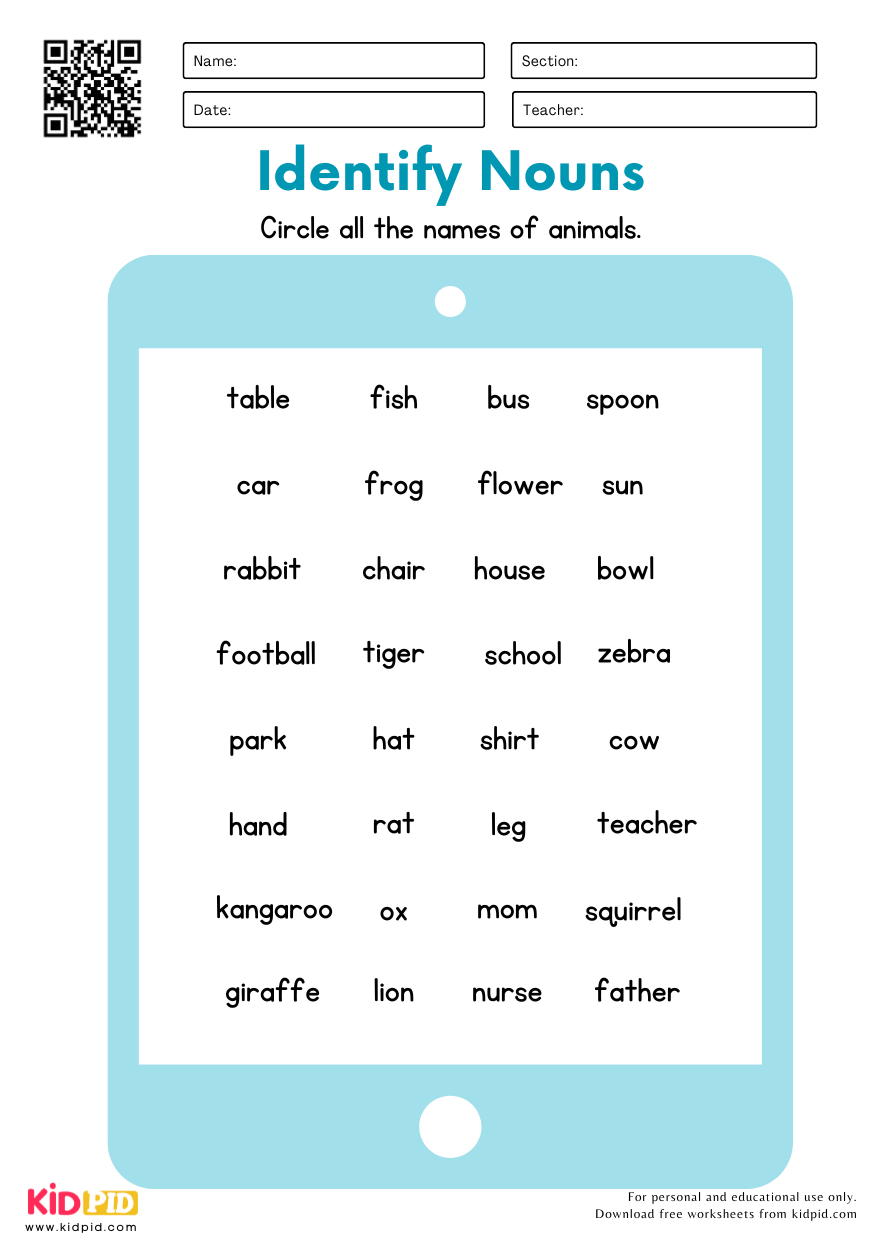
Help kids discover nouns with this fun worksheet! They’ll find words that name a person, place, or thing in simple sentences. Perfect for building grammar skills playfully and easily! Great for young learners!
Spot Nouns in Sentences: Worksheets for Grade 1
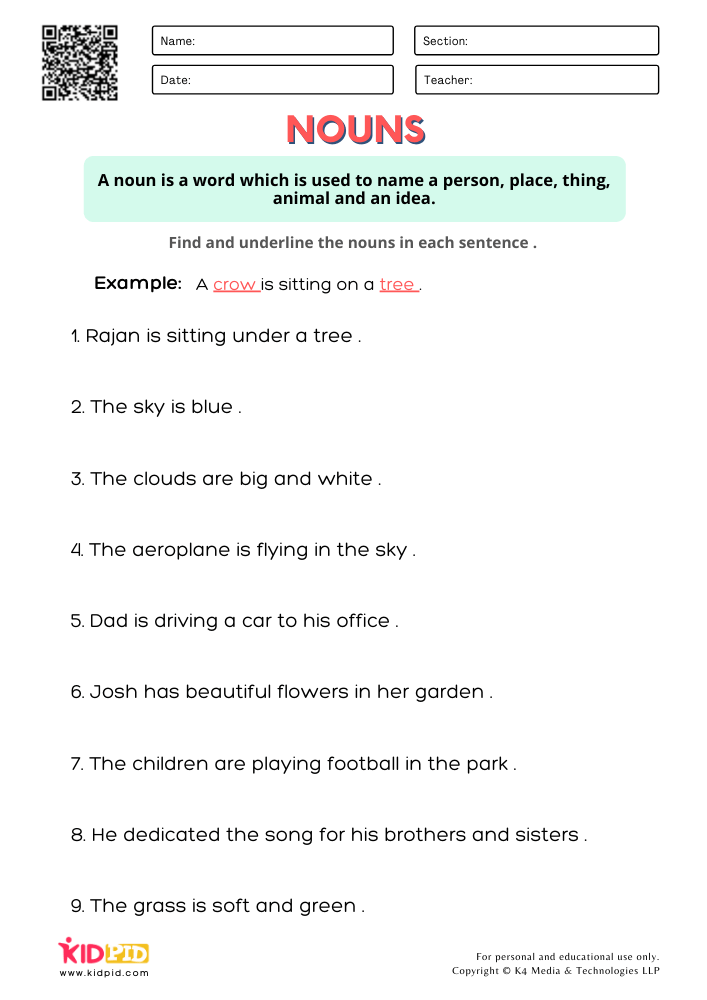
Help Grade 1 kids find nouns in sentences! These fun worksheets teach them to spot people, places, and things in simple sentences. A great way to build grammar skills while having fun learning!
Nouns Star: Fun Worksheets for Grade 2
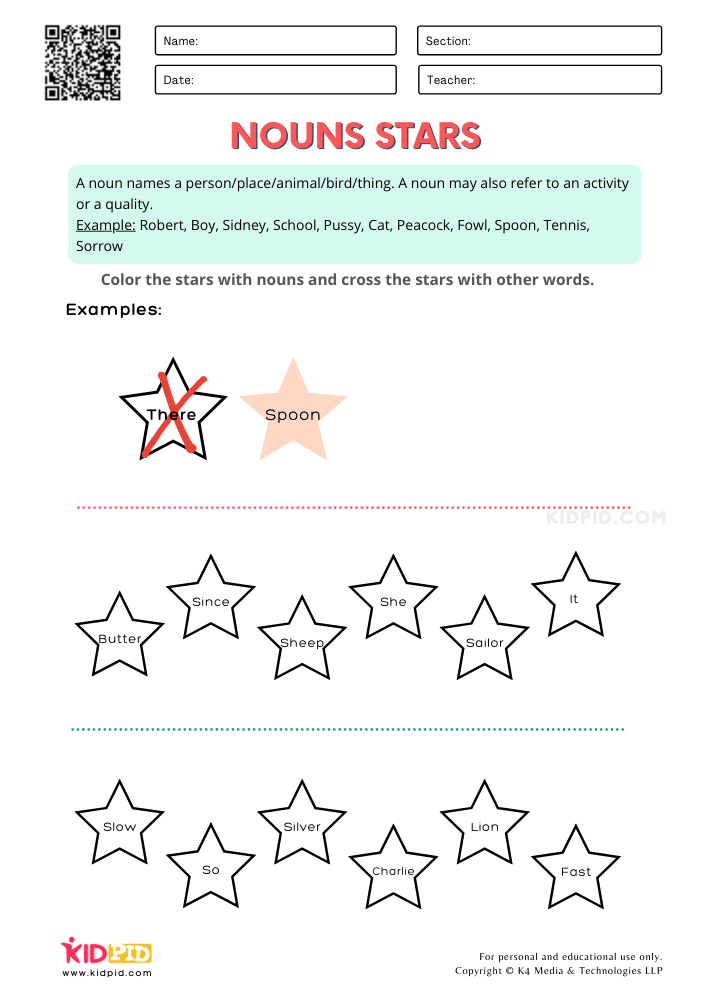
Help Grade 2 kids shine with “Nouns Star” worksheets! They’ll learn about nouns (people, places, and things) in a fun, star-themed way. Perfect for building grammar skills while having fun! Great for young learners!