

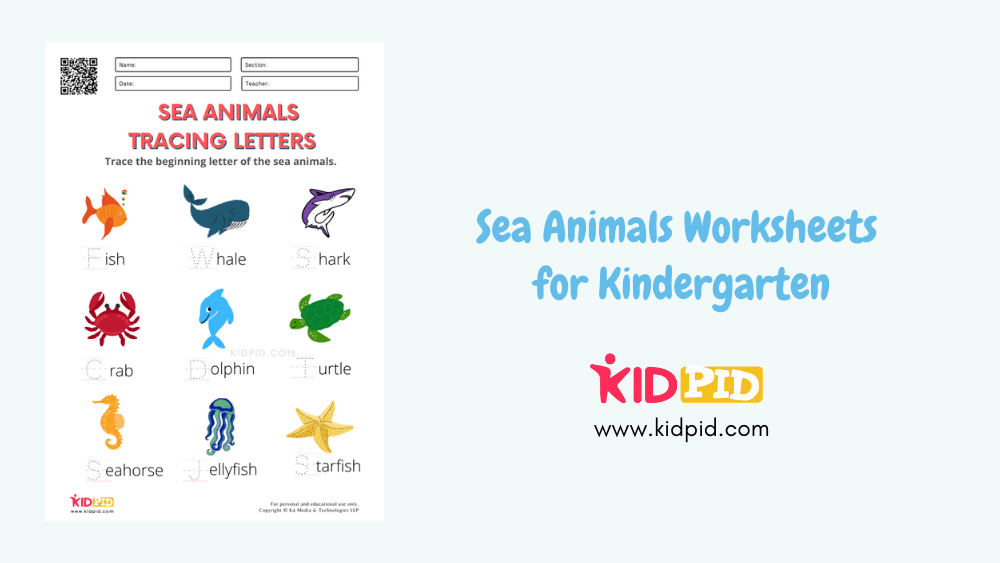
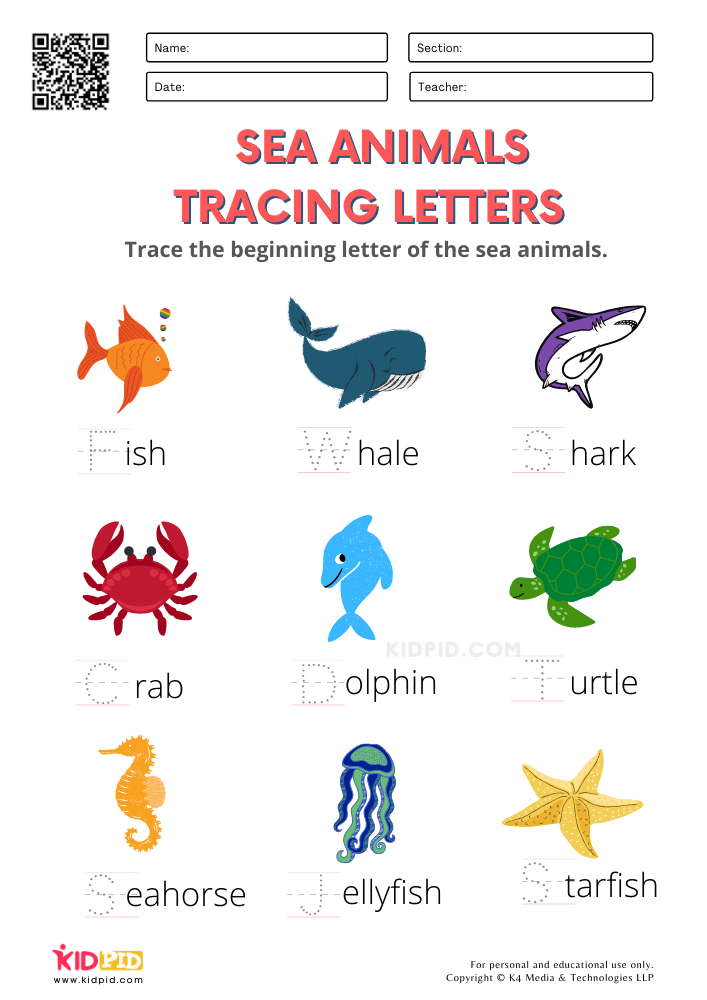
This is a worksheet that you can give your students and kids to understand and learn about sea animals. This is a printable worksheet with 5 pages with different activities to learn with fun. Here we have to identify and match activities, selecting the correct name of sea animals by seeing their pictures, tracing the first word of sea animals for beginners, and word search, which are very easy and fun activities that you can provide your students and kids to learn.
Things we will learn:-
- What are sea animals?
- List of Sea Animals
- Varieties of Sea Animals in detail
By hearing the word sea, the first thing that comes to our mind is water, shells, corals, sand, fish, sea animals, and many more. So basically, what are these sea animals? Let us understand.

Contents
- What are Sea Animals?
- Sea Animals in detail
- Sea Animals Worksheets for Kindergarten
- See carefully and think about the characteristics, and tick the correct name of sea animals
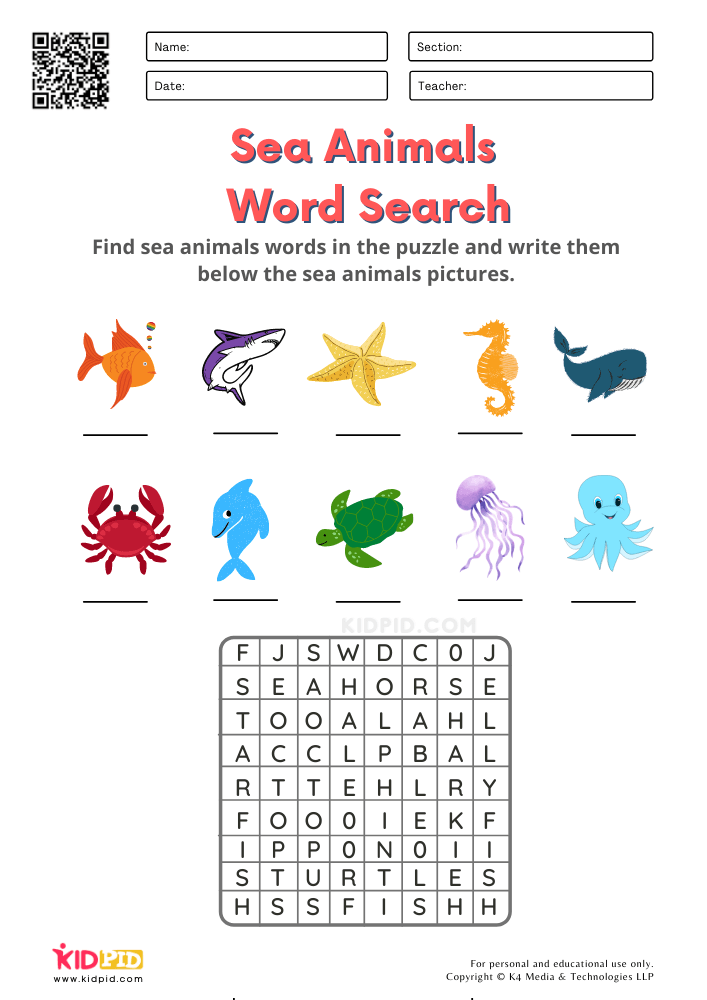
- In this, you have to search for words from the word puzzle, identify the correct sea animal, and write according.
- Key Facts About Sea Animals Worksheets
- Parts/Types/Examples of Sea Animals Worksheets
- Sea Animals Worksheets Working
- Benefits of Learning About Sea Animals Worksheets
- Learning Objectives
- Worksheet Instructions
- Interesting Facts About Sea Animals Worksheets
- Real-Life Applications
- FAQs
- Q1. What age group are Sea Animals Worksheets suitable for?
- Q2. What skills do these worksheets develop?
- Q3. Can these worksheets be used at home?
- Q4. Which sea animals are commonly included?
- Q5. Are these worksheets useful for science lessons?
- Q6. How often should children practice with these worksheets?
- Q8. Why is learning about sea animals important?
- Read More:
What are Sea Animals?
Animals that live in water for most or all of their lifetime are known as Sea Animals. These animals may breathe with their lungs and gills by extracting the oxygen dissolved in the water. Aquatic animals living in freshwater are known as Freshwater animals, and animals living in saltwater, such as sea, oceans, etc., are called Marine Animals.
Types of Animals
- Vertebrates: Vertebrates possess a backbone and an internal skeleton. They are comparatively larger than Invertebrates. For example: Mammals, Fish, Reptiles, etc.
- Invertebrates: Invertebrates do not possess a backbone or an internal skeleton. They are mostly smaller in size than vertebrates. For example, flatworms, insects, sponges, etc.
List of Sea Animals
- Sharks
- Seabirds
- Turtle(Sea Turtle)
- Whale
- Small Fishes
- Shellfish
- Jellyfish
- Starfish
- Crab
- Seahorse
- Dolphins
- Octopus
Sea Animals in detail
Small fish
- These fish are small in size and take a breath using gills, and they have fins that help them to swim in water.
Dolphins
- Dolphins are the most beautiful, intelligent, and friendly sea animals. They are basically mammals and not fish. They have lungs to breathe, and the young ones live with their mothers until they turn 3 years old.
Shark
- A shark is big in size and has a long, slim, and straight body, which helps it to swim fast and deep in the sea. Sharks can attack humans, but they don’t eat them, as humans lack fat.
Whales
- Whales are the largest animals. Whales are not fish they do not have gills, so they cannot breathe underwater. They must come up to the surface of the water to get air. The air is breathed in and out through their “blowhole,” which is on their back.
Sea Turtle
- A sea turtle is a creature living on both water and land and has four legs and a long neck. The body is covered with armor. This armor is as hard as stone. They have been on the earth far earlier than 220 million years and survived extreme weather changes that removed even the dinosaurs.
Octopus
- One of the few animals with blue blood. The octopus looks like a bag and has 8 arms. Octopuses are considered the most intelligent of all the invertebrates.
Seahorse
- A seahorse is a carnivorous fish with a long tail, a bent neck, and a head that looks like a horse. Seahorses are very bad swimmers. The male seahorse carries the baby instead of the female seahorse.
Crab
- Crabs walk the sidewalk. They can swim and have two claws. Crabs have shells and eat plants and animals.
Jelly Fish
- A jellyfish looks like a jelly. They don’t have a brain, heart, bones, or head, and have soft body structures. They can glow on a dark surface.
Star Fish
- They have 5 arms, some could have about 20 to 40 arms as well, and look like a star shape. They are heavy. They can change their gender at any time. The female produces millions of eggs. They can regenerate a body part within a year.
Based on the characteristics and information about sea animals mentioned above, you have to solve the following worksheets.
Sea Animals Worksheets for Kindergarten
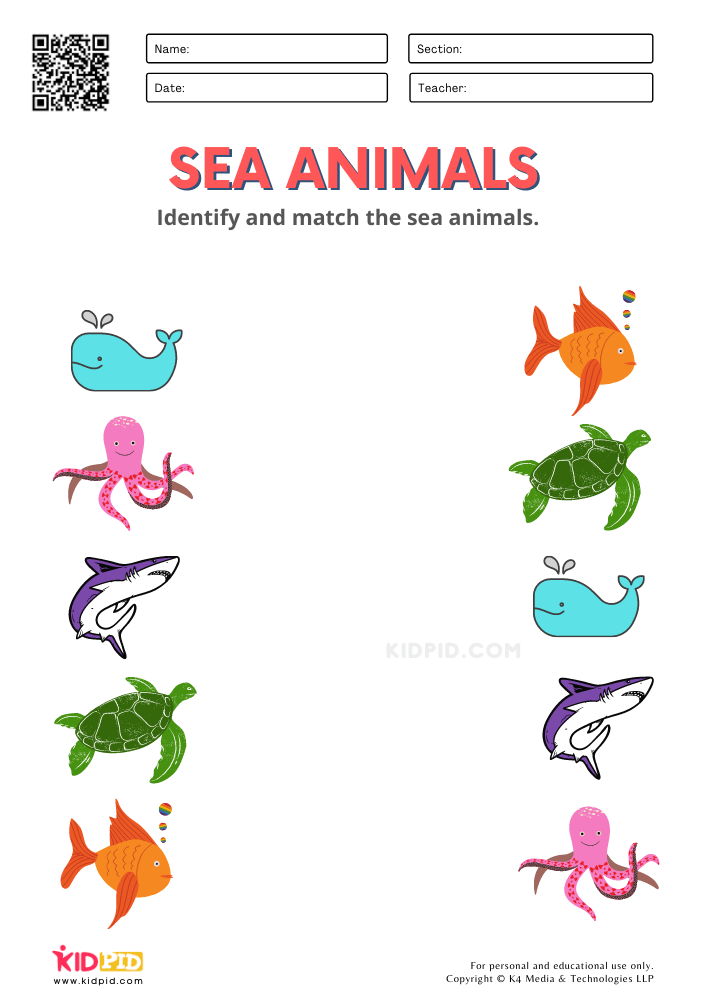
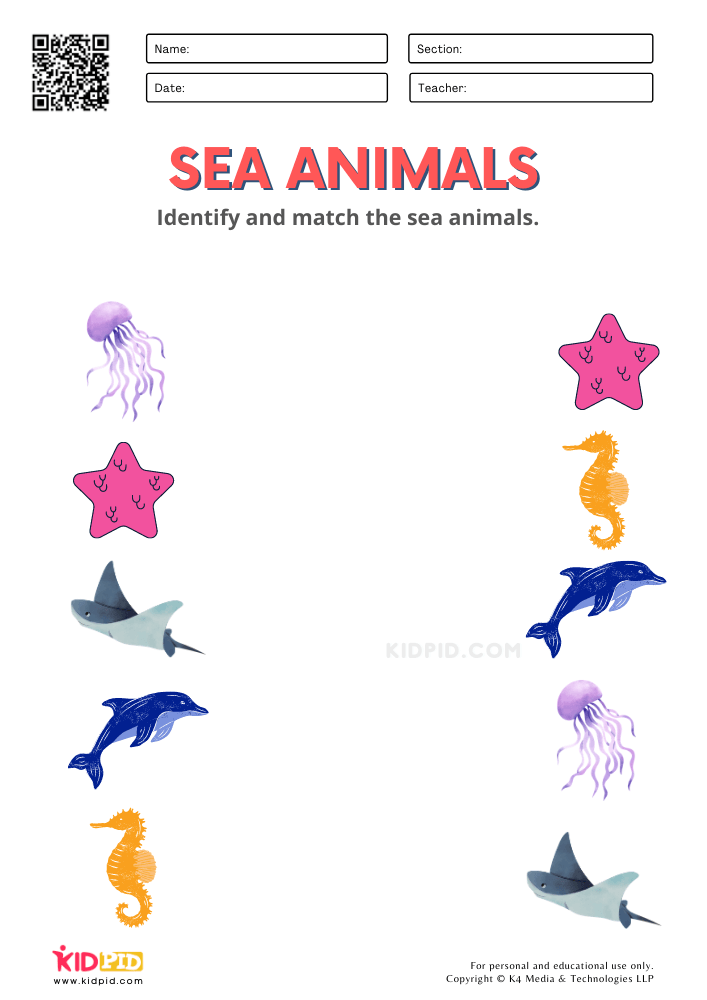
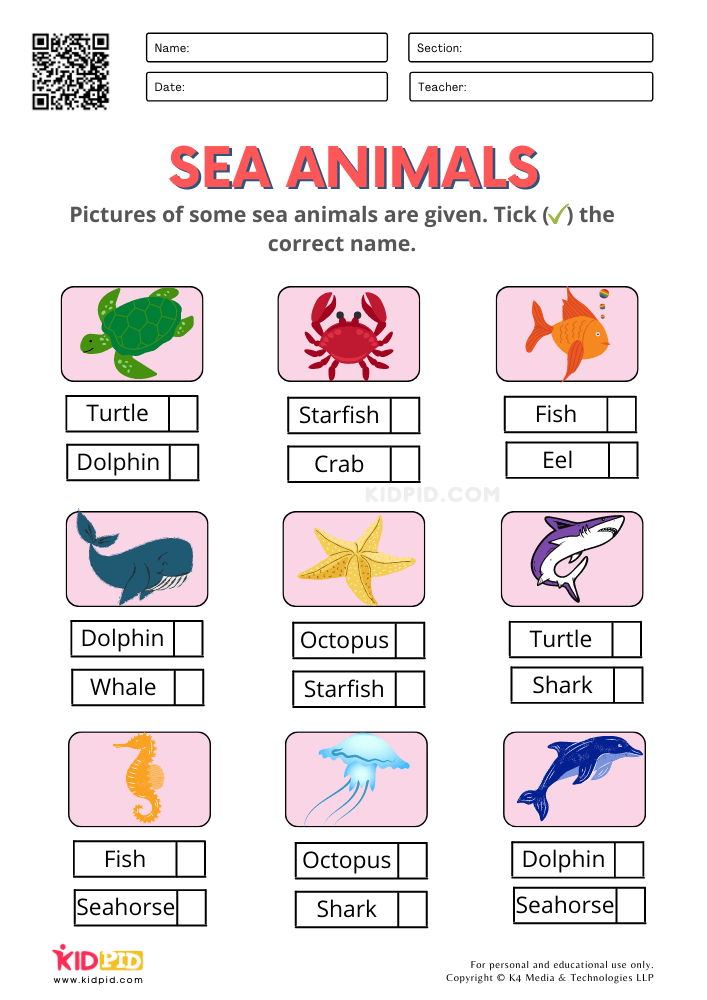
See carefully and think about the characteristics, and tick the correct name of sea animals
In this, you have to search for words from the word puzzle, identify the correct sea animal, and write according.
Key Facts About Sea Animals Worksheets
Sea Animals Worksheets for Kindergarten are engaging educational resources designed to introduce young children to fascinating marine life. These worksheets help children recognize, identify, and learn about different sea animals through fun activities such as coloring, matching, tracing, counting, and labeling. They support early science education while improving vocabulary, observation skills, and fine motor development. Sea animal worksheets are ideal for classroom learning, homeschooling, and independent practice. They make learning about ocean ecosystems enjoyable and age-appropriate for kindergarten learners.
Parts/Types/Examples of Sea Animals Worksheets
Sea animal worksheets come in various formats to support different learning styles:
- Coloring Worksheets – Children color animals such as dolphins, whales, and starfish.
- Matching Activities – Match sea animals with their names or pictures.
- Tracing Worksheets – Trace sea animal names and outlines.
- Counting Worksheets – Count fish, turtles, or other marine creatures.
- Identification Worksheets – Recognize and circle specific sea animals.
- Cut-and-Paste Activities – Sort animals according to categories.
Examples include worksheets featuring sharks, octopuses, jellyfish, crabs, seahorses, dolphins, and sea turtles.
Sea Animals Worksheets Working
These worksheets present children with visually appealing images and simple activities focused on marine animals. Students observe pictures, complete tasks such as coloring or matching, and learn animal names and characteristics. Teachers and parents can guide discussions about habitats, behaviors, and ocean conservation while children work through the activities. The combination of visuals and hands-on learning helps reinforce memory and understanding.
Benefits of Learning About Sea Animals Worksheets
- Improves animal recognition skills.
- Expands marine-life vocabulary.
- Enhances fine motor skills through coloring and tracing.
- Encourages curiosity about ocean ecosystems.
- Develops observation and critical-thinking abilities.
- Supports early science education concepts.
- Builds confidence through interactive learning.
- Promotes environmental awareness from an early age.
Learning Objectives
By completing Sea Animals Worksheets for Kindergarten, children will:
- Identify common sea animals.
- Learn basic facts about marine life.
- Improve visual discrimination skills.
- Strengthen hand-eye coordination.
- Build early reading and vocabulary skills.
- Develop counting and classification abilities.
- Understand that different animals live in different habitats.
- Foster interest in nature and science.
Worksheet Instructions
- Look carefully at each sea animal picture.
- Read or listen to the animal names.
- Complete the assigned activity, such as coloring, tracing, matching, or counting.
- Follow the directions provided on each worksheet.
- Ask questions about unfamiliar animals.
- Check your answers after completing the activity.
- Practice regularly to improve recognition and learning.
Interesting Facts About Sea Animals Worksheets
- Oceans cover more than 70% of Earth’s surface.
- Dolphins are highly intelligent marine mammals.
- Seahorses are unique because male seahorses carry babies.
- Octopuses have eight arms and remarkable problem-solving abilities.
- Sea turtles can live for several decades.
- Starfish can regenerate lost arms.
- Some whales are among the largest animals ever known.
- Jellyfish have existed for millions of years.
Real-Life Applications
Knowledge gained from sea animal worksheets can be applied in everyday learning experiences:
- Visiting aquariums and marine parks.
- Identifying sea animals in books and videos.
- Participating in ocean-themed classroom projects.
- Understanding basic environmental conservation.
- Exploring science and nature topics.
- Developing observation skills during educational field trips.
- Building a lifelong interest in marine biology and wildlife.
FAQs
Q1. What age group are Sea Animals Worksheets suitable for?
Answer: These worksheets are primarily designed for kindergarten children aged 4–6 years.
Q2. What skills do these worksheets develop?
Answer: They help improve vocabulary, fine motor skills, observation, matching, counting, and early science understanding.
Q3. Can these worksheets be used at home?
Answer: Yes, they are excellent for homeschooling, homework practice, and family learning activities.
Q4. Which sea animals are commonly included?
Answer: Popular animals include dolphins, whales, sharks, octopuses, jellyfish, crabs, seahorses, and sea turtles.
Q5. Are these worksheets useful for science lessons?
Answer: Yes, they provide an engaging introduction to marine life, habitats, and ocean ecosystems.
Q6. How often should children practice with these worksheets?
Answer: Regular practice a few times each week helps reinforce learning and improve retention.
Q8. Why is learning about sea animals important?
Answer: It helps children understand biodiversity, marine ecosystems, and the importance of protecting ocean environments.
Young learners can discover fascinating underwater creatures through these printable activities, making ocean-themed lessons enjoyable, interactive, and suitable for everyday practice. Stay connected with us on Facebook, Pinterest, YouTube & Telegram for exciting learning resources. Join our Telegram group to get the latest updates first!
Hope you liked these worksheets. Please check out our collection of beautiful and creative worksheets for your kids.
The Content Team designed this worksheet to build academic growth.
Reviewed By Komal Singh
Read More:



