Learning the multiplication table is crucial in building a strong foundation in mathematics. But when learning something difficult, children always have one question in their mind – why learn the table when I can just count?

Well, ask your child to count till 10 and then tell them to ask you the answer to 5*2. Answering their question will help them understand the difference in the time it took them to count till 10 and for you to answer 5*2, and help them realize the benefit of learning the multiplication tables – speed. Knowing the tables will allow a child to solve problems of multiplication and division much faster than they would with counting.

There are various ways to learn the multiplication tables, but the best way to practice what you’ve learnt is through solving problems, and these worksheets allow just that.

Multiplication Chart Worksheets for Kids

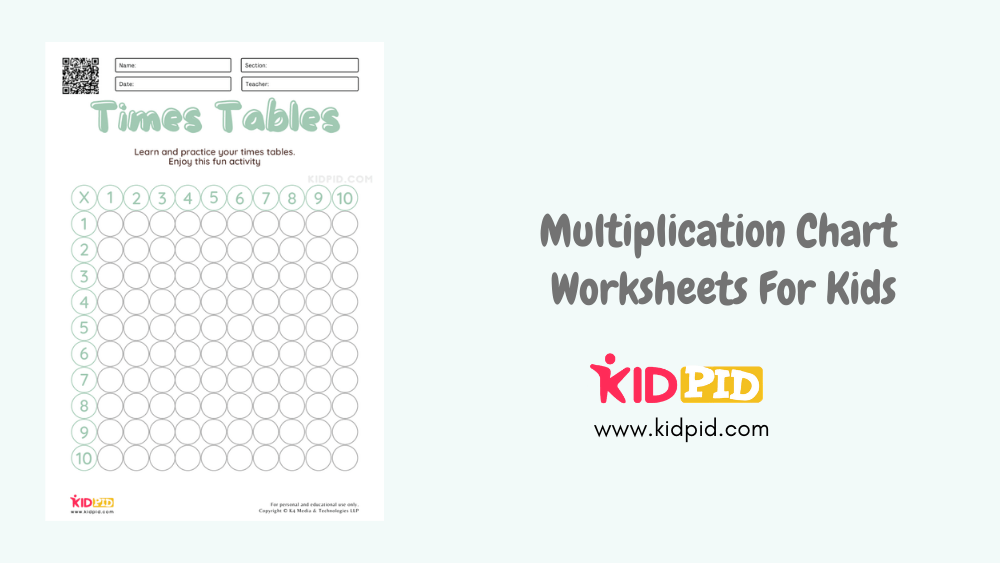
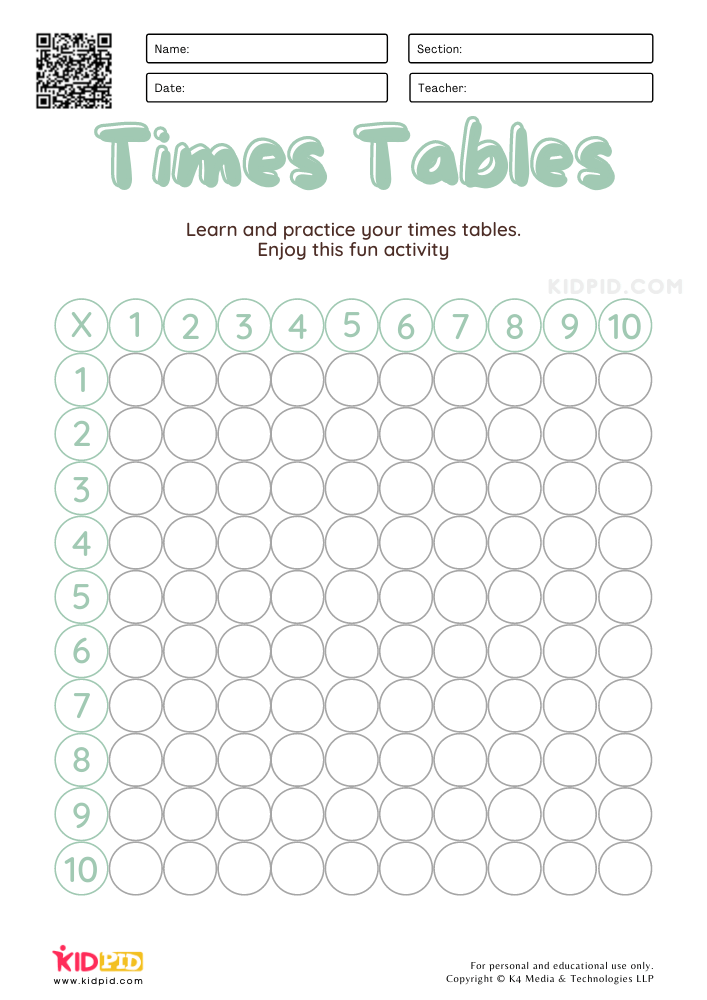
In the first worksheet, the numbers from 1 to 10 are given in a square format with empty spaces for the answer.
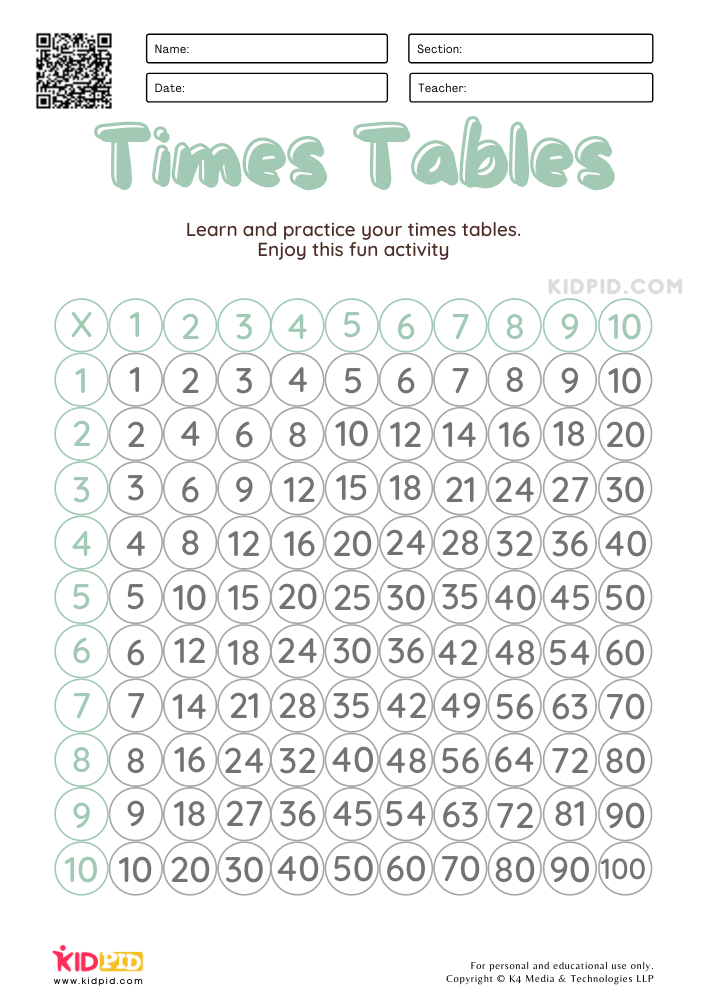
In this worksheet, the entire multiplication table from 1 to 10 is provided in square format. Children can use this to learn the tables and can refer to them when they get stuck solving problems.
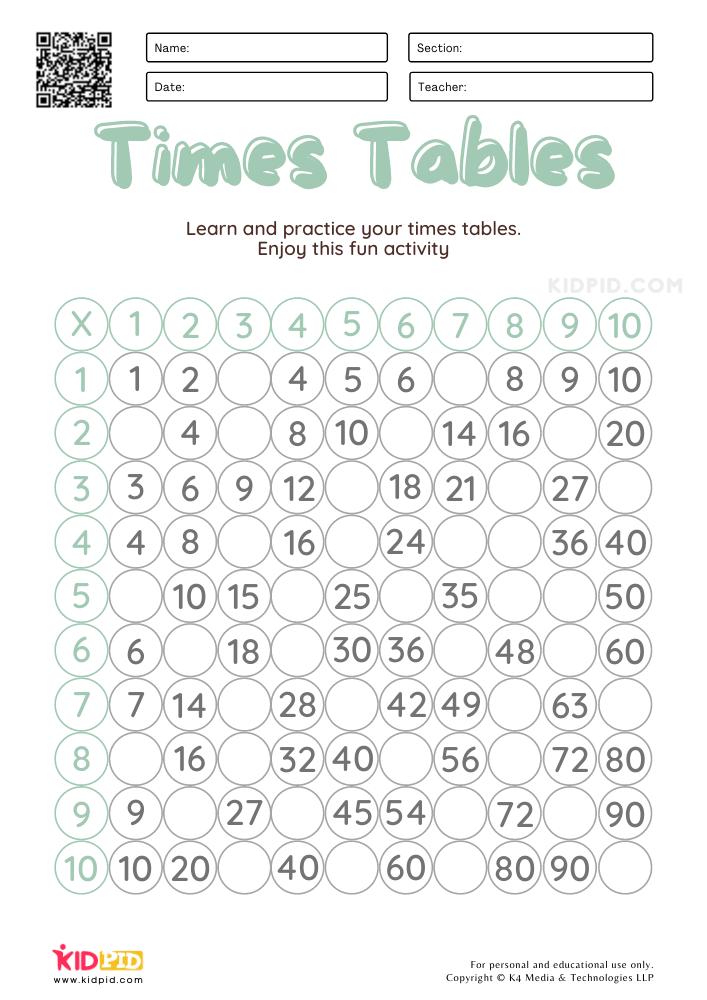
The final worksheet is an exercise where some of the tables have been filled while the rest are empty – kids must use what they’ve learned and write down the correct answer in the empty spaces.

Key Facts About Multiplication Chart Worksheets

  • Visual Math Foundations: A multiplication chart layout acts as a spatial framework that maps out numeric relationships, which helps kids progress past tedious finger-counting.
  • Target Age Group: These tools are universally introduced in Grade 2 through Grade 5 to transition young minds safely into advanced math operations.
  • Brain Training Mechanics: Working with grid matrices stimulates working memory and pattern identification, mapping math skills straight to long-term memory.
  • Flexible Learning Formats: These versatile printables can easily pivot from guided lesson companions to quick, timed assessment quizzes.

Parts, Types, and Examples of Multiplication Worksheets

Multiplication tools come in various designs depending on where a child is in their math journey:

  • Complete 1 to 10 Reference Grids: A fully populated numerical table. This acts as a visual dictionary for students just beginning to grasp the core concepts.
  • Blank Fill-In Frameworks: An empty grid matrix where columns and headers are provided, but the intersecting products are left completely blank for the student to write out.
  • Partial/Missing Factor Sheets: Targeted practice grids that leave specific columns out (like the trickier 7s or 8s tables) to challenge memory retention selectively.

How Does a Multiplication Chart Work?

Reading a grid chart comes down to tracking standard coordinates:

  1. Find the Factors: The child locates their first number on the top horizontal row and their second number along the left vertical column.
  2. Follow the Grid Lines: Drag one finger down the column and another finger directly across the row.
  3. Locate the Product: The exact coordinate square where both lines cross paths reveals the product. For instance, following row 4 down and column 3 across lands squarely on 12.

Benefits of Learning About Multiplication Charts

  • Unlocks Rapid Problem Solving: Rote tracking builds computational speed, cutting down the mental time needed to handle multivariable math equations later on.
  • Reveals Repeating Visual Patterns: Kids can literally see why properties function the way they do—like recognizing that numbers ending in 0 or 5 always fall along the same predictable paths.
  • Reduces Cognitive Load: By cementing basic product facts early on, students preserve critical mental energy to tackle heavy word problems, multi-digit division, or fractions.

Learning Objectives

By utilizing these printable charts regularly, young learners are expected to:

  • Fluently Multiply: Recall basic products between 1 and 10 with high accuracy and low hesitation.
  • Identify Math Properties: Understand core mathematical rules, such as the Commutative Property (realizing that 3 × 4 yields the same layout result as 4 × 3).
  • Connect Operations: Establish a distinct mental link between repeated addition and structured multiplication.

Worksheet Instructions

Follow these steps to complete your printable practice sheets successfully:

  1. Review Your Targets: Spend three minutes looking over a completed chart to familiarize your brain with the patterns.
  2. Track Closely: Work row-by-row on the blank grids, using your fingers to steady your vision if the grid lines begin blurring together.
  3. Pace Yourself: If you hit a roadblock on a tricky factor, temporarily skip ahead to easier tables (like the 2s, 5s, or 10s) to build up early rhythm and confidence.
  4. Self-Correct: Flip over your reference sheet when done and double-check your answers to fix any stray numerical errors.

Interesting Facts About Multiplication

  • The Babylonian Roots: The oldest known versions of multiplication tables were discovered on ancient clay tablets written by the Babylonians over 4,000 years ago!
  • The Magic Nine Mirror: When multiplying any single digit by 9, the individual digits of the resulting product will always add up to 9 (e.g., 9 × 4 = 36; and 3 + 6 = 9).
  • Symmetry Across the Middle: If you draw a diagonal line straight down from the top-left 1 to the bottom-right 100, the numbers on either side form a perfect mirror image of each other.

Vocabulary Words

  • Factor: The individual numbers that are multiplied together to build a new value (in 2 × 3 = 6The numbers 2 and 3 are factors.
  • Product: The final numeric result or answer achieved by multiplying factors together.
  • Grid / Matrix: A structured pattern of horizontal rows and vertical columns used to display data neatly.
  • Commutative Property: The mathematical rule stating that changing the order of numbers does not change the final product.

Real-Life Applications

Multiplication is a daily superpower used far outside the classroom walls:

  • Baking and Cooking: Doubling or tripling cookie recipes to feed a larger family gathering.
  • Money Management: Calculating total allowance savings over a stretch of consecutive weeks.
  • Event Planning: Figuring out exactly how many total chairs are available in an auditorium by quickly multiplying the rows by the seats per row.

FAQs

Q1. At what age is it best to introduce a multiplication chart?

Answer: Most educators introduce visual charts around age 7 or 8 (typically early 3rd grade), right as the curriculum shifts away from basic addition and subtraction.

Q2. Why use a grid instead of standard flashcards?

Answer: Flashcards isolate individual facts in a vacuum. Grids, on the other hand, show the entire big picture at once, helping kids recognize numeric spacing, scales, and overlapping number families.

Q3. How do I help a child who gets overwhelmed by the full chart?

Answer: Isolate the work. Use sheets of scrap paper to mask out rows 6 through 10 entirely. Focus completely on mastering the smaller, manageable 1-to-5 squares before moving down the sheet.

Positive reinforcement can go a long way when learning, and so it is important to remain patient when teaching children and praise them when they perform well. Learning the multiplication tables is tedious and time-consuming, and more often than not, children feel like giving up or no longer feel interested in what they’re learning. But learning through fun worksheets like this will help them stay focused and motivated throughout the process. Keep visiting our website and explore more paragraphsessaysworksheetsflashcardsQuizzes, and many other interactive resources. Don’t forget to follow us on YouTube & Facebook.
So, what are you waiting for? Download these free worksheets and get started today!

The Content Team crafted this worksheet to foster academic growth.

Reviewed By Drashti

Read More:

About the Author

Content Team

Kidpid Content Team is a team of experienced educators, curriculum researchers, and child-focused content creators specializing in early childhood and primary education. The team develops high-quality, research-based worksheets, learning activities, and educational articles aligned with age-appropriate learning standards. Every resource is carefully reviewed to ensure accuracy, clarity, and educational value, making Kidpid a trusted platform for parents, teachers, and schools worldwide.

View All Articles