Learning multiplication is an important aspect of every child’s learning journey. Children must have a good grasp of this concept because they will have to apply their knowledge to long multiplication as well as other new mathematical problems in the future. Multiplication is a big chunk of the curriculum, with both direct sums as well as descriptive problem sums.
Contents
- How do you solve multiplication sums?
- Double-Digit Multiplication Sums Worksheets for Class 3
- 1. Double-Digit Multiplication Sums Printable
- 2. Double-Digit Multiplication Sums Printable
- 3. Double-Digit Multiplication Sums Printable
- 4. Double-Digit Multiplication Sums Printable
- 5. Double-Digit Multiplication Sums Printable
- 6. Double-Digit Multiplication Sums Printable
- 7. Double-Digit Multiplication Sums Printable
- 8. Double-Digit Multiplication Sums Printable
- Key Facts About Double-Digit Multiplication Worksheets
- Parts, Types, and Examples of Double-Digit Worksheets
- How Does Double-Digit Multiplication Work?
- Benefits of Learning About Double-Digit Multiplication
- Learning Objectives
- Worksheet Instructions
- Interesting Facts About Multiplication
- Vocabulary Words
- Real-Life Applications
- FAQs
- Q1. At what grade should a child start learning double-digit multiplication?
- Q2. Why does my child keep getting the answers wrong even though they know their times tables?
- Q3. How can I tell if my child is ready for these worksheets?
- Q4. What is the alternative to the standard algorithm taught in schools today?
- Read More:
How do you solve multiplication sums?
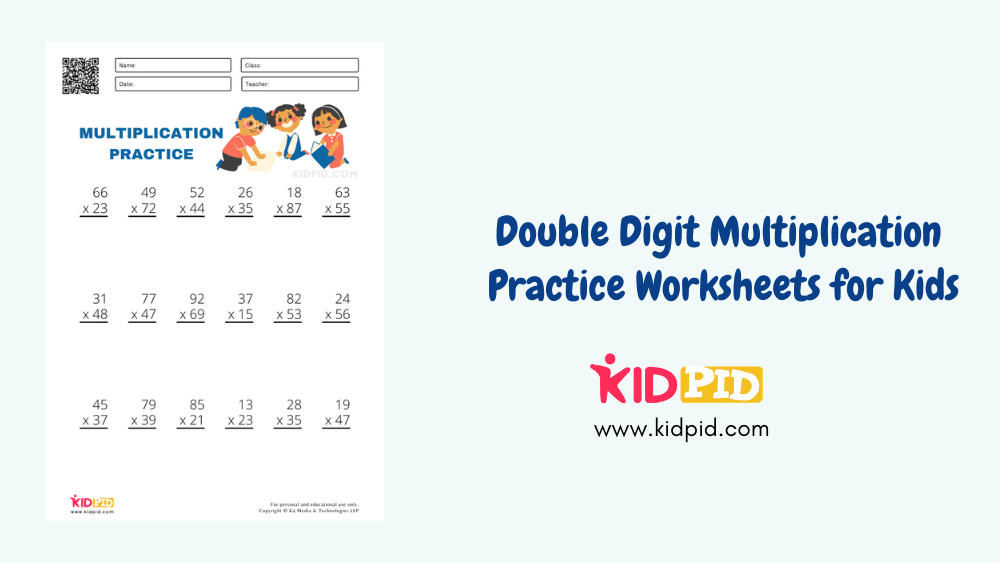
Multiplication of double-digit numbers is tricky and more challenging than single-digit number multiplication. The approach is the same as that for single-digit number multiplication – start by multiplying by the digit in the ones place and then carry out the second round of multiplication using the digit in the tens place. Once the basic formula is clear, double-digit multiplication will be a piece of cake!
So, let’s have a look at some worksheets that will help your child hone their multiplication skills.
Double-Digit Multiplication Sums Worksheets for Class 3

1. Double-Digit Multiplication Sums Printable
This is the first worksheet of the lot. Set a fixed number of worksheets for your child every day to help them practice and improve their multiplication skills.
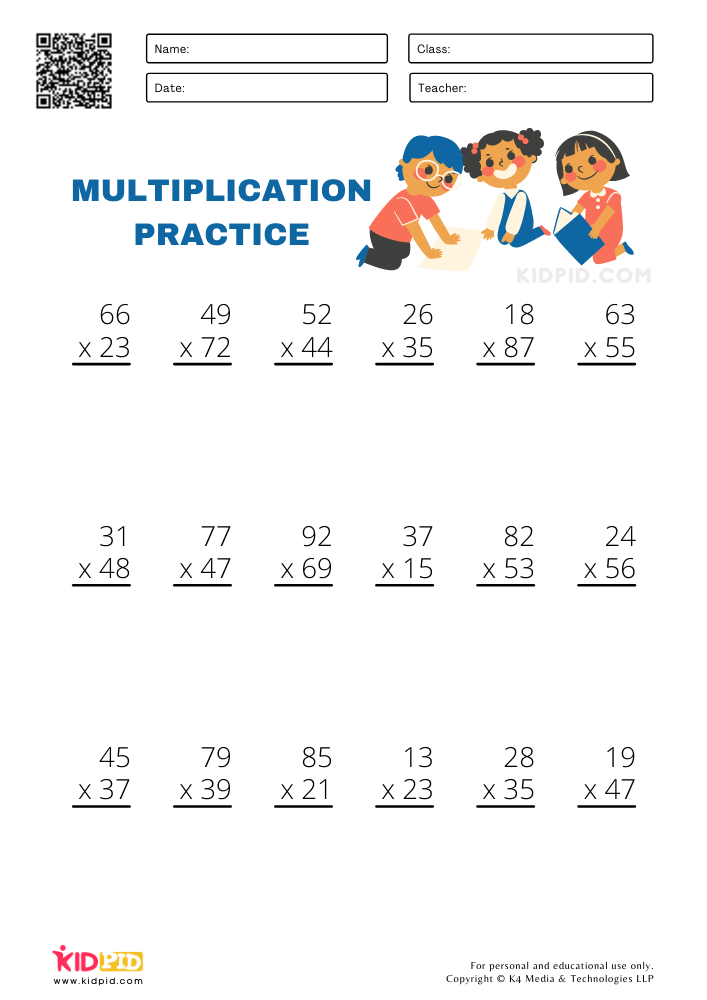
To solve double-digit multiplication problems, one must already be familiar with the multiplication tables from 1 to 12. This will not only make it easier to solve the problems but also help young learners calculate as well.
2. Double-Digit Multiplication Sums Printable
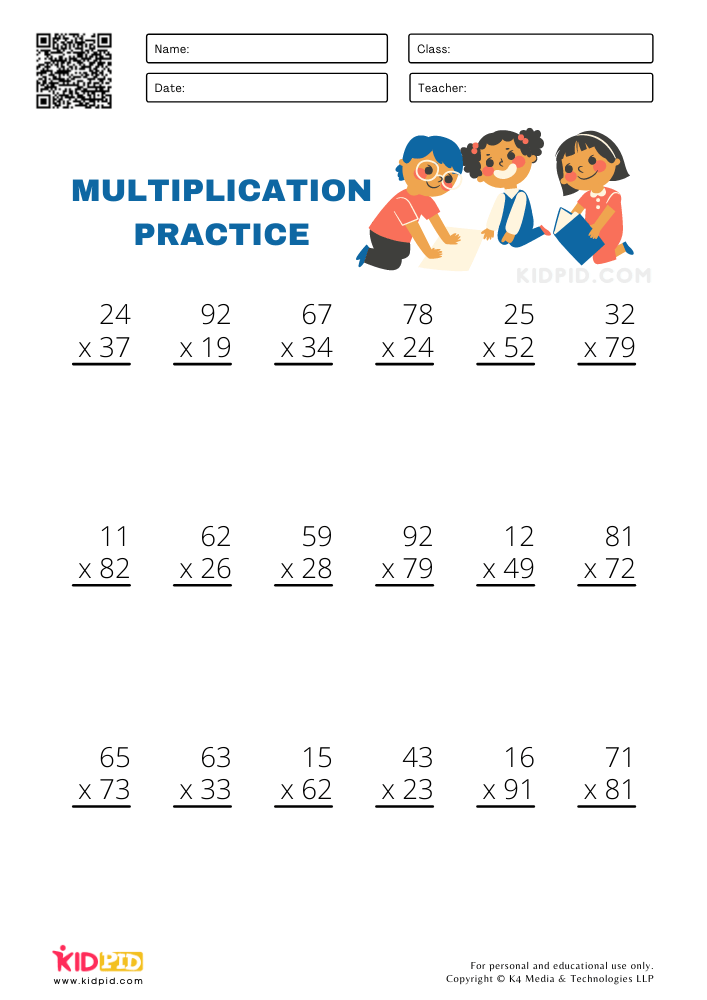
Solving these problems is tedious and time-consuming. If your child gets stuck on one problem, ask them to simply move on to the next one and come back to it later. This trick will help them stay positive and motivated during their task.
3. Double-Digit Multiplication Sums Printable
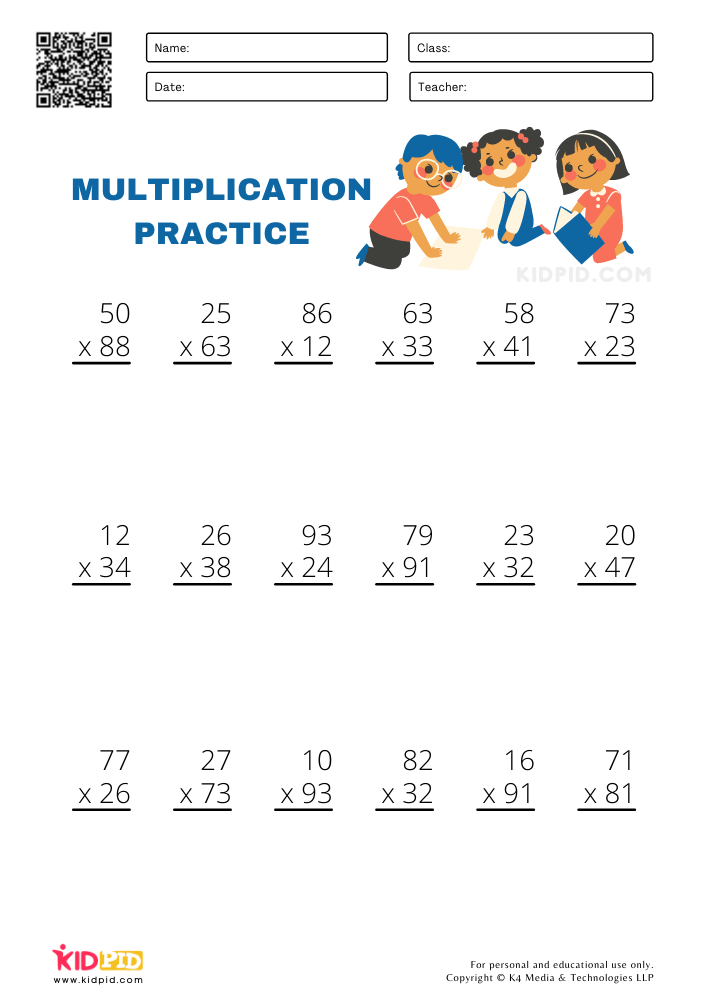
Children always want to finish studying as quickly as possible and, as a result, are prone to making mistakes. Make sure your child is focused on the task at hand.
4. Double-Digit Multiplication Sums Printable
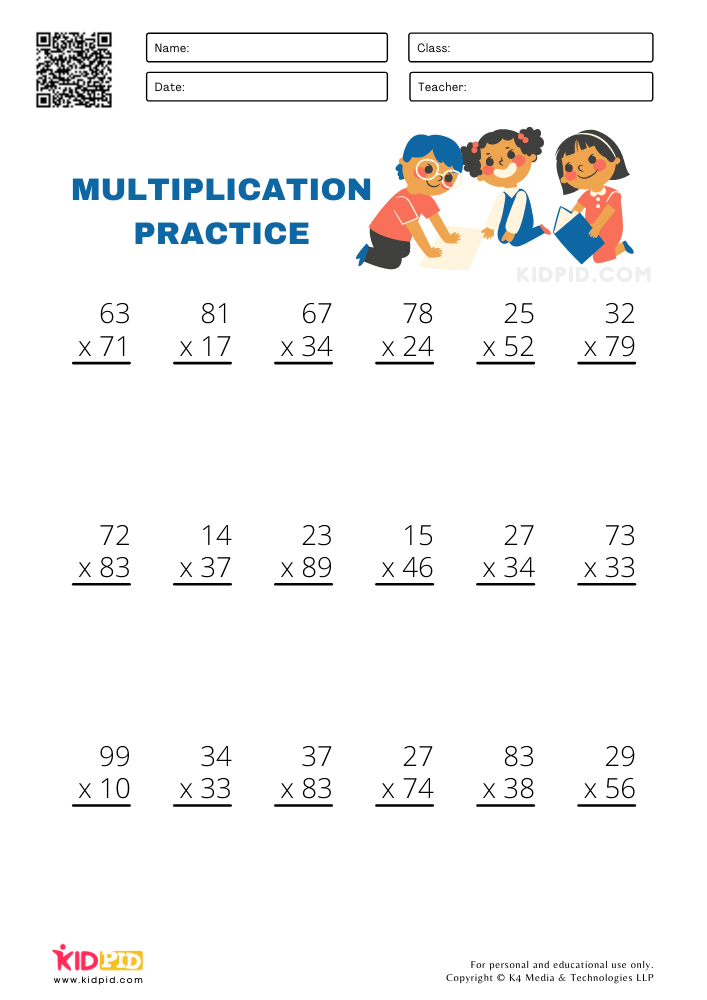
Multiplication of large numbers may feel intimidating at first, and your child is likely to make a lot of mistakes. But with regular practise with these worksheets, they will surely improve and become more comfortable with solving problems with even bigger numbers.
5. Double-Digit Multiplication Sums Printable
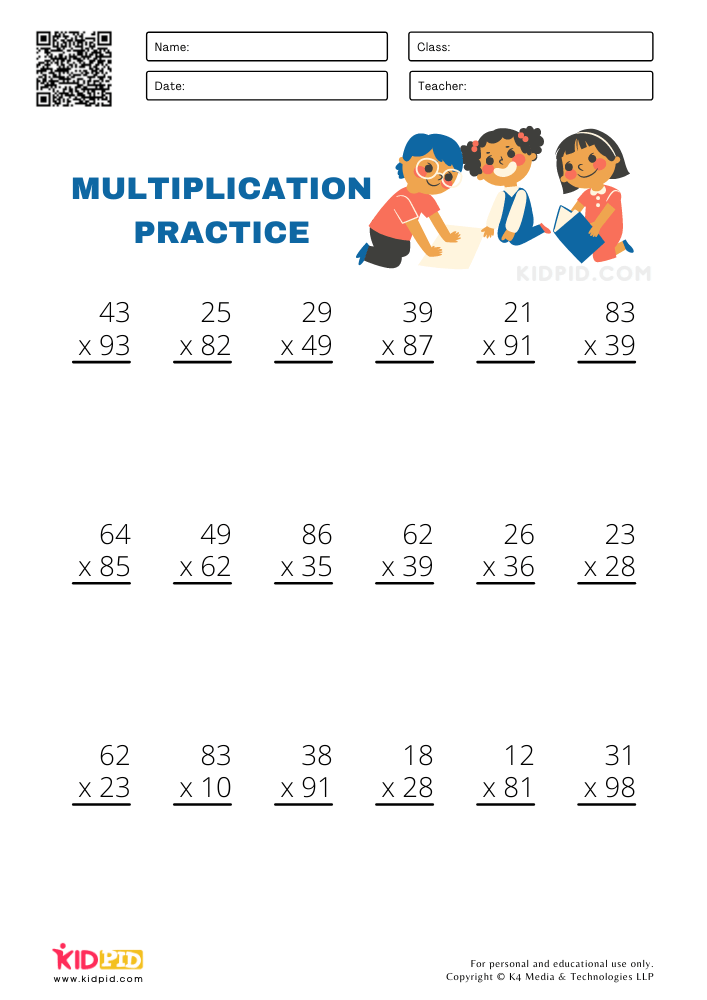
Once children become slightly used to the new problems, set a time limit for solving each sum or set of sums. This will help children get used to solving problems quickly under time pressure.
6. Double-Digit Multiplication Sums Printable
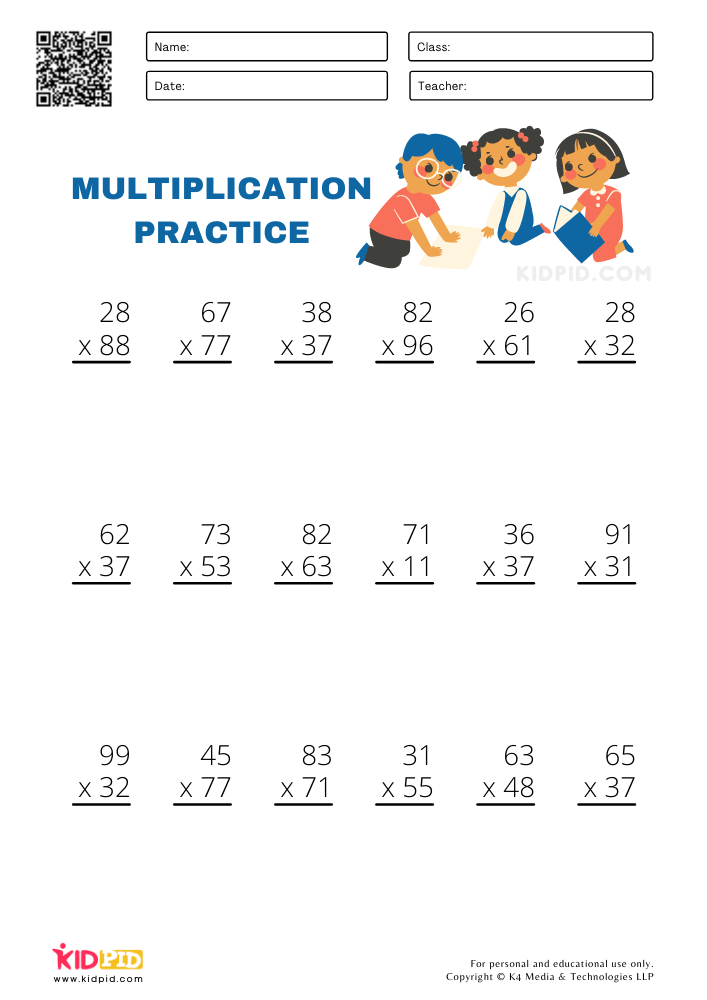
Every child is unique and learns at their own pace. It is important to positively motivate children to do their work, but at the same time, not make them feel pressured until they have enough confidence in themselves.
7. Double-Digit Multiplication Sums Printable
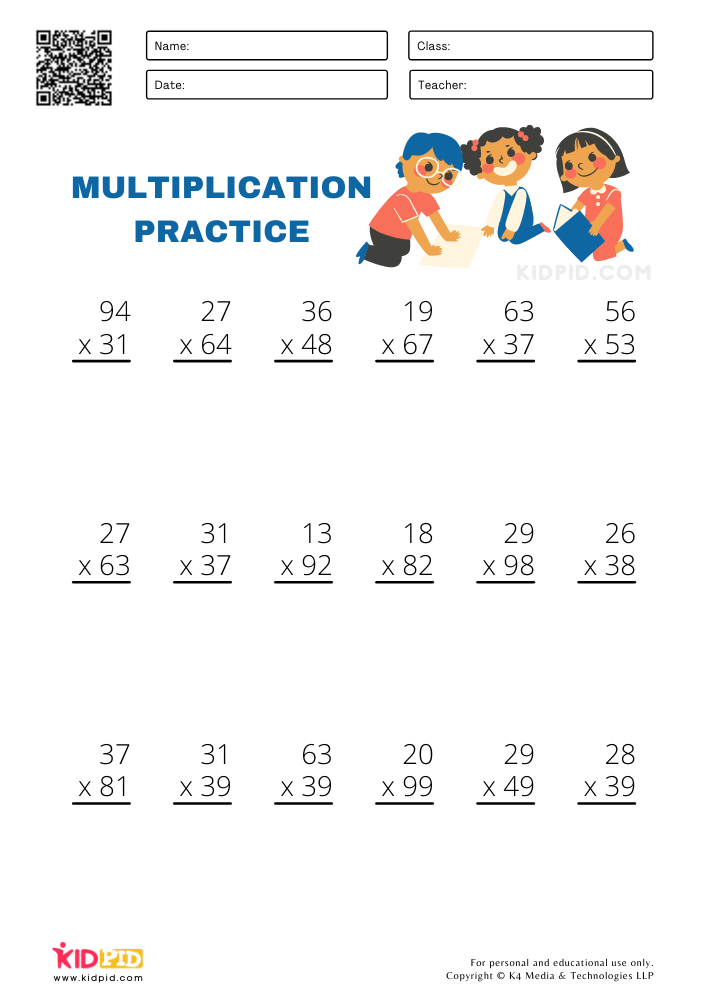
Solving worksheets daily will allow children to make mistakes, learn, and slowly but surely become better. Patience is key in this process, both for the student and the teacher.
8. Double-Digit Multiplication Sums Printable
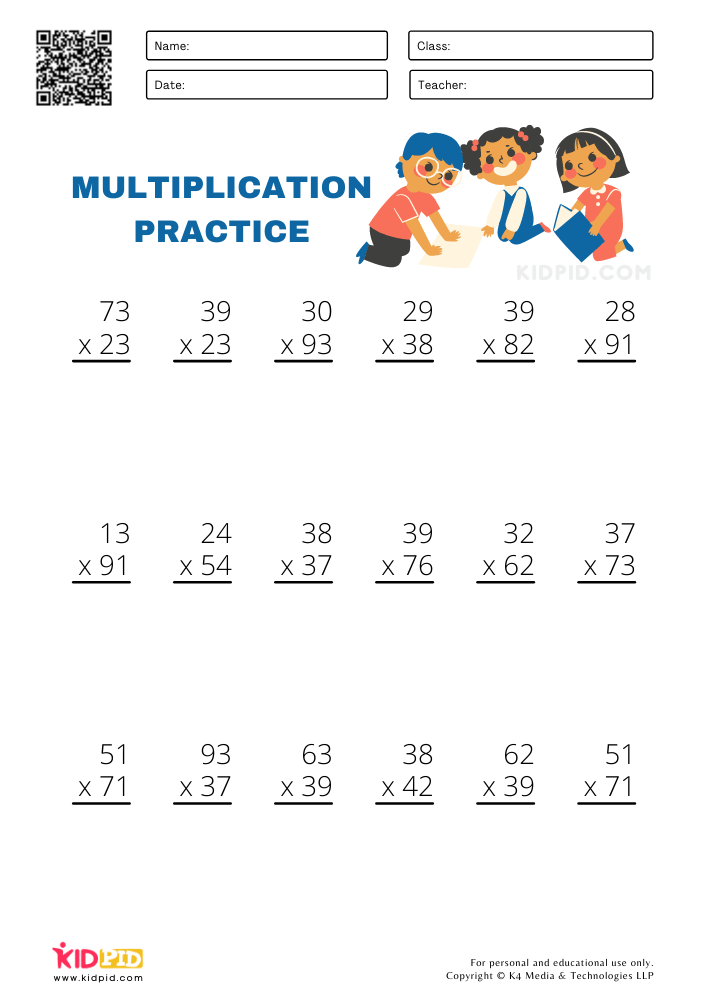
Children should have the multiplication table memorized before they move on to solving double-digit multiplication. Without it, the entire task will become monumentally more difficult for them and eventually create an aversion toward the topic. Worksheets are a great way to learn as it not only allows children to learn in a new way but also help keep track of their productivity. A single sheet of paper is far less intimidating for children to approach, and it sets them in a positive mindset before they begin learning. So, what are you waiting for?
Key Facts About Double-Digit Multiplication Worksheets
- Target Grade Level: Primarily designed for Grade 3 and Grade 4 students who have already mastered single-digit multiplication facts.
- Core Prerequisite: A strong grasp of the multiplication tables (1 to 12) and a solid understanding of place value (ones, tens, and hundreds).
- Pedagogical Value: Serves as the crucial bridge between basic arithmetic and advanced mathematical operations like long division and fractions.
- Cognitive Shift: Shifts a child’s focus from simple rote memorization to structured procedural thinking and multi-step logic.
Parts, Types, and Examples of Double-Digit Worksheets
To prevent cognitive fatigue, double-digit multiplication practice is broken down into specific structural types:
1. 2-Digit by 1-Digit Multiplication (No Regrouping)
The simplest entry point. Kids multiply a tens-and-ones number by a single number without needing to carry over.
Example: 23 × 3
2. 2-Digit by 1-Digit Multiplication (With Regrouping)
Introduces the concept of carrying over value to the next place value column.
Example: 47 × 6 (where 7 × 6 = 42, requiring the 4 to be regrouped to the tens column).
3. 2-Digit by 2-Digit Multiplication
The ultimate goal of these worksheets. Requires a two-step partial product method and a placeholder zero.
Example: 54 × 23
How Does Double-Digit Multiplication Work?
Double-digit multiplication uses the Standard Algorithm (or partial products method), which relies heavily on understanding place value. Here is the exact mental and physical process a child follows to solve a problem like 34 × 12:
- Step 1: Multiply by the Ones. The student multiplies the top number (34) by the digit in the ones place of the bottom number (2). (34 × 2 = 68).
- Step 2: The Critical Placeholder Zero. Before multiplying by the tens digit, the student must place a
0in the ones column of the second row. This is because they are multiplying by 10, not just 1. - Step 3: Multiply by the Tens. The student multiplies the top number by the digit in the tens place (34 × 1 = 34, which reads as 340 due to the placeholder zero).
- Step 4: Add the Partial Products. The student adds the two rows together (68 + 340 = 408) to find the final product.
Benefits of Learning About Double-Digit Multiplication
Mastering this mathematical milestone offers significant long-term academic benefits:
- Strengthens Working Memory: Students must hold numbers in their heads, regroup, and add lines of digits simultaneously, expanding their cognitive capacity.
- Reinforces Place Value: It transitions place value from an abstract concept into a concrete, functional tool that children use to organize numbers.
- Prepares for Advanced Math: Mastery of this skill is a non-negotiable prerequisite for learning long division, decimals, percentages, and early pre-algebra.
- Builds Academic Resilience: Because it is a multi-step process where errors can easily happen, finishing a worksheet builds patience, attention to detail, and a growth mindset.
Learning Objectives
By completing these worksheets regularly, the student will be able to:
- Demonstrate fluent execution of the standard multiplication algorithm for multi-digit numbers.
- Correctly apply regrouping (carrying over) techniques across different place value columns.
- Understand and explain the mathematical necessity of the placeholder zero when multiplying by tens.
- Self-correct errors by checking their work using estimation or inverse operations.
Worksheet Instructions
Parents and teachers, read these guidelines with your child before beginning:
- Grab a Pencil and Eraser: Mistakes are an essential part of learning! Avoid using pens so your workspace stays clean.
- Keep Columns Aligned: Write clearly. Make sure your ones, tens, and hundreds lines are perfectly straight. Misalignment is the number one cause of math mistakes!
- Don’t forget the Magic Zero: Always place your placeholder zero in the second row before you begin multiplying by the second digit.
- Take Your Time: Accuracy is much more important than speed. If you feel frustrated, take a 2-minute break and come back to the problem.
Interesting Facts About Multiplication
- The “X” Symbol: The multiplication sign (×) was introduced in 1631 by an English mathematician named William Oughtred.
- Ancient Computing: Before worksheets, ancient Babylonians used clay tablets etched with multiplication tables over 4,000 years ago to calculate trade goods!
- A Pattern Play: Any double-digit number multiplied by 11 has a cool trick: split the two digits apart, add them together, and put the sum in the middle! (e.g., 25 × 11 → 2 + 5 = 7 → 275).
Vocabulary Words
- Factor: The numbers that are multiplied together to get a result (e.g., in 12 × 5 = 60, both 12 and 5 are factors).
- Product: The final answer or result of a multiplication problem.
- Partial Product: The intermediate steps/results found when multiplying a number by individual digits of a multi-digit number before adding them together.
- Regrouping: The process of turning 10 ones into 1 ten, or 10 tens into 1 hundred, to carry them over to the next column.
- Placeholder: A digit (usually zero) written in a specific place value column to keep digits aligned correctly.
Real-Life Applications
Math isn’t just for school—double-digit multiplication happens around us every day:
- Budgeting and Shopping: If a family streaming subscription costs $15 a month, calculating how much it costs for 12 months ($15 × 12) requires double-digit multiplication.
- Party Planning: If you are planning a school event with 24 rows of chairs and 15 chairs in each row, you multiply 24 × 15 to see if you have enough seats for everyone.
- Time Management: Figuring out how many minutes are in a full day requires multiplying 24 hours by 60 minutes.
FAQs
Q1. At what grade should a child start learning double-digit multiplication?
Answer: Most children are introduced to 2-digit by 1-digit multiplication in late 3rd grade, progressing to full 2-digit by 2-digit multiplication by the middle of 4th grade.
Q2. Why does my child keep getting the answers wrong even though they know their times tables?
Answer: The most common culprit is spatial alignment or forgetting the placeholder zero. If their columns drop out of alignment, they will add the wrong numbers together at the end. Try using graph paper to keep their digits tidy.
Q3. How can I tell if my child is ready for these worksheets?
Answer: Your child is ready if they can confidently recall multiplication facts from 1 to 12 without pausing for more than a few seconds, and if they thoroughly understand how to regroup numbers during addition.
Q4. What is the alternative to the standard algorithm taught in schools today?
Answer: Many schools introduce the “Area Model” or “Box Method” before teaching the standard algorithm. This visual method breaks numbers down into expanded form (e.g., 24 becomes 20 + 4) to help children visualize the partial products before they transition to abstract column math.
Solving double-digit multiplication problems encourages accuracy, persistence, and efficient calculation strategies. These Grade 3 worksheets strengthen multiplication fluency and prepare students for more challenging mathematical concepts ahead. Continue exploring educational paragraphs, worksheets, quizzes, flashcards, and essays designed to make learning fun. Follow us on YouTube & Facebook.
The Content Team created this worksheet to enhance scholastic growth.
Reviewed By Gargy
Read More: