In geometry, rotation is a transformation that turns a figure around a fixed point. The fixed point is called the center of rotation. It means moving shapes around a fixed point. Similar to when an object is reflected across a line, when rotated, the rotation of the object is the same shape and size, but the figures may be turned in different directions. Rotations may be done clockwise or counterclockwise.
Contents
- Rotation On Paper Practice Worksheet
- Key Facts About Rotations on Paper Math Worksheets
- Parts/Types/Examples of Rotations on Paper Math Worksheets
- How do rotations on Paper Math Worksheets Work?
- Benefits of Learning About Rotations on Paper Math Worksheets
- Learning Objectives
- Worksheet Instructions
- Interesting Facts About Rotations on Paper Math Worksheets
- Real-Life Applications
- FAQs
- Q1. What is a rotation in geometry?
- Q2. Does a rotation change the size of a figure?
- Q3. What are the most common rotation angles?
- Q4. What is the difference between clockwise and counterclockwise rotation?
- Q5. Why are rotation worksheets important?
- Q6. At what grade level are rotation worksheets typically introduced?
- Q7. How do rotations help in real life?
- Q8. Can rotations be performed on a coordinate plane?
- Read More:
Rotation On Paper Practice Worksheet

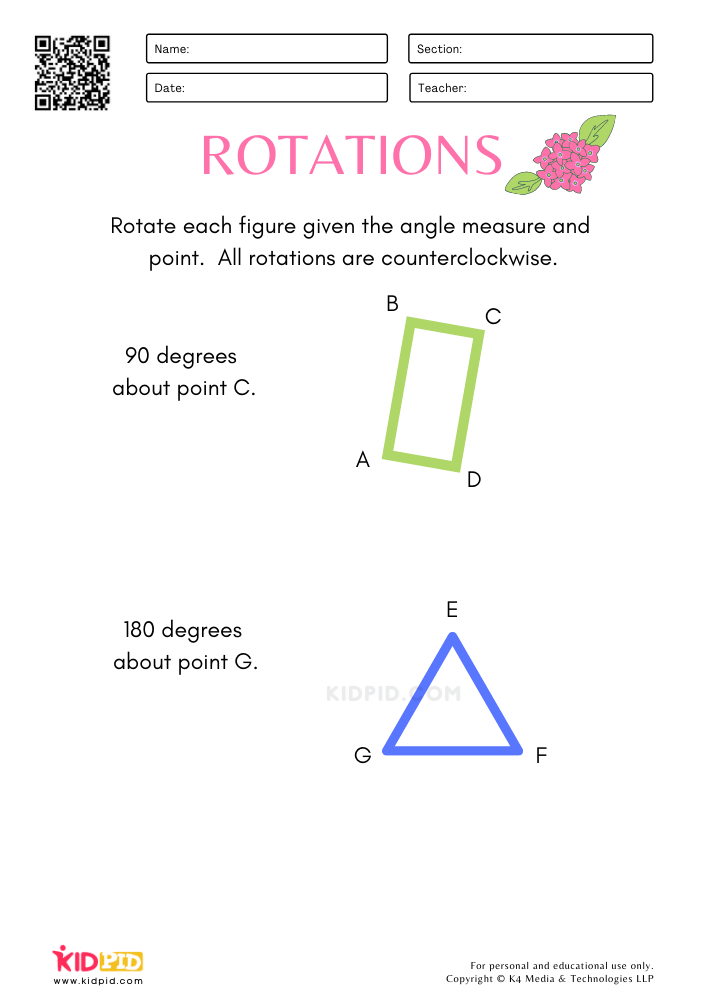
Our worksheet provides ample exercises to get started with rotations. Each of our five worksheets consists of two questions. The first one in the worksheet given below is a rectangle that needs to be rotated 90 degrees about point C. Similarly, the next one is a triangle that is to be rotated at an angle of 180 degrees about point G. The points C and G are the centers of rotation, as these are the fixed points around which the rotation shall take place.
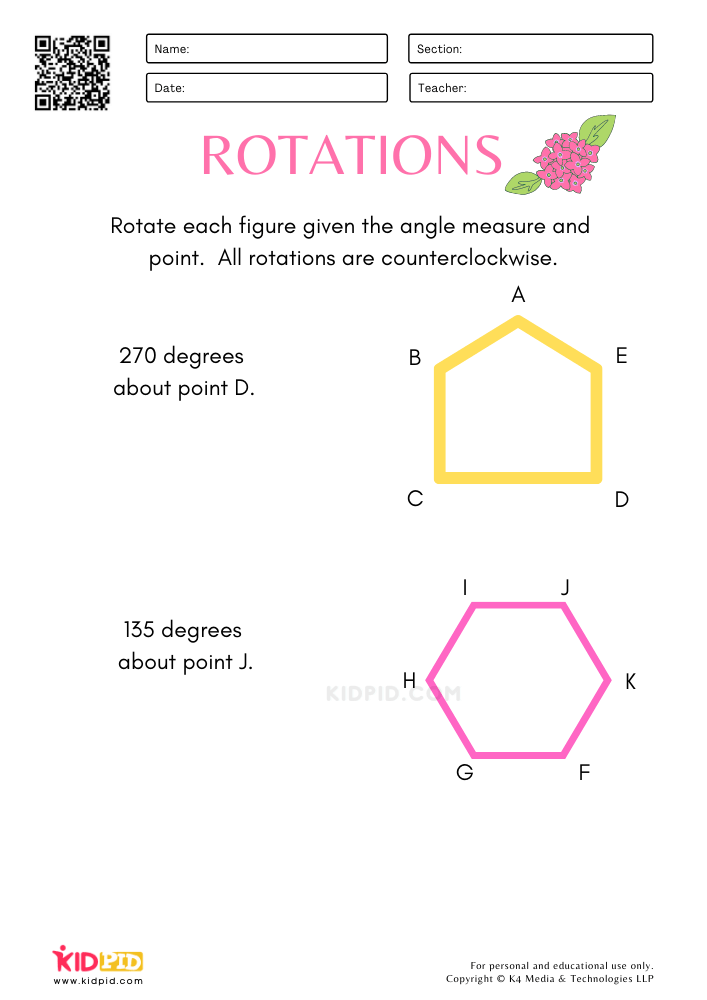
Practice makes a man perfect, and our worksheets aim for nothing but perfection. The second one provides two other exercises for your practice. Here, the first one is a pentagon which you need to rotate 270 degrees about point D. After that, we move on to a hexagon which needs to be rotated 135 degrees about point J. Be mindful that the shapes are to be rotated counterclockwise.
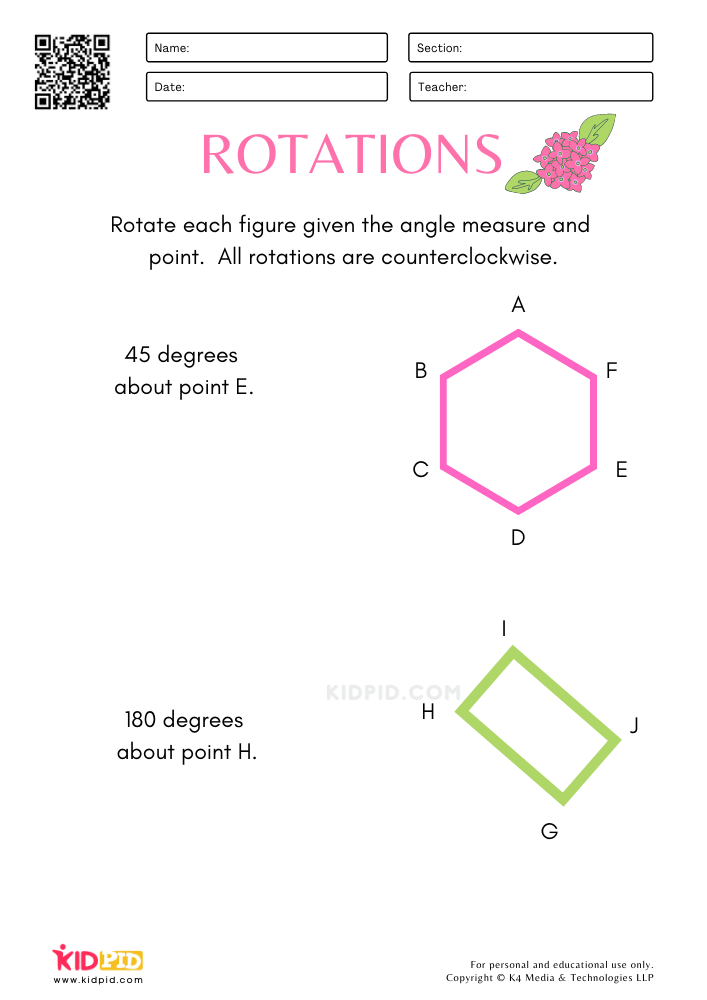
This is the third worksheet. You can always print these out for your ease. In this one, the first shape is a hexagon that is to be rotated counterclockwise at an angle of 45 degrees about point E. The next one is a rectangle that is to be rotated 18 degrees about point H.
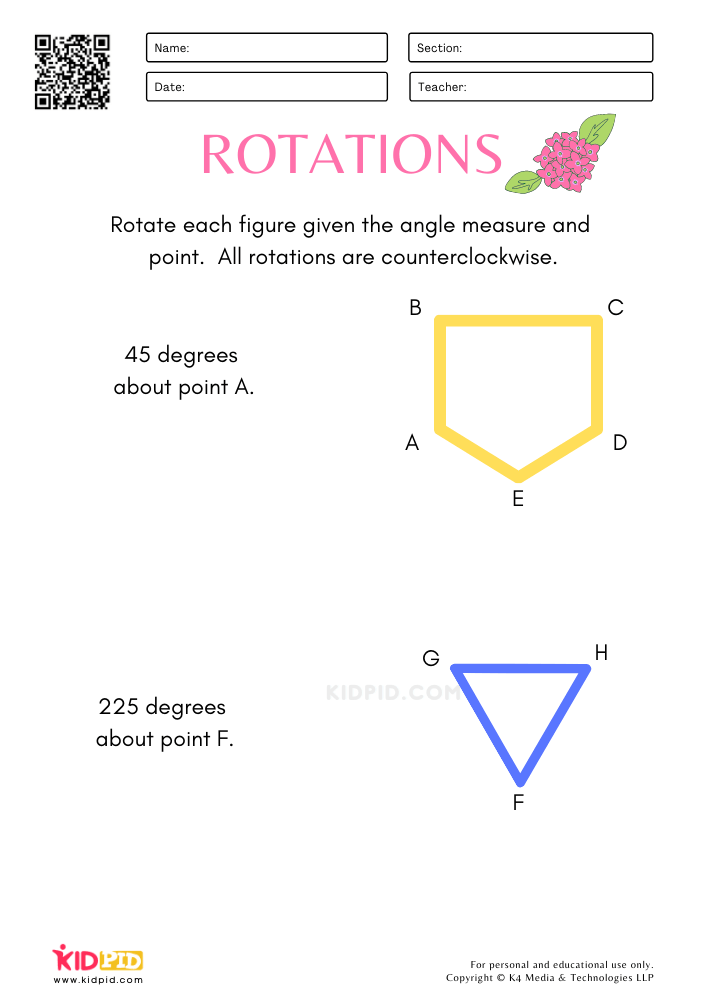
Here is another pentagon that is to be rotated counterclockwise at an angle of 45 degrees about point A. The next one is a triangle that you have to rotate 225 degrees with point F as the center of rotation.
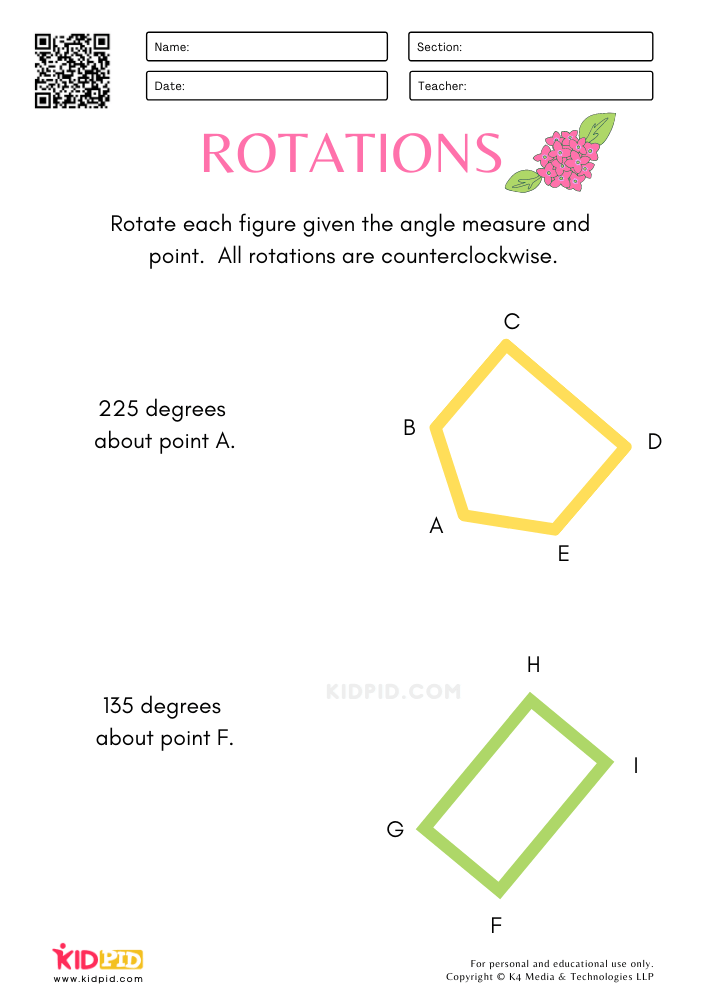
This is the final worksheet. Here, you have to rotate a pentagon and a rectangle counterclockwise at an angle of 225 degrees and 135 degrees, respectively, using the given points as the center of rotation.
Key Facts About Rotations on Paper Math Worksheets
Rotations on Paper Math Worksheets help students understand geometric transformations by turning shapes around a fixed point. These worksheets introduce learners to the concept of rotation, including clockwise and counterclockwise movements, angle measurements, and coordinate geometry applications. Through guided practice, students develop spatial reasoning, visualization skills, and a deeper understanding of geometry. Rotations are an essential topic in elementary and middle school mathematics and form the foundation for more advanced geometry concepts.
Parts/Types/Examples of Rotations on Paper Math Worksheets
Parts of Rotation Worksheets:
- Original shape or figure
- Center of rotation
- Rotation angle (90°, 180°, 270°, etc.)
- Direction of rotation (clockwise or counterclockwise)
- Rotated image or resulting figure
- Coordinate grid (in advanced worksheets)
Types of Rotation Worksheets:
- 90-degree rotations
- 180-degree rotations
- 270-degree rotations
- Clockwise rotations
- Counterclockwise rotations
- Coordinate plane rotations
- Real-world object rotation activities
Examples:
- Rotate a triangle 90° clockwise.
- Turn a square 180° around a marked point.
- Rotate a shape on a coordinate grid and identify new coordinates.
- Match the original figures with their rotated images.
How do rotations on Paper Math Worksheets Work?
Rotation worksheets guide students through the process of turning shapes around a fixed point without changing their size or shape. Students observe the original figure, identify the center of rotation, and rotate the figure according to the given angle and direction. Some worksheets include tracing, drawing, and coordinate plotting activities. As students practice, they learn how rotations affect the position and orientation of objects while preserving geometric properties.
Benefits of Learning About Rotations on Paper Math Worksheets
- Strengthens spatial reasoning and visualization skills.
- Develops understanding of geometric transformations.
- Improves problem-solving and critical-thinking abilities.
- Builds confidence in coordinate geometry concepts.
- Enhances accuracy in measuring angles and directions.
- Supports success in advanced mathematics and STEM subjects.
- Encourages logical and analytical thinking.
Learning Objectives
By completing these worksheets, students will:
- Understand the concept of rotation as a geometric transformation.
- Identify clockwise and counterclockwise rotations.
- Recognize common rotation angles such as 90°, 180°, and 270°.
- Rotate figures accurately around a center point.
- Apply rotation concepts on coordinate grids.
- Analyze relationships between original and rotated figures.
- Develop stronger geometry and spatial awareness skills.
Worksheet Instructions
- Carefully examine the original figure.
- Identify the center of rotation if provided.
- Read the angle and direction of rotation.
- Rotate the figure according to the instructions.
- Draw or plot the rotated image accurately.
- Compare your answer with the original figure.
- Double-check angle measurements and positioning.
- Complete all exercises using neat and accurate drawings.
Interesting Facts About Rotations on Paper Math Worksheets
- A rotation changes a figure’s position but not its size or shape.
- A 360-degree rotation returns an object to its original position.
- Rotations are one of the four major geometric transformations.
- The Earth rotates approximately once every 24 hours.
- Rotational symmetry appears in many natural and man-made objects.
- Engineers and architects frequently use rotational concepts in design.
- Computer graphics and animation rely heavily on geometric rotations.
Real-Life Applications
Rotations are used in many everyday situations and professional fields:
- Clock hands rotate around a central point.
- Wheels and gears function through rotational motion.
- Fans rotate to circulate air.
- Earth’s rotation creates day and night.
- Architects use rotations when designing structures.
- Graphic designers rotate images and objects digitally.
- Robotics engineers program rotating components for movement.
- Video game developers use rotations to animate characters and objects.
FAQs
Q1. What is a rotation in geometry?
Answer: A rotation is a transformation that turns a shape around a fixed point by a specific angle and direction.
Q2. Does a rotation change the size of a figure?
Answer: No. Rotations preserve the size, shape, and dimensions of the original figure.
Q3. What are the most common rotation angles?
Answer: The most common angles are 90°, 180°, 270°, and 360°.
Q4. What is the difference between clockwise and counterclockwise rotation?
Answer: Clockwise rotation moves in the same direction as clock hands, while counterclockwise rotation moves in the opposite direction.
Q5. Why are rotation worksheets important?
Answer: They help students develop spatial reasoning, geometry skills, and an understanding of transformations.
Q6. At what grade level are rotation worksheets typically introduced?
Answer: Basic rotations are often introduced in upper elementary grades and expanded upon in middle school geometry.
Q7. How do rotations help in real life?
Answer: Rotations are used in engineering, architecture, robotics, design, transportation, and everyday mechanical systems.
Q8. Can rotations be performed on a coordinate plane?
Answer: Yes. Students can rotate points and shapes using specific coordinate rules and rotation formulas.
Exploring rotations helps children understand how shapes move and change direction. These worksheets strengthen spatial reasoning, geometry skills, and visual thinking through engaging hands-on mathematical practice. From essays and quizzes to flashcards, worksheets, and paragraphs, our website offers educational resources for every young learner. Follow us on YouTube & Facebook for more. Unlock more learning opportunities with our collection of worksheets, essays, flashcards, paragraphs, quizzes, and interactive resources. Follow us on YouTube & Facebook for fresh content daily.
This worksheet was crafted by the Content Team to strengthen learning excellence.
Reviewed By Mahak Agarwal
Read More: